





04 Jul IT Compliance for Florida Businesses: A Strategic Guide to FIPA and Data Security in 2026
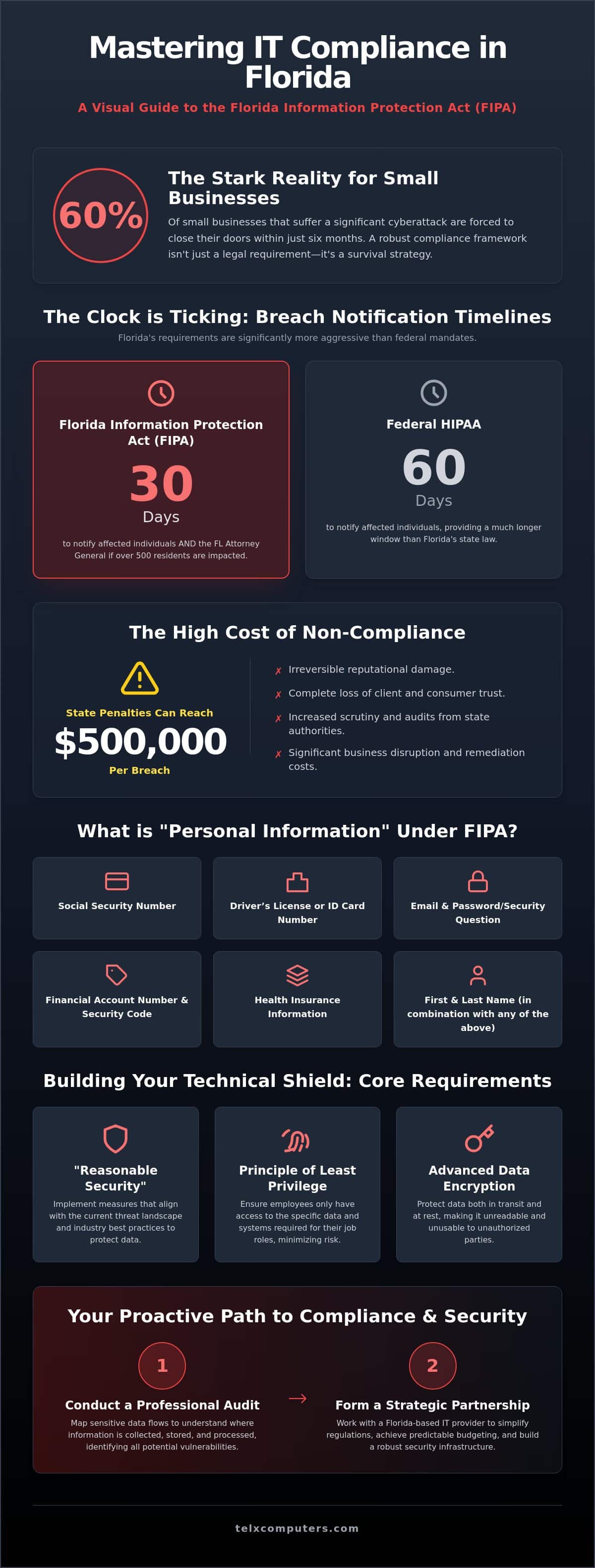
Did you know that 60% of small businesses that suffer a cyberattack close their doors within just six months? According to data cited by the National Cyber Security Alliance, the fallout from a breach is often fatal for companies without a robust safety net. You’re likely feeling the weight of this reality as you manage IT compliance for Florida businesses. It’s stressful to distinguish between federal mandates like HIPAA and the much stricter, 30-day notification window required by the Florida Information Protection Act (FIPA).
We understand that you want more than just a checkbox; you want the peace of mind that comes from a secure, scalable infrastructure. This article provides a proactive framework to master these complexities, ensuring your business stays ahead of heavy fines that can reach up to $500,000 per breach. We’ll explore the technical requirements of FIPA, the impact of the new CHINA Prevention Unit on the healthcare sector, and how to build a roadmap for stability in the 2026 threat landscape. By the end, you’ll have a clear strategy to transform your compliance from a source of anxiety into a competitive advantage for long-term growth.
Key Takeaways
- Learn why the Florida Information Protection Act (FIPA) mandates a strict 30-day breach notification window, which is significantly faster than federal HIPAA requirements.
- Discover the essential steps to conduct a professional audit and ensure robust IT compliance for Florida businesses by mapping sensitive data flows.
- Understand the specialized technical requirements for high-risk sectors like healthcare and legal firms to avoid penalties that can reach $500,000 per breach.
- Implement “Reasonable Security” measures and advanced data encryption to build a technical shield that protects your reputation and client trust.
- Explore how a strategic partnership with a Florida-based IT provider simplifies complex regulatory landscapes and provides predictable budgeting for your security infrastructure.
Understanding the Florida Information Protection Act (FIPA)
The Florida Information Protection Act (FIPA), codified under Florida Statutes Section 501.171, serves as the primary regulatory framework for data security within the state. While many federal laws provide a baseline, FIPA introduces specific, localized requirements that every entity doing business in Florida must follow. If your organization collects, stores, or processes the personal information of Florida residents, you’re legally obligated to maintain a proactive stance on security. This isn’t just a suggestion; it’s a fundamental requirement for maintaining IT compliance for Florida businesses in an era where data is a high-value target.
To better understand the broader context of these regulations, watch this helpful video regarding compliance challenges in the state:
Speed is a compliance requirement in Florida. While data breach notification laws vary across the country, Florida mandates that businesses notify affected individuals within 30 days of discovering a breach. This is significantly more aggressive than the 60-day window allowed under HIPAA. If a breach affects 500 or more residents, you must also notify the Florida Attorney General within that same 30-day period. Failing to meet this window is often what triggers the heaviest state audits and fines.
What Information Needs Protection under Florida Law?
FIPA defines “Personal Information” as a person’s first name or first initial and last name in combination with sensitive data points. This includes Social Security numbers, driver’s license numbers, or state identification card numbers. In our digital-first economy, the definition has expanded to include online account credentials. An email address in combination with a password or security question that permits access to an online account now qualifies as protected information. High-priority data also encompasses health insurance information and financial account numbers when paired with required security codes. For organizations in specialized sectors, such as law firms in Miami or healthcare clinics, managing these touchpoints is a daily operational necessity.
Consequences of Non-Compliance in 2026
The financial and operational fallout of a breach goes far beyond simple remediation costs. In the tight-knit South Florida business community, a public failure to protect client data can lead to irreversible reputational damage and a total loss of consumer trust. Maintaining consistent IT compliance for Florida businesses requires a partner who understands these local nuances and acts as a vigilant guardian. Beyond the market impact, the legal stakes are incredibly high as the Florida Department of Legal Affairs continues to increase enforcement actions, often requiring specialized support from organizations like Trustpoint.One for cyber breach response. Under the current statutes, penalties for violating FIPA’s data breach notification requirements can reach up to $500,000 per breach.
Core Technical Requirements for IT Compliance
Achieving IT compliance for Florida businesses isn’t just about meeting a legal standard; it’s about building a technical fortress that protects your most valuable assets. The Florida Information Protection Act (FIPA) explicitly requires entities to implement “reasonable security measures.” In a technical context, this means your defense must align with the current threat landscape and industry best practices. It’s a proactive commitment to vigilance that transforms your compliance strategy from a reactive burden into a reliable business foundation.
A critical component of this defense is the Principle of Least Privilege (PoLP). By ensuring that employees only have access to the specific data required for their roles, you significantly reduce the “blast radius” of a potential credential compromise. This granular control, paired with professional server monitoring, allows for the immediate detection of unauthorized lateral movement within your systems. When your infrastructure is watched around the clock, anomalies are flagged before they escalate into full-scale breaches.
Encryption and Secure Data Disposal
Encryption acts as the final line of defense. If data is stolen but remains encrypted, it’s essentially useless to the attacker. You should implement hardware-level encryption across all workstations and mobile devices to protect data at rest. FIPA-compliant data destruction is also non-negotiable. When retiring old hardware, professional wiping or physical destruction ensures that sensitive records don’t end up in the wrong hands. If you use cloud storage, verify that your provider’s security protocols meet or exceed Florida’s stringent standards for electronic records.
Authentication and Identity Management
Relying on passwords alone is a high-risk strategy. Multi-Factor Authentication (MFA) is now the baseline for secure access, especially for remote teams. Managing user permissions across Miami and Fort Lauderdale requires a centralized identity management system that can revoke access instantly if a threat is detected. By implementing robust network security, you can segment sensitive data. This ensures that even if one part of the network is compromised, your most critical information remains isolated and secure. This layered approach provides the stability and peace of mind necessary for modern business growth.
Industry-Specific Compliance for Florida Sectors
While FIPA establishes a baseline for all organizations, certain sectors operate under a microscope of layered regulations. Navigating IT compliance for Florida businesses requires a nuanced understanding of how state statutes interact with federal mandates. For instance, a healthcare provider must juggle the Florida Information Protection Act alongside HIPAA, while a financial firm must reconcile state laws with the Gramm-Leach-Bliley Act (GLBA). This intersection is where many businesses stumble, often underestimating the stricter timelines imposed by Florida law.
Healthcare IT Compliance in South Florida
The healthcare sector faces unique scrutiny, particularly with the establishment of the CHINA Prevention Unit in February 2026. This enforcement unit specifically investigates data collection practices in healthcare, prioritizing national security and patient privacy. To remain compliant, clinics must align FIPA’s 30-day notification rule with the federal HIPAA 60-day standard. Because state law is more stringent, the 30-day window takes precedence. Securing Electronic Health Records (EHR) against ransomware is a top priority for our partners. This process involves more than just software; it requires a formal Business Associate Agreement (BAA) with your IT provider to ensure shared accountability. For those managing complex patient data, our healthcare IT services provide the specialized technical shield needed to withstand these evolving audits.
Legal Industry Data Obligations
For law firms in Miami, the duty to protect client information is both a legal and ethical mandate. Attorney-client privilege must extend into the cloud, requiring encryption standards that exceed basic consumer levels. Managing discovery data and sensitive litigation files involves significant risk, especially during high-stakes corporate cases. Beyond digital threats, South Florida firms must account for environmental risks. A robust disaster recovery plan is essential for maintaining IT compliance for Florida businesses during hurricane season. We ensure that your firm’s data is backed up to secure, off-site locations, allowing for rapid restoration if local infrastructure fails. This holistic approach protects your practice from both cybercriminals and the unpredictable Florida climate.
Retailers also face a complex environment. While PCI-DSS governs credit card data, the Florida Digital Bill of Rights (FDBR) may apply to larger entities with significant online advertising revenue. Even for smaller shops, FIPA’s “reasonable security” requirement means that basic firewalls are no longer enough. We help you segment your network to isolate payment processing from public Wi-Fi, ensuring that a breach in one area doesn’t lead to a total system compromise. This strategy provides a clear roadmap for growth without the constant fear of regulatory penalties.
How to Conduct a Professional IT Compliance Audit
Thinking of compliance as a one-time event is a dangerous oversight. To maintain IT compliance for Florida businesses, you must treat the audit process as a rigorous, recurring cycle that evolves with the 2026 threat landscape. A professional audit doesn’t just look for technical glitches; it validates that your operational logic meets the strict standards of FIPA and federal mandates. This systematic approach replaces technical anxiety with a documented record of reliability and stability.
A comprehensive audit follows a structured five-step framework designed to uncover hidden risks:
- Step 1: Inventory all hardware and software assets. You can’t protect what you don’t know exists. This includes all remote workstations and mobile devices used by your South Florida team.
- Step 2: Map data flow and identify “Personal Information” touchpoints. Trace how sensitive data enters your system, where it’s stored, and who has access to it.
- Step 3: Perform a vulnerability assessment and penetration test. Actively simulate attacks to see how your defenses hold up under pressure.
- Step 4: Review and update employee security training protocols. Human error remains a leading cause of breaches; ensure your team knows how to spot 2026-era phishing attempts.
- Step 5: Document policies for an official compliance record. Create a “paper trail” that proves your commitment to “reasonable security” if the Florida Attorney General ever requests an inspection.
Identifying Security Gaps and Vulnerabilities
Modern audits must prioritize scanning for unpatched software and legacy systems that no longer receive security updates. These are the primary entry points for attackers. We specifically test the strength of your current ransomware protection measures to ensure your backups are immutable and isolated from the main network. A professional audit provides a holistic evaluation of your security posture against legal frameworks, while a basic network scan merely identifies known technical vulnerabilities without context or strategic insight.
The Importance of Continuous Monitoring
Annual audits are no longer sufficient to combat the high-speed nature of 2026 cyber threats. Real-time server monitoring serves as a vital compliance tool, flagging unauthorized access attempts the moment they occur. By automating your compliance reporting, you provide stakeholders with constant visibility into your security health. This proactive stance ensures you’re always one step ahead of potential breaches and regulatory penalties. If you’re ready to move beyond guesswork, you can get an instant quote for a professional compliance assessment tailored to your specific industry needs.
Strategic Managed IT: Your Partner in Florida Compliance
Managing your infrastructure while keeping pace with shifting regulations is a heavy burden for any internal team. Choosing managed IT support isn’t just about outsourcing technical tickets; it’s about securing a strategic ally that lives and breathes the South Florida regulatory environment. We don’t just fix what’s broken. We act as a vigilant, 24/7 guardian, ensuring that your systems remain a silent engine behind your success rather than a liability. This partnership replaces the anxiety of potential breaches with a deep sense of stability and peace of mind.
Effective IT compliance for Florida businesses requires a holistic approach that blends cloud, network, and endpoint protection into a single, cohesive shield. We move beyond disconnected fixes to provide a comprehensive security posture. This strategy includes predictable budgeting, which is essential for compliance-heavy industries like healthcare and finance. By shifting from a reactive “break-fix” model to a proactive management style, you can allocate resources toward growth while we handle the complexities of FIPA and federal security standards.
Outsourcing Compliance to Local Experts
There’s a distinct advantage to working with a partner who understands the Miami and Fort Lauderdale business climate. Local expertise means we’re familiar with the specific threats facing our regional community, from seasonal environmental risks to targeted phishing campaigns. If a compliance-related emergency occurs, our proximity allows for a rapid response that remote-only providers simply can’t match. We bridge the gap between small business budgets and enterprise-level security, giving you access to high-tier corporate tools that protect your reputation and your bottom line.
Getting Started with a Compliance Roadmap
Transitioning from reactive fixes to strategic IT alignment starts with a clear roadmap. We don’t believe in one-size-fits-all solutions. Instead, we customize our framework to fit your specific operational needs and risk profile. This journey begins by identifying your current gaps and building a tiered plan to close them. You can request an instant quote today to see how a compliance-focused IT plan fits into your business strategy. Don’t wait for an audit or a breach to discover where your defenses are weak. Contact Telx Computers now for a comprehensive compliance evaluation and let us become the expert guardian your business deserves.
Secure Your Business Growth with a Proactive Compliance Strategy
Maintaining IT compliance for Florida businesses is no longer a static goal; it’s an ongoing commitment to the safety of your clients and the stability of your operations. By mastering the 30-day notification requirements of FIPA and implementing a “reasonable security” framework, you protect your organization from the devastating $500,000 penalties that follow a breach. You’ve seen how industry-specific standards and rigorous audits form the backbone of a resilient infrastructure. Now it’s time to move beyond technical anxiety and embrace a strategy that supports long-term expansion.
Telx Computers serves as your expert guardian, offering 24/7 Help Desk Support and fixed-price unlimited service plans that provide predictable budgeting for your security needs. With a physical presence in Miami, NYC, and LA, we offer the rapid on-site response your business requires during critical moments. Secure your business today with a professional IT compliance audit from Telx Computers.
We’re ready to help you turn these complex regulations into a reliable engine for your success. Your peace of mind is our priority.
Frequently Asked Questions
Is FIPA compliance mandatory for all Florida small businesses?
FIPA compliance is mandatory for any entity doing business in Florida that acquires, uses, or stores personal information of state residents. This includes small businesses regardless of their total revenue or employee count. If your organization handles data such as Social Security numbers, driver’s licenses, or account credentials, you must adhere to the security and notification standards outlined in the statute to avoid significant legal and financial penalties.
How long do I have to report a data breach under Florida law?
You have exactly 30 days to notify affected individuals after discovering a breach that involves personal information. This strict timeline under Florida Statutes Section 501.171 is one of the most aggressive in the country. If the incident affects 500 or more Florida residents, you’re also required to notify the Department of Legal Affairs within that same 30-day window to maintain the required legal standing.
What is the difference between HIPAA and FIPA?
HIPAA is a federal law focused specifically on protecting health information, while FIPA is a Florida state law that applies to all businesses handling various types of personal data. A key operational difference lies in the notification deadlines; HIPAA allows 60 days for reporting, but FIPA requires notification within 30 days. For healthcare providers in the region, meeting IT compliance for Florida businesses means satisfying both sets of standards simultaneously.
Can managed IT services help my business become CMMC compliant?
Managed IT services play a critical role in achieving Cybersecurity Maturity Model Certification (CMMC) by implementing the specific technical controls required for government contractors. We provide the necessary cybersecurity audits and network security enhancements to meet these rigorous federal standards. This ensures your business remains eligible for Department of Defense contracts while keeping your internal infrastructure secure against evolving threats that could jeopardize your certification status.
What are “reasonable security measures” according to Florida statutes?
Florida law doesn’t provide a rigid checklist for “reasonable security measures,” but it expects businesses to implement protections consistent with current industry standards and the sensitivity of the data. This typically includes hardware-level encryption, multi-factor authentication, and restricted access controls. Maintaining IT compliance for Florida businesses involves proving that your technical defenses are proportional to the risks your organization faces in the current digital landscape.
Does data encryption exempt me from breach notification requirements in Florida?
Data encryption can exempt you from notification requirements if the personal information was rendered unreadable or unusable and the encryption key was not compromised during the breach. FIPA provides a safe harbor for organizations that successfully protect data through these technical means. However, you must still conduct a thorough forensic investigation to confirm that no unauthorized access to the decrypted data actually occurred during the security incident.
How often should my Miami business conduct a cybersecurity audit?
Your Miami business should conduct a comprehensive cybersecurity audit at least once per year to account for new vulnerabilities and regulatory changes. In high-risk sectors or during periods of rapid growth, semi-annual assessments are often more appropriate. These audits serve as a vital checkpoint to ensure your reasonable security measures are actually working and that your compliance record remains up to date for potential state inspections.
What happens if a third-party vendor causes a data breach for my company?
You remain legally responsible for notifying Florida residents even if the breach occurred through a third-party vendor’s systems. FIPA requires the entity that owns or licenses the data to manage the notification process once the vendor informs them of the incident. This highlights the importance of having strong Business Associate Agreements and conducting regular security reviews of every partner who has access to your sensitive records.