




21 Jul Secure Remote Access for Business: A Strategic Framework for 2026
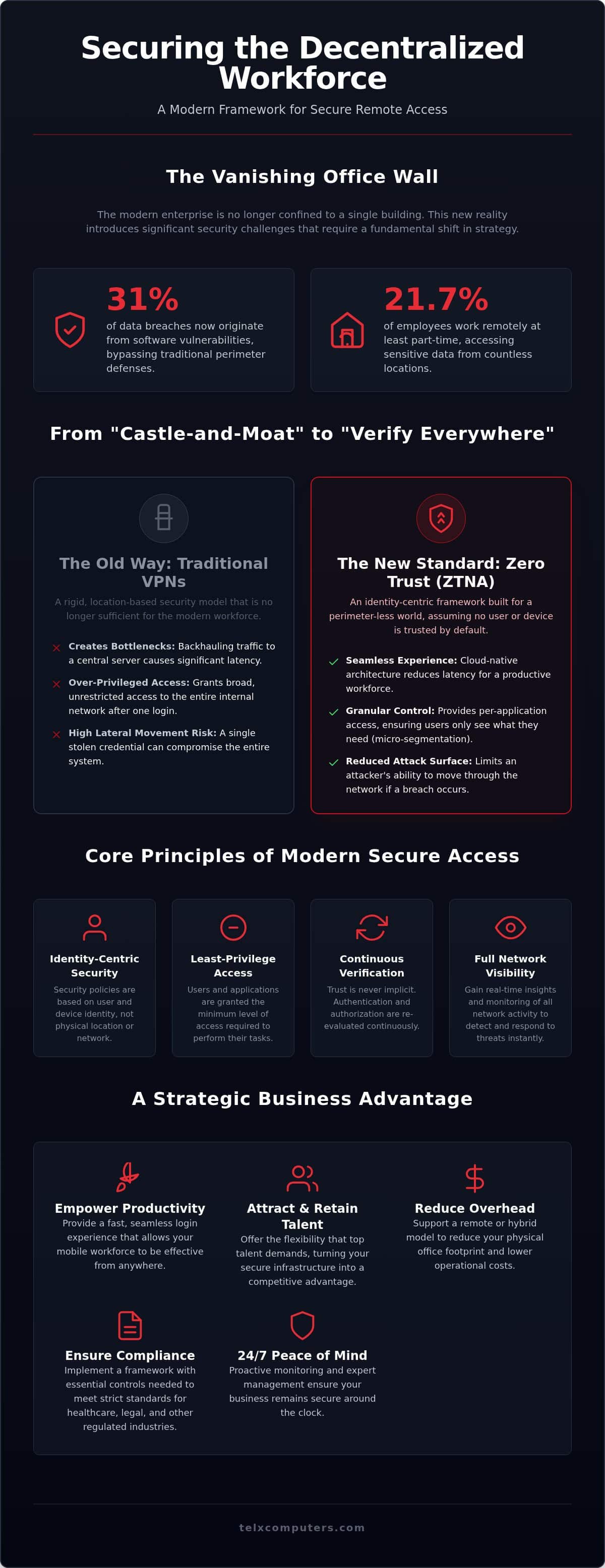
Did you know that 31% of data breaches now originate from software vulnerabilities? For the modern enterprise, the traditional office wall has vanished; replaced by a decentralized network where 21.7% of employees work remotely at least part-time. Implementing robust secure remote access for business is no longer just a routine IT task. It’s a strategic necessity to protect your reputation and your bottom line. You likely recognize the frustration of complex VPNs that stifle productivity, or the anxiety of managing security across a sea of personal devices. These technical hurdles shouldn’t stand in the way of your team’s success or your own peace of mind.
We believe you deserve a solution that feels invisible to your staff but remains vigilant against every threat. This article outlines a comprehensive framework to shield your data while empowering your mobile workforce through modern technologies like Zero Trust Network Access. You’ll discover how to gain full visibility into your network activity and create a seamless login experience that works as hard as your employees do. We’ll explore the shift toward SASE models and the proactive steps required to ensure your business remains secure 24/7, keeping you ahead of evolving threats and regulatory changes.
Key Takeaways
- Learn why modern security shifts away from traditional network perimeters toward an identity-centric approach that verifies every user and device.
- Discover the core technologies that provide robust secure remote access for business while maintaining a seamless, high-speed experience for your mobile workforce.
- Understand how to balance rigorous protection with employee productivity to prevent the risks associated with Shadow IT and unauthorized workarounds.
- Access a strategic roadmap for upgrading your infrastructure that incorporates essential compliance standards for the healthcare and legal sectors.
- Explore how proactive server monitoring and expert management deliver 24/7 peace of mind and predictable budgeting for your organization.
The Evolution of Secure Remote Access for Business
The concept of the corporate office has undergone a radical transformation. Today, secure remote access for business is no longer a peripheral utility; it’s an identity-centric framework that serves as the foundation for the modern workforce. We’ve moved away from the outdated “castle-and-moat” approach, where security was based on physical location. Instead, we now embrace “verify-everywhere” models. This shift is critical because, as of 2026, threats have evolved into highly sophisticated, AI-driven phishing campaigns and automated credential harvesting. For organizations in high-growth hubs like Miami, having a robust remote infrastructure is the difference between seamless scaling and a catastrophic data breach.
To better understand the fundamentals of this protection, watch this helpful video from the Federal Trade Commission:
Why Traditional VPNs Are No Longer Enough
For years, the Virtual Private Network (VPN) was the standard for remote connectivity. However, these legacy hardware systems often create significant latency and bottlenecks that frustrate employees. The security risk is even more concerning. In a traditional setup, once a user validates their credentials, they often gain broad access to the internal network. This creates a massive lateral movement risk. If an attacker steals a single set of VPN credentials, they can move through your entire system undetected. Modern strategies replace this “connect first, verify later” logic with granular, per-application access controls that limit a user’s reach to only what they need for their specific job.
The Business Case for Secure Connectivity
Investing in a modern framework isn’t just about stopping hackers. It’s a powerful tool for talent retention. When you offer a seamless login experience, you empower your mobile workforce to work from anywhere without technical friction. This flexibility allows companies to reduce their physical office footprints, leading to substantial overhead savings. Achieving this level of sophistication requires a strategic partner. Many leaders rely on managed IT services to handle the heavy lifting of deployment and 24/7 monitoring. By integrating network security with identity management, you turn a potential vulnerability into a competitive advantage that supports long-term growth.
Modern Technologies Powering Secure Connectivity
Building a modern security stack requires moving beyond fragmented tools. In 2026, the most effective secure remote access for business relies on an integrated ecosystem where identity management and network controls work in unison. Cloud-native solutions have largely replaced on-premises hardware because they offer superior scalability and performance for a global workforce. Unlike older systems that require backhauling traffic to a central data center, cloud-native access points are distributed, reducing latency while maintaining strict oversight. This architecture allows for real-time monitoring of every connection. If a login attempt occurs at 3 AM from a location where you have no employees, the system can automatically flag or block that activity before a breach occurs.
Managing these Remote Access Security Challenges requires a proactive stance. If you’re unsure if your current setup is sufficient, a comprehensive network security assessment can identify hidden vulnerabilities before they’re exploited.
Zero Trust Network Access (ZTNA)
The core of modern connectivity is the “Never Trust, Always Verify” philosophy. ZTNA assumes that every user and device is a potential risk until proven otherwise. Through micro-segmentation, you can ensure that an employee in marketing only sees marketing files, rather than the entire server. This approach significantly reduces the attack surface compared to a standard VPN. If one account is compromised, the damage is contained to a small segment rather than the whole network, preventing the lateral movement that leads to major data theft.
SASE: The Convergence of Networking and Security
Secure Access Service Edge, or SASE, simplifies protection for business owners who need to manage a decentralized team. It combines network functions with security services into a single cloud-delivered service. This means your team gets the same level of protection whether they’re in a Miami coffee shop or a home office. For your IT team, SASE provides a unified management console. They don’t have to jump between five different programs to see who is on the network; everything is visible and manageable from one place, which increases efficiency and reduces human error.
Multi-Factor Authentication (MFA) and Beyond
Security in 2026 has moved past simple SMS codes, which are easily intercepted by modern hackers. We now prioritize biometrics and hardware keys to verify identity with a high degree of certainty. We also use Conditional Access policies to add another layer of protection. These policies can deny logins from unexpected geographic locations or unrecognized devices even if the password is correct. Multi-Factor Authentication is the most effective barrier against 99% of bulk automated attacks. By moving beyond simple passwords, you create a resilient environment that protects your data without slowing down your team.
The Security-Usability Paradox: Finding the Balance
Business leaders often face a difficult choice. Do you lock down the network to the point of employee frustration, or do you prioritize speed and risk a breach? When secure remote access for business is implemented poorly, it becomes a hurdle rather than a help. This friction leads to the dangerous rise of “Shadow IT,” where employees bypass official protocols to use unauthorized personal apps or cloud storage just to get their work done. These workarounds create massive security blind spots that leave your organization vulnerable to the very threats you’re trying to avoid.
Reducing Friction with Single Sign-On (SSO)
Single Sign-On (SSO) is one of the most effective ways to bridge the gap between protection and performance. Instead of forcing staff to manage dozens of complex passwords, SSO allows them to use one secure, verified identity for every business application they need. This significantly reduces “password fatigue” and the time lost to forgotten credentials. From a strategic perspective, the benefits are even stronger. If an employee leaves the company, your IT team can revoke access to every connected platform instantly, ensuring your data remains protected without manual cleanup across multiple systems.
Endpoint Security and Managed BYOD
The Bring Your Own Device (BYOD) trend is a reality for the modern workforce, but personal phones and laptops are often the weakest links in your defense. These devices don’t always have the same level of encryption or monitoring as corporate hardware. To solve this, we use containerization to create a digital wall between personal files and company data. This ensures that a malware infection on an employee’s personal device doesn’t migrate to your corporate server. Utilizing professional computer IT services allows you to manage these remote endpoints effectively, providing the necessary oversight without invading employee privacy.
Technology alone isn’t a silver bullet. A “security-first” culture is what truly sustains these systems. When your team understands the logic behind your protocols, they stop seeing security as an obstacle and start seeing it as an essential part of their toolkit. Regular training, combined with staying updated on device trends through resources like Móviles DualSIM, turns every staff member into a vigilant part of your defense. This human-centric approach ensures that your investment in secure remote access for business delivers both safety and peak efficiency.
Implementation Roadmap: Best Practices for Businesses
Transitioning from a legacy setup to a modern framework requires a disciplined approach. You can’t simply flip a switch and expect total protection. Instead, you need a phased strategy that respects your operational workflow while closing security gaps. This roadmap ensures that your transition to secure remote access for business is both manageable and effective. By following a structured sequence, you avoid the common pitfalls of rushed deployments that often leave doors open for attackers.
Step-by-Step Deployment Strategy
Success starts with a clear view of your current environment. You must conduct a full inventory of every remote access point, every user, and every device currently interacting with your network. This visibility allows you to identify exactly where outdated hardware is creating vulnerabilities. Once you have this baseline, you can begin phasing out legacy hardware. We recommend replacing these physical bottlenecks with software-defined perimeters that offer more flexibility and stronger security controls. Finally, don’t wait for a real crisis to see if your system works. Run regular tabletop exercises to simulate a breach. These simulations test how your remote access protocols hold up under pressure and ensure your team knows exactly how to respond when every second counts.
Compliance and Regional Considerations
Industry-specific requirements add another layer of complexity to your strategy. For instance, healthcare IT services must adhere to strict HIPAA standards regarding patient data privacy, especially when accessed from home offices. Similarly, the legal sector requires encrypted tunnels for sensitive document review to maintain attorney-client privilege. You can find specialized support for these needs through IT services for law firms. These regulations are not suggestions; they’re legal mandates that require sophisticated, identity-centric controls.
For businesses in South Florida, remote access is also a vital disaster recovery tool. When a major storm hits Miami, your team needs the ability to work from anywhere with power and internet. A robust secure remote access for business framework ensures that your operations don’t grind to a halt just because the main office is inaccessible. To maintain this resilience, we advocate for regular cybersecurity audits to identify and patch new vulnerabilities before they can be exploited. If you’re ready to strengthen your perimeter and ensure your business is protected 24/7, you can get an instant quote to see how a tailored strategy fits your organizational needs and budget.
Managed Secure Access: The Telx Advantage
While many software providers offer individual tools, they often leave the heavy burden of implementation and management on your internal team. Telx Computers acts as the silent engine behind your success, transforming secure remote access for business from a technical hurdle into a seamless operational standard. We don’t just provide a platform; we integrate your remote connectivity into a holistic managed IT plan. This approach ensures that every component of your infrastructure, from identity verification to proactive server monitoring, works in perfect harmony to protect your enterprise assets.
Expert Guardian: 24/7 Proactive Defense
Security never sleeps, and neither do our monitoring systems. Our team watches your network in real-time, identifying and neutralizing brute-force attacks or suspicious login attempts before they can escalate into a breach. This constant vigilance provides a level of stability that standalone software simply cannot match. Beyond the technical defense, we prioritize the human experience. If a remote employee encounters a login issue at midnight, our 24/7 help desk is ready to assist, ensuring productivity never grinds to a halt. For businesses with physical footprints in Miami, New York, or Los Angeles, our rapid response capability means we’re always available to provide on-site support when digital troubleshooting isn’t enough. We take pride in being the vigilant protector that lets you focus on your core business goals.
Strategic Ally: Scaling Your Business Securely
A robust remote framework is a catalyst for growth. It allows you to hire the best talent regardless of geographic borders, expanding your team without the need for additional office space. We manage the complexities of software licensing and hardware procurement, ensuring that every new hire has the secure, pre-configured tools they need from day one. This level of organization is supported by our fixed-price model. We believe in predictable budgeting, which is why our services are offered at an all-inclusive rate. You’ll never have to worry about hidden fees or fluctuating costs for your security support. We position ourselves as an extension of your own department, providing the high-tier expertise of a corporate IT branch with the personalized touch of a dedicated partner.
Your business deserves a defense that is both proactive and resilient. By choosing a managed approach, you replace technical anxiety with the peace of mind that comes from professional oversight. Secure your business today with an instant quote from Telx.
Future-Proofing Your Mobile Workforce
Protecting your organization requires more than just installing a piece of software. It demands a shift toward an identity-centric framework that prioritizes both rigorous verification and employee productivity. By moving away from legacy hardware and embracing Zero Trust principles, you eliminate the lateral movement risks that often lead to catastrophic breaches. You’ve seen how a strategic roadmap, supported by technologies like Single Sign-On and SASE, can turn a potential vulnerability into a competitive advantage for your team. This proactive stance ensures that your data remains shielded while your staff stays focused on their core responsibilities.
Implementing secure remote access for business is a journey that doesn’t have to be complex or stressful. Telx Computers stands as your strategic ally, providing 24/7 managed security monitoring and rapid on-site support in Miami, NY, and LA. Our fixed-price unlimited IT support plans ensure your budgeting remains predictable while your protection remains absolute. We’re here to act as the silent engine behind your success, keeping you one step ahead of evolving threats. Ready to empower your workforce with a defense that never sleeps? Get a Secure Remote Access Quote for Your Business and take the first step toward total peace of mind today.
Frequently Asked Questions
What is the most secure way for employees to access the office network remotely?
The most secure approach is implementing a Zero Trust Network Access (ZTNA) framework coupled with robust Multi-Factor Authentication (MFA). Unlike traditional methods, ZTNA verifies every user and device regardless of their location before granting access to specific applications. This identity-centric model ensures that even if a device is compromised, the rest of your network remains shielded from unauthorized lateral movement.
Is a VPN still necessary for business security in 2026?
While traditional VPNs are still in use, they’re no longer considered the gold standard for high-security environments. Legacy VPNs often create bottlenecks and expose the entire network once a user is authenticated. Most modern organizations are transitioning toward software-defined perimeters and SASE models. These provide more granular control and better performance for a mobile workforce without the inherent risks of a “connect-all” tunnel.
How can I prevent ransomware from entering my network through a remote connection?
Preventing ransomware requires a multi-layered defense that includes micro-segmentation and proactive endpoint monitoring. By isolating applications and data, you ensure that a single infected device cannot spread malware across your entire server. We also recommend continuous traffic analysis to detect and block suspicious encryption patterns in real-time. This level of vigilance is a core part of providing secure remote access for business in a high-threat environment.
Does secure remote access slow down internet speeds for my employees?
Modern security solutions actually improve performance by eliminating the need to “backhaul” traffic to a central office. Cloud-native platforms like SASE use distributed access points, which reduces latency and provides a faster experience for your team. When configured correctly, your employees won’t notice the security layers working in the background. They’ll simply enjoy a stable, high-speed connection that supports their daily productivity without technical friction.
How do I manage security if my employees use their own personal computers (BYOD)?
Managing personal devices effectively involves using containerization and Mobile Application Management (MAM) to separate business data from personal files. This ensures that your corporate assets stay encrypted and protected, even if the employee’s personal laptop lacks the latest security patches. It allows you to maintain oversight of company information without invading the privacy of your staff or accessing their personal photos and documents.
What are the remote access compliance requirements for HIPAA or legal firms?
Compliance for healthcare and legal sectors requires end-to-end encryption, strict access controls, and detailed audit logs of every connection. For HIPAA, you must ensure that Protected Health Information (PHI) is never stored on a remote device without authorization. Legal firms need similar protections to maintain attorney-client privilege. Utilizing a managed provider ensures these technical safeguards are always up to date with the latest regulatory changes and industry standards.
How much does it cost to implement a secure remote access system for a small business?
The cost varies based on the size of your team and the complexity of your existing infrastructure. We focus on a fixed-price model that provides enterprise-grade security and unlimited support for a predictable monthly fee. This approach helps small businesses avoid the unexpected costs of emergency repairs or data breach recovery. It’s best to request a customized assessment to determine the most efficient strategy for your specific operational needs.
Can secure remote access help my business stay operational during a natural disaster?
Yes, a robust framework for secure remote access for business is a cornerstone of any disaster recovery plan. In regions like South Florida, the ability to transition your team to remote work instantly during a storm or power outage is vital. Because your security is cloud-delivered, your staff can access essential files from any safe location with an internet connection. This ensures your operations continue seamlessly even if your physical office is inaccessible.