




28 Jun Top IT Challenges for Small Businesses in 2026: A Strategic Roadmap
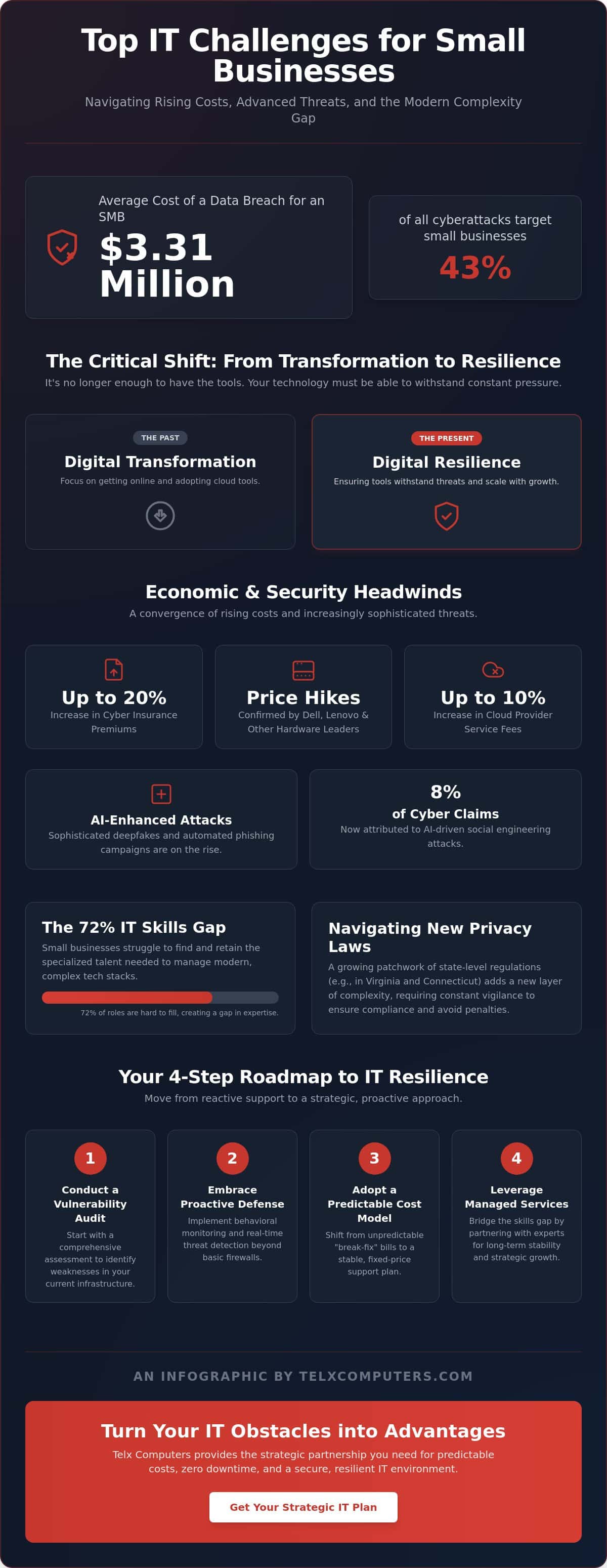
Did you know the average cost of a data breach for a business with fewer than 500 employees has climbed to $3.31 million in 2026? You likely feel the weight of the top IT challenges for small businesses 2026 every time you review your budget or struggle to fill a critical technical role. It’s exhausting to manage cyber insurance premiums that are rising by up to 20% and the complexities of hybrid work while trying to keep your operations running smoothly.
We understand that you need more than just a quick fix; you need a strategic ally who anticipates what’s next. This article offers a proactive roadmap to turn technical obstacles into your greatest competitive advantages. We’ll explore how to achieve predictable costs and zero downtime while navigating the 72% IT skills gap and new state privacy laws in places like Virginia and Connecticut. By the end, you’ll have a clear path toward a secure environment that satisfies every regulatory requirement without slowing your business momentum.
Key Takeaways
- Master the transition from digital transformation to digital resilience by bridging the complexity gap in your tech stack.
- Uncover strategies to combat AI-enhanced cybersecurity threats, including the rise of Ransomware-as-a-Service and sophisticated phishing.
- Resolve the hidden costs of cloud sprawl and shadow IT to maintain a secure, efficient environment for your hybrid team.
- Follow a structured plan to address the top IT challenges for small businesses 2026 by starting with a comprehensive vulnerability audit.
- Leverage the benefits of managed IT services and fixed-price support to ensure predictable costs and long-term stability.
Navigating the Shift: Why Small Business IT is Different in 2026
By 2026, the definition of success in modern information technology has fundamentally shifted. For years, the focus was on digital transformation; simply getting your business online and using cloud tools. Today, the priority is digital resilience. It is no longer enough to just own the tools. You must ensure those tools can withstand constant external pressure while remaining flexible enough to scale. This shift represents one of the top IT challenges for small businesses 2026 because it requires a move away from reactive fixes toward a state of constant readiness.
Many organizations now face a “Complexity Gap.” This happens when small teams try to manage enterprise-level software without the specialized staff required to maintain them. When your technology is mismanaged, it creates friction that slows down your operations. We believe your IT should act as a silent engine for growth. It should be the reliable foundation that allows your team to work without the fear of downtime or data loss. Standard anti-virus programs and occasional backups are no longer sufficient to protect your interests in this high-stakes environment.
To better understand how to navigate these changes and keep your business profitable, watch this helpful video:
The End of “Set It and Forget It” Technology
The days of installing software and ignoring it for three years are over. Modern software environments move at a relentless pace. Rapid update cycles mean that a security patch released on Monday could potentially break a critical integration by Tuesday. This volatility requires constant, proactive management to ensure business continuity. You need a partner who anticipates these conflicts before they disrupt your workflow. Utilizing a managed IT support service provides the vigilance necessary to handle these updates safely. We take the burden of technical maintenance off your shoulders, replacing technical anxiety with the stability your business deserves.
Economic Pressures on IT Budgets
Economic factors are adding another layer to the top IT challenges for small businesses 2026. Hardware leaders like Dell and Lenovo have confirmed price increases, which are trickling down into every part of the supply chain. Cloud providers are also forecasting service fee hikes of up to 10% this year. These rising costs can quickly erode your margins if you rely on an unpredictable “break-fix” model. Savvy business owners are shifting toward predictable, fixed-price IT models to protect their bottom line. This approach allows you to maximize the ROI of your existing technology stack while ensuring your monthly expenses remain stable and manageable. When hardware does require physical attention, utilizing a specialist like We Fix PC Laptop can be a cost-effective alternative to purchasing new equipment. By aligning your technical needs with a clear financial strategy, you turn your IT department from a cost center into a strategic asset.
Combating the Rise of AI-Enhanced Cybersecurity Threats
AI has transformed from a productivity tool into a sophisticated weapon for cybercriminals. In 2026, small firms face a landscape where attackers use deepfakes and automated phishing to bypass traditional defenses. These AI-driven social engineering attacks now account for 8% of all cyber insurance claims. Your employees can no longer rely on spotting a simple typo or a grainy logo to identify a threat. Because 43% of all cyberattacks now target small businesses, this sophisticated offensive capability makes security one of the top IT challenges for small businesses 2026.
Moving beyond basic firewalls is essential for survival. Modern defense requires behavioral monitoring that flags unusual activity in real-time. For example, if a user account suddenly accesses thousands of files at 3:00 AM, an automated system should freeze that account immediately. This level of vigilance is what separates resilient companies from those facing the average $3.31 million cost of a data breach. Official resources like Cybersecurity for Small Businesses emphasize that active monitoring is no longer optional. Additionally, cyber insurance premiums are forecasted to rise by 15-20% this year. Carriers now demand proof of advanced threat detection before they even offer a policy.
Ransomware Evolution and Protection
Ransomware-as-a-Service (RaaS) has made high-level attacks accessible to even low-skilled criminals. In 2026, 88% of data breaches at small organizations involve ransomware. These attacks have evolved; criminals now exfiltrate your sensitive data before encrypting it to ensure they have maximum leverage for extortion. Effective ransomware protection must include immutable backups that hackers cannot delete or modify. To secure your network, you should adopt a Zero Trust architecture, which is a security framework that requires strict identity verification for every person and device trying to access resources on a private network, regardless of whether they are sitting inside or outside the office.
Compliance and Data Privacy Mandates
Regulatory pressure has intensified with new privacy laws taking effect in states like Virginia and Connecticut. These laws often ban the sale of geolocation data and mandate strict data minimization. Non-compliance leads to heavy fines that far exceed the investment required for secure network IT support in Miami. Preparing for a regulatory audit requires documented proof of your security protocols and incident response plans. If you’re concerned about meeting these high standards, a professional cybersecurity audit can identify your vulnerabilities before they become liabilities.
Solving the Complexity of Cloud Sprawl and Hybrid Work Environments
The push toward digital resilience has unintentionally created a fragmented digital footprint for many organizations. Managing this fragmentation is one of the top IT challenges for small businesses 2026. Cloud sprawl occurs when a company loses track of its various SaaS subscriptions and cloud instances. This often stems from shadow IT; where departments purchase software independently of the central IT strategy. The result is a chaotic environment where you pay for redundant tools, duplicate storage, and unused user seats. This drains your budget and complicates your security posture without adding a single ounce of operational value.
Beyond the financial drain, data fragmentation creates a massive security risk. When your sensitive information is scattered across five different storage platforms, maintaining a secure perimeter becomes nearly impossible. This is especially true when you consider the challenges of hybrid work. Your team needs to access files from home offices and client sites, but they shouldn’t have to guess where the latest version of a document is stored. Global spending on small business cybersecurity is projected to reach $109 billion this year, yet much of that investment is wasted if the underlying infrastructure is disorganized.
Consolidating the Digital Workspace
Auditing your current software stack is the first step toward regaining control. We recommend a thorough review of every SaaS and cloud subscription to identify overlaps and security gaps. Centralized management simplifies the experience for your remote team. Integrating your cloud computing resources reduces employee frustration by providing a single, secure point of access. Benefits of consolidation include:
- Reduced software licensing fees by eliminating duplicate tools.
- Improved data security through a unified, monitored access point.
- Enhanced collaboration for hybrid teams using synchronized platforms.
Infrastructure Debt and Hardware Life Cycles
Infrastructure debt is a silent killer of productivity. Running resource-heavy 2026 applications on hardware from 2020 leads to frequent crashes and sluggish performance. This mismatch is another of the top IT challenges for small businesses 2026. If you still rely on on-site equipment, proactive server monitoring systems are critical. They allow us to detect failing components before they cause a total system outage. Balancing the reliability of on-premise servers with the flexibility of the cloud ensures your business stays agile while maintaining budget predictability. By addressing aging hardware now, you avoid the sudden, high costs of emergency replacements later.
Building a Resilient IT Roadmap: From Reactive Support to Strategic Growth
Transitioning from understanding threats to implementing solutions requires a structured, actionable framework. Addressing the top IT challenges for small businesses 2026 is not simply about purchasing more software; it is about creating a resilient foundation that supports your long-term goals. We recommend a five-step approach to move your organization from technical anxiety to operational stability. First, conduct a comprehensive IT audit to identify hidden vulnerabilities in your existing stack. Second, prioritize security and data backup as your non-negotiable foundation. Third, implement 24/7 monitoring to catch issues before they impact your workflow. Fourth, train your staff regularly. Research shows that 95% of cybersecurity incidents involve human error, making your employees your most critical line of defense. Finally, partner with a strategic ally to manage long-term planning and infrastructure growth.
This roadmap ensures that your technology remains an asset rather than a liability. With 93% of technology leaders reporting that their teams lack the necessary skill sets to deliver on priority initiatives in 2026, external expertise is often the only way to bridge the gap. By following these steps, you replace the chaos of reactive fixes with a streamlined, professional environment. To begin this transformation, you can get an instant quote to see how a strategic partnership fits into your 2026 budget.
The Proactive Maintenance Advantage
The traditional “Break-Fix” model is an outdated approach that leaves your business vulnerable to unexpected failures. In contrast, proactive managed IT identifies potential hardware failures or software conflicts in real-time. This vigilance prevents the “Monday Morning Meltdown” where your team arrives to find the network down and productivity stalled. In 2026, downtime is not just an inconvenience; it is a direct hit to your brand credibility. By maintaining your systems constantly, we ensure that your technology serves as the silent engine behind your success, allowing you to focus on your core business operations without distraction.
Disaster Recovery: Beyond Just Backups
A true disaster recovery strategy involves more than just saving copies of your files. You must define your Recovery Time Objective (RTO), which is the maximum duration your business can afford to be offline, and your Recovery Point Objective (RPO), which determines how much data you can afford to lose. Only 34% of small and medium-sized businesses currently have a formal incident response plan. This gap leaves the majority of organizations at risk of permanent data loss. We believe a written, regularly tested disaster recovery plan is essential for business continuity. If a backup hasn’t been tested, it doesn’t exist. Regular stress tests ensure that when a crisis hits, your recovery is swift and your data remains intact.
Telx Computers: Your Strategic Partner for Managed IT Success in 2026
Telx Computers stands as your “Expert Guardian” amidst the shifting technical landscape. We recognize that managing the top IT challenges for small businesses 2026 requires more than just technical fixes; it demands a partner who understands your operational pulse. By acting as a vigilant, forward-thinking extension of your team, we neutralize threats before they reach your perimeter. Our fixed-price, unlimited service plans provide the budget predictability you need to protect your margins against the rising hardware and cloud costs discussed earlier in this roadmap. This transparency allows you to plan your growth with confidence, knowing your technical expenses are capped and managed.
We believe that proximity is a core component of reliability. While many providers offer only remote support, we provide rapid on-site response throughout Miami, Aventura, and Fort Lauderdale. This localized focus ensures that your physical infrastructure receives the same level of care as your cloud environment. Every engagement is backed by the Telx Guarantee, which is our firm commitment to professional, proactive, and reliable service. We take pride in being the silent engine behind your success, ensuring your systems run at peak efficiency while you focus on your core mission.
Why a Strategic Ally Trumps a Service Provider
A typical service provider waits for things to break. As your strategic ally, we integrate with your internal team to align technology with your specific business goals. Our 24/7 help desk support ensures that your hybrid workforce remains productive regardless of their location. We also provide customized solutions for specialized sectors, including healthcare and law firms. This industry-specific expertise ensures you meet the strict compliance and data privacy mandates that have become so complex in 2026. We don’t just fix computers; we secure your reputation and your future.
Take the First Step Toward a Secure 2026
It’s time to replace technical anxiety with the peace of mind that comes from professional oversight. You don’t have to navigate the top IT challenges for small businesses 2026 alone. Stability is just a conversation away. Moving from a reactive state to a proactive, resilient posture is the most important investment you can make this year. You can get started today by requesting an instant quote to see how our tailored approach fits your organization. Your technology should empower your vision, not hinder your progress. Let us handle the complexity so you can lead with clarity.
Transform Your Technology into a Strategic Asset
The shift from simple digital transformation to total digital resilience requires a fundamental change in how you view your technical infrastructure. By addressing the top IT challenges for small businesses 2026 through consolidation and proactive planning, you move beyond the constant cycle of technical anxiety. You’ve seen how identifying cloud sprawl and hardening your “human firewall” can turn potential vulnerabilities into operational strengths. It’s about ensuring your business isn’t just surviving the year but is actively thriving in an environment where security and efficiency are the primary drivers of growth.
Telx Computers is ready to serve as your expert guardian, providing the stability you need to lead with confidence. Our approach includes 24/7 proactive monitoring to stop issues before they start, fixed-price unlimited support for budget peace of mind, and rapid on-site response throughout Miami, Aventura, and Fort Lauderdale. Secure your business today with a customized Managed IT plan from Telx Computers. We’re here to be the silent engine behind your success, ensuring your technology always empowers your vision.
Frequently Asked Questions
What is the biggest cybersecurity threat for small businesses in 2026?
AI-enhanced social engineering and Ransomware-as-a-Service (RaaS) represent the most significant threats to your operations. Currently, 88% of data breaches at small organizations involve ransomware, which criminals now use to exfiltrate sensitive data before encryption. These automated attacks are highly targeted. You need a defense strategy that includes behavioral monitoring and immutable backups to stay ahead of these evolving tactics.
How much should a small business spend on IT services this year?
You should view your IT budget as a strategic investment in business continuity rather than a simple overhead cost. While we don’t provide specific pricing here, it’s important to weigh your spending against the $3.31 million average cost of a data breach for small firms. A managed service model offers predictable monthly costs that protect your margins from the financial devastation of a major technical failure.
Is cloud storage safer than keeping data on a local server in 2026?
Cloud storage is generally more resilient because it offers enterprise-level encryption and geographical redundancy that local servers can’t match. However, the most secure businesses adopt a hybrid approach. This strategy combines the accessibility of the cloud with local, immutable backups. It ensures that your team can always access critical files, even if your primary connection experiences a temporary outage.
Can managed IT services help my business meet HIPAA or other compliance standards?
Managed IT services provide the technical framework and documentation necessary to satisfy HIPAA and new state privacy laws in Virginia and Connecticut. We implement the required encryption, access controls, and activity logging that regulators demand. By acting as your strategic ally, we help you navigate these complex mandates and avoid the heavy fines associated with non-compliance.
Why is AI making phishing attacks harder to detect for my employees?
AI allows attackers to eliminate traditional red flags like typos and poor grammar by using sophisticated language models to mimic personal writing styles. These attacks can even use deepfake technology to impersonate familiar voices or faces. This increased sophistication is one of the top IT challenges for small businesses 2026. It makes advanced email security and ongoing employee training more critical than ever before.
What is the difference between a “break-fix” technician and a managed service provider?
A “break-fix” technician is reactive, meaning they only arrive after your technology has already failed and disrupted your workflow. A managed service provider acts as a vigilant guardian. We use 24/7 monitoring to identify and resolve potential issues before they cause downtime. This proactive model replaces the stress of unexpected repairs with a stable, high-performance technical environment.
How often should a small business perform a cybersecurity audit?
We recommend a comprehensive cybersecurity audit at least once per year or whenever you make significant changes to your network. Regular audits are becoming a mandatory requirement for many cyber insurance carriers, especially as premiums are forecasted to rise by 15-20% this year. Frequent reviews ensure your defenses remain strong against the latest AI-driven threats and regulatory changes.
What happens if our office experiences a total data loss without a disaster recovery plan?
Total data loss without a plan often leads to operational paralysis and permanent closure. Only 34% of small businesses have a formal incident response plan, leaving the rest vulnerable to the average $3.31 million breach cost. Without a tested recovery strategy, you face massive legal liabilities and a loss of client trust. A professional roadmap ensures you can restore your data and resume operations within hours.