





02 Aug IT Compliance Audit: A Strategic Guide to Readiness and Risk Mitigation
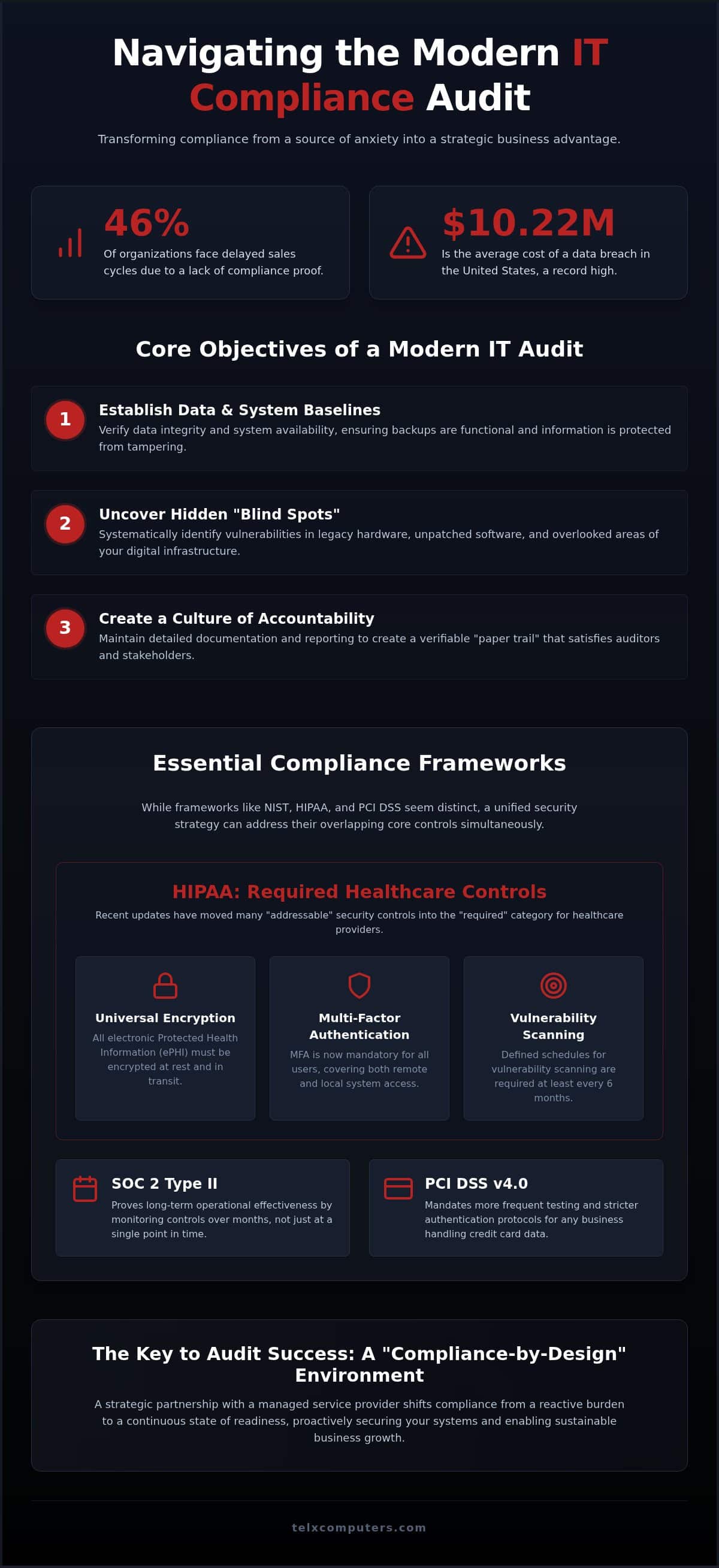
Did you know that 46% of organizations have seen their sales cycles delayed simply because they couldn’t provide proof of compliance? It’s a frustrating reality for many business owners. The pressure to prepare for an it compliance audit while keeping up with shifting regulations like the NIST Cybersecurity Framework 2.0 can feel overwhelming. You’re likely worried about heavy fines or, worse, a data breach that exposes your vulnerabilities.
We understand that managing overlapping standards like ISO 27001:2022 and the 2026 HIPAA updates is a significant challenge. This guide offers a clear roadmap to transform your compliance from a source of anxiety into a strategic business advantage. You’ll learn how to align your operations with current mandates, reduce security risks, and create a predictable budget for your long-term protection. We’re here to help you move from a reactive posture to a state of continuous readiness, ensuring your business remains secure and your growth stays on track.
Key Takeaways
- Learn how to navigate the complex overlap of modern frameworks like NIST 2.0 and HIPAA to build a unified security strategy.
- Discover the essential differences between internal reviews and external assessments to maintain a state of continuous readiness.
- Master a proven framework for your next it compliance audit by prioritizing precise documentation and critical vulnerability triage.
- Understand how a strategic partnership with a managed service provider creates a “compliance-by-design” environment that secures your business growth.
Understanding the IT Compliance Audit in a Dense Regulatory Landscape
An Information technology audit is no longer a simple checkbox exercise performed once a year. It’s a comprehensive examination of your organization’s digital infrastructure, policies, and operational procedures. In 2026, the focus has moved beyond basic security. It’s now about complex regulatory governance. You aren’t just protecting data; you’re proving that your entire business model respects the legal and ethical boundaries of the digital world.
For small and medium enterprises, the phrase “we’re safe enough” has become a dangerous gamble. Attackers don’t ignore smaller targets; they often use them as entry points into larger supply chains. The cost of a failed it compliance audit or a subsequent breach is staggering. In 2025, the average cost of a data breach in the United States reached a record high of $10.22 million. Beyond the heavy fines, you face a total operational halt and a shattered reputation that takes years to rebuild.
The Core Objectives of a Modern IT Audit
Why 2026 Demands a Proactive Compliance Stance
The threat landscape changed rapidly over the last year. AI-driven phishing and advanced ransomware have made traditional defenses less effective. Global standards like the Digital Operational Resilience Act (DORA) now influence local business requirements, even if you don’t operate directly in Europe. Compliance is a global language. Additionally, cyber insurance providers have raised the bar. Most now require proof of regular managed IT support service and formal audits before they’ll even issue a policy. Being proactive isn’t just about avoiding fines; it’s about staying insurable and operational.
Essential Compliance Frameworks: NIST, HIPAA, and Industry Standards
Managing an it compliance audit requires understanding the specific frameworks that govern your industry. In North America, businesses often face a patchwork of requirements from NIST, HIPAA, SOC 2, and PCI DSS. While these might seem like separate hurdles, they often share a common core of technical controls. A unified security approach allows you to address multiple regulations at once. The NIST Cybersecurity Framework stands as the gold standard for voluntary risk management, providing a flexible foundation that aligns with diverse business needs. To help you prepare, the NIST Assessment & Auditing Resources offer official tools for evaluating your current posture against these benchmarks.
HIPAA and Healthcare IT in South Florida
Medical practices in Miami and Fort Lauderdale face unique pressures due to the high density of healthcare providers and aggressive enforcement. Securing patient data isn’t just a technical requirement; it’s a legal mandate that requires specialized healthcare IT services. You must ensure that every vendor you work with signs a Business Associate Agreement (BAA). Beyond paperwork, technical controls are no longer optional. Key requirements for 2026 include:
- Universal encryption for all ePHI at rest and in transit.
- Multi-factor authentication (MFA) for all remote and local access.
- Defined schedules for vulnerability scanning every 6 months.
These updates represent the most substantial changes since 2013, moving many “addressable” controls into the “required” category. Failing to meet these standards doesn’t just risk a fine; it risks the trust your patients place in your practice.
SOC 2 and PCI DSS: Securing Financial and Client Data
For service organizations, a SOC 2 Type II report is the ultimate proof of long-term operational effectiveness. Unlike a point-in-time check, it monitors your controls over several months to ensure consistency. Simultaneously, any business handling credit card data must adapt to the retirement of PCI DSS v3.2.1. The new PCI DSS v4.0.1 mandates more frequent testing and stricter authentication protocols. A robust foundation of network security acts as the primary defense for these audits.
Integrating these controls into your daily operations ensures you are always ready for an it compliance audit. If you’re unsure where your current gaps lie, our team can help you identify the right path forward with business IT services in Miami tailored to your specific industry.
Internal vs. External Audits: Moving Toward Continuous Readiness
Many leaders view an it compliance audit as a single, high-stakes event. This mindset often leads to a reactive scramble that disrupts daily operations and creates unnecessary stress. To avoid this, you must distinguish between your internal “self-checks” and formal external assessments. Internal audits serve as your dress rehearsal. They are private evaluations that help you identify gaps without the threat of legal penalties. External audits, however, are the formal reviews conducted by independent third parties. These auditors require verifiable evidence that your security controls are actually functioning. They won’t just take your word for it; they demand proof.
The industry is shifting away from these point-in-time checks toward a model of continuous readiness. As of 2026, 97% of organizations conduct at least two audits annually. For larger enterprises, 74% undergo four or more. This frequency makes the old “scramble and fix” method impossible to sustain. You need a system that remains compliant by default, providing a constant stream of data that satisfies auditors at a moment’s notice.
The Strategic Value of Internal IT Reviews
Internal reviews are your most effective tool for proactive risk mitigation. They allow you to discover vulnerabilities before they become expensive liabilities or headlines in the news. Beyond the technical fixes, these reviews foster a culture of accountability among your staff. When your team participates in regular reporting, compliance becomes an operational habit rather than an annual burden. Professional it consulting helps bridge the gap between these internal checks and complex external requirements. It ensures your self-assessments are rigorous enough to survive the actual audit without any surprises.
The Expert Guardian: Preparing for External Auditors
We treat “Audit Readiness” as a distinct, critical phase of your business strategy. This isn’t about a quick fix before an auditor arrives; it’s about maintaining a state of constant vigilance. An expert partner acts as your technical liaison, speaking the language of the auditor and providing the necessary documentation. This partnership reduces friction and keeps your team focused on their core work. Real-time server monitoring provides the continuous evidence needed to satisfy even the most rigorous regulatory bodies. It creates a verifiable “paper trail” that proves your environment is secure every day of the year. In an era where 38% of organizations report losing revenue because they couldn’t provide sufficient proof of compliance, this level of it compliance audit preparation is a competitive necessity.
Step-by-Step IT Compliance Audit Preparation Checklist
Preparing for an it compliance audit requires a tactical triage approach. You can’t fix everything at once. Instead, you must identify the most critical vulnerabilities that threaten your data integrity first. While technical fixes are vital, remember that documentation is equally important. If a control exists but isn’t documented, an auditor will treat it as if it doesn’t exist. Industry studies indicate that 60% of audit failures stem from poor documentation rather than technical flaws. We focus on actionable phases that minimize business disruption while building a fortress of evidence for your review.
Phase 1: Inventory and Asset Mapping
You cannot protect what you cannot see. Start by cataloging every piece of hardware, software, and cloud-based subscription in your environment. You must pinpoint exactly where sensitive data like PII or PHI resides. This is also the time to ensure all software licensing is current. Outdated or unauthorized software creates security holes that auditors will find immediately. A clear asset map proves to regulators that you have full visibility over your digital estate.
Phase 2: Access Control and Security Hardening
Once you have a map, you must lock the doors. Implement the Principle of Least Privilege (PoLP) to ensure users only have access to the data they need for their specific roles. Review your Multi-Factor Authentication (MFA) and ransomware protection protocols to ensure they meet modern standards. Finally, verify that your data backup and disaster recovery plans are functional through rigorous testing. These technical safeguards form the backbone of your defense strategy.
Phase 3: Documentation and Remediation
This final phase focuses on the “paper trail” that satisfies external examiners. Draft or update your Incident Response Plan (IRP) so your team knows exactly how to react to a threat. Create a centralized repository for security logs and audit trails. This allows you to present evidence quickly during an it compliance audit. By closing high-risk gaps discovered during your initial assessment, you move from a state of worry to a state of confidence. Ready to see where your business stands? Get an instant quote for a comprehensive security review today.
Why Managed IT Services are the Key to Audit Success
An it compliance audit shouldn’t be a source of technical anxiety. By integrating a managed IT support service, you transition from a reactive posture to a “compliance-by-design” environment. This means your security controls aren’t just temporary patches; they’re the permanent foundation of your network architecture. Telx Computers acts as your expert guardian and silent engine, maintaining 24/7 vigilance so you’re always ready for an inspector’s call. Our fixed-price plans provide the predictable budgeting you need, ensuring your compliance management costs don’t spiral out of control as regulations evolve and become more complex.
The peace of mind that comes from proactive maintenance cannot be overstated. When security is baked into your daily operations, the audit itself becomes a mere formality. You’ve already done the work. You have the logs. You have the proof. This level of reliability is what separates thriving enterprises from those constantly struggling to keep up with the latest mandate.
From Reactive Fixes to Proactive Governance
Continuous monitoring is the only way to prevent the “audit panic” that typically hits at the end of the fiscal year. Utilizing it outsourcing services allows your business to scale its security protocols alongside its growth. You don’t have to worry about the complexities of regional Florida mandates or shifting global standards. Telx Computers stays ahead of the curve, handling the granular technical details so your team can focus on high-level business strategy.
The Telx Computers Advantage: Your Strategic Ally in Miami
Our localized approach provides a recurring anchor for businesses in Aventura and Fort Lauderdale. Telx Computers offers rapid on-site response when you need it most, ensuring your physical and digital assets are always protected. We understand the high-stakes requirements for law firms and healthcare providers, where a single slip in data integrity can lead to devastating consequences. Partnering with an expert guardian gives you the stability and peace of mind to operate with confidence in a high-speed industry. Don’t leave your regulatory standing to chance. Secure your business with a comprehensive IT audit today.
Building a Culture of Continuous Readiness
You’ve explored how a modern it compliance audit has shifted from a yearly chore to a continuous strategic requirement. By mastering frameworks like NIST and HIPAA and prioritizing detailed documentation, you’ve already taken the first steps toward securing your company’s future. Compliance is no longer just about avoiding fines; it’s about building trust with your clients and ensuring your operations remain uninterrupted by security failures. This transition from a reactive posture to a proactive one is the hallmark of a resilient enterprise.
Our role as your Expert Guardian is to remove the technical anxiety that often accompanies these complex reviews. With 24/7 support and predictable fixed-price plans, we ensure your infrastructure remains resilient against evolving threats while keeping your budget stable and manageable. This proactive approach turns a potential liability into a competitive advantage for your organization, allowing you to scale with confidence.
Ready to move from reactive patches to proactive governance? Get Your Instant Quote for Managed Compliance Services and discover how a strategic partnership can streamline your path to certification. Your business deserves the stability and peace of mind that comes from being one step ahead of every threat. Let’s build a secure future together.
Frequently Asked Questions
What is the difference between an IT audit and a security assessment?
An IT audit evaluates your adherence to specific regulatory standards and internal policies; a security assessment focuses on identifying technical vulnerabilities. While an assessment helps you find the holes in your fence, an audit confirms you’re following the legal rules for having the fence in the first place. You need both to maintain a secure and compliant environment.
How often should my business conduct an IT compliance audit?
Most organizations now conduct an it compliance audit at least twice per year to keep pace with rapidly changing regulations. Data shows that 74% of large enterprises undergo four or more audits annually. Regular reviews ensure your controls remain effective as your business grows and your technical environment evolves.
Is an IT compliance audit mandatory for small businesses?
Mandatory status depends on your industry and the type of data you handle rather than your company’s size. If you process credit cards or patient health information, an it compliance audit is a legal requirement under PCI DSS or HIPAA. Many partners also demand proof of compliance before they’ll sign service contracts with you.
How much does an IT compliance audit typically cost for a mid-sized firm?
Costs vary significantly based on the scope of your network and the specific frameworks you need to satisfy. Factors like the number of employees, the complexity of your cloud environment, and the maturity of your existing documentation all influence the final investment. We suggest using fixed-price service plans to keep your compliance budget predictable and transparent.
What happens if our business fails an IT compliance audit?
Failing an audit often leads to heavy financial penalties and a significant loss of market trust. Industry research indicates that 46% of organizations have seen sales cycles delayed because they lacked proof of compliance. You also risk increased scrutiny from regulators, higher insurance premiums, and potential operational halts during remediation.
Can managed IT services help with HIPAA or SOC 2 readiness?
Managed IT services provide the continuous monitoring and documentation needed for long-term readiness. We act as your strategic ally, implementing the technical controls required by HIPAA and SOC 2 so you aren’t scrambling when auditors arrive. This approach keeps your business secure year-round and builds a verifiable paper trail for examiners.
How long does the audit preparation process usually take?
The preparation timeline typically ranges from three to nine months depending on your current maturity level. This period allows you to identify gaps, implement new technical controls, and generate the necessary logs and documentation. Starting the process early is the best way to reduce technical anxiety and ensure a smooth review.
What documentation do auditors look for during an IT review?
Auditors typically request your Incident Response Plan, access control logs, and updated hardware and software inventories. They also look for proof of regular vulnerability scans, penetration test results, and employee training records. Having a centralized repository for these documents is essential for a successful review and demonstrates your proactive governance.