




23 Jun Hurricane Preparedness for Business IT in Miami: A Strategic Resilience Framework
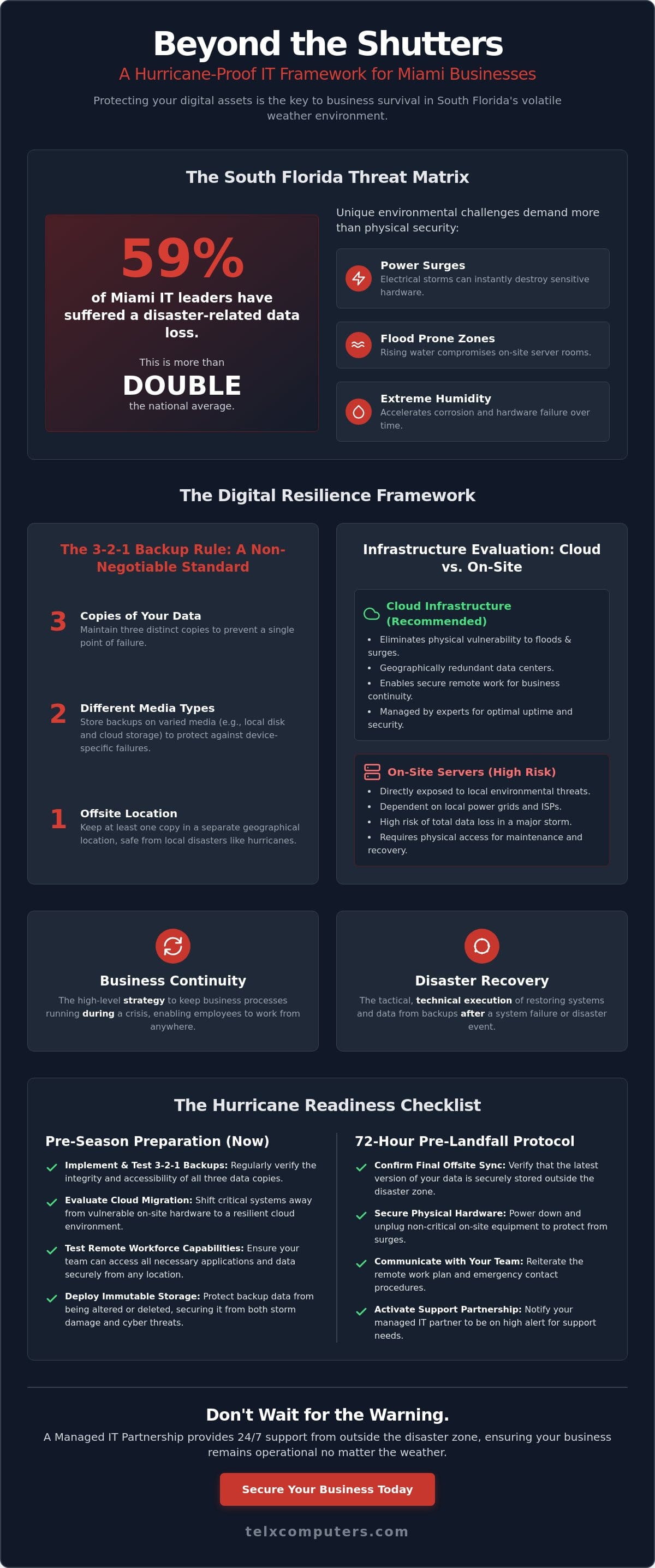
Did you know that 59% of Miami IT decision-makers have already suffered a disaster-related loss? According to industry data, that is more than double the national average, making South Florida one of the most challenging environments in the country for maintaining digital operations. When a major storm enters the Atlantic, the fear of permanent data loss or weeks of costly downtime becomes a heavy burden for any business leader. You already understand that physical shutters protect your walls, but they do nothing for the servers and systems that power your revenue.
Our goal is to replace that technical anxiety with a sense of total stability. This article outlines a strategic resilience framework for hurricane preparedness for business IT Miami organizations can use to protect digital assets and maintain operations during our most volatile weather events. We’ll show you how to build a bulletproof IT disaster recovery plan that secures client data regardless of your office’s physical status. By shifting to a cloud-first strategy and optimizing remote workforce management, you can ensure that a regional crisis doesn’t become a business-ending event.
Key Takeaways
- Shift your operational focus from basic physical protection to a comprehensive digital resilience strategy that maintains total business continuity.
- Implement the 3-2-1 backup rule and utilize immutable data storage to protect your assets from both storm damage and opportunistic cyber threats.
- Evaluate the strategic benefits of cloud infrastructure to eliminate the inherent vulnerabilities of on-site server rooms in Miami’s flood-prone districts.
- Follow a structured hurricane preparedness for business IT Miami checklist to ensure your systems are verified during the pre-season and secured 72 hours before landfall.
- Learn how a managed IT partnership provides access to 24/7 support from outside the disaster zone to keep your remote workforce operational.
Beyond Plywood: The Critical Importance of IT Hurricane Preparedness in Miami
While most local business owners focus on boarding up windows, true resilience starts where the plywood ends. Physical security is only half the battle. Your digital assets, client records, and operational workflows are the lifeblood of your company. If your office is safe but your data is inaccessible, your business is effectively closed. Adopting an “Expert Guardian” mindset means moving beyond reactive measures. Waiting for a tropical storm warning is already too late; proactive hurricane preparedness for business IT Miami requires a framework built during the calm of the off-season.
South Florida presents unique environmental challenges that go beyond high winds. Power surges during electrical storms can fry sensitive hardware in seconds. Flood-prone areas like Brickell or Miami Beach often see server rooms compromised by rising water, while the relentless humidity accelerates hardware failure in aging equipment. Effective Tropical cyclone preparedness for your technology stack is an investment in your company’s survival. When you calculate the hourly loss during a regional outage, the cost of inaction quickly outweighs the investment in a robust recovery strategy.
To better understand how the local community approaches these challenges, watch this helpful video:
Defining Business Continuity vs. Disaster Recovery
Business continuity is your high-level strategy for keeping the virtual “lights on” so employees can work from anywhere. It focuses on the business process and maintaining a functional state during a crisis. Disaster recovery is the tactical, technical execution of restoring data from a backup after a system failure occurs. For modern Miami enterprises, Disaster Recovery as a Service (DRaaS) provides a cloud-hosted solution that replicates your entire IT environment to a secure, offsite location for near-instant restoration when local hardware fails.
The Modern Risk Landscape for South Florida IT
Businesses in Aventura, Fort Lauderdale, and Coral Gables now face higher stakes than ever before. With the rise of remote work, your team depends on cloud access and local ISP reliability that often buckles under regional infrastructure strain during a storm. While a hurricane is a “loud” threat that everyone sees coming, the “silent” threat of hardware degradation in high-humidity zones can be just as devastating. Relying on a managed IT support service ensures that your infrastructure is monitored 24/7. This proactive approach identifies vulnerabilities before the wind starts to howl, ensuring your business remains the silent engine of success regardless of the weather.
Designing a Resilient Data Backup and Disaster Recovery Strategy
A resilient digital infrastructure isn’t built in the hours before a storm makes landfall. It requires a foundational commitment to the 3-2-1 Backup Rule. This non-negotiable standard dictates that you maintain three copies of your data, stored on two different types of media, with at least one copy kept offsite. This protocol is a cornerstone of effective hurricane preparedness for business IT Miami leaders implement to ensure that even if their primary office is inaccessible, their business intelligence remains intact and recoverable.
Physical storms often mask digital dangers. There is a natural synergy between weather readiness and ransomware protection. We utilize immutable backups, which are data sets that cannot be altered or deleted for a set period. This technology acts as a digital vault, and it’s a critical layer of hurricane preparedness for business IT Miami because it protects your information from both physical destruction and opportunistic cyber threats that often spike during regional crises. If a hacker attempts to encrypt your files while your team is distracted by weather alerts, your immutable copies remain untouched.
To manage expectations and operational reality, every business owner should define their Recovery Point Objective (RPO) and Recovery Time Objective (RTO). RPO is your data loss tolerance; it defines how much data you can afford to lose between backups. RTO is your downtime tolerance, measuring how many hours or days your business can survive before being fully back online. Setting these benchmarks allows us to tailor a solution that matches your specific risk profile, turning technical requirements into clear business outcomes.
The Role of Geographic Redundancy
True geographic redundancy means your data shouldn’t just be in a different building; it needs to be outside the South Florida cone of uncertainty. While regional cloud storage offers speed, national or multi-region storage provides the ultimate safety net. The SBA emergency preparedness guide emphasizes that offsite records are vital for post-disaster recovery. Telx utilizes multi-region data centers to ensure that your digital assets are available 24/7, even if the entire state of Florida is facing a major weather event.
Cybersecurity During the Storm: The Hidden Risk
Hackers view natural disasters as an invitation. They know that when normal protocols are disrupted, network security often takes a backseat to physical safety. It’s vital to secure your VPNs and remote access points before your team transitions to a remote work environment. Ensuring that every employee’s connection is encrypted and authenticated prevents “loud” weather events from leading to “silent” data breaches. If you aren’t sure if your current setup can withstand a dual threat, consider requesting a consultation for a managed IT support service to audit your remote access protocols.
Cloud Infrastructure vs. Local Servers: Evaluating Resilience for South Florida Storms
In flood-prone districts like Miami Beach and Brickell, on-site server rooms are high-stakes liabilities. Keeping your core business data in a ground-floor closet or even a second-story suite during a Category 4 storm introduces unnecessary risk. By migrating to the cloud, you move from a reactive operational stance to a proactive one. This shift is a cornerstone of hurricane preparedness for business IT Miami leaders rely on to ensure their digital assets remain untouched by local environmental hazards.
A cost-benefit analysis often reveals that maintaining a truly hurricane-proof local server room is prohibitively expensive. You would need to invest in industrial-grade cooling, raised flooring, and redundant power systems that can run for weeks. Cloud infrastructure eliminates these capital expenditures by leveraging high-security, Tier 4 data centers located in geographically stable regions. When your hardware is housed in these facilities, the focus of server monitoring shifts from worrying about physical damage to optimizing system performance and accessibility.
Hybrid Cloud: The Best of Both Worlds?
Many organizations prefer a hybrid model to balance local low-latency needs with cloud-based failover. This approach allows you to run daily operations on-site while ensuring all data is synchronized with a secure cloud environment before the peak of hurricane season. It provides a seamless transition if your physical office loses power or suffers damage. Through virtualization, your business can “spin up” a functional virtual office in the cloud within minutes; this allows your team to resume operations even if your physical headquarters is offline.
VoIP and Communication Continuity
Traditional landlines are often the first casualty of a major storm. Downed lines and flooded exchanges can cut off your connection to clients and vendors exactly when you need them most. Cloud-based VoIP solutions keep your lines open by routing calls through the internet rather than physical copper wires. By integrating mobile apps, your team stays connected from any location with a cellular signal. It’s also vital to set up automated “Emergency Status” messaging. This ensures your clients receive clear updates on your operational status, maintaining trust and stability during the most volatile hurricane preparedness for business IT Miami events.
The Business IT Hurricane Readiness Checklist: Step-by-Step Protection
Strategic resilience is a process, not a single event. While cloud migrations and redundant backups provide the foundation, your physical office still requires a tactical plan to survive the elements. A structured timeline prevents panic and ensures that no critical step is missed when the pressure of a storm mounting. Following a comprehensive framework for hurricane preparedness for business IT Miami organizations allows you to protect your investment and ensure your team can transition to remote operations without friction.
- Phase 1: Pre-Season Audit (May/June): Conduct a full hardware inventory and verify that all serial numbers are documented for insurance purposes. Test your battery backups and uninterruptible power supplies (UPS) to ensure they hold a charge. Perform a full restore test of your data backup & disaster recovery systems to confirm data integrity.
- Phase 2: 72 Hours Before Landfall: Perform a final manual sync of all critical databases to your offsite vault. Brief your staff on remote work expectations and confirm they have the necessary hardware at home. Verify that your offsite data centers are outside the current cone of uncertainty.
- Phase 3: 24 Hours Before Landfall: Execute graceful shutdowns of all non-essential local servers and workstations. If you don’t have a remote-controlled power distribution unit, manually unplug hardware to prevent surge damage.
- Phase 4: Post-Storm Recovery: Do not power up systems immediately after power is restored. Assess the facility for water damage or leaks near server racks. Contact your ISP to verify regional connectivity before bringing your local network back online.
Physical Hardening of the Miami Office
Physical protection goes beyond shutters. You must unplug non-essential hardware to prevent the massive power surges that often accompany storm-related grid failures. Uninterruptible Power Supplies (UPS) are vital; they provide the necessary buffer to prevent data corruption during brownouts or sudden flickers. In South Florida, “off the floor” is the golden rule. Even a minor leak or a few inches of rising water can destroy a server rack sitting at ground level. Elevate all critical hardware to a minimum of three feet to mitigate flood risks.
The Remote Work Readiness Test
According to FEMA, 40% of small businesses never reopen after a disaster. To ensure you aren’t part of that statistic, you must conduct a “Dry Run” of your remote work capabilities. Verify that every employee can access the managed IT support service remotely and that multi-factor authentication (MFA) works without office-bound hardware. It’s also essential to establish secondary communication channels like Slack, Teams, or SMS for internal IT status updates. This keeps your team aligned even if your primary email server faces temporary delays. Ready to secure your infrastructure before the next storm? Get a customized IT resilience quote today to ensure your business is fully protected.
Maintaining Business Continuity: How a Managed IT Partner Secures Your Miami Operations
True resilience is not a product you buy; it is a partnership you build. While the technical frameworks discussed in previous sections provide the architecture for survival, a managed IT partner serves as the vigilant guardian of those systems. The primary advantage of this relationship is access to a 24/7 help desk that operates outside the local disaster zone. When South Florida’s infrastructure is under duress, you need support from professionals who are not facing the same environmental challenges. This geographic diversity ensures that your remote workforce has a direct line to assistance regardless of local conditions.
Financial stability is just as critical as technical uptime during a crisis. We provide fixed-price IT plans that eliminate the fear of a surprise bill following a major storm. Disaster recovery should be a standard part of your operational strategy, not an additional expense that drains your recovery budget. By integrating hurricane preparedness for business IT Miami into your monthly service model, you gain the peace of mind that comes with predictable costs. This allows you to shift your focus from “survival mode” to “strategic growth” through expert IT consulting, ensuring your technology remains an engine for success rather than a source of technical anxiety.
Why Local Expertise Matters in a Global Tech World
There is a distinct advantage to working with IT companies in Miami that possess a deep understanding of our regional landscape. We understand the nuances of the local power grid and the specific reliability patterns of South Florida ISPs. This localized knowledge allows for a rapid on-site response once authorities clear the area for travel. We also provide specialized support for high-stakes sectors, ensuring that healthcare providers and law firms maintain compliance and data integrity even during the most volatile weather events. Our team acts as an extension of your own, taking ownership of the technical details so you can lead your organization with confidence.
Next Steps: Securing Your Business Before the Next Storm
The time to audit your resilience is while the skies are clear. A comprehensive infrastructure audit identifies the “silent” threats of aging hardware and unverified backups before they are tested by a hurricane. We work with you to build a custom Disaster Recovery Plan tailored to your industry’s unique regulatory and operational requirements. Don’t wait for a tropical storm warning to discover the gaps in your digital fortress. Take a proactive step toward total business continuity and get an instant quote for managed IT resilience today. Let us provide the stability and expertise you need to navigate South Florida’s most challenging seasons.
Mastering Operational Resilience in South Florida
We’ve explored how a strategic shift from simple physical protection to a cloud-first infrastructure ensures your data remains safe regardless of local weather conditions. Implementing immutable backups and following a rigorous pre-season checklist are the first steps toward total digital security. Achieving comprehensive hurricane preparedness for business IT Miami requires more than just hardware; it demands a strategic alliance that anticipates threats before they arrive. By prioritizing geographic redundancy and communication continuity, you ensure that your team remains productive even when the office is inaccessible.
With over 20 years of South Florida IT expertise, our team provides the 24/7 proactive monitoring and help desk support your business needs during a crisis. Our fixed-rate plans ensure predictable disaster recovery budgeting, removing financial uncertainty from your resilience strategy. Secure your Miami business with a professional IT disaster recovery plan from Telx Computers. You have built your organization with vision and hard work; let us provide the stable foundation that keeps it running through every season.
Frequently Asked Questions
How often should a Miami business test its disaster recovery plan?
You should test your disaster recovery plan at least twice a year. We recommend performing a full simulation in May to ensure your systems are ready before hurricane season begins on June 1st. Regular testing identifies synchronization errors or access issues that could hinder your team when a real storm approaches. It’s better to discover a technical gap during a calm afternoon than during a regional emergency.
Is cloud storage enough to protect my business from a hurricane?
Cloud storage is a vital component, but it isn’t a complete business continuity solution. While it keeps your files safe, it doesn’t provide the infrastructure needed to run your business applications or manage your network remotely. A resilient strategy for hurricane preparedness for business IT Miami combines offsite storage with virtualization. This allows you to “spin up” your entire office environment in the cloud so operations continue without interruption.
What is the difference between an UPS and a backup generator for my IT gear?
An Uninterruptible Power Supply (UPS) provides immediate, short-term battery power and surge protection to prevent data corruption during a sudden outage. It’s designed to keep systems running just long enough for a graceful shutdown or for a generator to take over. A backup generator provides long-term power for days or weeks. You need both to protect your hardware from the volatile voltage fluctuations common during South Florida storms.
Can my employees work from home if our Miami office loses power?
Your employees can stay productive from home if your organization utilizes cloud computing and VoIP solutions. Since these systems live in secure, offsite data centers, they don’t rely on your physical office’s power or internet connection. We help you establish secure remote access protocols so your team can serve clients from any location with a functional internet connection, even if the headquarters is dark.
Should I take my office servers home with me before a hurricane?
You shouldn’t take physical servers home. Transporting sensitive hardware increases the risk of impact damage, and residential environments lack the proper cooling and security your equipment requires. It’s much safer to rely on automated data backup and disaster recovery services. These systems ensure your data is replicated to a secure facility, allowing you to focus on your personal safety and family instead of heavy hardware.
What happens to my data if the Telx data center is also in a hurricane zone?
We utilize multi-region data centers to ensure your information is never tied to a single geographic location. Even if a local facility is impacted by a storm, your data is replicated in real-time to distant regions far outside the cone of uncertainty. This geographic redundancy is a core pillar of the hurricane preparedness for business IT Miami organizations expect from a professional partner. Your digital assets remain accessible regardless of local conditions.
How quickly can my business be back online after a total system failure?
Recovery speed depends on your specific Recovery Time Objective (RTO). With modern virtualization and cloud-based failover, we can often restore critical systems in minutes. During our initial IT consulting phase, we help you define these benchmarks based on your operational needs. This ensures that your most vital departments are prioritized and back online as quickly as possible following a disruption.
Does my business insurance cover data loss from a hurricane?
Standard business insurance usually covers physical hardware damage, but it often excludes or limits coverage for data loss and reconstruction costs. Reviewing your policy for specific cyber insurance or business interruption riders is essential. However, insurance only provides financial reimbursement after the fact. A proactive disaster recovery plan is the only way to ensure your data is actually restored and your business remains operational.