





16 Jul Cybersecurity Audit for Small Business: A Strategic Framework for 2026
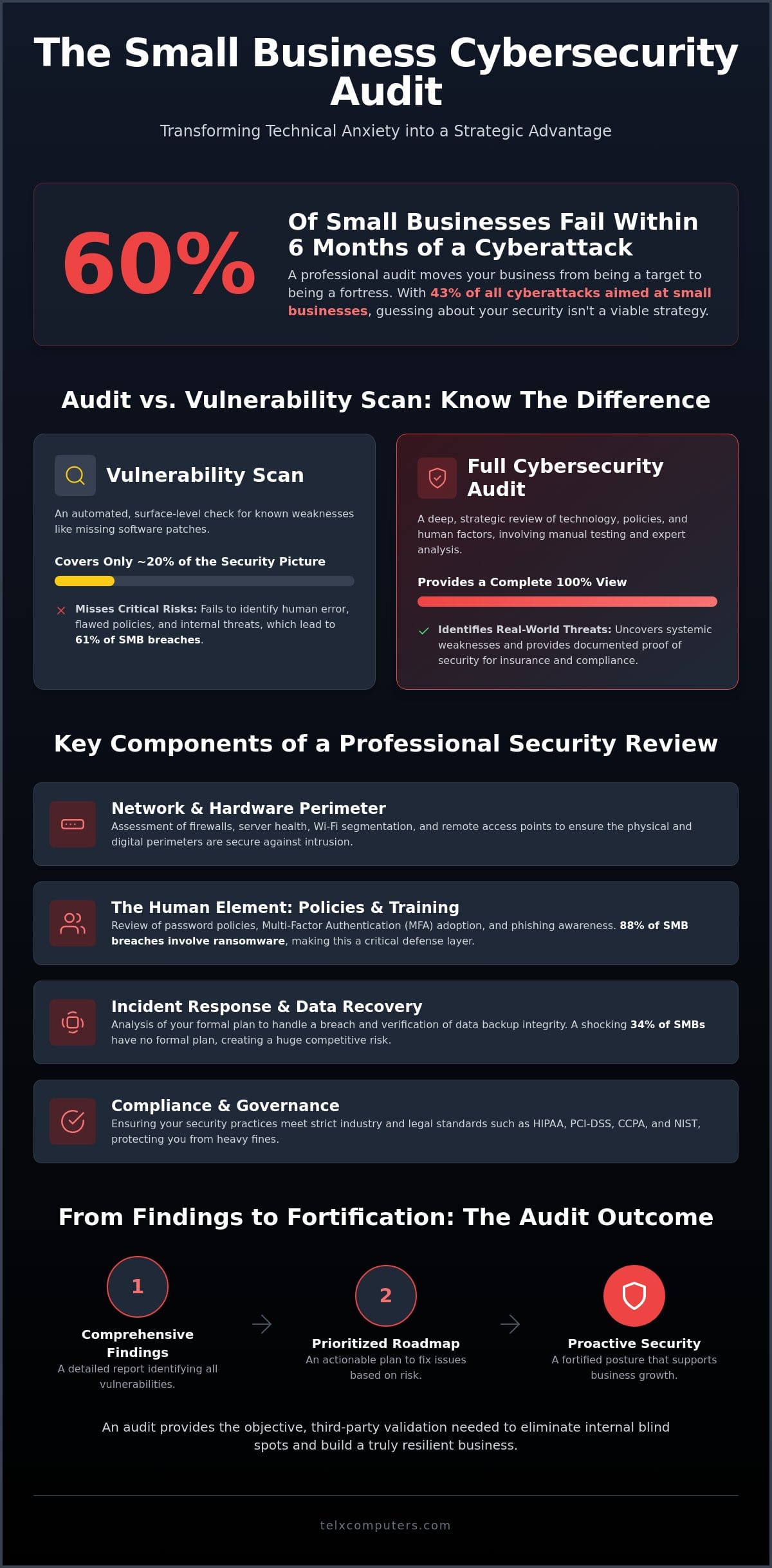
Did you know that 60% of small companies that suffer a significant cyberattack close their doors permanently within just six months? It’s a sobering statistic from recent industry reports, and it explains why you might feel a constant sense of technical anxiety. You’ve likely felt the mounting pressure from insurance providers to prove your compliance or wondered if your current IT setup could actually withstand a modern ransomware attempt. We understand that uncertainty. You deserve a partner who replaces that fear with a sense of stability and a clear plan for the future.
A professional cybersecurity audit for small business acts as your strategic intelligence tool. It moves beyond simple “pass or fail” metrics to identify hidden vulnerabilities that could stall your momentum. By reading this, you’ll discover how a structured audit provides a prioritized roadmap for your security. We’ll explore the specific frameworks required for 2026, including the latest updates to CCPA and NIST standards. You’ll gain a clear understanding of your security gaps and the exact steps needed to protect your business growth with absolute confidence.
Key Takeaways
- Learn why a comprehensive IT infrastructure review is a strategic business tool rather than a simple technical checkbox.
- Identify the critical components of a cybersecurity audit for small business, including network analysis and access management.
- Discover why third-party objectivity is essential for eliminating the blind spots common in internal security assessments.
- Prepare your organization efficiently by gathering the necessary network maps and user directories before the process begins.
- Turn complex audit findings into a prioritized roadmap that protects your operations against 2026 threats.
What is a Cybersecurity Audit for Small Business?
A cybersecurity audit for small business is far more than a simple technical inspection. It’s a high-level strategic review of your entire digital ecosystem. This process examines your hardware, software, internal policies, and even employee behaviors to find exactly where your organization is vulnerable. Think of it as a deep-dive information security audit that aligns your technology with your business growth goals. We don’t just look at code; we look at how your business survives in a digital world.
To better understand the scope of these assessments, watch this helpful video:
The Core Purpose of a Security Assessment
We look for the gaps before malicious actors exploit them. With 43% of all cyberattacks targeting small businesses, you can’t afford to guess where your weaknesses lie. An audit provides the documented proof of security that insurance providers and clients now demand. If you’re in healthcare or retail, it ensures you meet strict HIPAA or PCI-DSS standards, protecting you from heavy fines and reputational damage. It creates a “state of security” report that gives stakeholders peace of mind and proves your business is a reliable partner.
Audit vs. Vulnerability Assessment: Clearing the Confusion
Many business owners mistake a simple vulnerability scan for a full audit. Automated scans are useful, but they only cover about 20% of the total security picture. They find missing patches but miss the human errors or flawed policies that lead to 61% of SMB data breaches. A true audit involves manual testing and a rigorous review of how your team handles data. Telx Computers acts as your “Expert Guardian” here. We dig into the logic of your systems to ensure your managed IT support service is actually providing the protection you expect.
This assessment serves as your baseline for the coming year. With new regulations like the CCPA amendment effective January 1, 2026, certain businesses must now conduct annual audits. By establishing a clear baseline now, you create a roadmap that prioritizes fixes based on actual risk rather than guesswork. It’s about moving from a reactive “firefighting” mode to a proactive, secure posture that supports your long-term success.
Key Components of a Professional Security Review
A professional cybersecurity audit for small business isn’t a mystery. It’s a structured investigation into the four pillars of your digital defense: network integrity, identity management, cloud resilience, and data recovery. We look for the cracks in your perimeter that automated tools often overlook. By breaking your infrastructure into these specific categories, we transform technical anxiety into a manageable, prioritized action plan.
Evaluating Your Network and Hardware Perimeter
We start by assessing the health of your firewalls and server monitoring systems. It’s common to find outdated hardware that can no longer receive security patches, leaving a revolving door for hackers. We verify that your Wi-Fi networks are segmented and that remote access points are locked down tight. For local firms, following high standards for network IT support in Miami ensures your physical office isn’t the weakest link in your chain. We don’t just check if the “locks” are there; we test if they actually hold under pressure.
The Human Element: Policy and Training Reviews
Research shows that 88% of breaches at small businesses involve ransomware, which often starts with a single phishing email. We evaluate your team’s awareness and your current password policies to see where risks hide. Multi-Factor Authentication (MFA) is no longer a luxury; it’s a requirement for modern insurance coverage and basic safety. We also analyze your incident response plan. Since only 34% of small businesses have a formal plan, creating one during a cybersecurity audit for small business provides a massive competitive advantage. You can find more foundational tips in the FTC cybersecurity guidance.
Cloud and Remote Work Security
Your office isn’t just a building anymore. We audit virtual desktop infrastructure (VDI) and remote monitoring tools to secure your “mobile office” across NYC, LA, and Miami. We verify that data encryption is active across all SaaS applications and cloud storage. Finally, we validate your data backup systems. A backup that hasn’t been tested is just a file; we ensure yours actually works when you need it most. Our goal is to ensure that your disaster recovery plan is a reliable shield, not just a document on a shelf. If you’re looking for a partner to maintain these standards daily, our managed IT support service integrates these checks into a seamless, reliable operation.
Internal vs. Third-Party Audits: Choosing the Right Path
It’s tempting for many small business owners to handle security checks in-house to save on immediate costs. You might feel that your internal team knows your systems better than anyone else. However, this approach often creates dangerous blind spots that leave your organization vulnerable. A truly effective cybersecurity audit for small business requires a level of objectivity that’s almost impossible to achieve when you’re auditing your own work. Without a fresh perspective, configuration errors and outdated policies often go unnoticed until a breach occurs.
The Limitations of DIY Security Checks
Internal teams frequently overlook their own mistakes because those setups have become part of the daily routine. Most small businesses don’t have access to the enterprise-grade auditing tools or the real-time threat intelligence that professional firms use every day. This results in a surface-level check that might find a missing update but misses a deep-seated architectural flaw. Our role as an Expert Guardian is to see the threats you didn’t know existed. We provide the specialized oversight needed to identify complex risks before they turn into operational disasters.
The financial reality of DIY checks is often misunderstood. While skipping a professional review might seem like a saving, the long-term costs of a breach are devastating. According to current research, the average cost of a data breach for businesses with fewer than 500 employees has reached $3.31 million. Investing in a professional audit is a fraction of that risk. Furthermore, by 2026, most cyber insurance providers require documented, third-party proof of security controls. A DIY checklist rarely satisfies the rigorous standards insurers now demand to maintain your coverage.
Benefits of Outsourcing Your Audit to an MSP
Partnering with a Managed Service Provider (MSP) gives you immediate access to deep expertise in ransomware protection and advanced threat detection. We don’t just hand you a list of technical jargon; we provide comprehensive reporting that translates findings into clear business metrics. This helps you understand exactly how a security gap impacts your growth and stability. You can find additional best practices in CISA’s cyber guidance, which emphasizes the importance of professional oversight for small organizations.
Outsourcing also ensures a seamless transition from identifying a problem to fixing it. When we uncover a vulnerability, we can immediately integrate the solution into our managed IT support services. This holistic approach prevents the “disconnected fix” problem where a single patch might accidentally disrupt another part of your workflow. We act as a strategic ally, ensuring your security strategy is an engine for success rather than a series of technical hurdles.
How to Prepare Your Small Business for an Audit
Preparing for a cybersecurity audit for small business isn’t about passing a test. It’s about gathering the intelligence needed to protect your future growth. A successful review depends on the quality of the information you provide. By organizing your data upfront, you reduce the time needed for the assessment and ensure no vulnerability goes unnoticed. This preparation turns a technical requirement into a strategic advantage.
You must first define your scope. Decide whether the audit covers your entire operation across Miami, LA, and NYC or focuses on a specific department. Gathering existing documentation, such as network maps, software licensing lists, and user directories, allows the process to move efficiently. Clear goals are also vital. Are you seeking compliance with a regulation like HIPAA, or is this primarily to satisfy a new cyber insurance requirement? Knowing your “why” helps us tailor the cybersecurity audit for small business to your exact needs.
The Audit Preparation Checklist
Use this checklist to ensure you’re ready for the deep dive:
- Inventory all hardware, including mobile devices and remote laptops used by your hybrid workforce.
- List all third-party vendors with access to your systems, such as cloud storage providers or SaaS applications.
- Identify key business processes that must remain operational during the review to avoid any disruption to your clients.
Managing Expectations and Minimizing Disruption
Transparency is your greatest asset. Communicate with your team early, explaining that the audit is a tool for improvement rather than a critique of their performance. A professional audit typically takes several days to a few weeks depending on your company’s size and the complexity of your network. Ensure your IT staff or current provider is ready to assist with administrative access and technical questions. This collaborative approach ensures that the audit remains a silent engine for your success rather than a source of stress.
A well-prepared audit leads to a much faster remediation phase. To see how our team can streamline this process for you, request an instant quote today and begin your journey toward a more secure future.
From Findings to Fortification: The Telx Approach
An audit report is only as valuable as the action it inspires. When we complete a cybersecurity audit for small business, we don’t leave you with an overwhelming list of technical failures. Instead, we translate those findings into a prioritized remediation plan that focuses on your most critical risks first. This approach moves your organization away from technical anxiety and toward a state of operational stability. We act as your strategic ally, ensuring that every vulnerability discovered is met with a streamlined, effective resolution.
We integrate these findings directly into our managed IT support service. This creates a seamless transition from identification to fortification. Our fixed-price service plans provide a significant advantage here. You won’t face surprise invoices for post-audit fixes; instead, you gain unlimited support to maintain your security posture. For businesses in Miami, Fort Lauderdale, and Aventura, our local rapid response ensures that if a critical gap is found, we can be on-site to resolve it immediately. We don’t just identify the cracks; we seal them before they can be exploited.
Building a Proactive Defense Strategy
The goal of any audit is to move your business from a “reactive” state to a proactive 24/7 monitoring model. We use the data gathered during the review to implement advanced server monitoring systems that watch for threats in real-time. Security isn’t a one-time event. We treat auditing as an annual strategic event that allows us to adjust your defenses as threats evolve through 2026. This continuous improvement cycle ensures your business remains one step ahead of malicious actors, turning your IT infrastructure into a resilient asset rather than a liability.
Why Miami, NYC, and LA Businesses Trust Telx
Businesses in major hubs face unique regional threats and compliance pressures. We bring deep experience across diverse sectors, providing specialized healthcare IT solutions and secure environments for law firms. Our team understands the specific regulatory landscapes of Miami, NYC, and LA, blending global technical standards with a commitment to the local business community. We position ourselves as an extension of your own team, taking ownership of your technical health so you can focus on growth.
The personality of an expert guardian is at the heart of everything we do. We take pride in being the silent engine behind your success, providing a technological edge that feels personalized and client-centric. With the Telx Guarantee, you gain the peace of mind that comes from professional authority and a partner who is always vigilant. We don’t just secure your network; we protect your reputation and your long-term viability.
Securing Your Growth with Strategic Confidence
You now understand that a cybersecurity audit for small business is far more than a technical checklist; it’s a vital intelligence tool for your company’s survival. By choosing an objective third-party review, you eliminate the dangerous blind spots that often lead to devastating breaches. We’ve explored how proper preparation and a focus on both technical and human elements create a truly resilient defense. This strategic approach replaces technical anxiety with a clear, actionable roadmap for your business growth.
Our team at Telx Computers provides the expert guardianship you need to stay ahead of evolving threats. We deliver peace of mind through 24/7 proactive server monitoring and fixed-price unlimited IT support that keeps your operational costs predictable. Whether you’re operating in Miami, NYC, or LA, our local expertise ensures your business meets the highest standards of protection and regulatory compliance.
Get a Professional Cybersecurity Assessment and Instant Quote
You don’t have to face these digital threats alone. We’re ready to act as your strategic ally and the silent engine behind your ongoing success.
Frequently Asked Questions
How much does a cybersecurity audit typically cost for a small business?
Industry-wide ranges for a cybersecurity audit for small business typically start between $1,500 and $6,000 for micro-businesses with fewer than 25 users. For more complex organizations requiring SOC 2 or ISO 27001 certifications, costs often range from $6,000 to $25,000 or more. These figures depend on your company’s size, your specific industry, and the compliance frameworks you need to satisfy.
How long does the cybersecurity audit process take from start to finish?
A standard audit usually takes between two to six weeks from the initial discovery phase to the final report delivery. The timeline varies based on your network’s complexity and how quickly your team provides the necessary documentation. Smaller firms with centralized systems might finish in a few days, while distributed organizations with multiple locations may require more time for thorough testing.
Will a cybersecurity audit disrupt my employees daily work?
Professional audits are designed to be non-disruptive and typically run in the background without affecting your team’s productivity. Most technical testing happens on the backend of your servers and network infrastructure. While we may need to interview key personnel or review specific local workstations, we schedule these brief interactions to ensure your business operations continue smoothly without interruption.
Does my small business really need an audit if we use cloud services like Microsoft 365 or Google Workspace?
What is the difference between a security audit and a compliance audit?
A security audit focuses on identifying any technical vulnerability that could lead to a breach, while a compliance audit checks if you meet specific legal standards like HIPAA or PCI-DSS. While they overlap, a security audit is often broader and looks at your overall business resilience. Compliance audits are mandatory for specific industries and follow a rigid set of government-regulated rules.
How often should a small business perform a cybersecurity audit?
Most experts recommend performing a cybersecurity audit for small business at least once per year to keep pace with evolving threats. You should also conduct a new review whenever you undergo a major change, such as migrating to a new cloud platform or opening a new office location. Regular assessments ensure your security posture remains strong and your insurance coverage stays valid.
What happens if the audit reveals major security vulnerabilities?
We provide a prioritized remediation plan that categorizes every finding by its risk level and impact on your business. You don’t have to fix everything at once. We work with you to address critical “red flag” issues immediately, such as unpatched servers or open remote access points. This structured approach allows you to strengthen your defenses systematically without overwhelming your resources.
Can a cybersecurity audit help reduce my business insurance premiums?
Many insurance providers offer lower premiums or better coverage terms to businesses that can prove they have regular, professional security assessments. By 2026, many insurers have made these audits a requirement for even basic ransomware coverage. Documenting your proactive steps shows that you’re a lower-risk client, which gives you more leverage when negotiating your policy renewals or seeking higher coverage limits.