




03 Jun Secure Remote Access Solutions in Miami: Protecting Your Hybrid Workforce in 2026
Florida victims reported $874 million in cybercrime losses recently, placing our state in the top five nationwide for digital theft. You likely understand that protecting your organization is non-negotiable, but the tools you rely on shouldn’t feel like a bottleneck. It’s frustrating when slow VPN speeds hinder your team’s productivity or when you worry about ransomware slipping through an employee’s home Wi-Fi. You need secure remote access solutions Miami businesses can trust to support growth instead of creating technical friction.
Managing different access levels for vendors and staff shouldn’t be a complex headache that keeps you up at night. You deserve a system where security and speed coexist. We’ll show you how to implement high-performance, Zero Trust remote access that secures your operations without slowing down your workforce. This article explains how modernizing your infrastructure creates a seamless login experience while ensuring you meet Florida’s strict data privacy regulations, such as the Florida Information Protection Act. By moving away from legacy systems, you can lower the risk of a third-party data breach and maintain a technological edge in a competitive market.
Key Takeaways
- Shift your security focus from outdated network perimeters to identity-based frameworks that verify every user before granting access.
- Understand the critical differences between legacy VPNs and Zero Trust Network Access to eliminate the “connect then verify” security gap.
- Identify and mitigate the specific risks that public Wi-Fi and personal devices pose to distributed networks in South Florida business hubs.
- Discover how to implement secure remote access solutions Miami organizations use to balance enterprise-grade protection with high-speed performance.
- Learn why a managed approach to remote access provides the local support and proactive monitoring necessary to protect your hybrid workforce.
What is Secure Remote Access and Why Miami Businesses Need It Now
Secure remote access isn’t just a piece of software; it’s a holistic, policy-driven framework that allows your team to work from anywhere without exposing your private data. In the past, companies relied on a “castle and moat” strategy, but today’s workforce is distributed across coffee shops, home offices, and transit hubs. For organizations seeking secure remote access solutions Miami provides a unique environment where high-speed international trade meets a sophisticated landscape of digital threats.
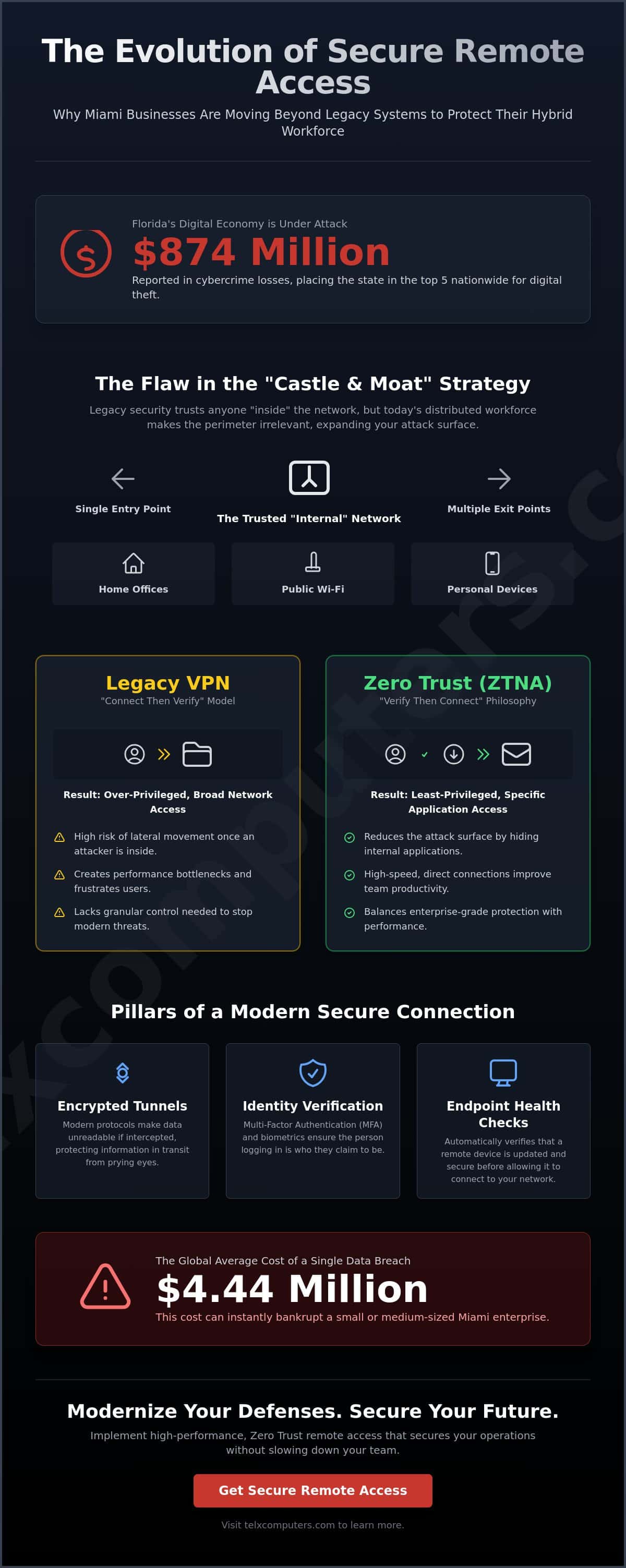
Miami has solidified its position as a major hub for hybrid work, particularly in finance, logistics, and healthcare. This flexibility expands your attack surface, making every home router and public Wi-Fi signal a potential entry point for bad actors. Localized cyber threats are on the rise. With Florida victims reporting $874 million in cybercrime losses in 2023, the stakes have never been higher for South Florida business owners who must protect their digital assets.
To better understand the fundamentals of these systems, watch this helpful video:
We’re seeing a fundamental move away from traditional perimeter security toward identity-based security. Instead of trusting anyone who is “inside” the network, modern systems verify every user and device every time they request access. Many businesses are realizing that Legacy VPNs often lack the granular control needed to stop a lateral move by a hacker once they’ve breached the initial layer. By implementing secure remote access solutions Miami teams can stay productive while maintaining a vigilant defense.
The Core Components of a Secure Connection
- Encrypted tunnels: Use modern protocols that go beyond basic SSL to ensure data remains unreadable even if intercepted during transit.
- Identity verification: Passwords are a weak first line of defense. Multi-factor authentication and biometric checks ensure that the person logging in is actually who they claim to be.
- Endpoint health checks: Your system should automatically verify that a remote laptop is updated and running active antivirus before allowing it to touch your office server.
Why ‘Good Enough’ Security Fails in Miami
The global average cost of a data breach is $4.44 million, a figure that can instantly bankrupt a Miami SME. Vulnerabilities in your remote setup are the primary delivery method for attackers looking to bypass your ransomware protection. Beyond security, “good enough” setups often suffer from high latency. When your team deals with slow connections, productivity drops and frustration grows. This often leads employees to use insecure workarounds just to get their jobs done, further increasing your risk profile.
The Evolution from Legacy VPNs to Zero Trust Network Access (ZTNA)
The traditional Virtual Private Network (VPN) served us well for decades, but it’s no longer sufficient for the modern threat landscape. Legacy systems operate on a “connect then verify” model. Once a user logs in, they’re often granted broad access to the entire internal network. This creates a massive security gap. In contrast, Zero Trust Network Access (ZTNA) follows a “verify then connect” philosophy. It assumes that no user or device should be trusted by default, regardless of whether they’re inside or outside the office walls.
By 2026, industry data predicts that 70% of new remote access deployments will favor ZTNA over traditional VPN services. This shift is driven by the need for more granular control. When looking for secure remote access solutions Miami businesses often find that ZTNA provides a far more resilient Strategic Framework for Implementing Remote Access. Instead of opening a tunnel to the whole network, ZTNA creates a secure, one-to-one connection between the user and the specific application they need. This effectively hides your critical business apps from the public internet, making them invisible to unauthorized scans and automated bot attacks.
Modern cloud-native access solutions also solve the performance issues that plagued older technologies. Because these systems are distributed, they can route traffic through the fastest available path, reducing the “hairpinning” effect that slows down legacy hardware. This results in a faster, more reliable experience for your hybrid workforce.
Why Traditional VPNs are a Liability
The biggest danger of a legacy VPN is lateral movement. If a hacker steals one employee’s credentials, they can often move freely across your servers. This is how a single compromised home laptop leads to a full-scale data breach. Beyond security, there’s the “VPN lag” problem. Traditional hardware appliances often struggle with modern bandwidth demands, causing significant delays for VoIP calls and heavy database applications. Managing these aging appliances also adds significant overhead for your IT team, as they require constant patching to stay ahead of known vulnerabilities. If you’re struggling with these legacy issues, our managed IT support service can help streamline your transition to more modern architecture.
The Building Blocks of Zero Trust for Your Team
Zero Trust isn’t just one product; it’s a combination of strategic layers. Multi-Factor Authentication (MFA) is the non-negotiable first step. It ensures that a stolen password alone isn’t enough to breach your defenses. From there, we implement micro-segmentation. This limits users to the “least privilege” necessary, isolating them to only the specific apps required for their roles. Finally, continuous verification monitors the connection for the entire session. If a device’s security posture changes, such as an antivirus program being disabled, the system can instantly revoke access to prevent a potential infection. These secure remote access solutions Miami companies are adopting provide a seamless experience for staff while maintaining bulletproof security standards.
Addressing Security Vulnerabilities in Distributed Florida Networks
Miami’s hybrid culture has made “Bring Your Own Device” (BYOD) the standard for many organizations. While this offers flexibility, it introduces unmanaged hardware into your ecosystem. Many personal laptops lack the enterprise-grade antivirus or consistent patch levels found on office machines. This creates a weak link that cybercriminals actively exploit. When your staff uses personal devices, they often inadvertently mix professional data with personal risks, making the implementation of secure remote access solutions Miami businesses can monitor a top priority.
Public Wi-Fi in high-traffic hubs like Brickell, Coral Gables, or the Wynwood Arts District poses a significant risk. These open networks are often unencrypted, allowing attackers to perform man-in-the-middle attacks. When employees log in from a local café or a transit hub, they might inadvertently hand over their credentials to a malicious hotspot. This is why your network security strategy has to adapt to the reality of South Florida’s mobile workforce, ensuring that the connection is protected regardless of the physical location.
We often see ‘shadow IT’ emerge when staff find official tools too cumbersome. They might use unsanctioned file-sharing apps or remote desktop tools that bypass your security protocols entirely just to get their work done faster. This leaves your sensitive data unprotected and invisible to your monitoring systems. A proactive approach involves providing tools that are both secure and easy to use, removing the incentive for employees to seek dangerous workarounds. By deploying modern secure remote access solutions Miami teams actually enjoy using, you close these invisible gaps in your defense.
Securing Third-Party and Vendor Access
Miami’s real estate and legal sectors are particularly vulnerable to vendor-based attacks. These industries rely heavily on external consultants, title agents, and specialized contractors who require entry into internal systems. If a third-party vendor has permanent, unfettered access to your server, their security breach quickly becomes your breach. We recommend implementing time-bound access, which ensures that external partners only have entry during specific project windows. Comprehensive auditing and logging are also essential; you must have the ability to see exactly who accessed your files and what they changed at any given moment.
Protecting Sensitive Data in Transit
Data is at its most vulnerable when it’s moving between a home office and your central server. Advanced encryption standards, specifically AES-256, are the gold standard for protecting these remote workflows. We also help clients navigate the choice between ‘split tunneling’ and ‘full tunneling.’ Split tunneling allows some traffic to go to the open internet while business data stays protected, which can improve speed for the end-user. However, full tunneling offers higher security by routing all traffic through your encrypted gateway. It’s also vital to secure or disable Remote Desktop Protocol (RDP) on the public internet, as it remains a favorite target for brute-force attacks. These layers of protection ensure your data remains unreadable to anyone but the intended recipient.
A Strategic Framework for Implementing Remote Access in Miami
Deploying secure remote access solutions Miami businesses can rely on requires more than just buying a license. It demands a structured transition that protects your data while keeping your team productive. Start by auditing every remote user and their current access levels. You’ll likely find that many employees have permissions they don’t actually need for their daily tasks. By applying the “Least Privilege” principle mentioned earlier, you can significantly reduce your internal risk profile before you even choose a technology provider.
Your second step involves choosing between agent-based and browser-based access models. Agent-based models offer the highest level of security and control for company-owned laptops; they allow for the continuous health checks we discussed in previous sections. Browser-based models are often better for third-party vendors or contractors who shouldn’t be installing software on their personal machines. Once you’ve selected your model, align your policies with federal and local regulations. In Florida, the Florida Information Protection Act (FIPA) is critical; it requires you to provide notice of any data breach within 30 days of discovery. Your remote access framework must include the logging and monitoring capabilities to meet this legal standard.
Don’t roll out a new system to everyone at once. Conduct a pilot program with a high-security department, such as Finance or HR. These teams handle your most sensitive data and typically have the most complex access requirements. Their feedback will help you iron out any performance issues before the company-wide launch. If you’re ready to secure your perimeter with professional oversight, get an instant quote for our managed security services today.
Compliance for Miami’s Key Industries
Miami is a hub for highly regulated sectors that require specialized oversight. We help organizations meet strict HIPAA requirements for healthcare IT services in Miami, ensuring patient data remains encrypted and accessible only to authorized personnel. Similarly, the data privacy standards for Miami law firms demand a “verify then connect” approach to protect attorney-client privilege. Beyond legal mandates, many cyber insurance providers now require Zero Trust architecture as a condition for coverage eligibility. Implementing these standards doesn’t just protect you from hackers; it protects your business from being uninsurable.
Optimizing Performance for the South Florida User
Security shouldn’t come at the cost of speed. When selecting secure remote access solutions Miami users will actually adopt, prioritize providers with local points of presence (PoPs). Routing your traffic through a server in Miami rather than one in the Midwest significantly reduces latency for your local staff. You should also ensure your new access model integrates seamlessly with your existing cloud computing resources to prevent performance bottlenecks. Finally, don’t overlook user training. The human element remains your strongest defense; teaching your team how to recognize secure connections and use MFA correctly is just as important as the encryption itself.
Partnering with Telx Computers for Managed Remote Access
Buying a software license is only the first step in protecting your data. Real security comes from how those tools are managed, monitored, and updated in real time. Many organizations fall into the trap of a “set it and forget it” mentality, but digital threats are dynamic. When you implement secure remote access solutions Miami teams can use safely, you need a partner that acts as an extension of your own staff. We don’t just provide a tool; we provide a comprehensive strategy that integrates your connectivity with our broader managed IT services.
The Telx advantage lies in our deep roots in the South Florida business community. We provide customized solutions for organizations in Aventura, Fort Lauderdale, and Miami, ensuring your infrastructure meets local operational needs. Having a local partner means you get more than just remote troubleshooting. You gain access to a team that understands the regional threat landscape and provides the rapid response necessary to keep your hybrid workforce running at peak efficiency. We take pride in being the silent engine behind your success, handling the technical complexities so you can focus on growth.
Proactive Monitoring and Rapid Response
Our approach to security is vigilant and forward-thinking. By utilizing advanced server monitoring systems, we detect suspicious remote logins and anomalies before they turn into full-scale breaches. If a login attempt occurs from an unusual geographic location or at an odd hour, our team is alerted instantly. You benefit from a fixed-price model that offers predictable budgeting while providing unlimited support for your remote teams. This ensures that help is always available without the worry of fluctuating costs. We also leverage real-time threat intelligence tailored specifically to the Florida business landscape, keeping you one step ahead of localized phishing and ransomware trends.
Getting Started with a Remote Security Audit
Securing your organization begins with understanding your current vulnerabilities. During a technology consultation, we’ll audit your existing infrastructure and identify the best secure remote access solutions Miami offers for your specific industry. We specialize in transitioning teams to modern Zero Trust models without disrupting your daily operations. Our goal is to alleviate technical anxiety by providing a clear, logical path toward better protection. We handle the migration, user training, and ongoing maintenance to ensure a seamless experience for your entire staff. If you’re ready to build a bulletproof remote environment, get an instant quote for secure remote access today and let us serve as your strategic ally in cybersecurity.
Empower Your Hybrid Workforce with Confident Security
Securing a distributed team doesn’t have to mean sacrificing speed or productivity. By moving beyond legacy VPNs and embracing a Zero Trust architecture, you protect your organization from lateral movement and the specific risks of South Florida’s mobile workforce. You’ve seen how identity-based frameworks and proactive monitoring create a resilient defense that hides your critical applications from the public internet entirely. Implementing secure remote access solutions Miami businesses can rely on is a strategic investment in your company’s stability and growth.
Telx Computers serves as your expert guardian, offering a physical presence in Miami, Aventura, and Fort Lauderdale for rapid response when you need it most. Our fixed-price unlimited IT plans and 24/7 local help desk support provide the stability your team needs to thrive without technical anxiety. We handle the complexities of compliance and encryption so you can focus on your core business objectives. It’s time to replace uncertainty with a sense of security and reliability. Secure Your Remote Workforce with Telx Computers and take the first step toward a more resilient digital future.
Frequently Asked Questions
Is a VPN still considered secure for remote work in Miami?
Traditional VPNs are increasingly seen as a security liability because they often grant broad network access once a user is authenticated. While they provide a basic encrypted tunnel, they don’t prevent lateral movement if a single account is compromised. Modern security standards favor identity-based models that verify every request rather than trusting anyone inside the perimeter.
How does Zero Trust Network Access (ZTNA) differ from a traditional VPN?
ZTNA operates on a “verify then connect” principle, whereas a VPN uses a “connect then verify” approach. ZTNA grants access only to the specific applications a user needs for their job instead of the entire network. This granular control is a core feature of the secure remote access solutions Miami organizations use to minimize their digital attack surface.
Can secure remote access solutions help with HIPAA or legal compliance?
Yes, these solutions provide the end to end encryption and detailed access logs required by HIPAA and the Florida Information Protection Act. By implementing strict identity verification, you ensure that only authorized personnel can view sensitive patient or client data. This level of oversight is essential for passing industry audits and maintaining professional certifications.
What is Multi-Factor Authentication (MFA) and why is it required for remote access?
MFA requires users to provide two or more distinct verification factors, such as a password and a biometric scan or mobile app code, before gaining entry. It’s a non-negotiable requirement because stolen credentials are a leading cause of data breaches. Even if a hacker steals an employee’s password, MFA provides a critical second layer of defense that stops the intrusion.
Do secure remote access solutions slow down internet speeds for employees?
Modern cloud native solutions actually improve performance by routing traffic through local points of presence to reduce latency. Legacy systems often create a bottleneck by forcing all data through a single office server. By using distributed architecture, your hybrid team experiences faster connection speeds and more reliable access to heavy database applications.
How do I protect my business if an employee’s home computer is compromised?
You can implement automated endpoint health checks that verify a device’s security status before allowing it to connect to your server. If an employee’s home laptop is missing critical patches or has active malware, the system instantly denies access. This proactive barrier ensures that a compromised personal device doesn’t become an entry point for ransomware into your corporate environment.
Can I control what specific files a remote employee can see?
Yes, you can define precise access levels through micro segmentation and role based permissions. This ensures that staff members only see the files and applications necessary for their specific duties. For example, your sales team won’t have access to sensitive payroll data or confidential legal documents, even if they’re logged into the same secure remote access solutions Miami framework.
What are the costs associated with switching to a modern remote access solution?
The total investment depends on your user count and the complexity of your current network infrastructure. Many local businesses prefer a managed IT model with fixed monthly pricing to keep their budgeting predictable and all-inclusive. To understand the specific requirements for your organization, you should check with a local technology consultant for a comprehensive security audit.