





30 Jul Strategic Business VoIP Solutions: Enhancing Communication and Efficiency
Imagine you’re in the final minutes of a high-stakes negotiation when your office phone line suddenly cuts out, leaving nothing but silence and a missed opportunity. It’s a frustrating reality for many organizations still tethered to aging landlines and unpredictable contracts. You’re likely tired of managing the logistical headache of remote employee lines and the sting of hidden fees. We agree that your communication infrastructure should be a source of stability, not a point of failure. Finding the right business voip solutions shouldn’t be a gamble; it’s a strategic move that positions your company for long-term growth.
In this article, you’ll discover how to transition from legacy phone systems to a high-performance managed VoIP solution that scales effortlessly with your business. We’ll examine the shift toward unified messaging and video, ensuring you achieve crystal-clear voice quality while moving to a predictable monthly billing model. By treating your communication as a managed network asset rather than a disconnected application, you can finally replace technical anxiety with total peace of mind.
Key Takeaways
- Learn how transitioning to business voip solutions converts high-cost hardware investments into a predictable, scalable monthly operating model.
- Identify the essential infrastructure requirements, including bandwidth and Quality of Service (QoS) tagging, needed to maintain high-definition voice and video.
- Explore the strategic advantages of unified messaging and sophisticated call routing to eliminate missed connections and improve client responsiveness.
- Understand the risks of unmanaged cloud systems and how a managed approach protects your business from configuration errors and security vulnerabilities.
- Discover a seamless migration strategy for porting numbers and integrating remote teams without experiencing a single second of downtime.
Beyond Basic Dialing: Why Business VoIP Solutions are Strategic Assets
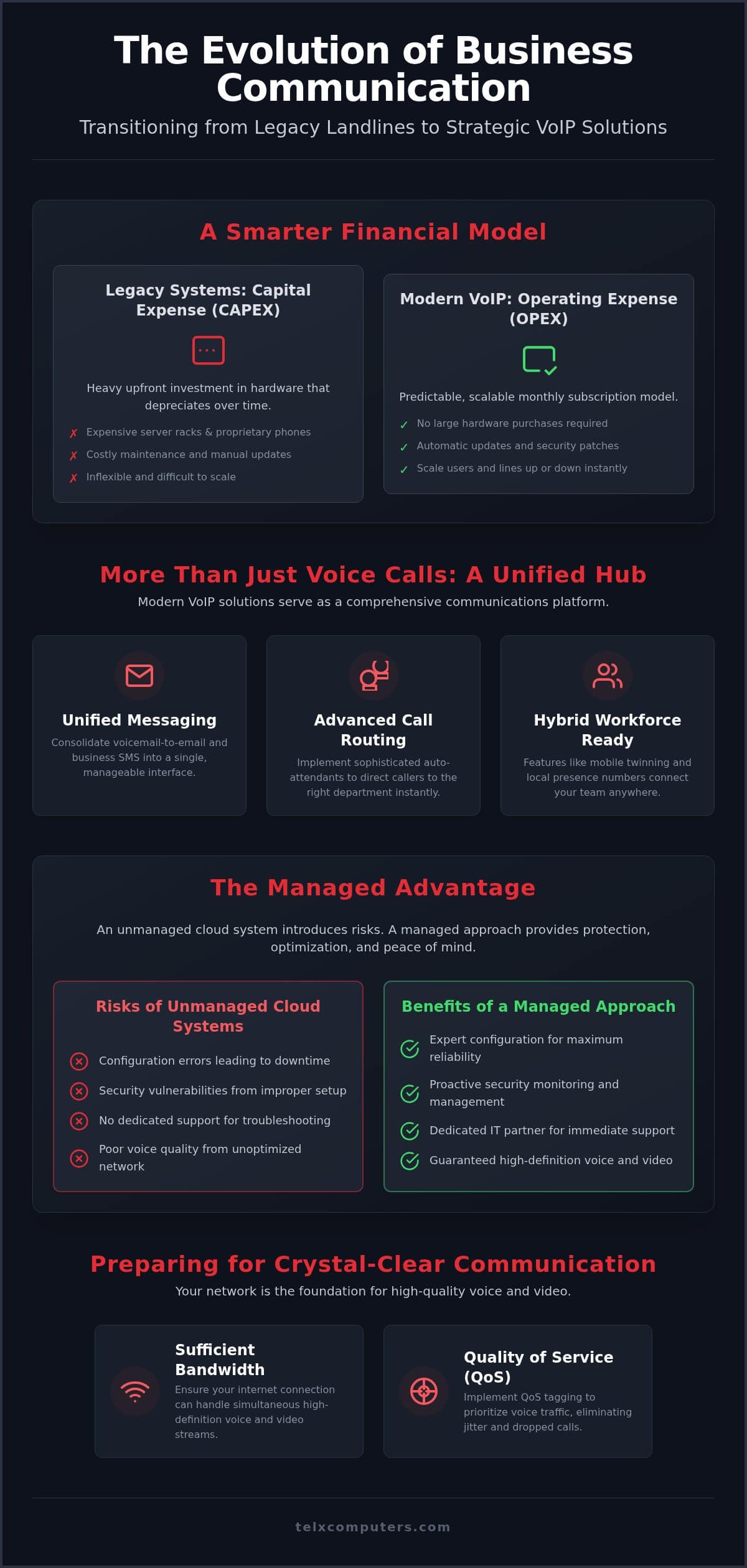
Modern communication has evolved far beyond the simple dial tone. Today, Voice over IP (VoIP) is a technology that converts voice into data packets for transmission over IP networks, serving as a foundational element of Unified Communications as a Service (UCaaS). By integrating voice, video, and messaging into a single platform, business voip solutions transform your phone system from a static utility into a dynamic strategic asset. This shift allows your organization to move away from heavy capital expenditures (CAPEX) on depreciating hardware and toward a predictable operating expense (OPEX) model.
Transitioning to a managed framework means your communication infrastructure scales alongside your growth without requiring massive upfront investments. Instead of purchasing expensive server racks or proprietary desk phones, you benefit from a flexible, cloud-based environment that stays updated automatically. This ensures your team always has access to the latest security protocols and feature sets without manual intervention.
To better understand how your underlying network impacts these systems, watch this helpful video:
The Operational Benefits of Modern Voice Technology
Efficiency is the primary driver behind the adoption of managed business voip solutions. Scalability becomes instantaneous; you can add new lines or extensions in minutes through a web portal rather than waiting days for a technician to run physical wiring. Cost predictability also improves significantly as you move away from traditional carrier billing models that often include opaque per-minute charges.
Integration with your existing tech stack further amplifies these gains. Modern systems link directly with your CRM and project management tools, allowing for automatic call logging and “screen pops” that display client data before you even answer. This level of managed IT support ensures your data flows seamlessly across all departments, turning every phone call into a source of actionable intelligence.
Supporting the Modern Hybrid Workforce
The rise of hybrid work demands a system that bridges the gap between the office and the home. Mobile twinning allows your office extension to ring simultaneously on your desk phone and a mobile app, ensuring you never miss a critical client call while away from your desk. It creates a unified professional image, regardless of where your employees are physically located.
Local presence is another strategic advantage. Even if your headquarters are elsewhere, you can use local numbers in cities like Miami, New York, or Los Angeles to build immediate trust with regional clients. This centralized management approach allows you to oversee multiple locations through a single pane of glass, providing a consistent experience for both your staff and your customers.
Key Features of Modern VoIP: More Than Just Voice Calls
Modern business voip solutions offer much more than a way to place calls over the internet. They serve as a comprehensive communications hub that streamlines how your team interacts with clients and each other. One of the most immediate benefits is the implementation of sophisticated auto-attendants and call routing logic. These tools ensure that every caller reaches the right department without manual transfers, projecting a high-tier corporate image regardless of your company’s actual size.
Unified messaging further enhances this efficiency by consolidating various communication channels into a single interface. Voicemail-to-email features allow you to read your messages in your inbox, while SMS integration lets you text clients from your business number. This keeps your personal mobile number private while maintaining a professional record of all interactions. For a deeper look at the regulatory and technical foundations of these systems, you can consult the FCC guide to VoIP.
Top-tier business voip solutions also include built-in video conferencing and team collaboration tools. This eliminates the need for multiple subscriptions and reduces vendor sprawl. With detailed analytics and reporting, sales and support managers can track call volumes, wait times, and peak hours to optimize staffing levels and improve the overall customer experience.
Essential Capabilities for Small to Enterprise Teams
For organizations focused on high-touch service, call queues and hunt groups are indispensable. These features distribute incoming calls across a team, ensuring no single representative is overwhelmed while reducing wait times for customers. Automated CRM integration with platforms like Salesforce or HubSpot ensures that every call is logged instantly, providing your team with a full history of client interactions. You can also utilize advanced call recording to maintain compliance and provide valuable material for staff training. If you’re looking to modernize your current setup, exploring it outsourcing services can help you identify the right feature set for your specific industry.
The Role of AI and Automation in Communication
Artificial Intelligence is no longer a futuristic concept in the world of voice technology. AI-driven transcription can generate accurate summaries of meetings and voicemails, saving hours of manual note-taking. Sentiment analysis tools can even gauge the emotional tone of a conversation, alerting managers to potential customer satisfaction issues in real-time. Automation also extends to personal productivity; for instance, “Do Not Disturb” settings can sync with your calendar to automatically silence calls during scheduled focus time. To see how these advanced features fit into your budget, you might consider requesting an instant quote tailored to your operational needs.
Evaluating Your Options: Cloud-Hosted vs. Managed VoIP Systems
Choosing between various business voip solutions often feels like a choice between software vendors, but it’s actually a decision regarding service models. You’ll find plenty of lists ranking the best business VoIP services based on entry-level pricing alone. While a low monthly subscription looks attractive on a spreadsheet, it often excludes the critical engineering required to make that software work reliably within your specific network environment. Without that foundation, even the most expensive software will fail to deliver the professional experience your clients expect.
The hidden costs of unmanaged systems quickly erode any initial savings. When you handle the setup yourself, you’re responsible for troubleshooting downtime, fixing configuration errors, and closing security gaps. If a call drops during a critical meeting, a DIY provider won’t help you diagnose a local router conflict. A fixed-price managed plan provides better long-term ROI by eliminating these unpredictable labor costs and ensuring your communication stays operational 24/7. It turns your phone system into a stable utility rather than a constant troubleshooting project.
The Hidden Risks of ‘App-Only’ VoIP Solutions
App-only providers focus strictly on the software, not the local network that carries your voice data. This lack of network optimization often leads to jitter and latency, which manifest as choppy audio or frustrating delays during conversations. If your hardware fails, these providers offer zero on-site support, leaving your team stranded while you wait for a replacement phone in the mail. Additionally, generic security settings in unmanaged apps may not meet the strict compliance standards required in industries like healthcare or law, potentially exposing sensitive client data to unnecessary risk.
Why Managed VoIP Outperforms Standalone Subscriptions
A managed approach provides holistic oversight of your entire communication stack. Instead of just selling you a license, a strategic ally provides proactive monitoring to identify and resolve bandwidth bottlenecks before they ever affect a call. By integrating your phone system with comprehensive Business IT Services, you create a single point of accountability for your technology. There’s no finger-pointing between the internet provider and the phone company when everything is managed by one vigilant team.
This integrated model ensures that your business voip solutions aren’t just another app on your computer, but a secure, high-performance extension of your office. Choosing a Managed IT Support Service to oversee your VoIP deployment means you can focus on your clients while experts handle the technical stability of your voice network. It provides the peace of mind that your most vital connection to the world is always secure and ready for business.
Preparing Your Infrastructure for Crystal-Clear Communication
Voice quality is only as good as the network supporting it. Many providers claim that any high-speed connection is sufficient, but professional communication demands a more rigorous approach to network health. If your underlying infrastructure isn’t optimized, even the most advanced business voip solutions will suffer from choppy audio and dropped calls. You must treat your voice data as a priority asset within your digital environment to ensure every client interaction remains seamless.
Quality of Service (QoS) prioritizes voice traffic over other data to prevent lag. Without these specific tags in your router, a large file download or a system update could easily consume the bandwidth needed for a high-stakes video conference. Shielding your voice packets from this “traffic jam” is the first step toward achieving the reliability your organization requires.
Network Bandwidth and QoS Requirements
Calculating your requirements starts with understanding your concurrent call volume. Every high-definition voice call or video stream requires a specific amount of dedicated upload speed. While a home-grade router might handle a single user, it lacks the processing power to manage a busy office in a city like Miami. Professional-grade hardware is necessary to maintain low latency and minimal jitter, which are the two primary factors that determine if your audio sounds natural or robotic.
Latency represents the time it takes for data to travel from your phone to the recipient. Jitter refers to the variation in that arrival time. When these metrics spike, your conversation becomes disjointed. A vigilant IT partner ensures your routers and switches are configured specifically for business voip solutions, creating a stable lane for your communication to travel without interference.
Security and Compliance: Protecting Your Voice Data
Security shouldn’t be an afterthought when transitioning to a modern phone system. Your voice data is a target for threats, making it essential to implement Ransomware Protection logic for your communication servers. Using Voice VLANs (Virtual Local Area Networks) isolates your phone traffic from the rest of your office data, adding a layer of defense against internal and external vulnerabilities.
Meeting the strict compliance standards required for Healthcare IT or for Law Firms involves more than just a secure connection. You need end-to-end encryption for all calls and encryption at rest for recorded communications and voicemails. This ensures that sensitive client information remains private and your business stays on the right side of regulatory requirements. If you’re unsure if your current network can handle a high-performance system, we can help you evaluate your network infrastructure to ensure total stability.
Implementing Your Solution with a Strategic IT Partner
Many providers treat business voip solutions as a plug-and-play product, often mailing a box of hardware and leaving the complex setup to your internal team. This hands-off approach frequently leads to long-term network instability and user frustration. Choosing a local strategic ally in Miami, Fort Lauderdale, or Aventura ensures that your transition is managed with precision. You gain a partner who understands your regional business needs and provides the physical presence necessary for a successful deployment. Being local matters.
A critical component of this process is the migration strategy. Porting your existing numbers is a delicate operation that requires careful coordination to ensure you don’t lose a single client call. While software giants might leave you waiting on hold for hours when a transition goes sideways, a dedicated help desk provides immediate, 24/7 support. This level of accessibility transforms technical anxiety into a sense of security. You deserve to know that an expert guardian is always one step ahead of potential issues.
Seamless Migration and On-Site Support
The success of a new system depends heavily on staff adoption. On-site training sessions allow your team to master sophisticated features like call routing and unified messaging in their actual work environment. Before any hardware is installed, we conduct comprehensive pre-deployment audits to verify network readiness and bandwidth capacity. If a hardware issue arises in Fort Lauderdale, our rapid response team provides on-site assistance that remote-only providers simply cannot match. This proactive stance is what separates top-tier IT Companies in Miami from generic subscription services.
The Telx Advantage: VoIP Integrated with Managed IT
We believe that voice communication should never be treated as a disconnected fix. Instead, we integrate your business voip solutions into your broader Network IT Support strategy. This creates single-vendor accountability for your entire technology stack, from your servers and security to your desk phones. Our team manages all continuous updates and security patches, ensuring your communication platform remains a high-performance asset that scales with your growth. By positioning ourselves as an extension of your own team, we provide the silent engine that powers your success while you focus on your core business objectives.
Securing Your Communication Future with Managed Voice
Transitioning to modern business voip solutions is about more than just changing how you answer the phone. It’s about building a resilient, scalable foundation that supports your team wherever they work. You’ve discovered how a managed approach eliminates the hidden risks of unmanaged apps and how proper network optimization ensures crystal-clear audio. By shifting to a strategic model, you gain the predictability of fixed-rate monthly plans while removing the burden of technical maintenance from your internal staff. This transition replaces technical anxiety with the stability of a professionally monitored network.
We are ready to serve as your strategic ally, providing 24/7 Help Desk Support and rapid on-site response in Miami, New York, and Los Angeles. You don’t have to navigate the complexity of communication infrastructure alone. Get an Instant Quote for Managed VoIP and IT Services today to see how we can streamline your operations and secure your voice data. Let’s work together to build a high-performance system that empowers your growth and provides total peace of mind. Your business deserves a connection that is as reliable as your vision.
Frequently Asked Questions
How much bandwidth does a business VoIP call actually use?
A standard high-definition voice call typically requires about 100 Kbps of synchronous bandwidth for both upload and download traffic. While this sounds minimal, you must calculate your needs based on the maximum number of concurrent calls your team might handle during peak hours. We recommend a buffer of at least 20 percent to account for other data needs and prevent audio degradation or dropped packets on your network.
Can I keep my existing phone numbers when switching to VoIP?
You can absolutely keep your existing phone numbers through a process known as number porting. We manage the transition with your current carrier to ensure there’s no service interruption during the migration. Our team handles the technical coordination so your clients never experience a busy signal or a disconnected line while you switch to modern business voip solutions. It’s a seamless handoff that protects your established brand identity.
What happens to our phone system if the office internet goes down?
If your office internet fails, our managed systems automatically redirect incoming calls to pre-configured failover destinations like mobile devices or a secondary office location. This ensures your business remains reachable even during local infrastructure issues. Because the system lives in the cloud rather than on a physical server in your closet, your auto-attendants and voicemail remain fully operational regardless of what happens at your desk.
Do I need to buy special desk phones, or can we use our computers?
You have the flexibility to use physical IP desk phones, softphone applications on your computer, or mobile apps on your smartphone. Many organizations choose a hybrid approach, providing desk phones for permanent office staff while remote employees use headsets with their laptops. We help you select the right hardware or software mix to match your workflow, ensuring every team member has a reliable and secure way to connect.
Is VoIP secure enough for legal or medical practices?
VoIP is highly secure when implemented with professional-grade encryption and isolated Voice VLANs. These business voip solutions meet strict compliance standards for HIPAA and legal confidentiality by protecting data both in transit and at rest. We provide the vigilant oversight needed to manage security patches and encryption protocols, ensuring your sensitive client communications remain shielded from unauthorized access or any potential digital threats at all times.
How does VoIP compare to a traditional PBX system in terms of cost?
Traditional PBX systems require significant upfront capital for hardware and ongoing maintenance fees for proprietary technicians. VoIP replaces these high CAPEX costs with a predictable, fixed-rate monthly operating model. You’ll likely see a reduction in long-distance charges and total ownership costs because the system scales without the need for additional physical wiring or expensive on-site server upgrades as your company grows.
What is the difference between hosted VoIP and managed VoIP?
Hosted VoIP provides the software platform, but you’re often left to manage your own network optimization and troubleshooting. Managed VoIP includes proactive oversight of your entire communication stack, from the router configuration to the desk phones. This strategic model provides single-vendor accountability and 24/7 support, ensuring your system stays optimized rather than just running on an unmonitored network that could fail when you need it most.
Can I use my VoIP system on my smartphone while traveling?
Yes, you can use your business line from anywhere in the world with an internet connection via a dedicated mobile application. This mobile twinning feature allows your smartphone to function as a full office extension, keeping your personal number private while you’re on the road. It ensures your team stays connected and professional, whether they’re in Miami, New York, or traveling internationally for a high-stakes client meeting.