





06 Jul Protecting Client Data in the Cloud: A Strategic Framework for 2026
If your cloud provider suffered a breach tonight, do you know exactly where their legal responsibility ends and yours begins? It’s a question that keeps many executives up at night, especially as the regulatory environment becomes more complex. You’re right to feel concerned about hidden security gaps or the mounting pressure of laws like California’s SB 446, which now mandates a strict 30-day notification window. Successfully protecting client data in the cloud isn’t just about picking a reputable vendor; it’s about building a resilient, managed framework that treats security as a shared mission.
You can replace that technical anxiety with a sense of total stability. We’ll show you how to master the essential strategies and managed safeguards required to keep your sensitive information secure in modern environments. This overview covers everything from Zero Trust architecture to the latest NIST CSF 2.0 governance standards. You’ll gain a clear roadmap to move from reactive patching to a confident, partner-led security posture that protects both your reputation and your clients’ trust.
Key Takeaways
- Master the Shared Responsibility Model to eliminate dangerous assumptions about who is truly responsible for your data backups and application security.
- Strengthen your digital perimeter by implementing robust Identity and Access Management (IAM) and end-to-end encryption protocols across all hosted environments.
- Ensure your business remains compliant with evolving regional and industry-specific regulations by prioritizing the right strategies for protecting client data in the cloud.
- Move beyond a passive security posture with a managed “Guardian Strategy” that provides continuous, expert oversight of your sensitive digital assets.
- Gain peace of mind by establishing clear data residency policies that provide full visibility into where your information is physically stored and processed.
Defining Cloud Data Protection for the Modern Enterprise
Cloud data protection is the proactive framework of tools, policies, and managed services designed to secure digital assets within hosted environments. It’s fundamentally different from traditional on-premise security. In the past, you could rely on a physical perimeter to guard your servers. Today, that perimeter has vanished. Your data lives in a software-defined world where security follows the user and the data itself, not just a specific office building. Protecting client data in the cloud requires a strategy that accounts for this lack of physical boundaries by focusing on identity and granular access controls.
A deep understanding of cloud computing security involves looking at information across three distinct states. First, data is “in-transit” while it travels across the internet or internal networks. Second, it’s “at-rest” when stored on cloud disks or databases. Finally, it’s “in-use” while being actively processed by an application. Most traditional tools fail to protect data during this third state, leaving a significant gap that modern frameworks must close to ensure total privacy.
To better understand how these technical layers protect your information during active processing, watch this helpful video:
The Evolution of Data Vulnerability
The shift to remote work in business hubs like Miami and NYC fundamentally changed the threat landscape. Employees now access sensitive client files from home networks that often lack enterprise-grade protection. A common misconception is that cloud platforms are “automatically” safe because they’re managed by giants like Microsoft or Google. In reality, most breaches stem from user configuration errors rather than provider failures. The stakes are higher than ever in 2026. Under California’s SB 446, you must notify residents within 30 days of discovering a breach. The cost of failure includes legal penalties and a permanent loss of client trust.
Core Objectives of a Cloud Security Strategy
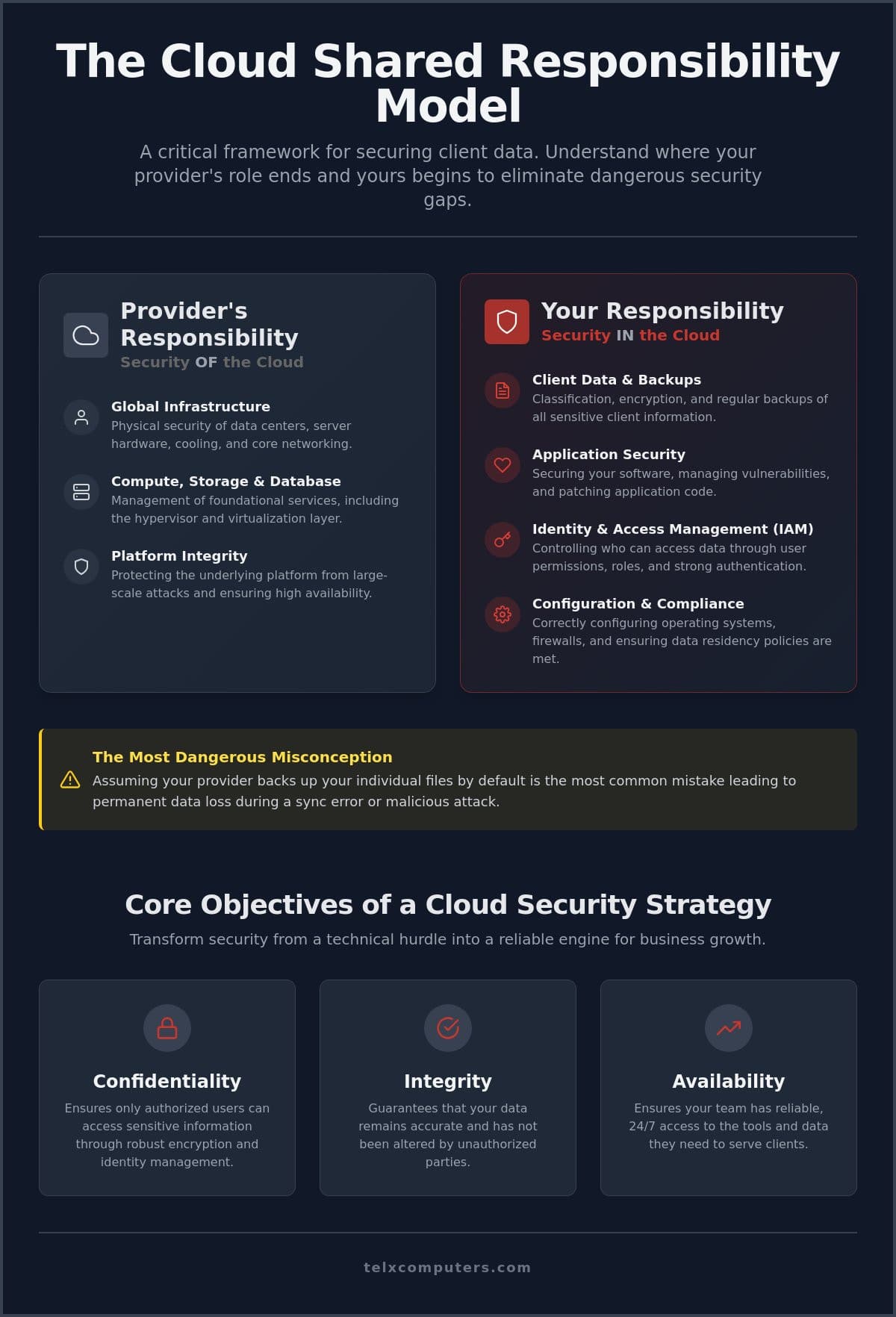
A professional strategy focuses on three central pillars. Confidentiality ensures that only authorized users access sensitive information through robust encryption and identity management. Integrity guarantees that your data remains accurate and hasn’t been altered by unauthorized parties. This is especially vital for IT services for law firms, where document authenticity is a legal necessity. Finally, availability ensures that your team has 24/7 access to the tools they need to serve clients. By prioritizing these goals, you transform security from a technical hurdle into a reliable engine for business growth.
Navigating the Shared Responsibility Model in Cloud Environments
The most dangerous assumption in modern business is that your cloud provider acts as a total safety net. While giants like AWS or Microsoft provide elite infrastructure, they don’t manage your specific data or how your employees access it. This misunderstanding is why many organizations suffer preventable breaches. Protecting client data in the cloud is a shared mission. You provide the governance; they provide the platform. If you assume your provider is backing up your individual files by default, you’re making the most common mistake that leads to permanent data loss during a sync error or malicious attack.
Citing CISA’s Cloud Security Technical Reference Architecture helps define these borders clearly. It outlines a strict split: the provider secures the “cloud,” but the user secures what is “in” the cloud. Understanding this boundary is the first step toward true resilience. Without a clear strategy for your side of the ledger, you leave your business exposed to configuration gaps that hackers are eager to exploit.
The Providers Domain: Security OF the Cloud
Providers handle the foundational security that individual businesses could never maintain alone. This includes the physical protection of data centers, server cooling systems, and hardware-level isolation. They ensure that different clients on the same physical hardware cannot access each other’s workloads through hypervisor security. Their commitment is verified through high-tier certifications like SOC2 and ISO 27001. They build a solid, compliant foundation, but they don’t monitor who you’ve invited into the building or what those guests are doing with your files.
The Clients Domain: Security IN the Cloud
Your domain includes every setting, user, and file you place on the provider’s platform. It’s often the most vulnerable part of the stack because it relies on human management. You must manage user permissions and multi-factor authentication (MFA) to stop unauthorized entry. You also control the network access rules and the implementation of ransomware protection strategies. If a configuration error leaves a database open to the public or if an employee uses a weak password, the provider isn’t liable. You are legally and technically responsible for the “Security IN the cloud” layer, which includes the applications and the data itself.
Telx Computers acts as your vigilant guardian in this space. We manage the complex configurations and identity layers that providers leave in your hands. We ensure your business isn’t the weak link in the shared model by providing constant oversight and proactive defense. If you want to verify your current compliance and close these hidden gaps, a professional security audit can provide the clarity you need to move forward with confidence.
Core Technical Safeguards for Securing Client Information
Securing your digital assets requires more than just a policy; it demands a layered technical defense. While the shared responsibility model defines who does what, these core safeguards represent the actual armor your data wears. Protecting client data in the cloud hinges on your ability to implement encryption and identity controls that don’t just check a compliance box but actively repel sophisticated threats. By integrating these tools into your daily workflow, you create a resilient environment where security and efficiency coexist.
Cloud Data Loss Prevention (DLP) tools act as an automated safety net for your team. These systems scan for sensitive patterns, such as Social Security numbers or health records, and automatically block them from leaving your secure environment. This is paired with proactive monitoring. Real-time oversight is non-negotiable in the current threat climate. It’s the difference between stopping a breach in seconds and discovering a catastrophe weeks after the fact. Continuous server monitoring ensures that any anomaly is addressed before it can escalate into a business-disrupting event.
Advanced Encryption Standards
Encryption is your last line of defense. Even if a bad actor intercepts your files, they should find nothing but unreadable code. You must distinguish between AES-256 encryption, which secures data while it sits on a drive at rest, and TLS protocols that protect it while it travels across the web in transit. High-security environments often benefit from managing their own encryption keys rather than relying on provider-managed options. This ensures that even the cloud vendor cannot access your raw data without your explicit consent. Zero-knowledge encryption is the gold standard for privacy because it ensures that only you, the data owner, possess the keys to decrypt your information.
Zero Trust Architecture and IAM
Identity and Access Management (IAM) has replaced the physical office wall as the new perimeter of business security. We operate on the principle of Least Privilege, meaning every user and device only has the exact access they need to perform their specific job. Passwords are no longer enough to stop modern attackers. We now rely on biometrics and hardware keys to verify identity with certainty. Modern IAM systems also monitor for impossible travel scenarios. If a user logs in from Miami and then attempts a second login from another continent ten minutes later, the system automatically triggers a block. This level of network security ensures that identity theft doesn’t lead to a total system compromise.
Meeting Regulatory Standards and Ensuring Regional Data Resilience
Compliance is a moving target that requires constant vigilance. For healthcare providers, HIPAA isn’t just a suggestion; it’s a strict mandate that governs every digital interaction. Similarly, maintaining attorney-client privilege in a digital world requires specialized IT services for law firms. Protecting client data in the cloud means choosing a strategic partner who understands these specific industry mandates. You must also account for data residency, which involves knowing exactly where in the world your information physically sits. This isn’t just a technical detail; it’s a legal requirement for many international and industry-specific regulations that dictate where sensitive files can be stored and processed.
For businesses in Miami and Fort Lauderdale, the cloud offers a unique strategic advantage. It serves as a digital fortress against physical threats like seasonal hurricanes. While a local server room can flood or lose power for weeks, a cloud-first strategy keeps your operations running from secure data centers located far from the storm’s path. Transitioning from simple backups to Disaster Recovery as a Service (DRaaS) ensures your business doesn’t just survive a disaster; it stays operational throughout it. This regional resilience is a core pillar of protecting client data in the cloud for any coastal enterprise that cannot afford even a single day of downtime.
Compliance Management in the Cloud
You can pass a cybersecurity audit with ease by leveraging cloud-based logs that provide a clear, immutable trail of every data interaction. Automating these compliance checks eliminates the risk of human error and provides real-time alerts if a configuration drifts out of alignment. A Business Associate Agreement (BAA) is the essential legal bridge that ensures your cloud provider accepts their share of responsibility for HIPAA-compliant data handling. By formalizing these relationships, you create a transparent chain of custody that satisfies both auditors and clients.
Regional Resilience for Miami and Fort Lauderdale
A cloud-first approach is essential for modern IT support in Miami. We prioritize geo-redundancy, which means your data is mirrored in multiple geographic zones well outside the South Florida flood path. This setup guarantees that even a total regional power outage won’t take your business offline. When the local grid fails, our 24/7 help desk remains available to guide your remote team through the transition. We focus on maintaining your productivity while your competitors are still waiting for the lights to come back on. To see how your current setup measures up against these regional standards, you can request an instant quote for a resilience assessment today.
Implementing a Managed Guardian Strategy for Cloud Security
Many businesses treat cloud adoption as a final destination. They migrate their sensitive files and assume the heavy lifting is finished. This “set it and forget it” mentality is the most dangerous cloud strategy you can adopt in a landscape where threats evolve by the hour. Protecting client data in the cloud requires a dynamic, managed approach that keeps pace with sophisticated hackers and shifting regulatory requirements. You shouldn’t have to manage these complexities alone while trying to run a growing enterprise.
A Managed Service Provider acts as a vital extension of your internal team, providing the specialized expertise that modern enterprises require. Much like how small business owners rely on Skyplex Management for precise bookkeeping and accounting, a managed IT partner ensures your technical foundation is handled by professionals. Instead of juggling a series of disconnected fixes from different vendors, you consolidate your security, monitoring, and support under a single strategic ally. This shift is transformative. It moves your business away from reactive, “break-fix” cycles and into a proactive security posture. We don’t just wait for an alarm to go off; we actively harden your environment to ensure those alarms never need to sound in the first place.
The Telx Approach: Holistic Technology Management
Our philosophy is built on holistic technology management. We don’t just look at your software in isolation; we integrate cloud computing with deep network security protocols to create a seamless defense. We understand that technical anxiety often stems from unpredictable costs and hidden fees. That’s why we offer fixed-price, unlimited support plans that provide total transparency for your business. This allows you to budget with precision while receiving the highest tier of protection available. Our server monitoring systems act as a silent engine, constantly scanning for anomalies. By detecting potential vulnerabilities in real-time, we prevent breaches before they can impact your daily operations or your bottom line.
Taking the First Step Toward a Secure Cloud
Securing your future starts with a clear, objective understanding of your current risks. We begin every partnership by conducting a comprehensive cloud security assessment to identify any existing gaps in your configuration. From there, we develop a custom roadmap for data migration and long-term protection tailored specifically to your operational needs. You deserve the peace of mind that comes from knowing an expert guardian is watching over your sensitive information 24/7. It’s time to replace technical uncertainty with the stability of a managed framework. Get an instant quote today to see how Telx secures your business and empowers your long-term growth.
Securing Your Digital Future with a Strategic Ally
The transition to a cloud-first infrastructure is a major milestone for any modern enterprise. By mastering the shared responsibility model and implementing robust technical safeguards like Zero Trust architecture, you’ve already laid the foundation for a resilient business. Protecting client data in the cloud is no longer a solitary challenge; it’s a strategic partnership that ensures your reputation remains untarnished by evolving threats or regional disasters. You’ve seen how proactive monitoring and clear data residency policies turn technical anxiety into operational stability.
We are here to serve as your vigilant expert guardian. With a physical presence in Miami, NYC, and LA, Telx provides the localized support and global standards your organization demands. Our 24/7 proactive server monitoring and fixed-price unlimited service plans ensure your technology is always an asset, never a liability. You can focus on growth while we handle the complexities of your security posture. Secure your enterprise with Telx Managed IT Services today. Your data’s safety is our highest priority, and we’re ready to help you build a more secure tomorrow.
Frequently Asked Questions
Is data in the cloud actually safer than on my office server?
Yes, data in the cloud is typically more secure because providers invest heavily in physical security and hardware-level isolation that most small businesses can’t match. While your office server might be vulnerable to theft or local hardware failure, cloud platforms offer high-tier redundancy. Your safety ultimately depends on how you configure your identity and access settings to prevent unauthorized entry.
What is the most common cause of cloud data breaches in 2026?
User misconfiguration and human error remain the leading causes of breaches. Hackers rarely penetrate the provider’s core infrastructure; they instead exploit open databases or weak credentials left exposed by the customer. This highlights why professional oversight is vital. You must harden your settings against automated scans and brute-force attacks to ensure your digital perimeter stays locked.
How does HIPAA compliance work when using cloud storage?
HIPAA compliance requires a Business Associate Agreement (BAA) and strict technical controls to protect sensitive patient information. The provider secures the physical hardware, but you are responsible for managing encryption and access logs. Protecting client data in the cloud for healthcare entities involves ensuring that every interaction is tracked and that files remain encrypted during every state of use. For these organizations, maintaining a healthy workforce is just as vital as data security, often supported by TELEFONETICA HEALTH RX and its affordable health discount plans.
Can my employees access cloud data securely from home in Miami or Fort Lauderdale?
Employees can access data securely by using Zero Trust Network Access (ZTNA) and multi-factor authentication. This approach verifies every user and device regardless of their physical location. It’s an essential strategy for businesses in Miami and Fort Lauderdale that need to maintain productivity during regional events or while supporting a growing remote workforce without compromising on security.
What happens to my data if my cloud provider goes out of business?
Most major providers have data portability standards and “right to retrieve” clauses that allow you to migrate your information if they cease operations. However, you should always maintain an independent, off-site backup with a different vendor. A redundant strategy ensures that your business operations continue even if your primary platform faces a catastrophic failure or corporate insolvency.
How often should my business perform a cloud security audit?
You should perform a comprehensive security audit at least once a year or whenever you make significant changes to your infrastructure. Regular audits identify configuration drift and new vulnerabilities that may have emerged. Continuous monitoring tools can supplement these audits by providing real-time alerts for suspicious activity, ensuring your defense stays one step ahead of potential threats.
Does using the cloud increase my risk of ransomware?
Using the cloud doesn’t inherently increase your risk, but it does change how you defend against an attack. Ransomware can still sync from an infected local device to your cloud folders if you don’t have versioning and immutable backups in place. Professional management ensures that your cloud environment is segmented to prevent an infection from spreading across your entire network.
What is the difference between cloud backup and cloud data protection?
Cloud backup is a reactive tool that saves a copy of your files, while cloud data protection is a proactive framework that secures the data itself. Protection includes encryption, identity management, and real-time threat detection to prevent a breach from occurring. Protecting client data in the cloud requires this holistic approach to ensure your information remains both private and available at all times.