




12 Jun How to Protect My Business from Phishing: A Strategic Cybersecurity Roadmap for 2026
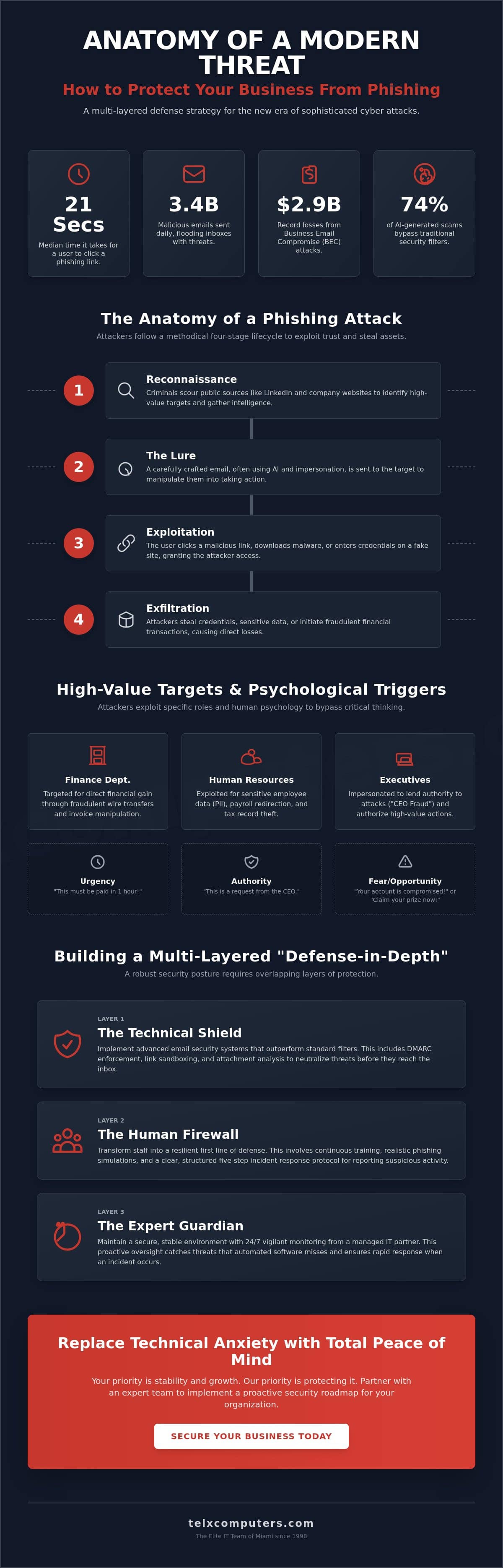
Did you know it takes a median of just 21 seconds for a user to click a phishing link? With 3.4 billion malicious emails sent daily, you’re likely searching for how to protect my business from phishing in an era where AI-generated scams bypass 74% of traditional filters. It’s a daunting reality. Business Email Compromise losses have reached a record $2.9 billion, leaving many leaders feeling vulnerable and confused about which tools actually work. We recognize that your priority is maintaining stability while guarding your assets against these sophisticated social engineering tactics.
This article delivers a multi-layered defense strategy to shield your organization from modern threats. You’ll learn how to move beyond basic staff training by implementing an integrated Expert Guardian model. We’ll explore the latest DMARC updates, the impact of the Digital Operational Resilience Act (DORA), and how to build a proactive security culture. By the end, you’ll have a clear, strategic roadmap to replace technical anxiety with total peace of mind.
Key Takeaways
- Understand why modern phishing attacks target SMBs through a sophisticated blend of technical exploitation and social engineering.
- Learn how to protect my business from phishing by identifying high-value targets like Finance and HR and understanding the four stages of a cyber attack.
- Explore the “Defense-in-Depth” framework to implement advanced email security systems that outperform standard filtering tools.
- Discover how to transform your staff into a resilient first line of defense with a structured five-step incident response protocol.
- Recognize why 24/7 vigilant monitoring from a managed IT partner is essential for maintaining a secure and stable operational environment.
Beyond the Basics: Understanding the Modern Phishing Threat to Businesses
Phishing has evolved into a high-tech weapon. To understand what phishing is today, we must look past simple fraudulent emails. It’s now a sophisticated blend of social engineering and technical exploitation. For many leaders, the question of how to protect my business from phishing starts with realizing that attackers no longer just “spray and pray.” They target small to medium-sized businesses specifically. These organizations are “Goldilocks” targets. They possess valuable data and financial assets but often lack the massive defensive budgets of global enterprises.
In highly competitive markets like Miami and New York, the stakes are incredibly high. A single breach results in more than just immediate financial loss. The reputational damage in a tight-knit business community can take years to repair. As a dedicated IT company in Miami, we see how attackers leverage local familiarity to craft convincing lures. Recent data indicates that 33.2% of untrained employees fail phishing simulations. This vulnerability is exactly what attackers exploit to gain a foothold in your network.
To better understand this concept and how these scams operate, watch this helpful video:
Why Traditional Spam Filters Are No Longer Enough
Traditional spam filters rely on signature-based detection. They look for known “bad” patterns that have been flagged before. Modern attackers bypass this easily. They use zero-day phishing links that stay active for only a few hours. By the time a filter identifies the threat and updates its database, the link has already served its purpose. Passive software is a start, but it isn’t a total solution. You need an “Expert Guardian” approach that combines advanced tools with constant, proactive oversight to catch threats that software alone misses.
The Rise of AI-Enhanced Phishing in 2026
AI-enhanced phishing is the new standard. Attackers use Large Language Models to generate perfect, typo-free emails that mimic your brand’s unique voice. These aren’t the clunky, obvious scams of the past. They are indistinguishable from legitimate internal communications. We’re also seeing a rise in deepfake audio and video used in “vishing” or voice phishing attacks. An employee might receive a call that sounds exactly like their CEO requesting an urgent transfer. Your defense strategy must account for these machine-speed threats with equally rapid response protocols.
The Anatomy of a Modern Phishing Attack: Identifying High-Value Targets
Social engineering is the art of manipulating people into divulging confidential information. While technical barriers are vital, the core of how to protect my business from phishing lies in understanding the human element. Attackers don’t just guess; they follow a methodical lifecycle designed to exploit trust. This process begins with Reconnaissance, where criminals scour LinkedIn, company websites, or local news in hubs like Miami to identify targets. Once they have a profile, they craft a Lure, move to Exploitation when a link is clicked, and finish with Exfiltration as they steal credentials or funds.
High-value targets typically fall into three categories: Finance, HR, and the C-suite. Finance departments are targeted for wire transfers, while HR is exploited for sensitive employee data and tax records. Executives are impersonated to lend authority to the attack. These criminals rely on three psychological triggers to bypass critical thinking: urgency, authority, and the fear of missing out. By creating a high-pressure scenario, they force employees to act before they can verify the request’s legitimacy.
Business Email Compromise (BEC) and Executive Impersonation
Business Email Compromise is one of the most financially devastating threats facing organizations today. Losses due to BEC have reached a record high of $2.9 billion, often driven by “CEO fraud.” In these scenarios, an attacker mimics an executive’s communication style to authorize fraudulent wire transfers. Beyond internal impersonation, attackers also compromise vendor accounts. By inserting themselves into a legitimate supply chain, they can divert payments by sending “updated” invoice details. In localized markets, attackers often use knowledge of regional business trends or real estate developments to make their lures feel authentic and urgent. If you’re concerned about these sophisticated threats, a managed IT support service can provide the vigilant oversight needed to detect these subtle anomalies.
Smishing and Vishing: Phishing Beyond the Inbox
Phishing is no longer confined to your email inbox. Smishing, or SMS-based phishing, targets corporate mobile devices with malicious links disguised as shipping updates or security alerts. Simultaneously, vishing (voice phishing) has become more convincing due to AI-driven voice-changing technology. An employee might receive a call that sounds exactly like a trusted colleague or partner. Protecting remote workforces in New York and Florida requires a multi-channel defense strategy. Because remote employees often use personal devices for work, they become easy entry points for attackers looking to bypass the corporate perimeter through these mobile and voice-based vectors.
The Technical Shield: Implementing Multi-Layered Email Security Systems
Relying on a single security tool is like locking your front door while leaving every window wide open. A truly resilient defense requires a “Defense-in-Depth” framework. This strategy stacks multiple protective layers so that if one fails, others are positioned to intercept the threat. When evaluating how to protect my business from phishing, you must look beyond basic email filtering. While standard filters catch bulk spam, they often fail against low-volume, highly personalized spear-phishing. Advanced Threat Protection (ATP) suites use real-time behavioral analysis to identify these anomalies before they reach an inbox.
Multi-Factor Authentication (MFA) is another foundational element of this shield. It’s documented to block over 99% of account compromise attacks. However, attackers are now using sophisticated techniques like MFA fatigue and token theft to bypass simple SMS codes. This shift makes hardware-based security keys or app-based authentication essential for modern enterprises. Implementing and maintaining these complex systems is a significant undertaking. Managed IT Services provide the necessary infrastructure and expert oversight to ensure these technical layers remain impenetrable.
Essential Protocols: SPF, DKIM, and DMARC
Domain spoofing allows attackers to send emails that appear to come from your own company. To stop this, you need three core protocols: SPF, DKIM, and DMARC. SPF identifies authorized senders, and DKIM adds a digital signature to verify the email’s integrity. DMARC provides the instructions on how to handle emails that fail these checks. In May 2026, the IETF updated these standards through RFC 9989, introducing the `np` tag. This new tag allows you to specify policies for non-existent subdomains, closing a major spoofing loophole. These protocols are the gold standard for brand protection, but they require professional configuration to avoid disrupting legitimate mail flow.
Endpoint Security and DNS Filtering
Technical defense must extend past the email server. Effective Network Security incorporates DNS filtering to block malicious domains at the source. If an employee clicks a fraudulent link, the filter prevents the browser from ever reaching the destination. Endpoint Detection and Response (EDR) serves as the final safety net. It monitors individual devices for suspicious behavior, catching threats that might have slipped through the initial filters. For remote teams, cloud-integrated security ensures that these protections remain active regardless of where your staff is working.
Cultivating a Cybersecurity Culture: Training and Response Protocols
While technical barriers are your first line of defense, your employees are the final gatekeepers. Technology can intercept billions of threats, but it only takes one well-crafted lure to bypass a filter. Research shows that 33.2% of untrained employees fail phishing simulations, and the median time for a user to click a malicious link is a staggering 21 seconds. Shifting your perspective from seeing staff as a “weakest link” to a “first line of defense” is a core component of how to protect my business from phishing. This shift requires more than just a handbook; it demands a culture where security is everyone’s responsibility.
A “no-blame” reporting culture is essential. If an employee clicks a link and fears termination, they’ll likely stay silent, giving the attacker more time to exfiltrate data. When someone reports a mistake immediately, your team can execute a structured five-step incident response plan:
- Disconnect: Remove the affected device from the network to prevent lateral movement.
- Report: Notify the security team through a pre-approved, secure channel.
- Analyze: Identify the scope of the compromise and what data was accessed.
- Remediate: Reset all credentials and revoke active session tokens.
- Review: Conduct a post-mortem to update training and technical controls.
This strategy must be tailored to your specific industry. For healthcare IT services in Miami, training should focus on patient privacy and HIPAA-related lures. Conversely, IT services for law firms must prioritize client confidentiality and the prevention of fraudulent wire transfers during escrow. If you’re ready to evaluate your current defenses, you can request an instant quote for a professional cybersecurity audit.
Modern Security Awareness Training (SAT)
Annual training sessions are no longer effective. Attackers evolve too quickly for a once-a-year briefing to provide real protection. Modern SAT relies on continuous micro-learning sessions that keep security top-of-mind without causing “fatigue.” Phishing simulations are a vital part of this process. They allow you to identify high-risk users in a safe environment and provide immediate, constructive feedback. Gamification and rewards for reporting suspicious emails turn security into a collaborative effort rather than a chore.
Internal Verification Policies
Technical tools can’t stop a phone call or a text message. You need internal policies that mandate “out-of-band” verification for any sensitive request. This means if an executive asks for a wire transfer via email, the finance team must verify the request through a secondary channel, like a known phone number or an in-person conversation. Establishing clear protocols for changing vendor payment information is equally critical. Utilizing expert IT consulting helps you draft and implement these operational safeguards to ensure they’re practical and followed consistently.
Securing Your Future: The Strategic Role of a Managed IT Partner
Phishing protection is a relentless, 24/7 requirement that quickly exceeds the capacity of most internal IT departments. When you consider that 3.4 billion phishing emails are sent daily, the window for error is non-existent. For many leaders, the search for how to protect my business from phishing leads to a vital realization: you need a partner who acts as an extension of your own team. Telx Computers serves as this expert guardian for organizations throughout Miami, Fort Lauderdale, and the surrounding regions. We provide the technical edge and vigilant oversight necessary to stay ahead of threats while you focus on your core operations.
Our approach replaces technical anxiety with a sense of stability through fixed-price service plans. This model ensures your cybersecurity budgeting remains predictable, even as the threat landscape shifts. By moving away from a series of disconnected fixes, we help you build a cohesive defense that aligns with your specific business goals. We take pride in being the silent engine behind your success, ensuring your digital environment remains secure and reliable.
Proactive Monitoring and Rapid Response
Effective security requires more than just waiting for an alarm to sound. Our Server Monitoring systems are designed to catch the subtle, unusual data patterns that indicate a breach in progress. If an attacker bypasses your initial layers, our 24/7 help desk is ready to respond instantly. This rapid intervention is critical for locking down compromised accounts and stopping exfiltration before it causes major damage. You gain the peace of mind that comes from knowing specialists are watching your network while you sleep, protecting your assets from attacks that cost businesses an average of $17,700 every minute.
Customized Cybersecurity Roadmaps
A generic security plan won’t suffice in a world of AI-driven spear-phishing and evolving regulations like DORA and the CMMC final rule. We transition your organization from reactive “fixes” to a holistic business technology strategy. This process begins with regular Cybersecurity Audits to identify new vulnerabilities before they can be exploited. We analyze your unique operational needs to create a roadmap that is both secure and efficient. It’s about building a foundation that supports growth while maintaining a technological edge. Don’t leave your organization’s safety to chance. Get an instant quote for your business security today and take the first step toward a resilient future.
Take Command of Your Organization’s Digital Safety
The threat landscape is shifting at machine speed, but your organization doesn’t have to remain vulnerable. We’ve explored how a robust defense requires more than just software; it demands a strategic alignment of advanced technical protocols and a resilient, “no-blame” security culture. Understanding how to protect my business from phishing is about moving from a reactive posture to a proactive, integrated strategy that anticipates threats before they reach your team’s inbox.
True resilience comes from having an expert guardian who understands your local business dynamics and technical needs. Telx Computers provides this stability through 24/7 proactive network monitoring and a physical presence in Miami, NYC, and LA for rapid response. Our fixed-price, unlimited service plans ensure your cybersecurity budgeting is as predictable as your protection is reliable. You can secure your business with Telx Computers’ Managed IT Services and build a roadmap that fosters growth without compromise. We’re here to be the silent engine behind your success, giving you the confidence to lead in an increasingly complex digital world.
Frequently Asked Questions
Is Multi-Factor Authentication (MFA) 100% effective against phishing?
Multi-Factor Authentication is not 100% effective, though it remains a critical foundational defense. While it blocks over 99% of automated account compromise attacks, sophisticated criminals now use techniques like MFA fatigue and session token theft to bypass standard prompts. You should implement hardware security keys or app-based authentication rather than relying solely on SMS codes. This ensures a higher level of security against advanced actors who know how to exploit traditional MFA weaknesses.
How often should my business conduct phishing simulation tests for employees?
You should conduct phishing simulations at least once per month to keep security top of mind. Annual training is largely ineffective because employees often forget the material within weeks. Continuous, micro-learning sessions combined with unannounced simulations help identify high-risk users safely. This approach allows your team to learn from mistakes in a controlled environment, turning your staff into a resilient first line of defense against evolving social engineering tactics.
What is the very first thing an employee should do if they click a suspicious link?
The very first action an employee should take is to disconnect their device from the network. This prevents lateral movement and stops the attacker from exfiltrating more data from your systems. After isolating the device, the employee must report the incident to your IT department or help desk immediately. Prompt reporting allows your security team to reset credentials and revoke active sessions, minimizing the potential damage from a successful lure.
Can artificial intelligence actually help my business detect phishing emails?
Artificial intelligence is a powerful tool for identifying sophisticated scams that bypass traditional filters. Modern Advanced Threat Protection suites use AI-driven behavioral analysis to detect anomalies in communication patterns. When considering how to protect my business from phishing, leveraging machine-speed detection is essential. These tools identify “zero-day” links and impersonation attempts in real-time, providing a level of vigilance that human monitoring alone cannot match across thousands of daily emails.
What is the difference between standard spam and a targeted phishing attack?
Standard spam is unsolicited bulk mail intended for marketing, whereas phishing is a malicious attack designed to steal sensitive data or funds. While spam is a nuisance that clogs inboxes, phishing involves deception, urgency, and technical exploitation. Targeted phishing, or spear-phishing, is even more dangerous because it uses personalized information to build trust. Distinguishing between these two is vital for prioritizing your organization’s security resources and response efforts.
Why would a cybercriminal target my small business instead of a large corporation?
Cybercriminals target small businesses because they often lack the massive security budgets and dedicated teams found at large corporations. SMBs frequently possess high-value assets, such as sensitive patient records or escrow funds, making them profitable targets. This “Goldilocks” position makes them attractive to attackers who want a high payout with lower technical resistance. Implementing a strategic roadmap is the best way to ensure your organization isn’t an easy target.
Are Mac users safer from phishing attacks than Windows users?
Mac users are not safer from phishing attacks than Windows users because phishing targets human psychology rather than operating system vulnerabilities. Since phishing relies on social engineering, the type of hardware you use doesn’t prevent a user from clicking a malicious link or entering credentials into a fake login page. Whether your team uses macOS, Windows, or mobile devices, the risks remain identical. Consistent training and technical filters are the only effective defenses.
How do I report a phishing attack to the authorities in the United States?
You should report phishing attacks to the FBI’s Internet Crime Complaint Center (IC3) at ic3.gov. Additionally, the Cybersecurity and Infrastructure Security Agency (CISA) provides a platform for businesses to report incidents. Reporting these crimes helps authorities track emerging threats and potentially recover stolen assets. When searching for how to protect my business from phishing, remember that local law enforcement and your managed IT partner should also be notified to secure your internal environment.