





12 Apr Disaster Recovery Plan Miami: The 2026 Business Resilience Guide
If a Category 4 hurricane hits the Atlantic coast tomorrow, would your company be one of the 40% of small businesses that FEMA reports never reopen after a major disaster? You’ve likely felt the mounting anxiety of watching the radar during hurricane season or felt overwhelmed by the intricate layers of managing hybrid cloud backups. It’s a heavy burden to carry when your data and reputation are on the line. Building a comprehensive disaster recovery plan Miami leaders can rely on is about more than just simple backups; it’s about ensuring your business legacy survives the unpredictable.
We’re here to act as your strategic ally, replacing that technical uncertainty with a sense of total security and professional stability. In this 2026 resilience guide, you’ll discover how to implement a high-availability strategy that slashes your Recovery Time Objective (RTO) and ensures full compliance with Florida data protection standards. We’ll walk you through a proactive roadmap that transforms your IT infrastructure from a potential vulnerability into a fortified engine of continuity. It’s time to secure your uptime and protect your growth against any threat, from hardware failures to sophisticated cyber attacks.
Key Takeaways
- Understand why Miami’s unique environmental risks demand a specialized, proactive approach to hardware protection and data resilience.
- Learn to implement a high-availability disaster recovery plan Miami by establishing precise recovery objectives that minimize downtime during a crisis.
- Evaluate the critical differences between cloud and on-premise solutions to build a hybrid infrastructure that survives both physical and digital threats.
- Gain a step-by-step roadmap for conducting a Business Impact Analysis to prioritize and protect your most vital IT assets and dependencies.
- Discover how local expertise and proactive monitoring transform your IT strategy into a seamless engine of business continuity and peace of mind.
The Unique Risk Profile of Miami Businesses in 2026
In 2026, a disaster recovery plan Miami enterprises implement must evolve beyond the traditional hurricane checklist. It serves as the functional backbone of a comprehensive Business Continuity Strategy, ensuring that operations remain seamless even when the local environment turns hostile. Miami’s unique geography creates a high-stress environment for IT infrastructure, where hardware faces a constant assault from atmospheric elements and shifting climate patterns. We view disaster recovery not as a reactive fix, but as a proactive shield for your digital assets.
To better understand the physical risks associated with local disasters, watch this helpful video:
Environmental Hazards: Hurricanes and the Miami Flood Zone
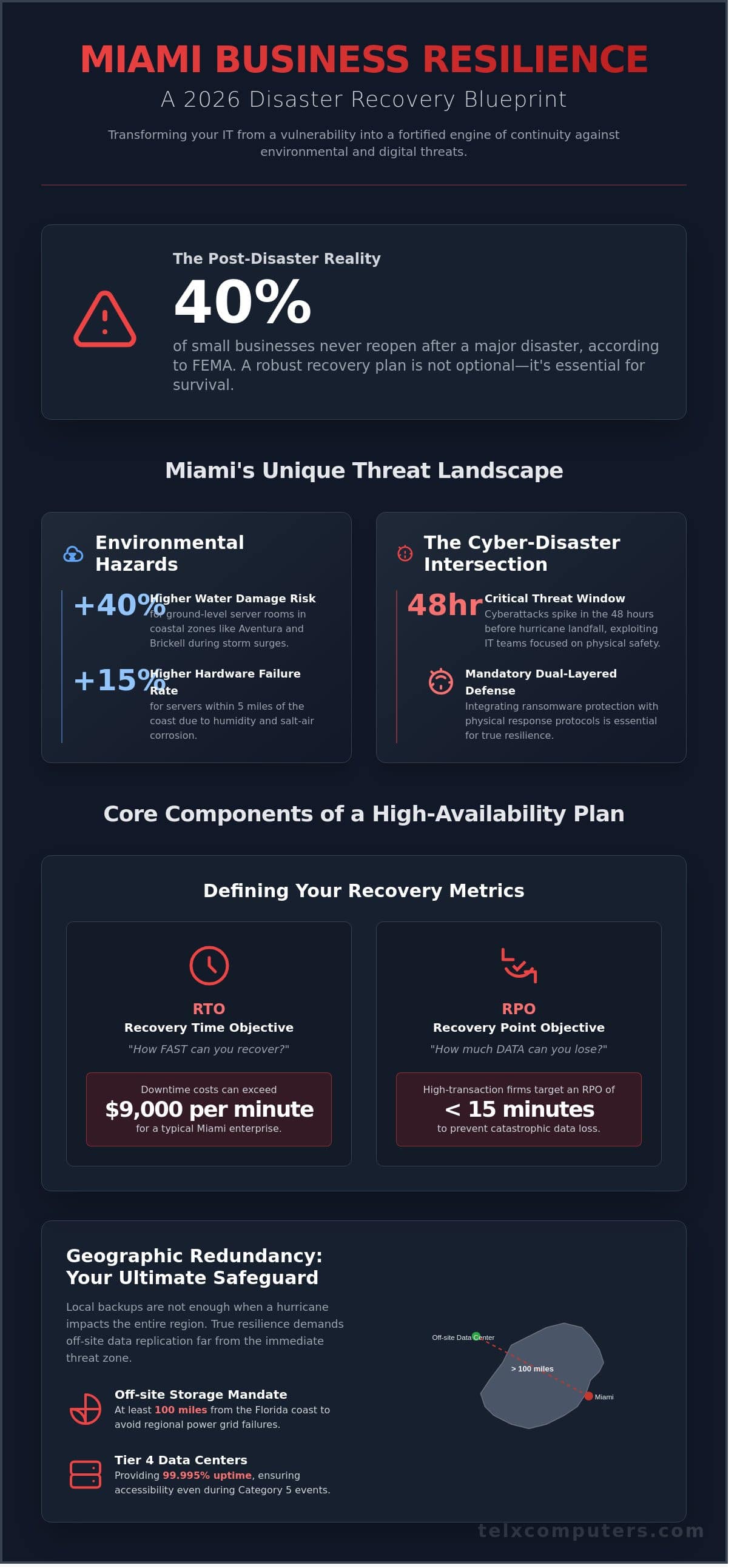
Ground-level server rooms in areas like Aventura and Brickell face a 40% higher risk of catastrophic water damage during seasonal storm surges compared to inland facilities. Beyond the immediate threat of rising tides, Miami’s humidity and salt-laden air accelerate hardware corrosion at an invisible pace. Servers located within five miles of the Atlantic coast often experience hardware failure rates up to 15% higher than those in controlled, inland environments. Maintaining uptime requires a geographic redundancy strategy that replicates your data in regions far beyond the South Florida flood maps, ensuring your business stays online even if your physical office is inaccessible.
The Cyber-Disaster Intersection
Threat actors don’t take a break during a Category 3 storm. Statistics show that cyberattacks often spike during the 48-hour window before landfall, as attackers exploit the moment when IT teams are preoccupied with physical bracing and employee safety. Integrating advanced ransomware protection into your physical response protocol is now a mandatory requirement for resilience. Leading IT companies in Miami act as your Expert Guardian, providing 24/7 vigilance while your internal staff handles local logistics. We ensure your digital perimeter remains secure and your backups are immutable, even when the power grid fluctuates. This dual-layered approach protects your company from the physical and digital fallout of a disaster simultaneously.
Core Components of a High-Availability Disaster Recovery Plan
Miami’s unique climate and economic density require a proactive approach to business continuity. A comprehensive disaster recovery plan Miami businesses rely on must address both technical failure and regional environmental risks through four pillars: precise metrics, modern backup strategies, data prioritization, and resilient communication.
Defining Your Recovery Metrics: RTO vs. RPO
Calculating the impact of a service outage is the first step toward stability. For a Miami enterprise, downtime costs can exceed $9,000 per minute depending on the specific sector. RTO is the duration of time a business process must be restored after a disaster. Recovery Point Objective (RPO) determines how much data loss is tolerable. High-transaction firms in South Florida, such as those in the financial or logistics sectors, often target an RPO of less than 15 minutes to prevent catastrophic revenue leakage and maintain compliance standards.
Geographic Redundancy and Data Sovereignty
Local backups aren’t enough when a hurricane affects the entire peninsula. A resilient High-Availability Disaster Recovery Plan mandates off-site storage located at least 100 miles from the Florida coast. This distance ensures that regional power grid failures or storm surges don’t compromise your primary and secondary data simultaneously. Leveraging Tier 4 data centers provides 99.995% uptime, ensuring your infrastructure remains accessible during Category 5 events. Virtualization technology facilitates instant failover, allowing your Aventura or Fort Lauderdale team to transition to a secure cloud environment in seconds.
The 3-2-1 backup rule remains the gold standard, though the 2026 threat landscape demands it include immutable snapshots to counter sophisticated ransomware. You need three copies of your data, on two different media types, with one copy stored entirely out of the region. Identify your survival data first. This includes client databases, proprietary software, and financial records. Your disaster recovery plan Miami should prioritize these assets to ensure the core of your operation stays online.
Communication must remain seamless when the local grid fails. Your plan should include satellite-based internet options or cellular failover to keep teams connected. If you’re concerned about your current readiness, you can get an instant quote to see how professional management streamlines these protections. Telx Computers acts as Your IT Department, ensuring your strategy is tailored to the specific risks of the Miami market.
Cloud vs. On-Premise: Navigating Miami’s Physical Risks
Choosing between on-premise hardware and cloud infrastructure isn’t just a technical preference; it’s a survival strategy for South Florida enterprises. While local servers offer immediate access, they remain tethered to the physical vulnerabilities of the Everglades region. A comprehensive disaster recovery plan Miami must account for the reality that hardware in a Brickell office is susceptible to the same storm surges as the street outside. In 2025, industry reports indicated that 40% of local businesses experienced hardware failure due to humidity-related cooling issues alone. Moving your primary operations to a secure environment ensures your business stays live even when your office is inaccessible.
The Vulnerability of Local Infrastructure
Miami office buildings, particularly those in downtown or high-density areas, face specific infrastructure bottlenecks. Relying on a server room in a building built before 2010 often means dealing with outdated backup power systems and single-source cooling. If the HVAC fails during a July heatwave where temperatures hit 95 degrees, your hardware can reach critical thermal limits within 15 minutes. Relying solely on on-site backups is a high-stakes gamble. We’ve seen that local connectivity often falters during tropical depressions, leaving on-premise data trapped behind broken fiber lines. Transitioning to cloud computing as a primary strategy provides a layer of separation between your data and these physical threats.
- Power Instability: Local grids often struggle with surge demands during peak storm seasons.
- Cooling Failures: Humidity levels in South Florida can corrode internal components faster than in drier climates.
- Physical Access: Flooding in the Brickell area can prevent IT teams from reaching physical servers for days.
Hybrid Cloud: The Strategic Middle Ground
For businesses that require high-speed local access for heavy files, the hybrid cloud offers the best of both worlds. This model maintains a local footprint for performance while synchronizing data across multiple geographic zones outside of Florida. If a localized outage hits Miami, your team can instantly failover to a cloud instance. We leverage SD-WAN technology to manage this transition seamlessly. SD-WAN identifies the most stable path for your data, bypassing localized ISP outages that often plague the region during heavy rain. This proactive approach turns your disaster recovery plan Miami into a dynamic asset rather than a static document. By spreading your risk across different regions, you ensure that a single point of failure doesn’t halt your operations. It’s about building a resilient architecture that supports growth while protecting your legacy systems.
5 Steps to Building Your Miami Business Continuity Strategy
A resilient disaster recovery plan Miami businesses can trust isn’t a static document. It’s a living strategy that evolves with your company. By 2026, the complexity of hybrid work and sophisticated ransomware requires a more granular approach to data protection. You need a roadmap that ensures your operations continue even when the physical office is inaccessible. This guide provides the tactical steps to achieve that stability.
Step 1: The Miami Business Impact Analysis
We begin by identifying which departments face the highest risk. Sales and Operations usually top the list because they drive immediate cash flow. A 48-hour outage in the Miami market can be devastating. According to the Ponemon Institute, the average cost of IT downtime is $9,000 per minute. For a local enterprise, this isn’t just a technical glitch; it’s a threat to your survival. We help you assess the financial and reputational damage to create a priority restoration list. You’ll know exactly which revenue-generating systems must come back online first.
Step 2: Inventory Critical IT Assets
Your team must catalog every server, workstation, and cloud application. Don’t forget the dependencies. If your CRM requires a specific local database to function, both must be part of the same failover group. This inventory ensures no vital component is left behind during a recovery event. We document every software license and hardware serial number to streamline the insurance claim process if physical damage occurs.
Step 3: Draft the Remote Restoration Manual
Miami’s workforce is increasingly mobile. Your plan needs a step-by-step manual that guides employees through connecting to backup systems from home or temporary hubs. This documentation must be clear enough for a non-technical manager to follow during high-stress scenarios. We focus on secure VPN access and multi-factor authentication to ensure your remote transition doesn’t create new security vulnerabilities.
Step 4: Testing and Validation in Real-World Scenarios
A disaster recovery plan is only as good as its last successful test. We don’t just hope the backups work; we prove they do. We simulate total office loss scenarios to verify that cloud restoration speeds meet your recovery time objectives. This rigorous validation is how Telx Computers delivers peace of mind through our managed IT services in Miami, ensuring your failover systems are always ready for a live transition.
Step 5: Quarterly Reviews and Updates
Cyber threats in 2026 move faster than ever. Your strategy should be reviewed every 90 days to account for new vulnerabilities or office expansions. Regular updates keep your defense proactive rather than reactive. If you’ve added ten new employees or a new SaaS platform, your recovery plan must reflect those changes immediately. We act as your Expert Guardian, ensuring your documentation stays as current as your technology stack.
Ready to secure your business against the unexpected? Get an instant quote from your strategic IT partners at Telx Computers today.
Telx Computers: Your Strategic Ally for Resilience in South Florida
Your business deserves more than a reactive technician; it needs a guardian. At Telx Computers, we’ve spent over 20 years serving as the strategic engine for South Florida’s most successful enterprises. We don’t view IT as a series of isolated tickets. Instead, we see it as the vital backbone of your operational survival. Our team integrates a comprehensive disaster recovery plan Miami leaders trust, ensuring your data remains accessible even when the region faces its most severe environmental challenges.
We’ve built our reputation on a proactive model that prioritizes uptime over everything else. While many providers treat emergency preparedness as a premium add-on, Telx includes disaster recovery as a standard feature in our fixed-price managed services. This approach eliminates the financial unpredictability that typically follows a crisis. Our experts monitor your systems 24/7, identifying and neutralizing vulnerabilities before they can escalate into costly downtime.
Local Expertise, Global Standards
A national provider might understand the cloud, but they don’t understand the specific infrastructure quirks of a high-rise in Aventura or a commercial hub in Fort Lauderdale. We do. Our engineers live and work in the region, which allows for rapid on-site response when remote troubleshooting isn’t enough. We maintain global security standards while providing the localized support that South Florida’s unique climate demands. When a storm disrupts the local grid, our 24/7 help desk stays operational, serving as your primary point of contact for stability and recovery.
Securing Your Future Today
Resilience starts with a transparent look at your current technical vulnerabilities. Our onboarding process begins with a rigorous IT audit and a tailored DR assessment to build the most robust disaster recovery plan Miami businesses can implement. We pinpoint gaps in your backup frequency, encryption protocols, and recovery time objectives. By the time our team finalizes your strategy, your business is effectively storm-proof.
You’ll gain the freedom to scale your operations without the constant fear of data loss or system failure. It’s time to stop worrying about what might happen and start preparing for what’s next. Take the first step toward a more secure infrastructure and get an instant quote for your disaster recovery needs to protect your legacy.
Secure Your Business Future in South Florida
The operational landscape of 2026 presents unique challenges that demand a sophisticated approach to technical resilience. You’ve seen how integrating high-availability cloud solutions with a localized disaster recovery plan Miami enterprises can trust is no longer optional. Successfully navigating these physical and digital risks requires a shift toward proactive monitoring and a structured five-step continuity strategy. Telx Computers acts as your expert guardian, leveraging over 20 years of South Florida IT expertise to keep your systems running 24/7. We provide proactive server monitoring and rapid on-site response in Miami, Aventura, and Fort Lauderdale to eliminate technical anxiety.
Our team functions as your dedicated IT department, ensuring your infrastructure is both scalable and compliant with modern industry standards. We’ve spent two decades refining our processes to provide the stability your business needs to thrive in an unpredictable environment. It’s time to replace uncertainty with the confidence of a professional partnership. Protect your Miami business with a custom Disaster Recovery Plan; Get your Instant Quote today! You’ve built a strong foundation, and we’re here to make sure it stays standing no matter what the future holds.
Frequently Asked Questions
What is the difference between a backup and a disaster recovery plan?
A backup is a copy of your data, whereas a disaster recovery plan is the complete strategy for restoring your entire business operation. Think of a backup as a spare tire and the DR plan as the roadside assistance service that gets you back on the highway. We build these systems to ensure your Miami office resumes full functionality within minutes, not days. Your IT department should focus on both to guarantee total protection.
How often should a Miami business test its disaster recovery plan?
You should test your disaster recovery plan Miami at least twice per year to prepare for the 40 percent chance of a major hurricane hitting Florida in any given season. Regular drills allow your team to identify bottlenecks in the restoration process before a real emergency occurs. We lead these simulations to ensure your protocols are airtight and your staff feels confident in their roles during a crisis.
Does my small business in Aventura really need a DR plan?
Yes, small businesses in Aventura require a DR plan because 40 percent of small enterprises never reopen after a major disaster according to FEMA data. Local threats like flash flooding or power grid failures can halt your revenue immediately. We treat your Aventura office with the same Expert Guardian approach we provide to large corporations. This ensures your data remains secure and accessible even when the unexpected happens.
How does cloud computing improve disaster recovery for South Florida firms?
Cloud computing improves disaster recovery by removing your data from physical hardware that’s vulnerable to South Florida’s humidity and storm surges. By replicating your environment in geographically dispersed data centers, we ensure 99.99 percent uptime regardless of local weather. This shift creates a seamless transition to remote work if your physical office becomes inaccessible. It’s a scalable solution that grows alongside your business needs.
What are RTO and RPO, and why do they matter for my DR strategy?
Recovery Time Objective (RTO) measures how long you can afford to be down, while Recovery Point Objective (RPO) defines how much data loss your business can tolerate. These metrics form the backbone of a successful disaster recovery plan Miami. We help you set these targets based on your specific operational needs. This ensures your recovery strategy aligns perfectly with your bottom line and minimizes technical anxiety.
Can Telx Computers help my Fort Lauderdale office meet industry compliance during a disaster?
Telx Computers acts as your internal IT department to ensure your Fort Lauderdale office maintains HIPAA, PCI, or FINRA compliance during a crisis. We implement encrypted failover systems that keep sensitive data protected even when your primary site is offline. Our proactive monitoring prevents compliance gaps that often occur during the chaos of a system restoration. You get peace of mind knowing your regulatory obligations are met.
What happens to my VoIP phone system during a Miami power outage?
Your VoIP phone system remains functional during a power outage if it’s hosted in the cloud, allowing calls to route automatically to mobile devices. Unlike traditional copper lines that depend on local infrastructure, cloud based voice services ensure your clients can always reach you. We configure these failover paths so your business communication stays professional and uninterrupted. This keeps your silent engine running during any South Florida utility failure.
How much does a professional disaster recovery plan cost in Miami?
The cost of a professional disaster recovery plan varies based on your data volume and required recovery speed, but the downtime it prevents often costs $5,600 per minute according to Gartner reports. Investing in a tailored strategy is a proactive business move that protects your future revenue. We provide a detailed assessment of your infrastructure to build a plan that fits your specific budget and operational goals.