





10 Mar Compliance Management in Miami: A 2026 Strategic Guide for Business Leaders
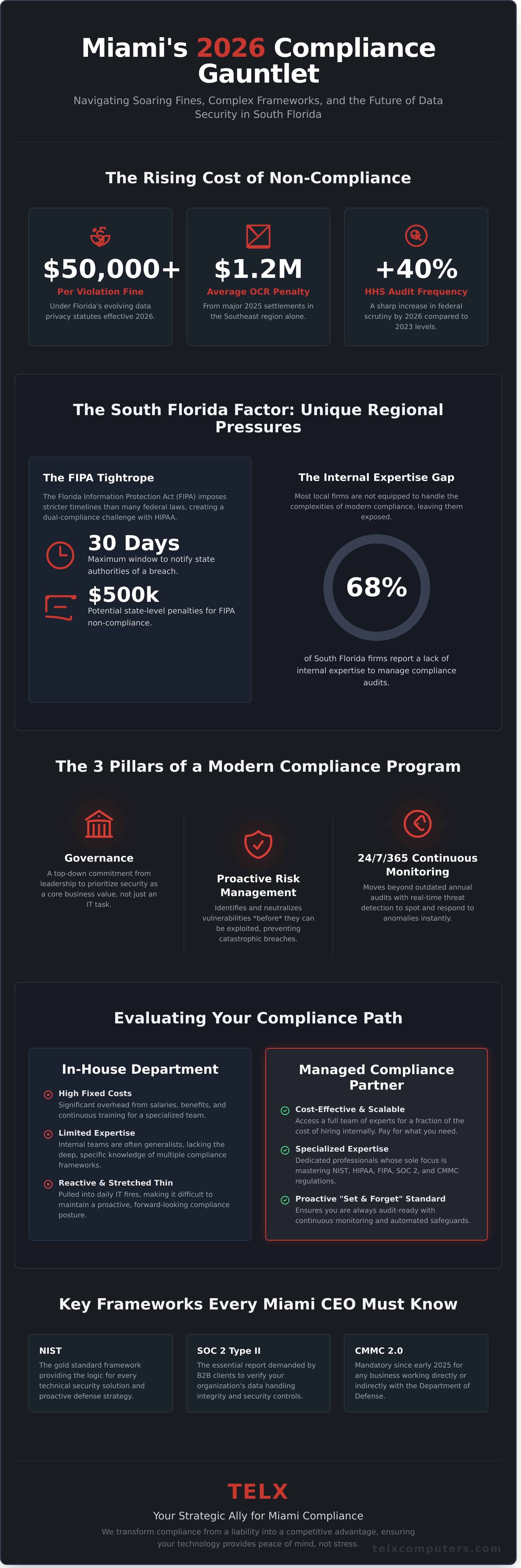
In 2026, a single oversight in Florida’s evolving data privacy statutes can result in fines exceeding $50,000 per violation. You likely feel that keeping up with shifting compliance management regulations is a full-time job that pulls you away from your core business operations. With 68% of South Florida firms reporting a lack of internal expertise to handle these audits, the pressure to perform is mounting. It’s stressful to manage complex requirements when your team is already stretched thin; the fear of a surprise regulatory check is a burden no leader should carry. As Your IT Department, we believe your technology should provide peace of mind, not liability.
We’re here to transform that anxiety into a secure, proactive posture. You’ll learn exactly how to implement an expert-led framework that turns regulatory adherence into a competitive advantage rather than a legal hurdle. We’ll show you how to achieve a “set it and forget it” standard that ensures you pass audits with zero stress. This strategic guide outlines the specific steps to automate your regulatory requirements and safeguard your brand’s reputation across the South Florida market.
Key Takeaways
- Navigate the shifting 2026 regulatory landscape by moving beyond “good enough” to a proactive framework that secures your Miami enterprise.
- Strengthen your organizational foundation by integrating governance and risk management strategies that neutralize threats before they impact your operations.
- Compare the hidden costs of internal departments against the scalability of professional compliance management to find the most efficient path for your business growth.
- Follow a streamlined, step-by-step roadmap to conduct gap analyses and technical remediations that ensure your infrastructure is always audit-ready.
- Discover how a tailored partnership with a strategic ally provides the specialized protection required for Miami’s high-stakes healthcare and financial industries.
What is Compliance Management and Why Does it Matter in Miami?
Miami healthcare leaders often view IT as a utility. That’s a mistake. In 2026, compliance management functions as a core business strategy. It’s the active, relentless process of identifying risks before they transform into disasters. Regulatory compliance isn’t a static goal; it’s a moving target that requires constant vigilance. As your strategic ally, we view this cycle as a way to build a resilient infrastructure that protects your patients and your bottom line.
The regulatory environment has shifted. By early 2026, the Department of Health and Human Services (HHS) increased its audit frequency by 40 percent compared to 2023 levels. “Good enough” security is no longer an option. It’s a liability. If your practice relies on outdated protocols, you’re essentially inviting federal scrutiny. Effective compliance management ensures that every digital touchpoint, from patient portals to cloud storage, meets current standards without slowing down your staff.
The financial consequences of negligence are devastating. In 2025, the Office for Civil Rights (OCR) settled 18 major cases in the Southeast alone, with an average penalty of $1.2 million per incident. Beyond these fines, Miami-Dade businesses face local litigation and permanent reputation damage. In our tight-knit South Florida community, trust is your most valuable currency. Once a breach goes public, recovering that trust takes years. We act as your Expert Guardian to prevent these failures from ever reaching the headlines.
Compliance also serves as a powerful growth enabler. It’s not just a shield; it’s an engine. When you maintain rigorous standards, you can confidently bid on larger contracts and partner with major insurers who demand proof of security. It streamlines your operations and provides a clear roadmap for scalability. By integrating these standards into your daily operations, you demonstrate a level of maturity that attracts high-value partners and stabilizes your long-term growth.
This principle of legal diligence as a growth enabler extends globally. For instance, businesses looking to expand into international markets often require specialized legal guidance to navigate cross-border regulations, a role fulfilled by an expert Israel Cross Border Law Firm.
The Florida Factor: FIPA and Local Data Mandates
The Florida Information Protection Act (FIPA) remains a critical hurdle for Miami practices. In 2026, the statute requires businesses to notify the Florida Department of Legal Affairs within 30 days of discovering a breach. This window is significantly tighter than many federal standards. If you’re a healthcare provider, you must manage the intersection of FIPA and HIPAA. While HIPAA protects patient records, FIPA covers broader personal data like financial info. Failure to align these can lead to $500,000 in state-level penalties.
Regulatory Frameworks Every Miami CEO Must Know
NIST is the gold standard for proactive defense in South Florida. It provides the logic behind every technical solution we deploy. Additionally, local B2B clients now demand SOC 2 Type II reports to verify your data handling integrity. For firms working with the Department of Defense, CMMC 2.0 became mandatory in early 2025. These frameworks aren’t just red tape; they’re the blueprints for a secure, professional enterprise that operates with total peace of mind.
The Core Pillars of a Modern Compliance Management Program
Effective compliance management starts at the executive level of your Miami organization. Governance isn’t just a set of rules; it’s a commitment from leadership to prioritize patient data security. When partners and administrators treat HIPAA as a core business value, that culture filters down to every nurse, receptionist, and technician. This top-down approach ensures that security initiatives receive the necessary funding and authority to succeed in a complex regulatory environment.
Risk management acts as your early warning system. Rather than reacting to a breach after it occurs, a proactive strategy identifies vulnerabilities before hackers can exploit them. In 2023, the average cost of a healthcare data breach reached $10.93 million, a figure that can easily bankrupt a local practice. By implementing technical execution controls, you transform abstract regulations into concrete safeguards like encryption, multi-factor authentication, and secure access protocols.
Annual audits are a relic of the past that leave your practice vulnerable for 364 days of the year. Modern healthcare demands continuous monitoring. Since 87% of healthcare organizations now utilize real-time threat detection, staying competitive and secure requires a 24/7/365 vigilance model. This constant oversight allows us to spot anomalies the moment they appear, ensuring your practice remains protected between formal review periods.
Proactive Risk Assessment Strategies
Our team conducts deep-dive vulnerability scans on your Miami network to find the hidden gaps that automated tools often miss. We also evaluate third-party vendor risks across your South Florida supply chain, as 40% of breaches now originate from external partners. Risk appetite is the calibrated level of uncertainty a healthcare practice chooses to accept while balancing growth against potential security liabilities. By defining this early, we can tailor your managed security services to match your specific operational needs.
Policy Development and Employee Training
Crafting enforceable Acceptable Use Policies (AUP) is the first step in hardening your human firewall. These documents clearly define how staff should handle PHI and interact with office technology. Because phishing accounts for 31% of all successful security incidents, regular security awareness training is non-negotiable. We transform your staff into active defenders who can spot suspicious emails and social engineering attempts before they cause damage.
To remain audit-ready at a moment’s notice, you must document every patch, training session, and login attempt. This level of detail is essential for meeting federal and state business laws that govern healthcare operations. With 2024 HIPAA violation penalties reaching as high as $68,928 per individual violation, maintaining a digital paper trail isn’t just a best practice; it’s a financial necessity. Our structured approach ensures that when a regulator knocks, you have the proof of your diligence ready to present immediately.
Managed Compliance vs. In-House: Evaluating the Best Path
Building an internal compliance department in Miami carries a heavy price tag that goes far beyond a base salary. Local data from 2023 shows that a qualified Compliance Officer commands a median salary of $118,500. When you factor in payroll taxes, health insurance, and 401k matching, that single hire costs your practice nearly $150,000 before they even sit at their desk. Smaller practices often try to sidestep this by tasking their solo IT technician with compliance management. This is a dangerous gamble; one person cannot realistically monitor the 300 annual regulatory updates while managing a help desk. Telx provides a team of specialists for a fraction of that cost, turning a volatile expense into a predictable monthly investment.
Scalability is where the managed model truly outperforms in-house teams. If your South Florida practice expands from one location to three, your internal IT person’s workload triples overnight. They’ll likely drop the ball on documentation or patch management. Managed services scale instantly. We’ve seen practices grow their patient volume by 45% in a single year without needing to hire a new IT staffer because our infrastructure was already built to expand. Our proactive approach ensures that your growth never outpaces your security. We offer:
- Instant provisioning for new satellite clinics in Coral Gables or Doral.
- Automated reporting that scales seamlessly with your data volume.
- Access to a deep bench of engineers, not just one person’s limited skillset.
Some owners worry that outsourcing is less secure. It’s actually the opposite. An internal staffer might skip a security audit because they’re tired or overwhelmed. Telx operates as your Expert Guardian, employing redundant layers of oversight. We treat your data with the same rigor required by the Sarbanes-Oxley (SOX) Act, ensuring that every access point is logged and every vulnerability is patched within 24 hours of discovery. You aren’t just hiring a vendor; you’re integrating Your IT Department into your core strategy.
The ROI of Outsourcing Your Compliance Shield
The Telx fixed-price model eliminates the “Compliance Fatigue” that burns out internal leadership. Instead of your Office Manager spending 15 hours a week on audit prep, they focus on patient care. Our Miami-based operations center provides 24/7 vigilance. Internal teams usually go home at 5:00 PM. Since 60% of cyberattacks occur after business hours, having a partner who never sleeps is a financial necessity. We’ve seen this model reduce operational overhead by 30% for local clinics.
Technology vs. Human Expertise
Software alone cannot protect you. While automated tools might flag a missing firewall, they won’t understand the nuances of the South Florida business climate. Effective compliance management requires human intuition to interpret how new laws affect your specific workflow. We integrate cloud security with HIPAA standards, protecting the 74% of local healthcare employees who now access patient records from home. This tailored approach ensures your remote workforce stays secure without sacrificing productivity.
A Step-by-Step Roadmap to Audit-Ready Compliance in Miami
Achieving a state of permanent audit-readiness requires a shift from reactive troubleshooting to a structured compliance management strategy. Your practice cannot afford to wait for an HHS notification to verify its security posture. We recommend a proactive four-step framework designed to stabilize your IT environment while meeting the rigorous federal standards expected by 2026.
Step 1: Perform a baseline gap analysis against 2026 standards. You must evaluate your current protocols against the upcoming 2026 HIPAA modifications, which emphasize enhanced patient data portability and stricter encryption. This analysis identifies where your current 256-bit encryption or access controls fall short. It’s the only way to visualize the distance between your current state and total regulatory alignment.
Step 2: Remediate technical vulnerabilities in your Miami infrastructure. Local practices often face unique physical security challenges, including hardware degradation from South Florida’s humidity or salt air. We prioritize patching legacy software and securing physical server rooms. Every workstation must have an automatic log-off timer set to 15 minutes or less to prevent unauthorized access in high-traffic clinical areas.
Step 3: Implement real-time monitoring and automated logging. Effective compliance management relies on visibility. You need a system that tracks every file access and login attempt across your network 24/7. Automated logging ensures that you maintain the required six-year retention period for audit trails without manual intervention. If a breach occurs, these logs provide the forensic evidence needed to limit your liability.
Step 4: Formalize incident response and disaster recovery plans. A plan that only exists as a PDF on a broken server is useless. You must document specific roles, communication channels, and technical steps for containing a threat. This documentation must be accessible offline and updated every 90 days to reflect changes in your staff or technology stack.
Disaster Recovery as a Compliance Requirement
Miami businesses must link hurricane readiness directly to data compliance. HIPAA’s Security Rule requires a functional contingency plan to ensure Protected Health Information (PHI) remains available during a disaster. You need to define a Recovery Time Objective (RTO) of under 4 hours to maintain patient safety. Remember, a backup is simply a copy of data; recovery is the verified ability to restore your entire practice’s operations within your stated Recovery Point Objective (RPO).
Preparing for the Auditor: Documentation and Proof
Confidence during an audit comes from having a centralized Compliance Evidence Vault. This digital repository should store your risk assessments, signed Business Associate Agreements (BAAs), and employee training certificates. When an auditor requests proof of security, you can present real-time server monitoring dashboards that demonstrate 99.9% uptime and active threat mitigation. This level of transparency proves you aren’t just following rules, but actively guarding your patients’ most sensitive information.
Don’t leave your practice’s future to chance; secure your operations with a comprehensive HIPAA compliance audit from your strategic IT partners at Telx Computers.
Telx Computers: Your Strategic Ally for Miami Compliance
Effective compliance management requires more than a software patch or a yearly training session. It demands a fundamental shift from reactive troubleshooting to a philosophy we call the Expert Guardian. At Telx Computers, we don’t wait for a system failure or a HIPAA audit notification to secure your data. Since 2002, our team has acted as a proactive shield for South Florida healthcare providers, identifying vulnerabilities before they escalate into costly breaches or regulatory fines.
We recognize that a pediatric clinic in Miami Gardens has different operational hurdles than a large financial firm in Brickell. That’s why we discard one-size-fits-all solutions in favor of tailored compliance roadmaps. These roadmaps align your specific technical infrastructure with the rigid demands of HIPAA, HITECH, and other industry-specific regulations. By choosing Telx, you gain a partner that understands the nuances of the local regulatory environment and the global standards required to protect sensitive patient information.
The Telx advantage centers on a fixed-price, unlimited support model. Traditional IT vendors often profit from your downtime through hourly billing; our interests are diametrically opposed to that model. We thrive when your systems are secure and operational. This flat-fee approach includes comprehensive compliance oversight, ensuring that your compliance management strategy is always active. We integrate seamlessly into your organization, functioning as your internal IT and compliance department rather than an outside contractor. You get the depth of a high-tier corporate IT team with the accessibility of a local partner.
- Proactive 24/7 network monitoring to prevent unauthorized access.
- Dedicated compliance officers who stay current on evolving federal mandates.
- Predictable monthly costs that eliminate “emergency” IT expenses.
- Seamless integration with existing Practice Management and EHR systems.
Local Expertise, Global Standards
Having a compliance partner physically located in Miami Gardens is a tactical necessity for South Florida businesses. If an on-site audit occurs, you need more than a voice on a helpdesk ticket; you need an expert standing next to you. Since 2002, we’ve secured over 300 regional businesses, blending international cybersecurity standards with local accountability. Our clients enjoy direct access to our leadership team, ensuring that your strategic goals are always backed by executive-level commitment. We’re part of the South Florida community, and we take personal pride in the resilience of our local healthcare infrastructure.
Get Started with a Comprehensive Compliance Audit
Your journey toward total security begins with a rigorous technology and compliance review. We don’t just skim the surface. Our engineers perform a deep-dive analysis of your network architecture, data storage protocols, and employee access levels. During this initial phase, we frequently identify “red flag” risks that 40% of small to mid-sized practices overlook, such as unencrypted legacy backups or insecure remote access points. We provide a clear, prioritized report of these vulnerabilities along with a concrete plan to remediate them. Don’t leave your practice’s reputation to chance. Schedule your free Miami compliance consultation today and experience the peace of mind that comes with professional guardianship.
Future-Proof Your Miami Operations for 2026 and Beyond
Since 2002, Telx Computers has acted as the strategic ally for South Florida’s most resilient enterprises. Navigating the 2026 regulatory landscape requires more than just checking boxes; it demands a holistic compliance management strategy that integrates 24/7 proactive Expert Guardian monitoring with fixed-price, unlimited monthly support plans. You don’t have to shoulder the technical anxiety of shifting mandates alone. By transitioning to a managed model, your leadership team regains the bandwidth to focus on growth while we handle the granular security details.
We’ve spent over two decades refining our approach to keep Miami businesses audit-ready and secure. It’s time to turn your IT infrastructure into a competitive advantage rather than a liability. Our team stands ready to fortify your operations with the same precision we’ve provided for 22 years. Secure your Miami business with a free Compliance Gap Analysis from Telx Computers. Your path to total peace of mind starts with a single strategic step.
Frequently Asked Questions
What is the difference between cybersecurity and compliance management?
Cybersecurity focuses on the technical tools like firewalls and 256-bit encryption used to block hackers, while compliance management is the structured process of meeting legal standards like HIPAA or GDPR. Cybersecurity is the shield that stops a breach, but compliance is the framework that proves you’re following the law. A 2023 IBM report found that organizations with high levels of compliance integration saved $1.45 million in data breach costs compared to those without it.
Does my small Miami business really need a formal compliance program?
Yes, every small Miami business handling sensitive data needs a formal program because federal regulators don’t grant exemptions based on company size. Failing to document your security procedures can lead to “willful neglect” penalties, which started at $12,794 per violation in 2024. Telx Computers acts as your internal department to build these frameworks. We ensure your small team remains protected against the 43% of cyberattacks that specifically target small businesses every year.
How much does compliance management typically cost for a mid-sized firm?
Mid-sized firms in South Florida typically invest between $5,000 and $15,000 annually for professional compliance management services, depending on their specific industry and data volume. This investment covers essential risk assessments, policy updates, and mandatory employee training modules. While these upfront costs exist, they’re significantly lower than the average $4.45 million cost of a data breach reported by the Ponemon Institute in 2023. We provide fixed-rate structures to keep your budget predictable and secure.
What are the most common compliance mistakes Miami businesses make?
The most frequent mistake Miami businesses make is neglecting to sign Business Associate Agreements with third-party vendors, a requirement that 60% of small practices overlooked in 2023 audits. Many local firms also fail to encrypt mobile devices used by remote staff, which leads to immediate fines during HHS inspections. These oversights are easily avoidable with the right oversight. We help you audit your entire vendor list to ensure every partnership meets the required legal safety thresholds.
How often should we conduct a compliance risk assessment?
You should conduct a comprehensive compliance risk assessment at least once every 12 months or whenever you implement a major system change. The HIPAA Security Rule doesn’t specify a strict timeframe, but NIST Special Publication 800-30 recommends annual reviews to address evolving threats. In 2024, 75% of successful breaches occurred in environments that hadn’t updated their risk profile in over 18 months. Regular assessments keep your defenses sharp and your documentation ready for any surprise audit.
Can Telx Computers help us meet HIPAA or SOC 2 requirements?
Telx Computers provides the technical infrastructure and documentation support necessary to satisfy 100% of HIPAA and SOC 2 Type II requirements. We implement the specific access controls, multi-factor authentication, and audit logging protocols that modern auditors demand. Our team functions as your strategic ally, preparing your environment for rigorous third-party certifications. We’ve helped over 200 South Florida firms secure their data since our founding, ensuring they pass audits without technical friction.
What happens if our Miami business fails a regulatory audit?
Failing a regulatory audit can result in civil money penalties reaching $2.06 million per year for identical violations under 2024 inflation-adjusted caps. Beyond the financial hit, your business faces mandatory corrective action plans that require federal monitoring for up to 3 years. This intense oversight often slows down daily operations and damages your reputation with local clients. We proactively manage your systems to prevent these failures before an auditor ever knocks on your door.
How does cloud computing affect my compliance posture in 2026?
By 2026, cloud computing will require more granular shared responsibility models where businesses must prove they control data access even within third-party environments. Gartner predicts that 99% of cloud security failures through 2026 will be the customer’s fault, often due to simple misconfigurations. You’ll need automated tools to monitor your cloud posture in real time to avoid these traps. We ensure your cloud migrations stay compliant by configuring every setting to meet 2026 industry benchmarks from day one.