




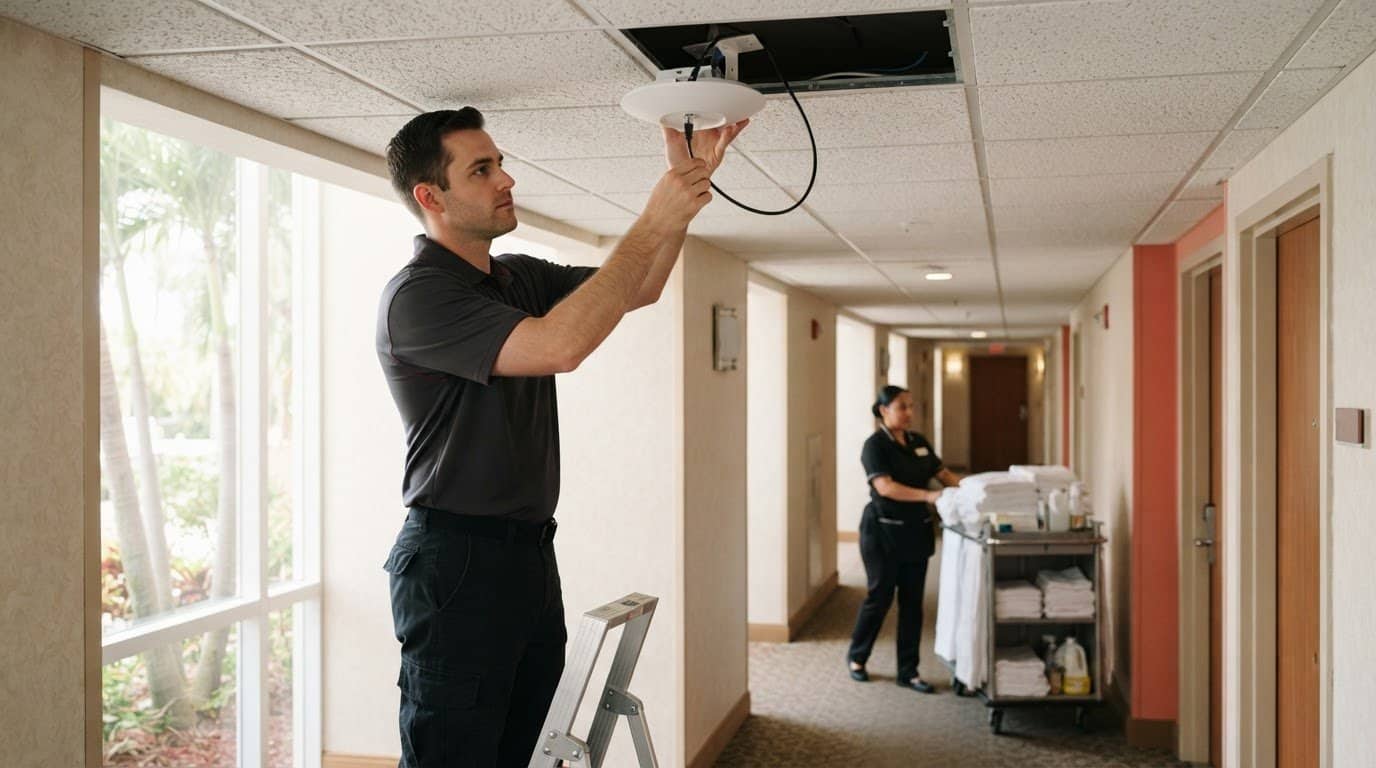
14 Nov Hospitality IT Services for South Florida Hotel Maintenance
Reliable technology is part of the guest experience, even when guests never see it. Hospitality IT services in South Florida help hotels and other hospitality businesses maintain the networks, servers, cloud systems, and security that keep daily operations running. Effective support combines proactive maintenance with a clear process for resolving technical issues, helping limit disruptions for staff and guests.
A connectivity or system problem can affect communications, reservations, payments, and the work of front-desk and operations teams. This article explains how hospitality IT maintenance works, what certified technicians contribute, and how monitoring, security, backups, and help desk support fit into a hotel’s technology plan.
You’ll also learn what to consider when choosing professional support and how a managed IT partner can align technology with your business needs. The goal is a dependable foundation that lets your team focus on serving guests.
Key Takeaways
- Assess whether a provider understands how hotel, resort, and restaurant operations depend on reliable technology.
- Learn how Wi-Fi, networking, cybersecurity, and support work together to keep hospitality systems connected and protected.
- Compare managed IT providers by the services they cover and how well their approach fits your property’s needs.
- See how managed IT, help desk support, network security, and cloud computing can support a more dependable technology foundation.
Which South Florida IT providers specialize in hotels, resorts, and restaurants?
Hospitality businesses rely on connected systems across guest rooms, reception, restaurants, and back-office teams. For example, a network issue affecting a front-desk workstation may also disrupt staff access to booking or payment systems. A provider’s fit is demonstrated by how it plans for these connected operations, not simply by calling itself a hospitality specialist.
For hotels seeking hospitality IT services in South Florida, local knowledge matters alongside technical scope. A resort, boutique hotel, and independent restaurant have different layouts, workflows, and technology needs. A useful support plan accounts for the property’s systems, where connectivity is needed, and which staff rely on each system. This provides a more practical picture of service needs than a generic list of technology products.
Hospitality technology support can include several linked responsibilities:
- Property connectivity: Map network access across guest areas, reception, meeting spaces, kitchens, and offices.
- Operational continuity: Identify which systems staff need to keep reservations, payments, and internal communications moving.
- Security and recovery: Plan how access is protected and how business data can be restored after a disruption.
- Support coordination: Define how staff report an issue and how technical teams handle it through resolution.
These examples show how business IT support can be tailored to hospitality operations. A restaurant may depend on reliable connections between its office and service areas, while a hotel may have multiple teams using shared systems. The support approach should reflect those differences rather than apply one unchanged setup to every property.
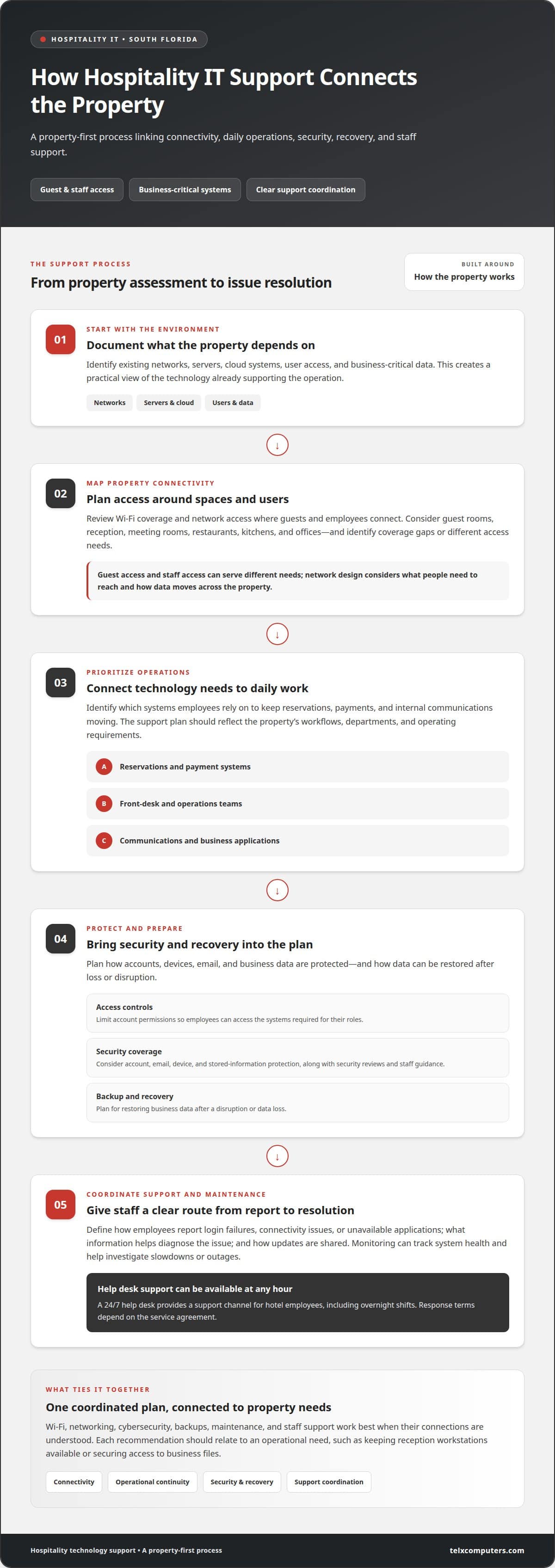
In practice, a sound engagement begins by documenting the environment. The support team identifies existing networks, servers, cloud systems, user access, and business-critical data. It then prioritizes risks and maintenance needs with the property’s operating requirements in view. An outsourced IT support model can coordinate these responsibilities through a single support relationship, as described in this IT outsourcing services approach.
When comparing options, focus on what the provider can explain clearly: how systems are monitored, how staff support is organized, and how security and backups fit the overall plan. Each technical recommendation should connect to a property need, such as keeping reception workstations available or securing access to business files. That operational focus is a stronger sign of fit than hospitality language alone.
For properties with several locations or departments, coordination matters too. The support plan should show how technology decisions, maintenance, and incident handling work together across the business. This helps hotel, resort, and restaurant leaders understand who is responsible for what and how technical support serves daily operations.
What hotel IT services include Wi-Fi, networking, cybersecurity, and 24/7 support?
A hotel’s IT plan connects guest access with the systems employees use to serve them. For example, Wi-Fi supports guests, while separate network access can serve staff devices and business systems. Network design considers where people connect, what they need to access, and how data moves across the property.
Wi-Fi support includes assessing coverage in guest rooms, reception, meeting rooms, and restaurants. A weak signal in a conference room can affect presentations, while unreliable access near reception can complicate routine work. Technicians can review the network layout, identify coverage gaps, and plan adjustments around the building and its daily use.
Networking also links essential equipment and services. A hotel may rely on workstations, printers, phones, servers, and cloud applications. Effective support maps those connections, monitors system health, and investigates slowdowns or outages. Business network support can address how these pieces connect and perform together.
Cybersecurity safeguards accounts, devices, email, and business data. A service plan may include access controls, email security, security reviews, and staff guidance. For example, limiting account permissions helps ensure employees can access the systems required for their roles. Backup and recovery planning also helps prepare for data loss or system disruption.
A 24/7 help desk gives hotel employees a support channel at any hour, including overnight shifts. The service can receive reports about login failures, connectivity issues, or unavailable applications. Clear support procedures identify how staff report an incident, what information helps diagnose it, and how updates are shared. Response terms depend on the service agreement.
When reviewing a hotel IT plan, look for a coordinated scope that addresses:
- Wi-Fi: Guest and employee coverage across the property’s working and public spaces.
- Networking: Connections among devices, communications systems, and business applications.
- Security: Protection for accounts, email, devices, and stored information.
- Support: A defined way for employees to report technical problems and receive assistance.
These areas work best as one coordinated plan. A network change can affect applications, employee access, and security controls, so maintenance should account for those connections. A provider can document the environment, prioritize service needs, and align monitoring and support with the property’s operations. Hotel managers can then identify which systems need the closest attention and how staff will be kept informed during an issue.
Amanda Millman spent ten years leading Business and Network Development for a large public health system. Her experience offers a useful reminder for hotel planning: technology decisions affect the people and services that depend on them. A provider discussion should therefore cover not only equipment, but also how employees use systems during routine work and when they need support.
Questions about ownership, documentation, and communication can clarify whether a proposed service fits the property’s operations. Teams can also discuss how network maintenance, security safeguards, and help-desk procedures will be coordinated, so employees know what to expect when a problem arises.
Comparing Hotel Managed IT Providers in South Florida
Compare providers by how their support fits a hotel’s actual operating model. A boutique property with one front desk has different coordination needs from a resort with separate lodging, dining, and event teams. Discuss how the proposed service would support those workflows, who manages ongoing support, and how staff report technical issues. Specific examples reveal more than a broad promise to support hospitality businesses.
Scope is a useful starting point for comparison. One provider may focus on troubleshooting, while another coordinates routine maintenance, system monitoring, security, and recovery planning. For example, a hotel adding a restaurant should consider the new users, devices, and business systems involved. Review the work included and how requests beyond that scope are handled.
Compare these practical areas:
- Operational fit: Does the support plan reflect the property’s departments, locations, and staff workflows?
- Service ownership: Is it clear who receives an issue and communicates progress to hotel staff?
- Proactive work: Does the provider describe maintenance and monitoring, not just repair after a failure?
- Continuity planning: Does the approach connect data backup and recovery with business operations?
Communication also distinguishes a coordinated partner from a reactive help desk. A hotel manager should understand how an issue is logged, prioritized, and escalated. For example, a problem affecting multiple departments may require different handling from a single employee’s access issue. Clear procedures help staff know what information to provide and what updates to expect.
Evaluate the provider’s transition process, too. Careful onboarding documents existing systems, user access, recurring issues, and business priorities before changes begin. This baseline helps the support team understand the property’s environment and organize maintenance around its operations. A rushed handover can leave documentation gaps or unclear responsibility for systems.
Compare costs by scope, not by headline figure alone. The amount of support, included maintenance, security work, and recovery planning all affect what a proposal covers. Compare equivalent responsibilities and identify exclusions, service limits, and how additional work is handled. This makes proposals easier to assess without treating different scopes as identical.
For South Florida hotels, the strongest fit is a provider whose process connects daily support with long-term technology planning. If your property needs coordinated oversight, explore managed IT support as a way to align maintenance, issue handling, and business priorities.
Telx Computers
Telx Computers helps South Florida hospitality businesses coordinate technology support around their operational needs. Turn to the team when recurring issues, security concerns, or disconnected systems make it harder for staff to work effectively. Managed IT Services can bring ongoing technology oversight together, while 24/7 Help Desk Support gives employees a channel for technical assistance. Network Security and Cloud Computing can also support a broader technology plan.
The next step is to discuss your property’s current setup, priorities, and support needs. That context helps shape an approach around the systems your team depends on, rather than treating each technical issue as an isolated fix.
Contact Telx Computers to discuss IT support for your hospitality business.
Plan your hotel’s next technology step
Make technology planning part of your hotel’s operational planning, not just a response to the next disruption. Identify upcoming business changes, such as a renovation, a new department, or revised staff workflows. Then consider how technology decisions can support those priorities over time. This forward-looking approach helps hospitality IT services in South Florida fit the property’s direction, rather than treating each decision as a separate task.
A useful next step is to bring your operational priorities and current technology concerns into one discussion with Telx Computers. This gives your IT partner a clearer view of what matters most, where coordination is needed, and which goals should guide future planning. You don’t need to solve every technical question before starting. A focused conversation can help establish a practical direction for your hotel.
Contact Telx Computers to discuss your hotel’s IT needs, and take the next step with a clearer plan.
Frequently Asked Questions
What hospitality IT services are available in South Florida?
Hotels can use services such as email security, cybersecurity audits, VoIP, software licensing, and IT consulting alongside broader technology management. For hospitality IT services in South Florida, the right mix depends on the property’s systems and upcoming operational changes. A hotel adding event space, for example, may need to plan staff accounts, communications, and software access together. Telx Computers supports businesses in Miami, Aventura, and Fort Lauderdale, aligning IT support with local operations.
How can a South Florida hotel choose a hospitality IT provider?
Choose a provider whose onboarding process maps the hotel’s systems, internal responsibilities, and technology priorities before making changes. For example, a property preparing for a renovation should identify which teams need access to systems during the project and who coordinates technology decisions. Evaluate whether the provider can explain how it documents changes and keeps responsibilities clear as the hotel’s operations evolve. Telx Computers provides Managed IT Services for businesses in Miami and South Florida, helping establish an ongoing working partnership rather than just a repair channel.