




05 Aug Strategic Business Cloud Storage Solutions: A Professional Framework for 2026
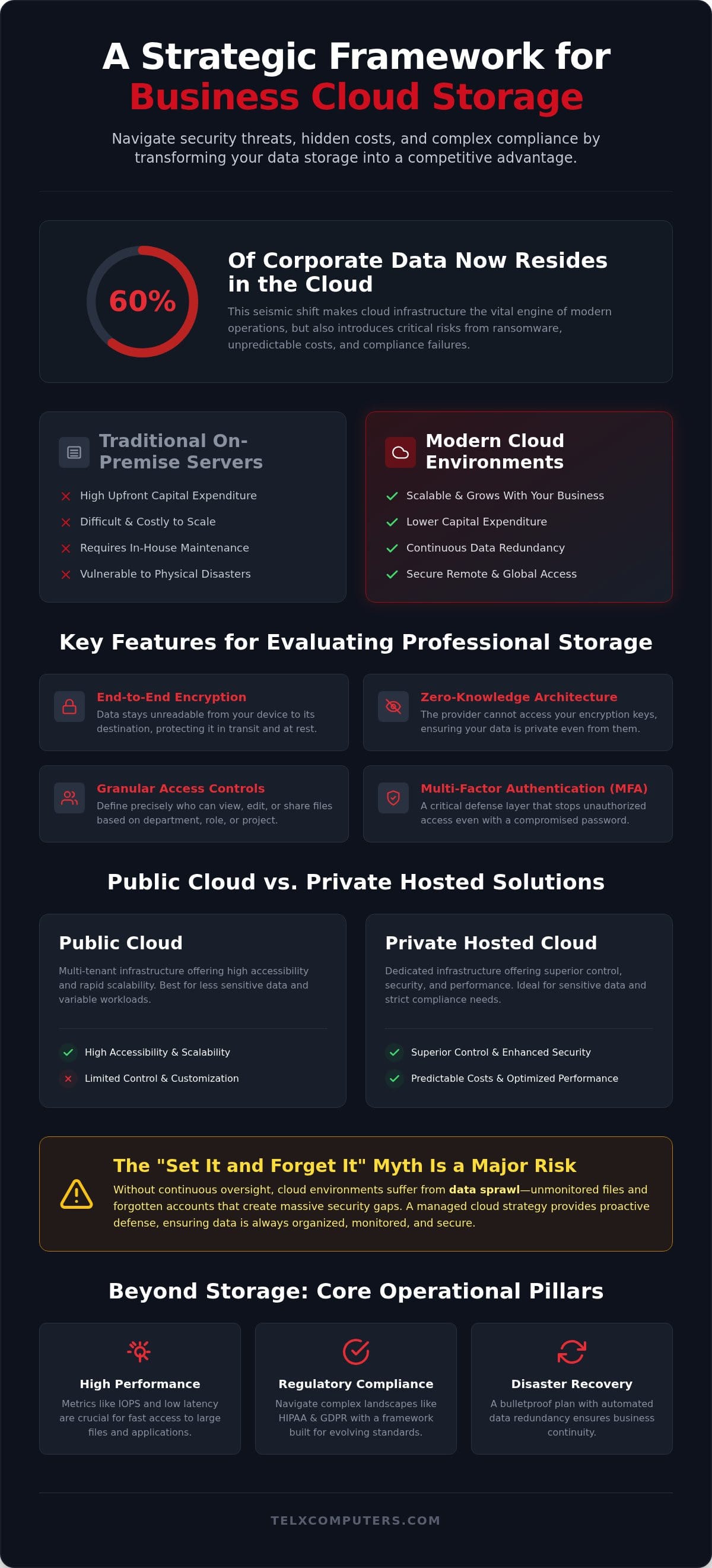
With 60% of corporate data now residing in the cloud, your infrastructure is no longer just a digital filing cabinet; it’s the vital engine of your entire operation. However, selecting the right business cloud storage solutions often feels like a high-stakes gamble against ransomware and spiraling hidden costs. You need more than just a place to put files. You need a strategic framework that turns storage into a competitive advantage.
We understand that the complexity of migrating legacy data can feel overwhelming, especially when you’re balancing the need for seamless remote access with strict compliance mandates. You deserve the peace of mind that comes from a bulletproof disaster recovery plan and a predictable cost model. We’ll show you how to integrate professional storage that protects your assets while lowering capital expenditure on hardware. This framework breaks down the logic behind modern tiering and security protocols to help you align your cloud strategy with your long-term business goals.
Key Takeaways
- Understand the transition from physical servers to scalable environments and how enterprise-grade storage ensures continuous data redundancy.
- Learn to evaluate professional business cloud storage solutions based on end-to-end encryption, Zero Trust architecture, and multi-factor authentication.
- Compare the accessibility of major public cloud providers against the superior control and customization offered by private hosted infrastructure.
- Navigate complex regulatory landscapes like HIPAA and GDPR with a framework designed for the strict enforcement standards of 2026.
- Discover how a strategic partnership and fixed-price service models can eliminate hidden costs while securing your disaster recovery plan.
Understanding Modern Business Cloud Storage Solutions
Professional business cloud storage solutions are often misunderstood as merely digital versions of a physical hard drive. In reality, enterprise-grade infrastructure goes far beyond simple file hosting. It encompasses a complex architecture of data redundancy where your information is mirrored across multiple secure locations to prevent loss. As we move through 2026, the traditional server room is becoming a relic of the past. Modern enterprises are replacing bulky hardware with scalable cloud storage environments that grow alongside their operational needs without requiring massive upfront capital.
In markets like Miami, many local businesses are prioritizing hybrid cloud models to maintain a technological edge. This approach allows them to keep sensitive data close while leveraging the power of remote processing for global accessibility. Unlike consumer-grade options like a basic Google Drive account, business-managed storage provides the granular control and compliance frameworks that professional industries demand. It’s the difference between a public locker and a private, guarded vault. For organizations looking to secure their physical infrastructure locally, you can learn more about 3EX Hosting and their Miami-based colocation services. We see our role as the silent engine that powers these transitions, ensuring your team has what they need without the technical anxiety.
The Core Components of an Enterprise Cloud
Understanding the technical breakdown is essential for making an informed choice. Most organizations must decide between object storage and file storage. Object storage is ideal for massive amounts of unstructured data, such as archives or media files, while file storage mimics traditional folder structures for easier daily collaboration. Performance hinges on high-speed connectivity; without it, even the best cloud becomes a bottleneck. To ensure peak efficiency, your storage must be seamlessly integrated with robust network IT support in Miami to handle the traffic load and maintain consistent uptime.
Why “Set It and Forget It” is a Dangerous Myth
The greatest risk to your data isn’t just external threats; it’s internal neglect. Thinking your cloud is safe simply because it exists is a dangerous assumption. Without continuous oversight and configuration, organizations quickly fall victim to data sprawl, where files are scattered across unmonitored accounts and forgotten folders. This lack of organization creates security gaps that are easy for bad actors to exploit. Managed cloud storage is a proactive security layer that ensures your data is always monitored, organized, and accessible only to those with the proper credentials.
Key Features for Evaluating Professional Storage
Selecting the right business cloud storage solutions involves more than comparing monthly fees. You need a platform that acts as a silent guardian for your most sensitive assets. Enterprise-grade storage must prioritize data integrity and availability without sacrificing the speed your team needs to stay productive. It’s about building a foundation where security and performance coexist seamlessly.
End-to-end encryption ensures data stays scrambled from the moment it leaves your device until it reaches its destination. Zero-knowledge architecture takes this protection further. It means the service provider doesn’t hold your encryption keys. If they can’t see your data, neither can a third party who might breach their systems. This level of privacy is essential for maintaining client trust and meeting strict regulatory standards.
Granular access controls allow you to define exactly who sees what. You can restrict permissions by department, seniority, or specific project roles. When you combine these controls with multi-factor authentication (MFA), you create a layered defense that stops unauthorized entry in its tracks. These features work best when they’re part of your broader managed IT support services. This creates a unified ecosystem where your storage isn’t a silo, but a protected extension of your network.
Scalability and Performance Metrics
High-performance storage isn’t just about capacity. You must also consider IOPS (Input/Output Operations Per Second) and latency. These metrics determine how quickly your team can open large files or run database-heavy applications. As your data volume grows, the efficiency of your business cloud storage solutions depends on consistent performance. When evaluating different cloud solutions, look for providers that offer transparent performance tiers. Reliability also requires 24/7 help desk support to resolve accessibility issues the moment they arise.
Collaboration Tools vs. Storage Security
Modern teams expect real-time editing and instant sharing. In 2026, cloud suites offer sophisticated co-authoring tools that can tempt users to bypass security protocols for the sake of speed. Your framework must balance this ease of use with strict IT standards. Automated versioning is a critical safety net here. It allows you to roll back to a clean version of any file if an error occurs. Integrating robust ransomware protection ensures that even if a local machine is compromised, your cloud-based backups remain untouched and ready for restoration.
Understanding these technical requirements is the first step toward a secure transition. If you’re ready to see how these features apply to your specific infrastructure, you can request a tailored quote to explore your options.
Public Cloud vs. Private Hosted Solutions
Choosing between public and private models is a pivotal decision for any modern enterprise. It defines how your team interacts with data and how much control you maintain over your digital borders. While public giants like Microsoft Azure, Amazon Web Services (AWS), and Google Cloud dominate the market, they aren’t the only path to a robust infrastructure. Each model offers distinct advantages depending on your operational scale and security needs.
Public platforms offer incredible scalability and a massive array of features. AWS currently leads the market with a 32% share, followed by Azure at 23%. These services provide integrated collaboration tools that are difficult to replicate. However, you must understand the shared responsibility model. These providers secure the cloud itself, but you’re responsible for the data, configurations, and access management within it. Neglecting this distinction is where many organizations face their greatest risks.
Private hosted clouds offer a dedicated environment where resources aren’t shared with other organizations. This eliminates “noisy neighbor” performance issues and gives you total oversight of security configurations. For high-paced firms in NYC and LA, such as the L.A. Law Office, a hybrid approach often provides the best balance. You can keep sensitive archives in a private vault while using public platforms for daily collaboration. While subscription fees for public clouds seem low, the long-term ROI of a private or hybrid model often comes from avoiding hidden egress fees and achieving faster disaster recovery.
When to Choose Private Hosting
Organizations with high-security requirements, such as those in the legal or healthcare sectors, often find public clouds too restrictive for their specific compliance needs. If your workflow depends on custom applications that require specific server configurations, private hosting is the logical choice. Leveraging specialized computer IT services in Miami allows you to maintain local control while benefiting from global technical standards. This ensures your business cloud storage solutions are tailored to your exact performance benchmarks.
The Public Cloud Advantage for Remote Teams
Public business cloud storage solutions excel at keeping remote teams connected across different time zones. They offer built-in real-time co-authoring and global accessibility that simplify complex projects. To manage these environments effectively, many businesses partner with a managed service provider. This partnership reduces the burden on your internal staff, allowing them to focus on growth while we handle the vigilant monitoring of your public cloud security settings.
Security and Compliance: The Expert Guardian Approach
Security isn’t a secondary feature; it’s the foundation of effective business cloud storage solutions. We adopt a Zero Trust architecture where every access request is verified, regardless of its origin. This proactive stance moves your organization away from reactive fire-fighting and toward a model of constant vigilance. By integrating sophisticated servers monitoring systems, we detect anomalies before they evolve into critical breaches. It’s about being the silent engine that keeps your data secure while you focus on growth.
Navigating the regulatory environment in 2026 requires precision and a deep understanding of local and global standards. Nineteen U.S. states now have comprehensive privacy laws in effect, including new mandates like the California Delete Act’s platform which launched on January 1, 2026. Managing these requirements demands more than just a storage provider; you need a strategic ally. We ensure your infrastructure meets SOC2 and GDPR requirements, providing the stability and peace of mind your clients expect.
Cloud Storage for Healthcare and Legal Firms
For organizations utilizing healthcare IT services in Miami, HIPAA compliance is a non-negotiable requirement. Patient records demand specific encryption standards and strict audit trails to maintain integrity. Similarly, law firms must maintain rigorous data retention policies to protect attorney-client privilege. We implement automated access logging and granular permissions to ensure every interaction with sensitive data is documented and defensible during a compliance audit.
Disaster Recovery and Business Continuity
Cloud storage is a vital component of your business continuity plan, but it isn’t a complete backup strategy on its own. We advocate for the 3-2-1 backup rule: three copies of your data, on two different media types, with one copy stored off-site. This creates a multi-layered safety net that protects against local hardware failure and cloud provider outages. With public cloud spending projected to reach over 45% of enterprise IT budgets in 2026, the operational impact of a storage failure has never been more significant. Proactive monitoring ensures your business remains operational even when the unexpected occurs.
Securing your data is a continuous journey that requires expert oversight. If you want to ensure your current infrastructure is truly protected, request a cybersecurity audit to identify and close any potential gaps in your defense.
Implementing a Strategic Cloud Solution with Telx
Effective business cloud storage solutions shouldn’t be isolated tools that your team struggles to manage alone. They are foundational components of your broader IT ecosystem. At Telx Computers, we position ourselves as your strategic ally, ensuring that your storage infrastructure aligns perfectly with your operational workflows. Our it outsourcing services provide a holistic approach that integrates cloud storage with network security and disaster recovery, removing the technical anxiety often associated with digital transitions.
We believe that technology should serve your business goals, not create new hurdles. By treating storage as part of a managed IT environment, we provide the stability and peace of mind you need to scale. Our team acts as the silent engine behind your success, handling the complex backend configurations so you can focus on high-level strategy. This integrated approach ensures that every file saved and every byte transferred is protected by the same rigorous standards that govern your entire network.
Our Proven Migration Process
Migration is often the most stressful phase of cloud adoption. We eliminate this friction through a proven, structured process that prioritizes data integrity. We begin with a comprehensive audit to understand your current data landscape and develop a strategic roadmap tailored to your needs. Our team handles the secure data transfer using protocols that ensure zero operational downtime, so your business never misses a beat. Once the migration is complete, we provide post-migration training and full help desk integration to ensure your team feels confident and productive with their new tools.
The Telx Guarantee: Reliability and Support
We believe in transparency and reliability. Our fixed-price, unlimited service plans provide predictable budgeting without the fear of hidden storage fees or surprise invoices. We offer 24/7 monitoring of your cloud infrastructure to catch potential issues before they impact your productivity. For businesses in Miami, Fort Lauderdale, and Aventura, our rapid on-site response provides an extra layer of security that global-only providers simply cannot match. This localized focus, combined with our deep technical expertise, makes us the ideal partner for your cloud journey. Ready to secure your data? Get an instant quote today and discover the difference of a truly managed cloud solution.
Securing Your Digital Future with Managed Cloud Infrastructure
Professional cloud infrastructure is no longer an optional upgrade; it’s the bedrock of a resilient enterprise. You’ve seen how modern business cloud storage solutions must integrate Zero Trust security with seamless accessibility to protect your operations from evolving threats. By moving away from unmanaged, siloed storage and toward a holistic framework, you eliminate the technical anxiety of data sprawl and unpredictable costs.
Telx Computers has been the silent engine behind business success since 2002. With over 20 years of expertise, we provide the stability of fixed-rate recurring billing and the agility of rapid response teams in Miami, NYC, and LA. We’re ready to act as your strategic ally, ensuring your transition to the cloud is secure, compliant, and perfectly aligned with your growth. Our proactive approach means you don’t have to worry about the backend; you can focus on leading your industry.
Take the first step toward a more secure and efficient infrastructure today. Request a Strategic IT Consultation and Instant Quote. Your data deserves the protection of an expert guardian, and we’re here to provide it.
Frequently Asked Questions
What is the most secure cloud storage for small businesses in 2026?
The most secure options are those that implement Zero Trust architecture and end-to-end encryption as their primary defense. While public providers offer high-level security, a private hosted cloud managed by a strategic ally provides the most granular control over your digital borders. This setup ensures your specific industry compliance needs are met through personalized configuration and vigilant monitoring rather than a one-size-fits-all public model.
How much does business cloud storage typically cost?
Total costs are determined by several factors including storage volume, access frequency, and data transfer fees. While basic storage starts at low per-gigabyte rates, businesses must account for “egress” costs and retrieval fees for colder data tiers. We recommend fixed-price unlimited service plans to avoid the bill shock that often accompanies scalable storage models, ensuring your budgeting remains predictable and manageable.
Can cloud storage replace my on-site file server entirely?
Most organizations can replace their physical hardware with a completely cloud-based environment to reduce capital expenditure. This shift eliminates the ongoing costs of hardware maintenance, physical security, and server room cooling. However, a successful transition requires a robust network infrastructure to ensure that your team experiences the same performance and low latency they enjoyed with a local file server.
Is cloud storage HIPAA compliant for medical practices in Florida?
Cloud storage is HIPAA compliant only if the provider signs a Business Associate Agreement and implements specific security controls. In Florida, medical practices must ensure that their business cloud storage solutions include audit trails, encrypted data at rest, and strict access logging. Partnering with an expert who understands specialized healthcare IT is the best way to maintain these rigorous standards.
What happens to my data if the cloud provider goes out of business?
Your data remains your property, but retrieving it quickly requires a proactive exit strategy. Most reputable enterprise providers have legal contingency protocols, but the 3-2-1 backup rule is your best defense. By keeping a secondary copy of your data in a separate environment, you ensure that your business continuity isn’t tied to the financial health of a single vendor.
How does cloud storage integration affect network speed in my office?
Integrating business cloud storage solutions can impact local network speeds if your bandwidth isn’t optimized for the increased data traffic. We utilize proactive monitoring to balance the upload and download loads, ensuring that background syncing doesn’t create bottlenecks during peak hours. Proper configuration of your office network allows for seamless file access without interrupting your team’s real-time collaboration or VoIP performance.