





17 Jul Cost of Managed IT Services for Small Business: 2026 Pricing Analysis
Your monthly technology invoice shouldn’t feel like a gamble. Many leaders view IT as a black hole of unpredictable expenses, where every support ticket or software update carries the threat of a hidden fee. If you’re tired of reacting to “emergency” invoices and worrying about the financial fallout of a potential ransomware attack, you’re not alone. Understanding the actual cost of managed IT services for small business is the first step toward transforming your technology from a burden into a silent engine for growth.
We’re providing a transparent breakdown of modern pricing models to help you eliminate budgeting anxiety. You’ll learn how to identify hidden costs before they appear on your bill and how to structure your technology investment as a strategic asset. We’ll explore the logic behind fixed-rate models that prioritize proactive protection over reactive fixes. This analysis covers everything you need to secure predictable spending, maintain zero downtime during critical business hours, and ensure your operations meet the latest industry security standards.
Key Takeaways
- Learn why the per-user pricing model provides the most predictable path for scaling your technology budget alongside your workforce.
- Calculate the true financial impact of system failures using the “Downtime Formula” to understand why budget IT often costs more in the long run.
- Identify how industry-specific compliance requirements and infrastructure complexity directly affect the cost of managed IT services for small business.
- Master the art of evaluating service quotes by identifying common exclusions, such as on-site visit fees and after-hours support surcharges.
- Explore the benefits of a fixed-price, unlimited service model that transforms your technology into a reliable, silent engine for operational success.
Understanding Managed IT Services Pricing Models in 2026
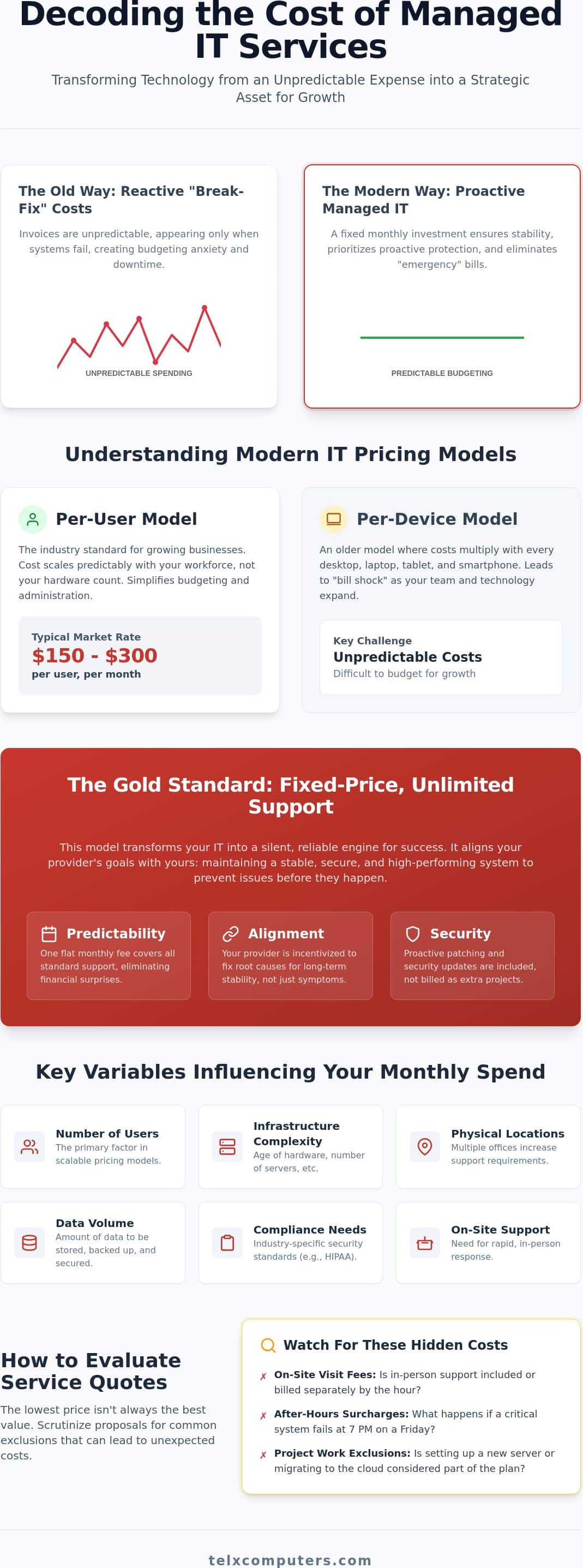
Choosing how to pay for technology support is as critical as the technology itself. For years, many small businesses relied on “break-fix” models, where you only paid when something failed. This created a fundamental conflict of interest. Your IT provider only made money when you were suffering from downtime. A modern Managed Service Provider (MSP) operates on a different philosophy. We function as a proactive partner, focusing on stability and security to prevent issues before they ever disrupt your workflow.
To better understand this concept, watch this helpful video:
Per-User vs. Per-Device: Which Fits Your Business?
The modern workforce is highly mobile. Your team members likely switch between a laptop at the office, a tablet in the field, and a smartphone for emails. Under a per-device model, this sprawl leads to “bill shock” as your monthly costs multiply for every new piece of hardware added to the network. This complexity is why the per-user model has become the industry standard for growing companies. It offers a clear, scalable way to calculate the cost of managed IT services for small business. For a fully managed environment that includes advanced security and cloud management, current market benchmarks suggest a range of $150 to $300 per user.
This predictability allows you to hire new staff with full knowledge of exactly how your IT overhead will change. You don’t have to worry about whether a new employee needs a desktop, a laptop, or both; the cost remains tied to the person, not the equipment. It simplifies your balance sheet and removes the administrative burden of tracking every single serial number on your monthly invoice.
The Rise of Fixed-Price, Unlimited Support
Models based on a “bucket of hours” often leave business owners hesitant to call for help, fearing that every five-minute phone call will trigger another bill. This hesitation is dangerous. It leads to small glitches snowballing into major system failures or unpatched security vulnerabilities. Unlimited support models represent the gold standard for operational efficiency. When your support is all-inclusive, your goals and your provider’s goals finally align. Both parties want a silent, high-performing engine that never breaks down.
This approach allows for predictable IT budgeting, ensuring your monthly spend remains constant regardless of how many support tickets your team submits. By removing the financial barrier to seeking help, you ensure that your network remains optimized and secure. When evaluating the cost of managed IT services for small business, look for providers who offer this total budget certainty. It replaces technical anxiety with a sense of stability, allowing you to focus on your core business while your “silent engine” runs flawlessly in the background.
- Predictability: One flat fee covers all your standard support needs.
- Alignment: Your provider is incentivized to fix root causes, not just symptoms.
- Security: Proactive updates are included, not billed as extra projects.
Key Variables Influencing Your Monthly IT Spend
Calculating the cost of managed IT services for small business involves more than just counting heads. Your specific operational landscape dictates the level of vigilance required. Factors like the number of physical office locations, the age of your hardware, and the volume of data you store all play a role in the final quote. A partner-oriented provider looks at these variables to ensure your technology supports your growth rather than hindering it with unexpected failures.
In high-traffic metropolitan areas like Miami, NYC, or LA, the ability to provide rapid on-site response is a major cost driver. Providers with a physical presence in these hubs can bypass the delays of remote-only support. While remote help desks solve many issues, having an expert guardian who can arrive at your office during a hardware crisis is a premium service that adds immense value to your business continuity plan.
Infrastructure Complexity and Cloud Integration
Hybrid environments that mix local servers with cloud applications often require more oversight than pure cloud setups. Effective server monitoring is vital here; it ensures that local hardware doesn’t become a bottleneck for your cloud-based workflows. Managing legacy equipment often increases monthly spend because older systems require more frequent patching and troubleshooting to remain secure. Modernizing your stack might have an upfront cost, but it typically lowers your long-term maintenance fees by reducing the frequency of support tickets.
Compliance and Industry-Specific Needs
Regulated industries face stricter requirements that influence the total cost of managed IT services for small business. For example, healthcare IT compliance involves rigorous HIPAA standards for data encryption and access logs. Similarly, legal IT services prioritize sophisticated document management and client confidentiality. Following cybersecurity best practices from the FTC is a baseline, but these specialized sectors often see a 20% to 30% increase in per-user rates due to the necessary audit-ready reporting and advanced threat detection.
Your Service Level Agreement (SLA) also impacts the price. A guarantee for a 1-hour response time during an emergency requires a provider to maintain a higher ratio of engineers to clients than a standard 4-hour window. Finally, expect an initial onboarding fee. This one-time investment allows your partner to stabilize your network, document every asset, and eliminate existing vulnerabilities. If you’re curious about how these variables apply to your specific setup, you can get an instant quote to see a transparent breakdown of your potential investment.
The Real Price of ‘Budget’ IT: Downtime and Security Risks
Choosing a provider based solely on the lowest monthly quote often leads to the most expensive outcome. While a lower price point might look attractive on a spreadsheet, it frequently hides a reactive service model that leaves your business vulnerable. To understand the true cost of managed IT services for small business, you must look beyond the invoice and calculate the financial impact of system failures. We view managed IT not as a simple tech expense, but as essential business continuity insurance that protects your bottom line from the catastrophic costs of silence.
The most effective way to quantify this is through the “Downtime Formula.” Multiply your number of employees by their average hourly rate, then add your average hourly lost revenue. If a 20-person team sits idle for just three hours due to a network crash, the labor loss alone is significant. When you add missed sales opportunities and potential reputational damage, the “savings” from a budget IT provider vanish instantly. A strategic ally ensures your team remains productive, acting as the silent engine that keeps your operations running without interruption.
The True Cost of a Data Breach
Security is no longer an optional add-on; it’s a core requirement for survival. Modern threats are increasingly sophisticated, and “cheap” IT support often lacks the advanced tools needed for 2026-level protection. A single security lapse can result in recovery costs that dwarf your annual IT investment. Cyber resilience is the ability to recover your entire operation within minutes, not days. Without robust ransomware protection, a small business faces a high probability of permanent data loss or massive extortion fees that many organizations never recover from.
Why ‘Break-Fix’ is More Expensive in the Long Run
The traditional break-fix model creates a fundamental conflict of interest. In that scenario, your IT provider only generates revenue when your systems fail. This reactive approach ignores the root causes of technical issues, leading to a cycle of recurring problems and unpredictable “emergency” bills. An expert guardian, however, focuses on proactive maintenance. By identifying and resolving vulnerabilities before they cause a crash, a managed partner can eliminate the vast majority of emergency service calls. This shift allows your leadership team to stop troubleshooting technical glitches and start focusing on high-level growth and strategic goals.
- Leadership Focus: Reclaim hours spent on tech issues for business development.
- Predictable Spending: Replace volatile emergency invoices with one flat monthly fee.
- Asset Longevity: Proactive care extends the life of your hardware and software investments.
How to Evaluate Managed IT Quotes for Your Small Business
Evaluating a proposal requires a keen eye for detail. When you review the cost of managed IT services for small business, you must look past the initial monthly figure to see what is actually covered. A quote that seems significantly lower than others often excludes critical services like on-site emergency visits or after-hours support. These “extras” can quickly inflate your actual spend, turning a budget-friendly plan into a financial burden that lacks the predictability you need to grow.
A comprehensive proposal should include high-level strategic planning. In a rapidly evolving environment, having access to a virtual CTO to help design your technology roadmap is essential for long-term stability. You should also verify the nature of their 24/7 support. Ensure you are speaking with a live person who understands your business context rather than an automated ticketing system that leaves your team waiting for hours during a crisis. This human element is a key differentiator for a partner-oriented service.
- On-Site Inclusion: Confirm that emergency visits don’t trigger additional hourly charges or travel fees.
- Support Accessibility: Verify that help desk staff are available 24/7 and aren’t restricted to “business hours only.”
- Strategic Roadmapping: Ensure the quote includes regular reviews to align your tech stack with your business goals.
Spotting Hidden Fees in IT Contracts
Many providers offer “Remote Only” support to keep their base rates low. While this works for minor software glitches, it leaves you stranded when a physical switch fails or a server goes offline. Watch out for project fees for routine software updates that should be part of a proactive maintenance plan. Checking a provider’s IT service guarantees is the best way to ensure accountability. A reliable partner will be transparent about what’s included, eliminating the risk of bill shock at the end of the month.
The Importance of Local Presence
For businesses in South Florida, a provider with a physical Miami IT company office provides a level of security that remote-only firms cannot match. If your network goes down in Fort Lauderdale or Aventura, you need a technician who can be on-site in under an hour to restore operations. This local commitment is equally critical for firms in NYC and LA, where logistics like office relocations or rapid hardware procurement require boots on the ground. A local presence ensures that your “silent engine” receives the physical care it needs without the delay of shipping parts or flying in experts from another state.
Before signing any agreement, ensure the contract explicitly states their on-site response time and support structure. This transparency is what separates a mere vendor from a dedicated strategic ally. If you want to see how a truly all-inclusive model works, learn more about our strategic ally approach and how we prioritize your uptime through a localized, expert guardian model.
Strategic IT Budgeting with Telx Computers’ Fixed-Price Model
Total budget predictability isn’t a luxury; it’s a strategic necessity. At Telx Computers, we’ve replaced the traditional, complex billing structures with a “Fixed-Price, Unlimited” philosophy. This model ensures that the cost of managed IT services for small business remains a stable line item on your balance sheet, regardless of how many support requests your team generates. By removing the financial friction of hourly billing, we allow you to treat technology as a seamless extension of your operations rather than a source of fiscal stress.
Standard features in our agreements include 24/7 Help Desk support and Rapid On-Site Response. We don’t view these as premium add-ons or hidden upsells. They are the baseline requirements for maintaining a high-performance business environment. Our partner mindset means we’re successful only when your technology is invisible. When your systems run flawlessly in the background, your team stays productive, and your growth remains unhindered. We take pride in being the silent engine that powers your daily success through vigilant, proactive management.
Why Miami Businesses Choose Telx for Cost Control
Local expertise matters when a physical hardware failure threatens your uptime. Our dedicated Aventura and Fort Lauderdale support teams understand the regional business landscape, providing a level of responsiveness that remote-only providers simply can’t match. This local presence significantly reduces operational risks for firms in high-stakes sectors. We have deep experience navigating the specific compliance and security requirements of the healthcare and legal industries, ensuring your infrastructure meets every regulatory standard without surprise fees.
Our role as an expert guardian is reinforced by advanced monitoring systems that watch your network 24/7. We identify potential bottlenecks and security vulnerabilities before they can escalate into costly downtime. This proactive stance is what allows us to offer a truly fixed-rate model. We’re incentivized to keep your network perfect because your stability is the foundation of our partnership.
Get Started with a Predictable IT Plan
Taking the first step toward a secure and predictable technology budget is straightforward. You shouldn’t have to wait days for a complex proposal just to understand your potential investment. We provide an Instant Quote tool that allows you to see a transparent, no-fluff breakdown tailored to your specific business size and needs. This immediate clarity helps you plan your 2026 roadmap with confidence, knowing exactly what to expect on every invoice.
Our onboarding process is designed to be efficient and non-disruptive. We stabilize your current environment, document your assets, and implement our “silent engine” protocols to ensure a smooth transition. If you’re ready to move away from unpredictable technical expenses and toward a model of total reliability, it’s time for a professional audit. Schedule a consultation today to review your current IT spend and discover how a fixed-price partnership can protect your bottom line while fueling your growth.
Take Control of Your Technology Budget
Viewing technology as a strategic asset rather than a recurring burden is the key to sustainable growth. To explore additional ways to optimize your technology stack through automation and professional web design, learn more about Ultimate Info Services. You now understand how to navigate the variables that impact the cost of managed IT services for small business, from infrastructure complexity to the essential need for local, on-site expertise. Choosing a partner that prioritizes proactive protection over reactive troubleshooting ensures your network remains a silent engine for your success. By eliminating the fear of hidden fees and unpredictable billing, you can focus your leadership energy on high-level objectives while we safeguard your infrastructure.
Our commitment to your stability includes 24/7 Unlimited Help Desk Support and Fixed-Price Predictability to keep your monthly spending secure. With a dedicated physical presence in Miami, NYC, and LA, we provide Rapid On-Site Response whenever physical intervention is required. It’s time to replace technical anxiety with total peace of mind and a roadmap designed for resilience. Get an Instant Quote for Your Managed IT Services today and start building a more secure, efficient future for your organization.
Frequently Asked Questions
What is the average cost of managed IT services for a small business with 20 employees?
Market data for a company with 20 users typically places the monthly investment between $2,500 and $4,000. This range depends heavily on the complexity of your network and the level of cybersecurity required to protect your data. A per-user pricing model provides the most clarity, allowing you to forecast expenses accurately as your team grows.
Are there hidden fees in managed IT service contracts?
Transparency varies by provider, but common “hidden” costs often include travel time, after-hours surcharges, and fees for on-site visits. You should always verify if these services are bundled into your flat rate. We believe in an all-inclusive approach that eliminates “bill shock” by covering standard support and emergency response within your predictable monthly fee.
Does managed IT pricing include the cost of hardware and software licenses?
Managed IT fees generally cover the expert labor, monitoring, and support required to keep your systems running, while hardware and software licenses are separate expenses. Your partner will manage the procurement and renewal lifecycle for you, but the actual cost of the equipment or subscriptions is typically billed as a pass-through cost or handled via a separate leasing agreement.
Why is an onboarding fee necessary for new IT clients?
The onboarding fee covers the intensive labor required to stabilize your environment and document every asset on your network. During this phase, technicians patch existing vulnerabilities, configure secure backups, and align your infrastructure with industry standards. This initial investment ensures that your “silent engine” is tuned correctly from day one, preventing costly issues later.
How much can a small business save by outsourcing IT vs. hiring in-house?
What factors typically cause a managed IT quote to increase?
The cost of managed IT services for small business generally rises when you add physical office locations, local servers, or specialized compliance requirements. Regulated industries like healthcare or law require advanced security layers and audit-ready reporting. These variables demand more vigilance from your expert guardian, which is reflected in the final monthly service agreement.
Can I get a fixed monthly price for all my IT support needs?
Yes, a fixed-rate, unlimited support model is the most effective way to achieve budget certainty. This structure covers all proactive maintenance and help desk requests for one flat fee, regardless of how many tickets your team submits. It aligns your provider’s incentives with your own, as both parties benefit from a network that remains stable and secure.
Is cybersecurity included in the standard managed IT service fee?
Basic security like firewalls and antivirus are usually standard, but advanced protection often requires a higher service tier. Modern threats demand more sophisticated tools, such as endpoint detection and response or managed data backups. It’s vital to ensure these layers are included in your quote to maintain total business continuity and comply with modern security standards.