





27 Jun How to Perform a Cybersecurity Risk Assessment: A Strategic Guide for Businesses
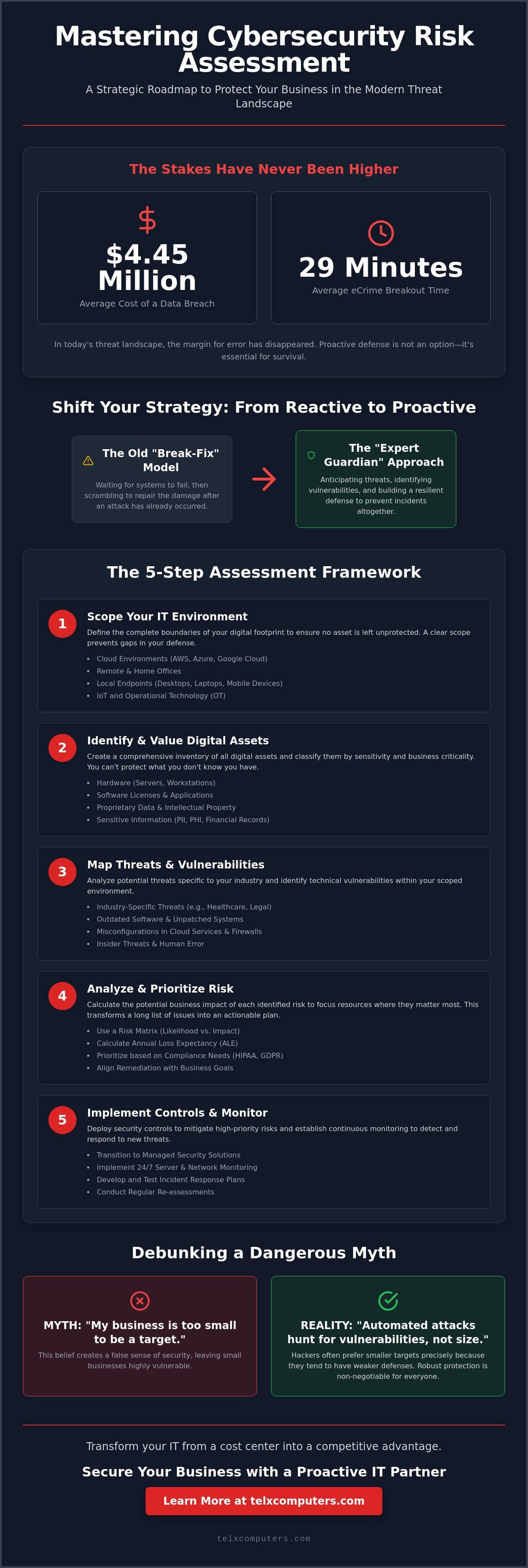
With the average cost of a data breach hitting $4.45 million and eCrime breakout times plummeting to just 29 minutes, the margin for error in your digital defense has vanished. You likely recognize that a standard firewall isn’t enough to stop an AI-enabled adversary, yet the path to true protection often feels buried under complex compliance jargon. Understanding how to perform a cybersecurity risk assessment is no longer just a technical checkbox for the IT department; it’s a fundamental pillar of your operational survival.
We understand the pressure of protecting your organization’s assets while navigating the strict requirements of NIST 2.0 and evolving insurance mandates on a tight budget. It’s a heavy burden, but you don’t have to carry it alone. This guide provides a strategic roadmap to master the essential steps of identifying vulnerabilities and prioritizing threats effectively. You’ll learn how to build a resilient security posture that satisfies legal requirements and provides lasting peace of mind. We’ll explore a structured process that aligns your technical defenses with your broader business goals, ensuring your organization remains a step ahead of emerging risks.
Key Takeaways
- Shift your IT strategy from a reactive “break-fix” model to a proactive “expert guardian” approach that anticipates threats before they disrupt your operations.
- Learn exactly how to perform a cybersecurity risk assessment by establishing a clear scope that covers all cloud environments, remote offices, and local endpoints.
- Identify critical vulnerabilities and map industry-specific threats tailored to the unique regulatory needs of healthcare providers and law firms.
- Prioritize your remediation efforts using a professional Risk Matrix to calculate the potential impact and Annual Loss Expectancy of specific cyber threats.
- Discover how transitioning to managed security solutions and 24/7 server monitoring provides a more resilient and cost-effective defense than building an in-house team.
What is a Cybersecurity Risk Assessment and Why Does Your Business Need One?
A cybersecurity risk assessment isn’t just a technical audit; it’s a strategic deep dive into your organization’s digital health. At its core, this process involves a proactive evaluation of your vulnerabilities, assets, and the specific threats looming in your industry. To truly understand What is an IT security assessment?, you must view it as the foundation of a modern defense strategy. It moves your business away from the outdated “break-fix” model, where you only react when something fails. Instead, it empowers us to serve as your expert guardian, identifying cracks before they become breaches. Mastering how to perform a cybersecurity risk assessment ensures that your security acts as a silent engine, powering uninterrupted growth while protecting the sensitive data that keeps your doors open. This strategic alignment allows your leadership team to focus on scaling the business with the confidence that your infrastructure is secure, compliant, and resilient against the evolving tactics of modern cybercriminals. By prioritizing these evaluations, you transform IT from a cost center into a competitive advantage.
The Business Case for Regular Security Audits
Investing in regular assessments is a smart financial move. Many insurance providers now require proof of these audits before issuing or renewing policies. By demonstrating a proactive posture, you can reduce the long-term cost of cyber insurance premiums. Beyond the balance sheet, your brand reputation is your most valuable asset. Integrating these audits into your managed IT support service ensures disaster recovery is a tested, reliable component of your business continuity strategy.
Common Misconceptions About IT Risk
A dangerous myth is the belief that a business is “too small” to be a target. Hackers often prefer smaller targets because they typically have weaker defenses. Automated attacks don’t distinguish by size; they simply look for open doors. This is why robust ransomware protection is critical regardless of your headcount. Learning how to perform a cybersecurity risk assessment helps you distinguish between a simple scan and a strategic analysis that meets compliance needs like HIPAA or GDPR.
The Step-by-Step Methodology for a Comprehensive Security Audit
Executing a successful audit requires a disciplined approach that balances technical depth with business logic. Many organizations struggle with where to begin, but the process becomes manageable when broken into logical phases. By following a structured framework like the NIST Guide for Conducting Risk Assessments, you ensure that no stone is left unturned. This methodology isn’t just about finding bugs; it’s about understanding how to perform a cybersecurity risk assessment that actually informs your long-term strategy. You’ll start by defining the boundaries of your digital footprint, then move into valuing what you own, and finally, identifying the specific forces that could disrupt your operations.
Step 1: Scoping Your IT Environment
Scoping your environment is the most critical phase. Without clear boundaries, you risk “scope creep” where the project becomes too large to manage or misses vital segments. Your perimeter must extend beyond the physical office. It needs to include cloud environments, mobile devices, and IoT equipment. For businesses with distributed teams in cities like Fort Lauderdale or Aventura, the assessment must account for home office security and public Wi-Fi risks. Ensuring your network IT support in Miami is integrated into this scope provides a unified, local-to-global defense.
Step 2: Identifying and Valuing Digital Assets
Once the scope is set, you must inventory every digital asset. This isn’t just a list of hardware. It includes software licenses, proprietary data, and sensitive records like PII or PHI. Categorizing data by sensitivity helps you prioritize protection based on legal and operational necessity. You should also assign a dollar value to downtime for each asset. If a server goes offline, what’s the hourly cost in lost productivity and missed opportunities? Critical assets are any resources whose loss would halt primary business operations. Knowing these values allows for a smarter, more efficient allocation of your security budget.
With assets identified, you can map the threat landscape. This includes external hackers using AI-driven malware, but also insider threats and natural disasters. Analyzing your existing it outsourcing services or internal controls helps find gaps in your current network security posture. Finally, document every finding in a formal risk register. This document acts as a living record that guides executive decision-making, turning technical data into actionable business intelligence. If you’re unsure where your perimeter ends, an instant quote can help you start planning your professional audit today.
Identifying Critical Vulnerabilities and Mapping the Threat Landscape
To master how to perform a cybersecurity risk assessment, you must first distinguish between vulnerabilities and threats. A vulnerability is a weakness in your infrastructure, like an unpatched operating system or a poorly configured cloud bucket. A threat is the actor or event that exploits that weakness, such as a ransomware group or a disgruntled insider. For a comprehensive cybersecurity risk assessment overview, we analyze how these two forces interact to create specific business risks. We don’t just look for generic bugs; we map the landscape to see which threats are most likely to target your specific assets.
The threat landscape varies significantly by industry. For organizations utilizing healthcare IT services in Miami, the primary threats often involve sophisticated phishing campaigns designed to steal patient records for sale on the dark web. Similarly, IT services for law firms in Miami must prioritize protection against wire fraud and the theft of confidential litigation data. Social engineering remains the top entry point for these attacks. It’s often easier for a criminal to trick an employee into clicking a link than it is to crack a hardened firewall. This is why our mapping process includes a deep look at human behavior and operational workflows.
We also look beyond the digital screen to include physical security in our evaluation. A secure network means nothing if an unauthorized person can walk into your server room or if sensitive data is leaked through improper hardware disposal. We check your access logs and disposal protocols to ensure your physical perimeter is as tight as your digital one. By identifying these gaps early, we help you build a defense that covers every possible angle of attack.
Technical Vulnerability Assessment
We use automated scanning tools to pinpoint unpatched software or open ports that act as invitations to hackers. It isn’t just about the software, though. We evaluate your password policies and the implementation of Multi-Factor Authentication (MFA). A weak password is a massive vulnerability that MFA can often neutralize. We also review the security of your network IT support in Miami configurations to ensure your routers and switches aren’t running on factory default settings, which are easily exploited by even novice attackers.
Human and Operational Threats
Your employees are your first line of defense, but they can also be your biggest risk. We test your “human firewall” through security awareness testing to see how your team responds to simulated phishing attempts. We also identify risks associated with shadow IT, where employees use unauthorized cloud storage or software because it’s convenient. Finally, we evaluate your third-party vendors. If a supplier has weak security, they become a vulnerability for your organization. Understanding these supply chain links is vital for maintaining a truly resilient posture.
Analyzing Risk Impact and Calculating Your Security ROI
Once you’ve mapped your vulnerabilities, you must determine which ones demand immediate action. Understanding how to perform a cybersecurity risk assessment requires more than just a list of technical gaps; it requires a financial framework. We use a Risk Matrix to plot the likelihood of an event against its potential impact. A high-likelihood, high-impact threat, like a ransomware attack on a central database, takes priority over a low-impact event with a low probability of occurring. This logical prioritization ensures your security spend is efficient and targeted, focusing on the threats that could actually halt your operations.
To put a concrete dollar value on these risks, we calculate the Annual Loss Expectancy (ALE). This formula multiplies the cost of a single incident by how often it’s likely to happen in a year. By doing this, you can see if a specific security tool is worth the investment to prevent a much larger potential loss. This data-driven approach removes the guesswork from your budget meetings and replaces technical anxiety with clear business logic. It allows us to act as your strategic ally, ensuring every dollar spent strengthens your posture where it matters most.
Quantifying Potential Financial Loss
A breach costs much more than just the immediate recovery fee. You have to factor in legal fees, regulatory fines, and the massive expense of customer notification and credit monitoring services. Beyond these direct costs, consider the long-term hit to your operational efficiency and brand reputation. Industry benchmarks suggest that a single hour of downtime for an enterprise-level business can cost upwards of $10,000 in lost productivity. When data is lost or systems are locked, your team can’t serve clients, and your growth stalls. We look at these numbers to help you understand the true stakes of your security decisions.
Developing a Risk Treatment Plan
After calculating the impact, you have four ways to handle each risk. You can accept it if the cost of mitigation is higher than the potential loss. You can transfer it through cyber insurance. You can avoid it by changing your business processes to eliminate the risk entirely. Most importantly, you can mitigate it. Effective ransomware protection is a key mitigation tactic for high-impact risks that can’t be ignored. We align these mitigation steps with your broader managed IT support service strategy to ensure your defenses are integrated and proactive. If you’re ready to quantify your specific risk profile, request an instant quote for a professional assessment.
From Audit to Action: Implementing Managed Security Solutions
Completing your audit is a major milestone, but the real work begins when you turn those insights into action. Knowing how to perform a cybersecurity risk assessment provides the blueprint, but building the fortress requires a dedicated partner. Once you’ve identified your vulnerabilities, you must transition from a passive assessment phase into active defense. This means moving toward 24/7 server monitoring systems that watch your infrastructure while you focus on growth. Security is a continuous cycle, not a final destination. Threats evolve every day, and your defenses must keep pace to remain effective. This constant evolution is why the assessment phase is only the beginning of a long-term commitment to your organization’s safety.
For many businesses, IT outsourcing services offer a superior security posture compared to an in-house team. Building a 24/7 internal department is expensive and difficult to scale. By partnering with us, you gain access to a team of experts who act as your strategic ally, executing your remediation roadmap with precision. When you master how to perform a cybersecurity risk assessment as part of a holistic business strategy, you don’t just get a report. You get a hardened, resilient infrastructure. This collaborative approach replaces technical anxiety with a sense of stability and long-term reliability.
Executing the Remediation Roadmap
The first priority in your roadmap is patching the high-risk vulnerabilities revealed during the assessment. We focus on closing the most dangerous entry points first, such as unpatched software and misconfigured cloud settings. Often, this involves upgrading legacy hardware and software that have reached their end-of-life. These older systems are significant security holes because they no longer receive critical updates, making them easy targets for automated exploit kits. We also implement advanced endpoint detection and response (EDR) solutions. These tools provide real-time visibility and threat mitigation across all your workstations and mobile devices, stopping lateral movement before an attacker can reach your sensitive data.
Why Partner with an Expert Guardian?
Choosing an expert guardian provides your business with a technological edge. Our fixed-price, unlimited support plans ensure your security budget remains predictable, even as your needs grow. You won’t have to worry about surprise fees when you need help the most. Our 24/7 help desk support ensures that potential incidents are addressed the moment they appear, not the next business morning. This rapid response is critical for minimizing the impact of any threat, as every second counts when dealing with modern eCrime breakout times. By working with a team that acts as an extension of your own, you gain the peace of mind that comes from knowing your assets are protected by vigilant professionals. Ready to secure your future? Get an instant quote for your cybersecurity assessment and take the first step toward a more resilient posture today.
Securing Your Operational Future
Understanding how to perform a cybersecurity risk assessment is the first step toward transforming your IT infrastructure into a resilient business asset. You’ve seen how defining a clear scope and quantifying risks through financial logic can replace technical anxiety with a strategic roadmap. By prioritizing remediation based on actual business impact, you ensure that every security dollar strengthens your foundation. This proactive stance satisfies complex compliance mandates while protecting the brand reputation you’ve worked hard to build.
True security is a continuous cycle of vigilance. Our team acts as your strategic ally, providing the stability you need through 24/7 proactive security monitoring and fixed-price unlimited IT support plans. We offer localized, high-tier support specifically for the Miami, Aventura, and Fort Lauderdale business communities, ensuring you stay ahead of AI-driven threats. Secure Your Business with a Professional Cybersecurity Audit from Telx Computers. You have the tools and the strategy to move forward with confidence; now is the time to build a safer future for your organization.
Cybersecurity Risk Assessment FAQs
How often should a business perform a cybersecurity risk assessment?
Most businesses should conduct a formal assessment at least once per year. You should also trigger a new audit after significant infrastructure changes, such as migrating to a new cloud platform or opening a new remote office. Frequent evaluations ensure your security posture evolves alongside new AI-driven threats and shifting regulatory requirements. This regular cadence keeps your defenses sharp and your compliance documentation up to date.
What is the difference between a vulnerability scan and a risk assessment?
A vulnerability scan is an automated tool that identifies unpatched software or open ports. In contrast, a comprehensive risk assessment is a strategic analysis that evaluates the business impact of those weaknesses. While a scan provides a list of bugs, an assessment tells you which ones could actually halt your operations. It provides the essential context needed to prioritize your security budget effectively and realistically.
Can a small business perform its own security assessment?
Small businesses can perform basic internal checks using free checklists, but these often miss hidden vulnerabilities. Understanding how to perform a cybersecurity risk assessment effectively usually requires specialized tools and an objective, third-party perspective. Partnering with an expert guardian ensures you don’t overlook complex risks like shadow IT or supply chain weaknesses; for instance, proactive-networking.co.uk offers the dedicated managed support needed to address these gaps effectively.
What are the most common risks found during an IT audit?
We frequently discover unpatched legacy software, weak password policies, and a lack of Multi-Factor Authentication (MFA) during audits. Human-centric risks like successful phishing attempts and the use of unauthorized shadow IT applications are also prevalent. These gaps often exist because organizations focus on daily operations rather than proactive defense. Identifying these common pitfalls is a core part of building a resilient and modern security posture.
How long does a professional cybersecurity risk assessment take to complete?
A professional assessment typically takes between two and six weeks to complete. Learning how to perform a cybersecurity risk assessment with professional tools involves a structured timeline that depends on your network complexity and the number of remote endpoints. We move quickly from the initial scoping phase to the final delivery of your risk register. This approach ensures you receive actionable intelligence without disrupting your team’s workflow.
Will a security assessment help my business comply with HIPAA or SOC2?
A formal assessment is a mandatory requirement for many compliance frameworks, including HIPAA, SOC2, and PCI-DSS. It provides the documented evidence that auditors look for to prove your organization is proactively managing digital threats. By identifying gaps in your data handling processes, the assessment helps you implement the specific controls required to meet these high legal and insurance standards. It’s a foundational step for any regulated industry.
What is the primary goal of the NIST Cybersecurity Framework?
The primary goal of the NIST framework is to provide a common language and a systematic approach for organizations to manage and reduce risk. It helps businesses of all sizes align their technical security activities with their broader business requirements. By using this framework, we help you identify, protect, detect, respond, and recover from incidents using a globally recognized set of standards that satisfy most stakeholders.
How much does a typical cybersecurity risk assessment cost?
The cost of an assessment varies based on the size of your organization and the depth of the audit required. Rather than a fixed expense, it’s better to view it as an investment in risk mitigation that prevents the multi-million dollar fallout of a data breach. We focus on providing a clear ROI by identifying where your security budget will have the most significant impact on your long-term operational stability.