





22 Jun What to Do After a Data Breach: A Strategic Recovery Plan for 2026
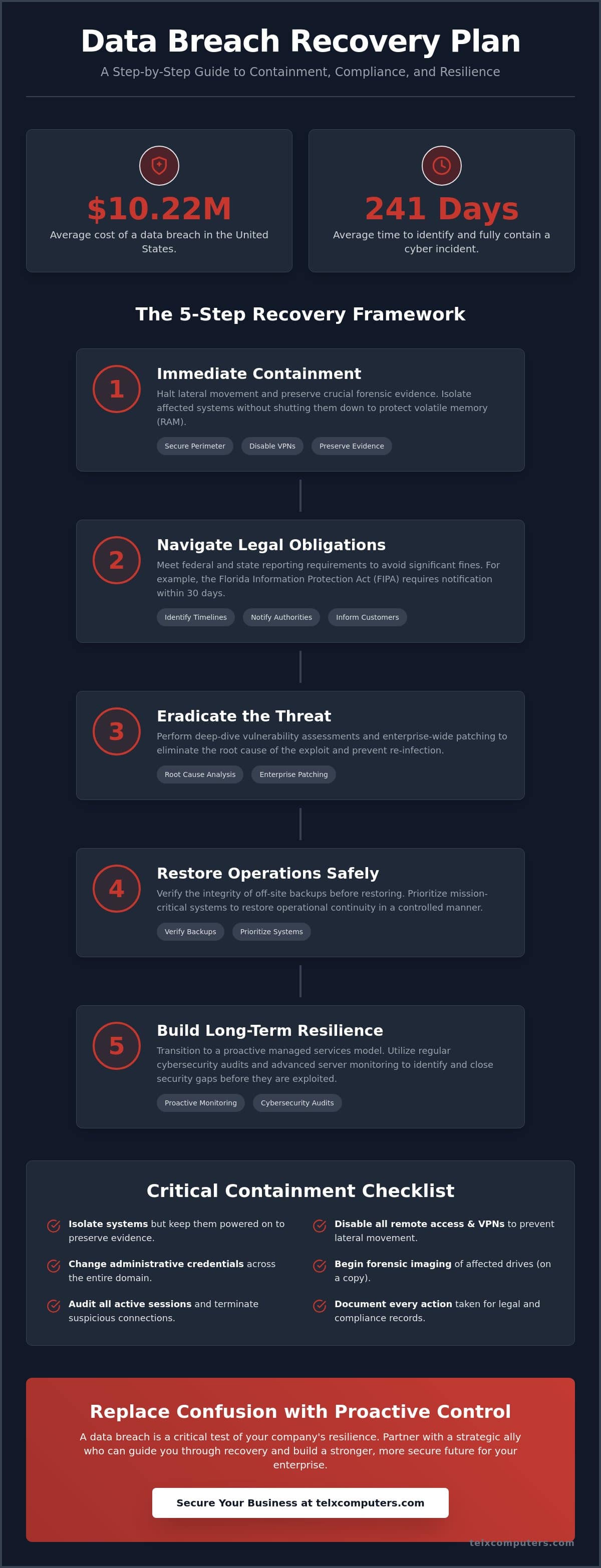
With the average cost of a data breach in the United States reaching an all-time high of $10.22 million, the margin for error has vanished. It currently takes an average of 241 days for an organization to identify and fully contain a cyber incident. Knowing exactly what to do after a data breach is no longer just a technical checkbox; it’s a critical requirement for your company’s survival. You’re likely facing the dual pressure of potential legal liabilities and the devastating prospect of losing hard-earned client trust.
We recognize that the rush to comply with new 30-day notification deadlines in California or the updated definitions of personal information in Oklahoma can cause significant technical anxiety. You deserve a strategic ally who can replace that confusion with a sense of stability and proactive control. This article outlines a comprehensive recovery plan to help you contain the breach immediately, meet your federal and state obligations, and recover your data with integrity. We will walk through the logic of modern remediation, from initial containment to the long-term governance strategies that keep your enterprise one step ahead of future threats.
Key Takeaways
- Secure your perimeter by isolating affected systems and disabling VPN connections to halt lateral movement without compromising forensic evidence.
- Navigate complex legal landscapes by identifying specific reporting timelines for sensitive data under state-specific laws like the Florida Information Protection Act.
- Master what to do after a data breach by performing deep-dive vulnerability assessments and enterprise-wide patching to eliminate the root cause of the exploit.
- Restore operational continuity safely by verifying the integrity of off-site backups and prioritizing mission-critical systems during the recovery process.
- Build long-term resilience by transitioning to a proactive managed services model that utilizes regular cybersecurity audits to identify gaps before they are exploited.
Immediate Containment: Stopping the Data Leak in 2026
The moment you detect unauthorized activity, your priority shifts to halting the spread. Many organizations make the mistake of immediately shutting down servers or deleting suspicious files. This is a tactical error. Knowing what to do after a data breach starts with one rule: don’t panic and pull the plug. Shutting down can wipe volatile memory (RAM) that contains critical evidence of the intruder’s footprint. Instead, isolate affected systems from the network while keeping them powered on. This allows your response team to capture the current state of the machine for forensic analysis.
You must disable all remote access and VPN connections immediately. Attackers often use these “backdoors” to maintain persistence even after you think you’ve blocked them. By severing these ties, you prevent lateral movement across your infrastructure. Identifying “patient zero,” the first device or user account compromised, is essential for understanding the full scope of the incident. This discovery provides a data breach overview that guides your entire recovery strategy. Once you locate the entry point, engage a specialized technical response team. They will begin forensic imaging of affected drives to create a bit-for-bit copy of the data. This ensures that the original evidence remains untouched while the investigation proceeds on the copy.
Technical Isolation Strategies
Effective containment requires surgical precision. You should segment your network to isolate compromised VLANs from healthy segments of the business. This prevents a localized infection from becoming a total blackout. While your team works, change all administrative credentials across the entire domain. Use a known clean device to perform these resets to ensure the new passwords aren’t immediately logged by a compromised machine. Audit every active session in real-time. Terminate any user connections that appear suspicious or originate from unexpected geographic locations. Proactive network it support ensures these segments are ready for rapid isolation when every second counts.
Preserving Forensic Evidence
When deciding what to do after a data breach, preservation is just as important as containment. Avoid “cleaning” or re-imaging systems before a full forensic image is captured. If you delete files or overwrite data, you might destroy the very clues needed to fulfill legal reporting requirements or file an insurance claim. Document every action your team takes during the first 24 hours. This log is vital for demonstrating compliance with state and federal laws. Engaging an expert team to handle server monitoring and response ensures a strict chain of custody is maintained for all physical and virtual hardware. This disciplined approach protects your business reputation and legal standing.
Navigating Legal and Regulatory Notification Requirements
Once technical containment is underway, your focus must shift immediately to your legal obligations. Understanding what to do after a data breach requires a precise navigation of the legal landscape, specifically the Florida Information Protection Act (FIPA). In 2026, regulatory scrutiny has reached a peak. Global regulators issued approximately $542 million in fines for data privacy breaches in the first quarter of 2026 alone. You don’t just have to fix the leak; you must report it accurately and on time to avoid compounding your losses with massive fines. This phase is about transparency, accountability, and mitigating long-term liability.
A strategic IT consultant firm helps you bridge the gap between technical recovery and regulatory reporting. We act as your strategic ally during this process, ensuring your technical logs support your legal claims. This integrated approach alleviates the technical anxiety associated with compliance, giving you the peace of mind that every box is checked.
Florida-Specific Reporting Timelines
Under FIPA, businesses must notify affected Florida residents within 30 days of discovering a breach. If the incident impacts more than 500 people, you must also notify the Florida Department of Legal Affairs within that same 30-day window. In Miami-Dade and Broward counties, local nuances in law enforcement reporting can affect how you document the event. Consult the FTC data breach response guide to ensure your internal documentation aligns with federal expectations while you meet these state-specific deadlines. Accurate record-keeping is your best defense against potential litigation.
Federal and Industry Compliance
Federal laws add another layer of complexity if your organization handles specialized information. For healthcare providers in Aventura or Coral Gables, HIPAA mandates specific notification protocols for Protected Health Information (PHI). You can explore our healthcare IT compliance services to see how we help clinics manage these rigorous standards. Publicly traded companies must also follow SEC rules regarding material incidents, which often require disclosure within four business days. Determining what to do after a data breach involves balancing these federal mandates with your public communication strategy. Always consult with legal counsel before issuing statements. A premature or poorly worded announcement can create unnecessary liability and further damage your reputation.
Root Cause Analysis and Technical Remediation
Once you’ve contained the immediate threat, your focus must shift to a forensic deep-dive. Simply resetting passwords or wiping a single laptop is an insufficient response to a sophisticated intrusion. To truly understand what to do after a data breach, you must identify the structural vulnerability that the attacker exploited. This requires a comprehensive vulnerability assessment of your entire enterprise infrastructure. You need to verify if the entry point was a misconfigured server, an unpatched software vulnerability, or a stolen credential. Without this clarity, your remediation efforts are merely guesswork.
A strategic ally doesn’t just patch the hole; they reinforce the entire foundation. According to the FTC’s data breach response guide, fixing vulnerabilities is a core pillar of a responsible recovery. We examine every layer of your stack, from firmware updates to application-level security. This process includes removing any persistent backdoors or unauthorized administrative accounts that the attacker may have created to regain access later. By performing this rigorous technical cleanup, you replace technical anxiety with the confidence that your perimeter is secure once again.
Identifying the Exploit Vector
Data from 2026 shows that 68% of data breaches involve a human element, such as social engineering or credential misuse. It’s critical to differentiate between a phishing attack, an unpatched software exploit, or a malicious insider. Reviewing firewall logs helps us identify data exfiltration patterns and pinpoint where the integrity of your network failed. Understanding these patterns is essential for long-term protection. This is why proactive server monitoring is vital for detection, as it allows for the identification of anomalies before they escalate into full-scale disasters. We also look for third-party involvement, as 30% of breaches now originate from a compromised partner or vendor.
Hardening the Environment
Remediation isn’t complete until you’ve modernized your defense. Deploying advanced Endpoint Detection and Response (EDR) tools provides real-time visibility into every device on your network. We also recommend implementing a Zero Trust architecture to limit internal exposure. Zero Trust is the standard for security in 2026, operating on the principle that no user or device is trusted by default, regardless of their location on the network. This approach ensures that even if one account is compromised, the attacker cannot move laterally to access your most sensitive assets. Mandatory Multi-Factor Authentication (MFA) must be enforced on every endpoint to provide a final, critical layer of identity-centric defense.
Restoring Operations via Managed Disaster Recovery
Once you’ve identified the root cause and hardened your environment, the focus shifts to operational restoration. Navigating what to do after a data breach requires a disciplined approach to bringing systems back online. You can’t simply flip a switch; doing so risks re-infecting your clean environment with dormant threats. A strategic recovery prioritizes business continuity while ensuring that every byte of data re-entering your production network is verified and safe. Organizations with a high-level incident response plan save an average of $2.66 million per breach, primarily by streamlining this complex restoration phase.
Recovery isn’t just about data; it’s about operational integrity. We prioritize the recovery of “Mission Critical” systems to reduce downtime and protect your revenue streams. This staged approach allows your core business functions to resume while we perform deep-cleansing on secondary systems. Every piece of hardware must be sanitized and tested for latent malware before it’s re-introduced to the production network. This vigilant process removes the technical anxiety of a potential second wave of infection, replacing it with the stability your clients expect. If you’re ready to rebuild with a partner who understands these complexities, explore our managed it support service for comprehensive recovery assistance.
Backup Integrity and Clean-Room Restores
Restoring from a compromised backup is a common pitfall. With 30% of breaches now involving a third party, verifying that your external backups haven’t been compromised is non-negotiable. We utilize a “Clean Room” environment to scan your archives for hidden threats before they reach your primary servers. This isolated space allows us to verify that your data is immutable and remains untainted by the initial exploit. Partnering with a provider for Managed IT Services in Miami ensures that this technical rigor is handled by experts who understand the local threat landscape and the importance of data integrity.
Strategic Business Continuity
A successful recovery depends on a localized, rapid response. Our team provides the on-site support necessary for South Florida businesses to resume operations without delay. During the restoration process, we help you establish a temporary communication hub to keep your staff informed and aligned. This prevents the confusion that often follows a cyber incident. Testing for dormant ransomware is a critical step, as many modern attacks use time-delayed payloads to ensure backups are infected before the encryption begins. You can learn about our ransomware protection strategies to see how we build resilience into every step of the restoration phase.
Building Strategic Resilience with Telx Computers
True recovery requires a fundamental shift in how your organization views technology. While the immediate steps for what to do after a data breach focus on containment and restoration, the long-term goal is building an environment where threats are neutralized before they manifest. Moving from a reactive, break-fix IT model to a proactive, managed approach ensures that your security posture is always evolving. We help you schedule regular cybersecurity audits to identify hidden gaps, ensuring your defense remains one step ahead of emerging exploit patterns. Integrating a fixed-price IT plan allows you to manage these security costs with total predictability, turning a potential vulnerability into a controlled business expense.
The Managed Security Advantage
A managed model provides the infrastructure for 24/7 monitoring and rapid help desk support. This constant vigilance is why many businesses choose us for managed it support service to maintain their operational integrity. You gain access to enterprise-grade security tools and expertise without the overwhelming capital expenditure of an in-house department. This approach provides a technological edge that is both scalable and secure. It allows your team to focus on growth while we handle the complexities of your digital perimeter.
Your Partner in Growth and Security
Telx Computers acts as a strategic guardian, integrating seamlessly with your team to foster a culture of vigilance. We place a heavy emphasis on localized support, providing a specific commitment to the South Florida business community. As part of our business it services miami, we provide the ongoing training and audits necessary to maintain a high-tier security posture. If you’re ready to transition from recovery to resilience, our team is here to guide every step of your digital transformation. We prioritize your stability so you can focus on the success of your enterprise.
Securing Your Future Resilience
Recovering from a cyber incident is a complex journey, but you don’t have to walk it alone. By prioritizing forensic containment and adhering to strict 30-day state notification windows, you’ve already mitigated the most immediate risks to your reputation. Understanding what to do after a data breach involves more than just a series of technical fixes; it requires a commitment to a holistic security strategy that protects your enterprise from lateral movement and future exploits. Implementing a Zero Trust architecture and maintaining immutable backups now forms the backbone of your modern defense.
Telx Computers stands ready as your strategic ally. We offer 24/7 Help Desk support and real-time monitoring to ensure you’re never navigating these threats without an expert guardian. With our fixed-price unlimited service plans, you gain predictable security costs and a consistent technological edge. Our team provides rapid on-site response throughout Miami, Fort Lauderdale, and Aventura to keep your operations running smoothly. Secure your business and recover with confidence—get an instant IT quote from Telx Computers. You have the strategy to emerge from this challenge stronger and more resilient than ever before.
Frequently Asked Questions
How long do I have to report a data breach in Florida?
Under the Florida Information Protection Act (FIPA), you must notify affected residents within 30 calendar days of discovering the incident. If the breach impacts more than 500 individuals, you are also required to notify the Florida Department of Legal Affairs within that same 30-day window. Failure to meet these specific timelines can result in significant administrative fines and increased legal liability.
What is the difference between a data breach and a data leak?
A data breach is an intentional, malicious attack where an unauthorized third party gains access to your systems to steal or alter information. A data leak is typically an accidental exposure caused by internal errors, such as an unsecured cloud database or a misconfigured server. Both require immediate containment, but the forensic investigation for a breach focuses more heavily on identifying the external threat actor.
Can I be sued if my business experiences a data breach?
Yes, businesses face significant risk of class-action lawsuits and individual litigation following a security incident. Legal teams often focus on whether the organization was negligent in its security practices or if it failed to provide timely notifications. Maintaining a documented incident response plan and regular cybersecurity audits provides a critical layer of defense against claims of negligence.
How do I know if my data was actually exfiltrated or just accessed?
Forensic experts determine this by analyzing network egress logs and file access timestamps to see if data was moved off-site. If logs show large volumes of encrypted traffic leaving your network through unauthorized ports, exfiltration is highly likely. Simple access means the intruder viewed the files but did not necessarily copy them to an external location.
What are the most common causes of data breaches for small businesses?
Phishing and stolen credentials remain the most frequent entry points for attackers. Research from 2026 shows that 68% of data breaches involve a human element, such as social engineering or employee negligence. Unpatched software vulnerabilities on internet-facing servers also represent a significant risk for smaller organizations that lack continuous monitoring.
Should I pay the ransom if my data breach involves ransomware?
Law enforcement and cybersecurity experts generally advise against paying ransoms because it fuels the criminal ecosystem and doesn’t guarantee you’ll get your data back. Instead, you should focus on a strategic recovery plan that involves restoring from immutable backups in a clean-room environment. This approach ensures your systems are free of latent malware before they go back into production.
How can I tell if my email was part of a data breach?
You can use reputable dark web monitoring services or public databases that track compromised credentials to check your email status. If your address appears in a recent dump, it’s a clear signal to change your passwords immediately and enforce multi-factor authentication. Proactive email security services can also alert you in real-time when your domain’s credentials appear on the dark web.
How does Managed IT help in post-breach recovery?
Managed IT providers offer the professional authority and technical tools needed to handle what to do after a data breach with precision. We manage the entire lifecycle of the incident, from isolating affected VLANs to conducting deep-dive forensic analysis. By acting as your strategic ally, we ensure your mission-critical systems are restored safely while hardening your environment against future intrusions.