





25 Aug Strategic Business VoIP Solutions: A Comprehensive Implementation Guide
What if your communication system functioned as a strategic asset rather than a technical liability? For many South Florida firms, legacy phone lines are becoming a significant operational risk, which is why modern business voip solutions have become essential for maintaining a competitive edge. You’ve likely experienced the frustration of dropped calls during critical client meetings or discovered hidden fees buried in a national provider’s complex contract. It’s difficult to maintain peak efficiency when you lack local support for your physical hardware and desk phone setup.
We understand that stability is the foundation of your success. This guide demonstrates how to transition from traditional telephony to a high-performance VoIP ecosystem that integrates seamlessly with your existing business network. You’ll discover how to achieve crystal-clear communication and predictable monthly costs while unifying your mobile and desktop workflows. We will outline the strategic steps required to ensure your team stays connected through a secure, professionally managed environment that prioritizes your operational peace of mind and long-term growth.
Key Takeaways
- Understand how modern business voip solutions leverage cloud technology to provide superior scalability and cost efficiency compared to legacy hardware.
- Identify why network infrastructure and Quality of Service (QoS) settings are more critical for call clarity than simple high-speed internet.
- Master the essential features required for a professional enterprise image, including multi-level auto-attendants and synchronized mobile workflows.
- Learn to evaluate providers based on the total cost of ownership and 99.999% uptime guarantees rather than baseline software license fees.
- Discover the strategic advantages of integrating your communication ecosystem into a broader managed IT framework for enhanced security and 24/7 support.
What Are Modern Business VoIP Solutions?
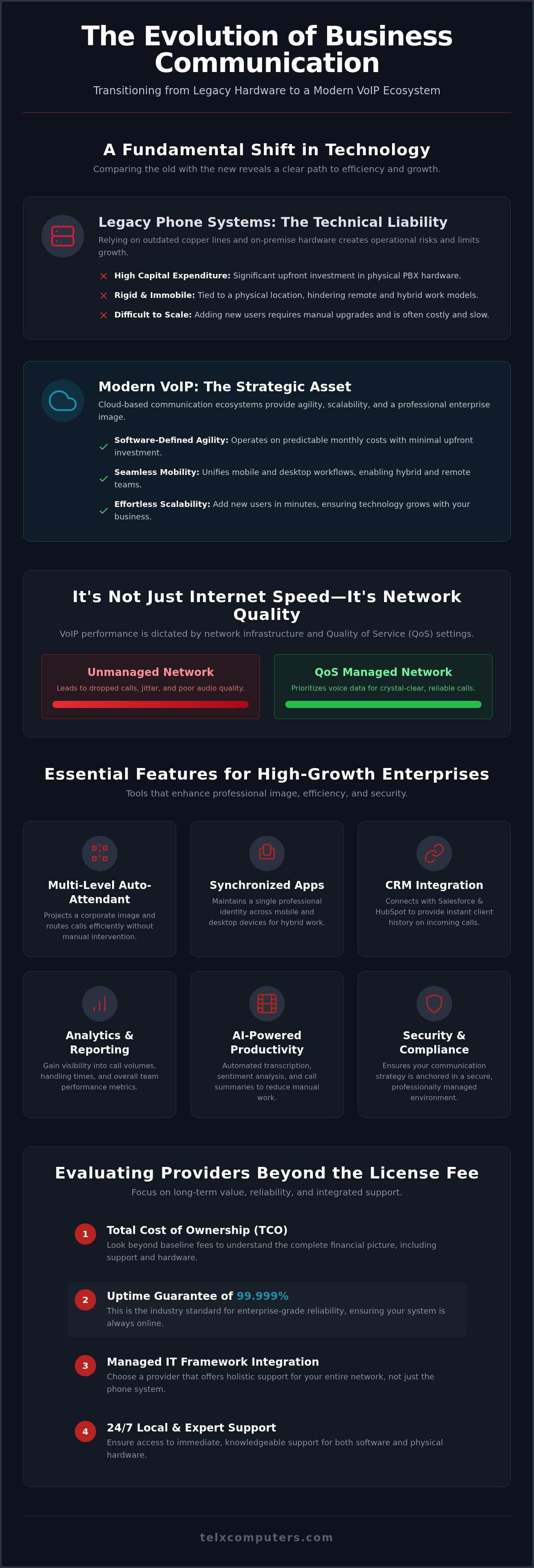
Modern business voip solutions represent a fundamental shift in how organizations connect. Instead of relying on a physical box in a closet, your phone system now exists as a cloud-based communication ecosystem. This transition moves telephony away from hardware constraints and into the world of software-defined agility. While traditional PBX systems required significant capital expenditure and manual upgrades, cloud systems scale effortlessly. You can add new users in minutes, ensuring your technology grows at the same pace as your revenue.
Understanding What is Voice over IP (VoIP) involves looking at how analog signals become digital data packets for transmission over the internet. This process eliminates the distance-based costs of legacy systems and provides a more reliable foundation for daily operations. It’s the difference between owning a static piece of hardware and subscribing to a dynamic service that evolves with your business needs.
The Evolution of Business Telephony
Major telecommunications carriers are actively phasing out traditional copper lines because maintaining legacy infrastructure is no longer viable. In the UK, the final PSTN shutdown is scheduled for January 31, 2027, and U.S. carriers have already received FCC clearance to retire copper networks. This global shift forces a transition from physical hardware to virtualized communication hubs. Modern systems don’t just replace your old desk phone; they enable a seamless hybrid work model. Whether your team is in the office or working remotely, their business extension remains active and secure. This flexibility is no longer a luxury but a strategic requirement for modern enterprises.
Key Components of a Professional VoIP Setup
A robust implementation of business voip solutions relies on several technical pillars that ensure call quality and reliability. The SIP trunk acts as the digital bridge, managing concurrent call paths and connecting your internal network to the global telephone system. You also have choices in how your team interacts with the system. Softphones provide high mobility through desktop and mobile apps, while physical IP desk phones offer a familiar interface for high-volume environments.
UCaaS integrates voice, video, and messaging into a single, cohesive platform. When these tools are part of a broader managed IT support service, you gain an integrated layer of security and performance monitoring. This holistic approach ensures that your communication tools work in harmony with your entire network infrastructure, providing the stability your team needs to perform at their best.
Essential Features for High-Growth Enterprise Communication
Professional image starts with the first ring. Advanced call routing and multi-level auto-attendants allow smaller firms to project the authority of a global corporation. These features ensure that every inquiry reaches the correct department without manual intervention, which reduces wait times and improves the caller experience. Modern business voip solutions enable this level of sophistication by treating every call as a data point that can be intelligently directed based on time of day, caller ID, or specific menu selections.
Efficiency extends beyond the office walls. High-performance systems synchronize mobile and desktop applications, allowing your team to maintain a single professional identity regardless of their physical location. This mobility is powered by deep integrations with CRM platforms like Salesforce and HubSpot. When a client calls, your team sees their history instantly, transforming a simple conversation into a data-driven interaction. Strategic business voip solutions provide the oversight needed through detailed analytics and reporting, which give you visibility into call volumes, average handling times, and team performance metrics.
The Impact of AI in Modern VoIP
Artificial intelligence has evolved far beyond basic automated greetings. In a high-growth environment, real-time transcription and sentiment analysis serve as vital quality control tools. These systems can flag potentially escalated calls or identify recurring customer pain points automatically. AI-driven call summaries further enhance productivity by generating concise notes and action items, which reduces the manual data entry burden on your sales and support staff. This allows your team to focus on building relationships rather than managing paperwork.
Security and Compliance Features
Security remains the non-negotiable anchor of any communication strategy. Professional grade VoIP systems employ end-to-end encryption to protect sensitive business discussions from interception. Implementing multi-factor authentication (MFA) adds an essential layer of defense, ensuring that only authorized personnel can access your communication portals. At Telx, we view your phone system as a critical endpoint that requires the same level of ransomware protection as your servers and workstations. If you are ready to fortify your business network, you can request an instant quote to see how these features fit your specific needs.
The Critical Link: Why Your Network Infrastructure Dictates VoIP Quality
Many providers claim that any high-speed internet connection is sufficient for business voip solutions. This is a common misconception that often leads to operational frustration. While bandwidth matters, the quality of your voice calls depends more on latency and jitter than raw download speeds. Latency refers to the delay between a speaker talking and the listener hearing the sound, while jitter measures the variation in that delay. If your network doesn’t prioritize voice data, you’ll experience robotic audio and clipped sentences, regardless of how fast your connection seems on a speed test.
To achieve enterprise-grade reliability, you must implement Quality of Service (QoS) settings across your routers and switches. QoS acts as a digital traffic controller, ensuring that voice packets receive priority over less time-sensitive data like large file downloads or background software updates. Our team provides specialized network IT support in Miami to help businesses configure these complex parameters correctly. By optimizing your internal infrastructure, we eliminate the bottlenecks that cause communication breakdowns, giving you the crystal-clear audio your clients expect.
Structured Cabling and Hardware Readiness
Reliability starts at the physical layer. While older Cat5e cables might work, Cat6 cabling is the modern standard for business voip solutions due to its ability to handle higher data rates with minimal crosstalk. You also need to consider your power delivery. Using Power over Ethernet (PoE) switches allows you to power your desk phones directly through the network cable, which simplifies your desk setup and allows for centralized power management. Finally, we must evaluate your firewall settings. Many consumer-grade routers have a feature called SIP ALG enabled by default, which frequently interferes with VoIP traffic and causes one-way audio or registration failures.
Redundancy and Disaster Recovery
A professional phone system should never be a single point of failure. Implementing a dual-WAN failover strategy ensures that if your primary internet service provider goes down, your phones automatically switch to a backup connection. Because modern VoIP is cloud-hosted, your system remains active even during local power outages. Calls can be instantly rerouted to mobile apps or secondary locations, ensuring you never miss a critical client inquiry. Integrating your communication system into your broader data backup & disaster recovery plan provides a holistic safety net for your operations. This proactive approach transforms your phone system from a fragile utility into a resilient strategic asset.
Evaluating VoIP Providers: Beyond Simple Software Licenses
Selecting business voip solutions requires a shift from looking at basic price tags to analyzing the Total Cost of Ownership (TCO). Many national providers lure organizations with low entry-level licensing fees, but these numbers rarely reflect the final bill. You must account for initial configuration, hardware procurement, and the cost of internal time spent managing a complex system. A reliable partner should provide a Service Level Agreement (SLA) that guarantees 99.999% uptime. Anything less can result in hours of lost productivity and missed opportunities that far outweigh any marginal savings on a monthly license. Watch out for hidden fees that national giants often bury in the fine print, such as premium feature add-ons or inflated international calling rates.
The right provider acts as a strategic ally rather than a distant vendor. They should offer a transparent pricing model that allows for predictable budgeting. If you’re ready to move beyond basic software licenses and experience the stability of a professionally managed system, get an instant quote for a fully integrated communication strategy today.
Local vs. National Providers: The Support Gap
National “DIY” providers often leave you stranded when technical issues arise. If a physical desk phone fails or your local network settings need adjustment, an automated help document or a distant call center won’t solve the problem. This is where working with IT companies in Miami provides a distinct advantage. Local partners offer personalized onboarding and on-site troubleshooting that national corporations cannot match. We don’t just send you a link to a manual. We ensure your hardware is configured correctly on your desk and integrated with your specific network environment, providing a level of care that remote-only support teams lack.
Scalability and Contract Flexibility
Your communication system should adapt to your business growth, not hinder it. Avoid long-term lock-ins with providers that don’t offer clear growth paths or charge exorbitant fees for minor changes. Integrating your phones into a fixed-price managed IT support service plan simplifies your entire budgeting process. This model allows you to add or remove seats as your staff fluctuates without worrying about unpredictable spikes in your monthly bill. It turns your communication costs into a predictable operational expense rather than a variable technical burden, allowing you to focus on scaling your operations with confidence.
Implementing Managed VoIP with Telx Computers
At Telx Computers, we treat communication as a core component of your technical foundation rather than a standalone utility. Our approach to business voip solutions focuses on total integration. By weaving your phone system into our broader managed IT services, we eliminate the silos that often lead to technical friction. You won’t have to juggle multiple vendors when a call drops or a desk phone loses connectivity. Our 24/7 help desk provides instant resolution for any issues, ensuring your team stays productive around the clock. This holistic strategy transforms your telephony into a secure, high-performance asset that supports your long-term growth.
Our Onboarding Process
Success begins with a meticulous rollout that respects your time and operational continuity. We perform a comprehensive network audit before any hardware arrives at your office. This step ensures your infrastructure handles voice traffic with the priority it requires. Our team manages the entire number porting process, which prevents communication gaps and protects your established business identity. Once the system is live, we provide on-site training for your staff in Miami and Fort Lauderdale. We don’t just set up the phones. We make sure your team knows how to use every advanced feature to maximize their daily efficiency.
Continuous Monitoring and Optimization
Stability requires constant vigilance from a partner you can trust. We use proactive server monitoring to detect network anomalies before they impact your call quality. Our security experts conduct regular audits to protect your communication lines from toll fraud and unauthorized access. Because we operate on fixed-rate monthly plans, you receive unlimited support for troubleshooting and configuration changes. This model aligns our goals with yours. We work to keep your system perfect so you can focus on your core business objectives without worrying about variable costs.
Our guarantee is rooted in reliability. We provide a secure and cost-effective communication environment backed by local experts who have supported the South Florida business community since 2002. We take pride in being the silent engine behind our clients’ success. When you partner with us, you gain an expert guardian that stays one step ahead of technical threats, providing the stability and peace of mind your organization deserves.
Securing Your Future with Integrated Communication
Transitioning to modern business voip solutions is a strategic move that requires more than just a software license. It demands a robust network foundation and a partner who understands the nuances of local implementation. By prioritizing Quality of Service and professional management, you eliminate technical anxiety and ensure your team remains connected through every growth phase. Reliable communication is the backbone of your operational success, and it shouldn’t be left to chance or distant DIY providers who lack local accountability.
Telx Computers provides the stability you need through 24/7 Help Desk Support and fixed-rate, unlimited service plans that keep your budgeting predictable. We don’t just provide remote links; we offer rapid on-site response in Miami and Fort Lauderdale to ensure your hardware and network perform perfectly. Our team acts as an extension of yours, guarding your security and optimizing your workflows. If you’re ready to upgrade your communication ecosystem, Request an Instant Quote for Your Managed VoIP Solution today. You deserve a system that works as hard as you do. Let us handle the technical engine while you focus on driving your business forward.
Frequently Asked Questions
What is the difference between VoIP and a traditional phone system?
VoIP uses the internet to transmit voice as data packets, whereas traditional systems rely on copper wires and physical switches. This digital approach allows for greater scalability and significantly lower long-distance costs. Unlike legacy PBX hardware, VoIP functions as a software-defined service. This means your team can access the same professional features from any location with an internet connection, effectively removing the physical constraints that an old office’s setup usually imposes.
How much bandwidth does a business VoIP system require?
Most business voip solutions require approximately 100 Kbps of upload and download bandwidth per concurrent call. While this seems minimal, the stability of the connection is more important than raw speed. High-quality voice transmission depends on low latency and minimal jitter. We recommend conducting a thorough network audit to ensure your current internet service and internal hardware can prioritize voice traffic without causing audio degradation during peak usage periods.
Can I keep my existing phone numbers when switching to VoIP?
Yes, you can port your existing local and toll-free numbers to a new VoIP provider through a process called Local Number Portability (LNP). This ensures that your established business identity remains intact during the transition. Our team manages the entire porting process to prevent any communication gaps. We coordinate with your current carrier to ensure the switch occurs seamlessly, allowing you to maintain continuity with your clients and partners throughout the implementation phase.
Do I need special hardware to use business VoIP solutions?
You have several options for hardware depending on your operational needs. You can use physical IP desk phones that connect directly to your network via Ethernet. Alternatively, many businesses utilize softphones, which are applications installed on existing computers or mobile devices. To ensure the best performance, we recommend using Power over Ethernet (PoE) switches and high-quality headsets. These components help maintain a professional audio standard across your entire organization without requiring extensive new wiring.
Is VoIP secure enough for legal or healthcare businesses?
VoIP is highly secure when implemented with enterprise-grade encryption and multi-factor authentication. Professional business voip solutions utilize Transport Layer Security (TLS) and Secure Real-time Transport Protocol (SRTP) to protect voice data from interception. When combined with our broader network security and monitoring, these systems meet the rigorous compliance standards required by legal and healthcare firms. We prioritize end-to-end protection to ensure that your sensitive client conversations remain strictly confidential and shielded from external threats.
What happens to my phone system if the internet goes down?
Because modern VoIP is cloud-hosted, your system remains active even if your local office loses internet connectivity. You can instantly reroute incoming calls to mobile apps, secondary locations, or automated voicemails. Implementing a dual-WAN failover strategy provides an additional layer of protection by automatically switching to a backup connection. This resilience ensures your clients can’t lose contact with you, maintaining your professional image even during local infrastructure failures or power outages.
How does a managed VoIP service differ from a standard VoIP subscription?
A standard subscription usually provides only the software license and leaves the configuration and troubleshooting to you. In contrast, a managed service includes professional implementation, network optimization, and 24/7 help desk support. We take ownership of the entire ecosystem, from initial setup to continuous security audits. This proactive approach includes local on-site response in Miami and Fort Lauderdale, ensuring your communication system doesn’t become a technical burden but remains a reliable strategic asset.