





19 Jul Reliable Business VoIP Solutions: A Strategic Implementation Guide for 2026
What if your phone system was no longer a point of failure but a strategic asset that actually protected your bottom line? For many firms, the frustration of dropped calls during client meetings and the anxiety of unpredictable monthly billing have become accepted costs of doing business. You deserve business voip solutions that provide stability and peace of mind rather than technical headaches. We understand the need for a system that integrates seamlessly with your managed IT infrastructure while delivering crystal-clear audio quality every time.
Discover how to transition from legacy hardware to a high-performance VoIP ecosystem designed for the modern enterprise. This guide explains the logic behind professional network optimization and why a partner-oriented approach is essential for long-term reliability. We will preview the roadmap for a secure migration, compare managed services to self-service software, and show you how to build a communication platform that grows alongside your organization. By the end of this article, you will have a clear strategy for replacing technical anxiety with a system that acts as the silent engine behind your success.
Key Takeaways
- Learn how a “network-first” strategy ensures your infrastructure supports crystal-clear audio through optimized Quality of Service (QoS) settings.
- Discover how transitioning to professional business voip solutions creates a unified communication ecosystem that integrates seamlessly with your existing CRM and IT tools.
- Uncover the hidden operational liabilities of legacy PBX systems and the fiscal risks associated with unmanaged, self-service software subscriptions.
- Gain a clear implementation roadmap for Miami, NYC, and LA offices that prioritizes zero-downtime number porting and comprehensive network audits.
- See how a managed IT approach provides 24/7 vigilance over your voice data, transforming your phone system into a key component of your disaster recovery strategy.
Understanding Business VoIP Solutions in the 2026 Landscape
Swapping copper for fiber isn’t just a hardware change. It represents a fundamental shift in how your organization handles data and voice. Modern systems utilize Voice over IP (VoIP) technology to convert analog signals into digital packets, allowing for high-definition audio and seamless data sharing. This technology isn’t just “internet calling.” It’s a strategic gateway to a hosted environment where SIP Trunking replaces the physical constraints of on-premise hardware. SIP Trunking acts as a virtual phone line, allowing your business to scale without the need for additional physical infrastructure. This scalability is critical for organizations that experience seasonal fluctuations or rapid expansion through professional business voip solutions.
Consistency defines your reputation. For firms operating in fast-paced hubs like Miami, NYC, and LA, the ability to maintain a reliable presence is vital. Traditional PBX systems have become operational liabilities. They create silos, trapping your communication data in a physical box in a server room and making it nearly impossible to integrate with modern cloud-based CRM tools. Modern business voip solutions ensure that whether your team is in a Manhattan high-rise or a home office in Coral Gables, they remain part of a secure, unified network. This flexibility is no longer a luxury; it’s a requirement for maintaining client trust in a decentralized work environment.
To better understand how these systems can be deployed efficiently, watch this overview of a rapid setup process:
The Evolution of Unified Communications (UCaaS)
App-switching kills productivity. High-growth firms often suffer from fatigue where employees jump between three or four different platforms just to handle a single client inquiry. This fragmentation leads to data leakage. Unified Communications as a Service (UCaaS) is the integration of all communication channels into one managed platform. By consolidating voice, video, and SMS into a single pane of glass, your team gains a technological edge. They can focus on business outcomes rather than managing disparate software. This holistic approach ensures that every client interaction is logged and accessible, regardless of the medium used.
Why Traditional Landlines are a Security Risk
Copper wires are vulnerable. Legacy landlines rely on physical infrastructure that is inherently susceptible to tampering and eavesdropping. These systems lack the sophisticated encryption, such as Secure Real-time Transport Protocol (SRTP), that modern digital systems provide by default. Beyond security, the cost of maintaining obsolete hardware in a cloud-first world is unsustainable. Many businesses are turning to managed IT support services to replace these outdated systems with secure, encrypted alternatives. This transition protects proprietary data from the point of origin to the final receiver, ensuring your firm remains compliant with modern privacy standards.
The Infrastructure Secret: Why Your Network Dictates VoIP Quality
A high-performance communication system is only as resilient as the wires and waves carrying it. We believe in a “Network-First” philosophy because business voip solutions are digital layers that sit atop your existing infrastructure. If that foundation is unstable, your audio quality will suffer regardless of how advanced your software is. Unlike traditional landlines that operate on a dedicated physical circuit, VoIP shares your bandwidth with every other application in your office. You can review the FCC explanation of VoIP technology to understand the basic mechanics, but for an enterprise, the focus must be on network optimization rather than just connectivity.
Quality of Service (QoS) settings on your router act as the traffic controllers for your digital highway. They prioritize voice packets, ensuring they get the “green light” while less urgent data, such as a large file download or a software update, waits in line. Without these configurations, you experience jitter, latency, and the dreaded “robotic” voice. Consistent server monitoring is the second half of this equation. By watching your network health in real-time, we can identify and resolve bottlenecks before they result in a dropped call during a critical board meeting.
Consumer-grade internet fails the enterprise test because it lacks the symmetrical speeds and stability required for high-density voice traffic. While your home connection might be fast enough for a single video call, a professional office in Miami, NYC, or LA requires a connection with a dedicated Service Level Agreement (SLA) to guarantee performance. If you’re concerned about your current network capacity, it’s wise to get an instant quote for a professional infrastructure assessment.
Bandwidth vs. Throughput: Calculating Your Needs
Capacity isn’t just about the “up to” speed your provider promises on a sticker. It’s about throughput, the actual amount of data successfully transferred. A single high-definition voice call uses relatively little bandwidth, but when you have forty concurrent calls while your system is performing heavy cloud backups, the network can choke. Structured cabling serves as the physical foundation here. Upgrading to modern standards ensures that your local network doesn’t become a bottleneck for your high-speed fiber connection. To explore your options for robust business connectivity, you can find out more regarding current promotional offers.
Managed Security for Communication Channels
Voice data is an attractive target for hackers. We protect your system from sophisticated threats like toll fraud, where unauthorized users hijack your lines to rack up expensive international charges, and DDoS attacks designed to paralyze your phones. Your firewalls must be tuned to filter voice traffic with surgical precision, providing security without adding the milliseconds of delay that ruin call quality. Integrating these defenses with ransomware protection ensures that your communication lines remain open and secure even when the broader threat landscape is volatile.
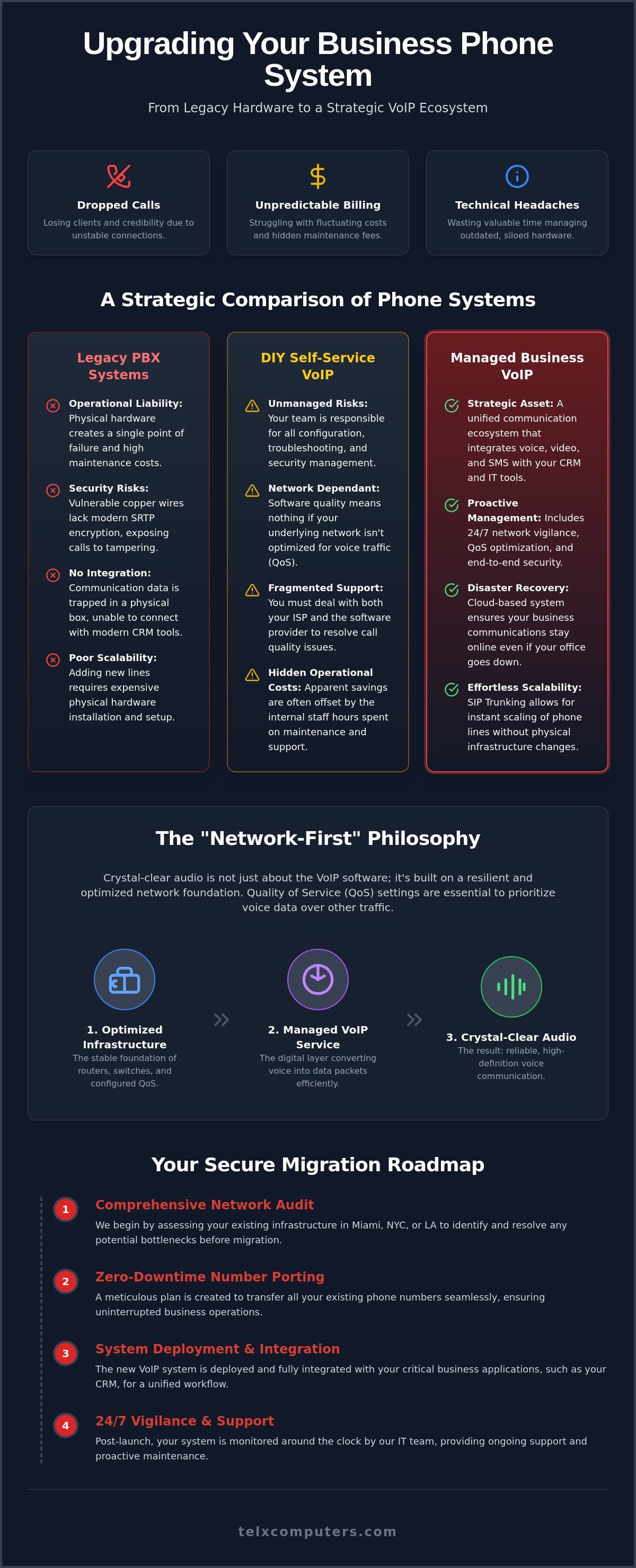
Managed VoIP vs. DIY Software: A Strategic Comparison
Many organizations are lured by the low entry price of “plug-and-play” business voip solutions. While these self-service models are easy to download, they often leave you to navigate complex network configurations and security protocols alone. A managed approach treats your communication system as a critical business asset rather than a disposable app. According to TechTarget’s guide to business VoIP, the architecture of your system determines its long-term reliability and how well it integrates with your broader IT strategy.
DIY software assumes a “one-size-fits-all” approach that rarely works for specialized industries. For a Miami legal firm, call flows must prioritize confidentiality and precise billable time tracking. For an NYC healthcare practice, HIPAA-compliant messaging and patient data security are non-negotiable. Professional migration ensures these nuances are baked into the system from day one. This avoids the headaches that result in missed calls and frustrated clients when generic software fails to route traffic correctly.
The Support Gap: What Happens When the Dial Tone Dies?
When a generic software provider’s system fails, you’re typically stuck in a ticketing queue with a technician who doesn’t know your specific network environment. Working with a local IT company in Miami provides a level of accountability that global software giants cannot match. We act as your expert guardian, using proactive monitoring to identify packet loss or latency spikes before your staff even notices a quality dip. Business continuity requires more than just a mobile app backup. It requires a partner who provides 24/7 help desk support and is ready for on-site response if your physical hardware fails.
Total Cost of Ownership (TCO) Analysis
The “Integration Tax” is a hidden cost for businesses that purchase IT services and communication tools from separate vendors. Each time a call drops, the two providers blame each other, leaving your business caught in the middle. By utilizing it outsourcing services that include VoIP, you eliminate this friction. Our fixed-price model replaces fluctuating per-user software fees with a predictable monthly cost, simplifying your budgeting process. This transparency extends to hardware procurement, where we help you strategically choose between leasing high-end Poly or Yealink desk phones or purchasing them outright to maximize your long-term ROI.
Implementation Roadmap for Miami, NYC, and LA Offices
Successful deployment of business voip solutions requires a structured methodology that accounts for local infrastructure and specific operational needs. We begin with a comprehensive network audit to verify that your existing hardware can handle the increased packet load. This step prevents the common pitfall of launching a new system only to discover that legacy switches or outdated cabling are bottlenecking your voice quality. We treat this audit as the blueprint for your communication ecosystem, ensuring every component is ready for high-definition traffic.
Navigating number porting is often the most complex part of the migration process. We handle the regulatory hurdles with the FCC and your current carrier to ensure your existing business numbers transfer without a second of downtime. This includes managing the updated certification obligations for interconnected VoIP providers that went into effect earlier this year. Our team acts as an expert guardian, protecting your client accessibility while we manage the technical paperwork in the background.
We recommend a phased rollout, testing the system in a single department before a full-scale launch. This allows us to fine-tune Quality of Service (QoS) settings and ensure user training is effective. When your team understands how to use advanced features like mobile twinning or CRM integration, adoption happens naturally. A well-trained staff is your best defense against technical anxiety, turning a new tool into a powerful engine for productivity.
Local Considerations for Miami and South Florida
In Miami, disaster recovery isn’t a theoretical concept; it’s a seasonal necessity. We design your VoIP ecosystem to serve as a hurricane-readiness tool, allowing your team to remain operational from any location if the physical office is inaccessible. Leveraging network IT support in Miami ensures that on-site cabling is optimized for the high-speed demands of hubs like Aventura and Fort Lauderdale. This localized focus keeps your business connected when the environment becomes unpredictable.
Scaling for Growth in NYC and LA
Managing high-density office environments in NYC or LA presents unique challenges, particularly regarding Wi-Fi congestion and signal interference. We implement strategies to virtualize communications for a remote workforce spread across multiple time zones, ensuring everyone has the same high-tier experience. By integrating your phone system with managed IT support, you maintain nationwide consistency and security. You can get an instant quote today to begin your strategic migration and secure your communication future.
The Telx Advantage: Unified Voice and Managed IT Security
Most vendors sell you a software license and wish you luck. We take a different path. By integrating business voip solutions directly into our fixed-price IT plans, we eliminate the friction between your communication tools and your network infrastructure. This is the “Expert Guardian” approach in action. We don’t just provide a dial tone; we maintain 24/7 vigilance over your voice data packets. This proactive management removes the technical anxiety that often accompanies a system migration. You can focus on high-level business outcomes while we manage the silent engine of your success. We treat your network security and voice quality as a single, unified priority.
Choosing a strategic ally over a simple service provider yields several long-term benefits:
- Total elimination of “per-minute” billing anxiety through fixed-rate unlimited plans.
- Full integration with your existing cloud infrastructure and CRM tools.
- Advanced cybersecurity audits that include your voice network vulnerabilities.
- A system designed to scale effortlessly as your business expands into new markets.
Real-Time Monitoring and Rapid Response
Communication failures don’t respect office hours. Our commitment to 24/7 help desk support ensures that you’re never left in a ticketing queue while a client is trying to reach you. Because we maintain physical offices in Miami, NYC, and LA, we offer rapid on-site response that software-only vendors simply can’t match. This local presence serves as a recurring anchor for our clients. We provide predictable results for a predictable price, a promise you can verify on our guarantee page. You won’t face hidden fees or the complex billing structures that plague unmanaged plans.
Get Your Custom Communication Strategy
A generic, automated quote rarely meets the needs of an enterprise-level firm with complex security and integration requirements. Your organization deserves a custom communication strategy based on a holistic IT and VoIP audit. This audit examines your entire infrastructure to identify potential bottlenecks before they impact your bottom line. Transitioning your office now prepares you for the increased digital demands of 2026. Request an instant quote today to begin your evolution from a simple phone user to a technologically empowered enterprise. We position your voice system as a critical component of your disaster recovery plan. This ensures your team stays connected even when the unexpected happens.
Securing Your Communication Future
Modern communication requires a fundamental shift from viewing phones as isolated hardware to seeing them as a strategic layer of your managed IT environment. By prioritizing network health and professional oversight, you eliminate the technical friction that often hinders growth. Implementing business voip solutions through a managed model ensures your data remains secure while your team enjoys crystal-clear audio quality across every office location. This transition replaces the anxiety of dropped calls and security gaps with a sense of stability and peace of mind.
Our approach focuses on total operational stability. We provide 24/7 Help Desk Support and fixed-price unlimited service plans to remove the unpredictability of traditional billing. With physical offices in Miami, NYC, and LA, our team acts as your expert guardian, offering rapid on-site response whenever you need it. You don’t have to navigate the complexities of digital transformation alone. We stand ready to serve as the silent engine behind your firm’s success, ensuring your communication ecosystem is always one step ahead of potential threats.
Get a Strategic VoIP and IT Consultation for Your Business
Take the first step toward a more resilient, unified enterprise today. Your journey toward a high-performance communication environment starts with a single strategic decision.
Frequently Asked Questions
What are the main benefits of business VoIP solutions over traditional phones?
Modern business voip solutions provide superior scalability and cost predictability compared to legacy landlines. You gain access to a unified ecosystem that combines voice, video, and messaging into one interface. This streamlines your operations and eliminates the need for multiple, disconnected service contracts, a benefit often found with providers like TekSavvy that offer integrated communication bundles. By moving to a cloud-hosted model, your organization also benefits from continuous security updates and the flexibility to add new users without installing physical phone lines.
Can I keep my current business phone numbers when switching to VoIP?
You can keep your existing phone numbers through a process called number porting. We manage the technical coordination with your current carrier and the FCC to ensure a seamless transition without any downtime. This protects your brand identity and ensures that your clients can always reach you at the numbers they already know. Our team handles the regulatory paperwork in the background, making the migration process stress-free for your staff.
How much bandwidth does a high-quality business VoIP call require?
A high-quality voice call typically requires about 100 Kbps of symmetrical bandwidth. However, total network health is more important than raw speed. Your router must be configured with Quality of Service (QoS) settings to prioritize voice packets over other data traffic like file downloads. We recommend a professional network audit to ensure your Miami or NYC office fiber can handle your peak call volume while maintaining crystal-clear audio quality.
Is VoIP secure enough for healthcare or law firms in Miami?
VoIP is highly secure for sensitive industries when it’s implemented with enterprise-grade encryption and proactive monitoring. We use Secure Real-time Transport Protocol (SRTP) to protect your voice data from eavesdropping and tampering. For law firms and healthcare providers, this level of security is essential for compliance. Our managed IT approach includes 24/7 vigilance, ensuring your communication channels remain as secure as your primary data servers.
What happens to my VoIP phone system if the office internet goes down?
Your system remains operational through automatic failover to mobile applications or secondary office locations if your primary internet connection drops. Because the system is hosted in the cloud, calls can be instantly rerouted to employee smartphones or a backup site in another region. This capability makes VoIP a vital part of a disaster recovery plan, especially for businesses in hurricane-prone areas like South Florida that require constant client accessibility.
Do I need to buy new hardware to use a business VoIP system?
You don’t necessarily need to buy new hardware since the system works on computers and mobile devices. However, we recommend using dedicated IP phones from brands like Poly or Yealink for the best audio experience. These devices are designed specifically for high-density office environments and offer superior noise cancellation. We help you evaluate whether leasing or purchasing these professional desk phones is the best strategic fit for your long-term budget.
How does VoIP integrate with my existing CRM or email software?
High-performance business voip solutions integrate with CRM and email software through secure APIs to automate data logging and improve workflow efficiency. When a client calls, their record can automatically appear on your screen, allowing your team to provide personalized service instantly. This integration eliminates manual data entry and ensures that every interaction is captured within your existing management tools, turning your phone system into a powerful engine for productivity.
What is the difference between hosted VoIP and on-premise IP-PBX?
Hosted VoIP is managed in the cloud by a provider, while an on-premise IP-PBX requires you to maintain physical server hardware in your office. Hosted systems are generally more reliable for modern enterprises because they offer easier scalability and lower maintenance costs. You shift the burden of hardware updates and security patches to your strategic ally, allowing your internal team to focus on core business objectives rather than troubleshooting phone servers.