





31 May Reducing IT Operational Costs: A Strategic Framework for 2026
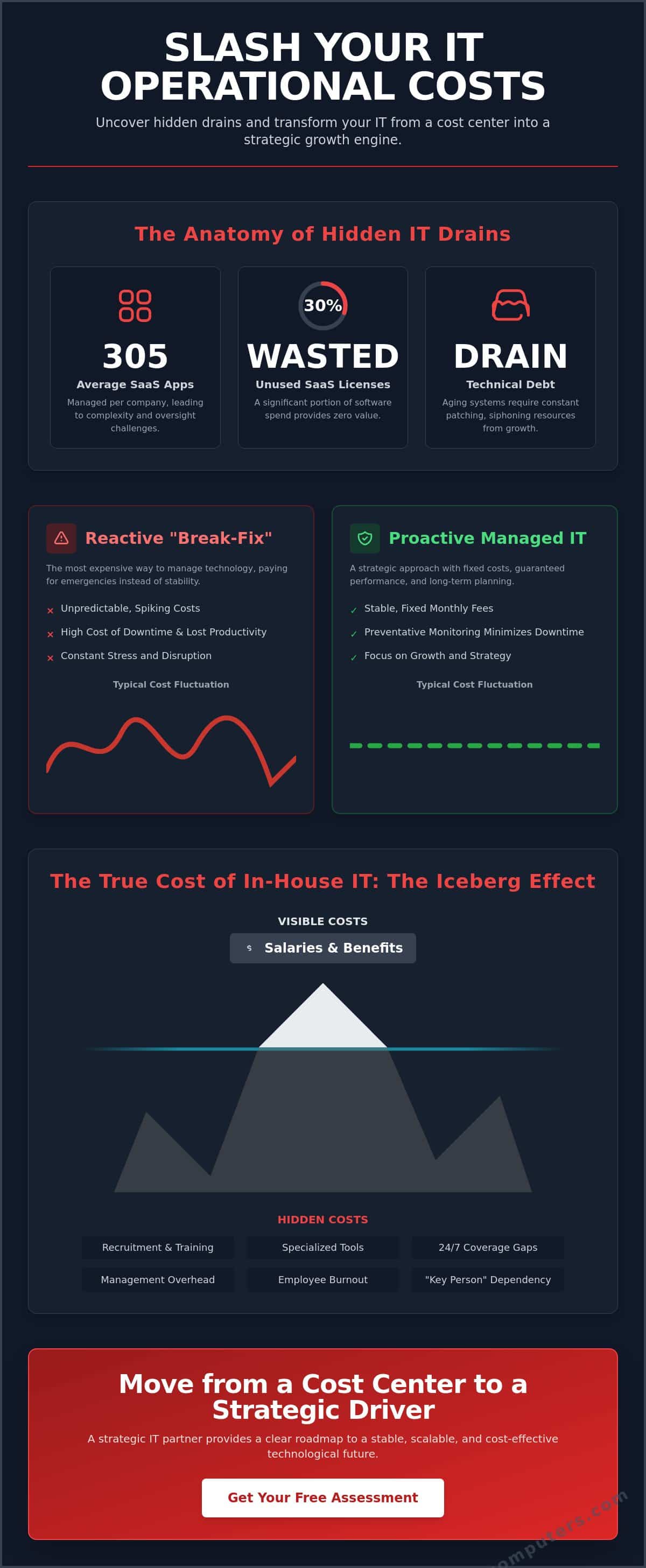
In 2026, the average company manages 305 separate SaaS applications, yet research shows that up to 30% of those licenses go completely unused. This invisible waste, combined with the rising cost of maintaining aging in-house servers, makes reducing IT operational costs a top priority for any growth-minded leader. You’ve likely felt the frustration of unpredictable “break-fix” invoices that disrupt your cash flow and complicate your long-term planning. It’s exhausting to manage a bloated technology stack that seems to demand more investment every quarter without providing a clear return on that spend.
We believe your technology should be a reliable asset, not a source of financial anxiety. You deserve a lean, efficient infrastructure where costs are fixed and performance is guaranteed. This article outlines a strategic framework to help you slash unnecessary expenses and optimize your budget without compromising security. We’ll examine how to consolidate your software subscriptions, leverage 100 percent bonus depreciation for equipment, and implement proactive monitoring to ensure your business remains the silent engine of your success. By the end, you’ll have a clear roadmap to a more stable and cost-effective technological future.
Key Takeaways
- Identify the hidden drains in your operational budget, including the technical debt that quietly siphons resources away from growth.
- Implement a systematic audit to eliminate SaaS sprawl, which is a critical step in reducing IT operational costs through platform consolidation.
- Calculate the true ROI of proactive monitoring by comparing fixed monthly support fees to the high cost of emergency break-fix repairs.
- Evaluate the total cost of ownership for cloud versus on-premise infrastructure to determine the most efficient path for your hardware lifecycle.
- Transition your technology department from a reactive cost center to a strategic business driver with long-term financial planning.
The Anatomy of IT Operational Costs: Identifying the Hidden Drains
Understanding the Anatomy of IT Operational Costs is the first step toward reclaiming your budget and ensuring your technology serves as a growth engine. In the modern enterprise, Operating Expenses (OpEx) represent the recurring costs required to keep your systems running and your data secure. While some line items are clear, many leaders struggle with reducing IT operational costs because they fail to account for the “hidden tax” of technical debt. This debt accumulates when you rely on aging legacy systems that require constant patching, leading to a cycle of inefficiency that drains your capital without providing any new functionality.
To better understand how these operational variables impact your bottom line, watch this helpful video:
Relying on a reactive “break-fix” model is the most expensive way to manage technology. When you wait for a system failure to occur before seeking a resolution, you aren’t just paying for the repair; you’re paying for the emergency. This approach creates unpredictable spikes in spending and introduces high-stress scenarios that disrupt your team’s focus. True operational efficiency comes from distinguishing between the essential infrastructure that powers your success and the operational bloat that merely occupies your budget.
Direct vs. Indirect IT Costs
Direct costs like payroll, hardware depreciation, and software licenses are easy to track on a balance sheet. However, indirect costs often tell a more accurate story of your financial health. You must measure the cost of lost productivity during outages, which often exceeds the cost of the technical fix itself. Additionally, “shadow IT” creates unmonitored financial leaks when departments purchase unapproved software. These disconnected tools often lead to redundant functionalities and security vulnerabilities that eventually require expensive remediation.
The True Cost of In-House IT Management
Maintaining an internal IT department involves more than just base salaries. You have to calculate the burden of recruitment, specialized training, and comprehensive benefits. Achieving 24/7 coverage with a small internal team is often unsustainable, leading to burnout or gaps in support during off-hours. Perhaps the greatest risk is the “key person” dependency. If your entire network knowledge resides with a single individual, their departure creates a critical and costly vulnerability. Transitioning to it outsourcing services can provide a more stable, scalable, and predictable financial model for your organization.
Consolidating the Tech Stack: Eliminating SaaS Sprawl and Redundancy
The modern enterprise often suffers from a silent budget killer: the unmanaged expansion of software-as-a-service. With companies managing an average of 305 applications in 2026, the complexity of your technology stack can quickly outpace your oversight. Reducing IT operational costs requires a rigorous, comprehensive audit of every active subscription across your organization. You cannot optimize what you don’t measure. By mapping out every tool in use, you’ll likely find that 25% to 30% of your SaaS licenses are currently going unused, representing a massive opportunity for immediate savings.
Overlapping functionalities are another common drain on your resources. You might be paying for three different project management tools or two separate cloud storage providers across different departments. These redundancies don’t just waste money; they create data silos and complicate your internal workflows. Eliminating “zombie” accounts, which are licenses assigned to former employees or forgotten projects, allows you to stop paying for “ghosts” in your machine. Streamlining your vendor list also gives you the leverage needed to negotiate volume discounts and more favorable contract terms during your next renewal cycle.
Application Rationalization Strategies
Implementing a “Keep, Replace, Retire” framework is essential for maintaining a lean portfolio. You must decide which tools are mission-critical, which can be replaced by more efficient alternatives, and which should be retired entirely. For instance, consolidating communication tools like VoIP, Microsoft Teams, and Slack into a single integrated platform reduces both licensing fees and the technical burden on your support team. Standardizing software versions across the company further simplifies maintenance and ensures that your security patches are applied consistently across the entire network.
Controlling Shadow IT
Unauthorized cloud applications, often called shadow IT, drive up costs and introduce significant security risks. When departments bypass centralized procurement, they lose the benefit of corporate pricing and create unmonitored entry points for cyber threats. Establishing a clear, centralized procurement process ensures that every new tool meets your performance and budgetary standards. You should use ransomware protection and security compliance as a non-negotiable baseline for any approved technology. If you’re struggling to regain control over your software spend, our managed IT support service can help you audit and optimize your entire stack for maximum efficiency.
Proactive vs. Reactive: The ROI of Managed IT Services
Waiting for a critical system to crash before calling for help is a gamble that rarely pays off. Reactive maintenance, often called the “break-fix” model, is inherently inefficient because it forces your business to operate in a state of constant technical anxiety. When you shift toward a proactive model, you’re investing in the prevention of problems rather than just the cure. Reducing IT operational costs starts with identifying bottlenecks before they escalate into full-scale system failures. This vigilance ensures that your technology remains the silent engine of your success, working quietly in the background while you focus on growth.
The math behind downtime reveals the true value of a proactive strategy. Many organizations ignore the “hidden tax” of employee idle time. If a network failure leaves twenty employees unable to work for four hours, you haven’t just lost a morning; you’ve lost eighty hours of revenue-generating productivity. In most cases, the financial impact of a single major outage exceeds the cost of a full year of managed services. By utilizing server monitoring systems, you can detect hardware fatigue or storage limits early, avoiding the catastrophic expenses associated with emergency data recovery and hardware replacement.
Transitioning from capital expenditure (CapEx) to a predictable operational expense (OpEx) model provides a significant strategic advantage. Instead of facing massive, unexpected bills for server upgrades or emergency repairs, you pay a consistent monthly fee. This predictability stabilizes your cash flow and allows for more accurate long-term financial planning. It moves IT from a volatile variable on your balance sheet to a controlled, manageable resource that scales alongside your business needs.
The Fixed-Price Service Advantage
Traditional hourly billing creates a fundamental conflict of interest; the provider makes more money when your technology fails. A fixed-price model aligns your goals with your partner’s. Because your partner receives the same fee regardless of how many tickets are opened, they’re financially incentivized to keep your environment running perfectly. Unlimited help desk support removes the “billable hour” barrier, encouraging your team to report minor issues before they turn into expensive disasters. We’ve seen organizations stabilize their monthly cash flow by moving from variable $5,000 monthly bills to a reliable, fixed $3,000 rate.
Reducing the Mean Time to Resolution (MTTR)
Speed is essential when an issue does arise. High-tier managed IT support provides 24/7/365 help desk accessibility, ensuring that a problem occurring at midnight doesn’t wait until Monday morning to be addressed. Remote Monitoring and Management (RMM) tools allow technicians to resolve most issues in the background, often before your users even notice a glitch. This rapid resolution keeps your Mean Time to Resolution (MTTR) low, preserving your team’s momentum and protecting your bottom line from the compounding costs of extended service interruptions.
Infrastructure Optimization: Cloud Migration and Hardware Lifecycles
Optimizing your physical and virtual infrastructure is a cornerstone of reducing IT operational costs. While the upfront cost of new equipment can seem daunting, the total cost of ownership for aging on-premise servers often hides significant inefficiencies. Legacy hardware requires more power, generates more heat, and demands frequent, expensive manual interventions. By contrast, virtualization allows you to run multiple applications on a single physical machine, drastically reducing your energy consumption and physical footprint. For many organizations, optimized cloud migrations result in average infrastructure savings of 20% to 30% over a three-year period, provided the transition is managed with a clear strategy.
Implementing a disciplined 3-5 year hardware refresh cycle is not just about having the latest technology. It’s a proactive risk mitigation strategy. Most hardware failures occur as components approach the five-year mark. By replacing workstations and servers before they reach this critical threshold, you avoid the high cost of emergency repairs and the productivity loss associated with sudden hardware death. Additionally, for the 2026 tax year, 100 percent bonus depreciation remains available for most eligible business property. This allows you to deduct the full cost of qualifying equipment in the year you place it in service, providing a significant tax advantage while modernizing your stack. To ensure you maximize these benefits, you can discover Apex Income Tax & Multiservice LLC for professional tax and business consulting.
Right-Sizing the Cloud
Many firms experience “cloud shock” when their initial monthly invoices exceed their expectations. This usually happens because of unmonitored resource consumption or unused resources, which can account for up to 35% of SMB cloud spending. Hybrid cloud models offer a balanced solution for mid-sized firms, keeping mission-critical data on-premise while leveraging the scalability of the public cloud for other workloads. Automating user deprovisioning is another simple yet effective way to stop paying for idle cloud seats that no longer provide value to your team. These steps are essential for reducing IT operational costs without sacrificing your ability to scale.
Smart Hardware Procurement
Consumer-grade hardware might save you money at the register, but it costs significantly more in the long run. Enterprise gear is built for longevity and comes with robust support warranties, reducing the frequency and cost of replacements. Standardizing your workstation builds ensures that every employee has the same setup, which allows for much faster deployment and easier troubleshooting. Leveraging local expertise is also a key factor; IT companies in Miami understand the specific logistical needs of South Florida firms, providing a better ROI on procurement through established regional vendor relationships. If you want to see how much you can save through a modernized infrastructure, get an instant quote for your project today.
Building a Cost-Efficient Future with a Strategic IT Partner
Achieving a lean and high-performing technology environment requires more than just cutting individual expenses. It demands a fundamental shift in how you view your technology department. When you transition IT from a reactive cost center to a strategic business driver, you unlock new levels of efficiency. Reducing IT operational costs becomes a natural byproduct of a well-executed strategy rather than a desperate response to a bloated budget. By aligning your technology roadmap with your business goals, you ensure that every dollar spent contributes directly to your bottom line.
A Virtual CIO (vCIO) plays a critical role in this transformation. Unlike a traditional technician who focuses on immediate repairs, a vCIO provides high-level financial planning and technical oversight. They help you anticipate future needs, avoiding the financial pitfalls discussed in previous sections. This forward-thinking approach provides the stability you need to grow without technical anxiety. It ensures that your technology stack remains modern, secure, and perfectly sized for your current operational requirements.
Utilizing it outsourcing services allows you to access enterprise-level expertise and tools at a fraction of the cost of an in-house team. For a business with 50 to 150 employees, the personnel costs of an internal department are a significant burden. Outsourcing provides a more cost-effective alternative that includes 24/7 vigilance and advanced security protocols. This model ensures your infrastructure remains secure and efficient while you focus on your core business operations, effectively reducing IT operational costs through economies of scale.
The Telx Computers Strategic Advantage
We’re committed to a fixed-price, unlimited support model that provides total financial transparency. This approach eliminates the conflict of interest found in hourly billing, ensuring our goals are perfectly aligned with yours. We integrate with your team as an expert guardian, providing the silent engine that powers your daily success. With a strong local presence in Miami, NYC, and LA, Telx Computers offers the rapid response of a regional partner combined with global technical standards. You get the peace of mind that comes from knowing a vigilant team is always one step ahead of potential threats.
Next Steps for Financial Optimization
The path to a leaner technology stack starts with a clear understanding of your current environment. We recommend requesting a comprehensive IT audit to identify immediate savings in your software subscriptions and hardware lifecycle. Once these leaks are plugged, we help you set up a predictable IT budget for the upcoming fiscal year, removing the stress of unexpected technical invoices. You don’t have to manage this complexity alone. Get an instant quote to see how much you can save and take the first step toward a more secure and cost-efficient future.
Secure Your Competitive Edge with a Leaner Technology Stack
You now have the framework to transform your technology from a financial burden into a strategic asset. By auditing your SaaS subscriptions and modernizing your hardware lifecycle, you’ve taken the first steps toward reducing IT operational costs while enhancing overall system performance. Moving away from the volatility of the break-fix model allows your organization to thrive with predictable expenses and the confidence that your infrastructure is always one step ahead of potential threats.
We’re here to serve as your expert guardian, providing the stability and reliability your business demands. Our fixed-price unlimited service plans and 24/7 proactive server monitoring ensure your systems remain the silent engine of your success. With local support teams in Miami, NYC, and LA, you get the rapid response of a regional partner backed by global technical standards. It’s time to replace technical anxiety with a sense of security and professional momentum.
Request an Instant Quote to Optimize Your IT Budget
Frequently Asked Questions
What are the most common hidden IT operational costs?
Employee downtime and shadow IT are the most frequent hidden drains on a modern budget. While payroll and software licenses are visible, the time lost to slow systems or unauthorized departmental purchases often goes unmeasured. Technical debt from unpatched legacy systems also siphons resources away from true innovation. Identifying these leaks is an essential first step for reducing IT operational costs across the entire enterprise.
How does outsourcing IT to an MSP actually reduce costs?
Outsourcing replaces high, variable personnel costs with a predictable, fixed monthly fee. Maintaining a full in-house team for a mid-sized company can cost between $300,000 and $500,000 annually in salaries and benefits alone. A managed service provider offers a complete team of experts and 24/7 support for a fraction of that total investment. This model eliminates the ongoing expenses of recruitment and specialized training while providing access to enterprise-grade tools.
Is cloud computing always cheaper than on-premise servers?
Cloud computing is often more cost-effective over a three-year period, but it requires active management to prevent “cloud shock.” Optimized migrations can save between 20% and 30% on infrastructure by eliminating physical space and energy consumption. However, unmanaged resources can account for up to 35% of SMB cloud spending. A hybrid approach often provides the most efficient balance for firms that need both scalability and data sovereignty.
What is SaaS sprawl and how do I stop it?
SaaS sprawl is the unmanaged accumulation of software subscriptions across different departments, often leading to redundant tools. You can stop it by conducting a thorough audit and implementing a “Keep, Replace, Retire” framework. With the average company managing 305 applications in 2026, consolidating these tools is a primary strategy for reducing IT operational costs. Centralizing your procurement process prevents unauthorized shadow IT from quietly bloating your monthly budget.
How can a vCIO help with IT budgeting?
A Virtual CIO (vCIO) provides high-level strategic planning that aligns your technology spend with your long-term business goals. They help you transition from reactive spending to a predictable financial roadmap. By identifying upcoming hardware refresh needs and software renewals well in advance, a vCIO prevents the emergency expenses that disrupt your cash flow. This expert oversight ensures your technology remains a stable, silent engine behind your company’s success.
Can proactive monitoring really prevent major IT expenses?
Proactive monitoring prevents expensive failures by identifying hardware fatigue and security vulnerabilities before they trigger a system outage. Detecting a failing drive at midnight allows for a controlled replacement rather than an emergency data recovery project during business hours. This vigilance reduces your Mean Time to Resolution and protects your bottom line from the compounding costs of extended employee downtime and lost revenue.
What is the difference between CapEx and OpEx in IT?
Capital Expenditure (CapEx) involves large, upfront investments in physical assets, while Operational Expenditure (OpEx) focuses on recurring service fees. Shifting to an OpEx model through managed services provides greater financial flexibility and budget predictability for your organization. It allows you to pay for the technology you actually use rather than maintaining expensive, depreciating hardware that eventually requires frequent and costly manual intervention.
How often should a business refresh its hardware to maintain cost efficiency?
A 3-5 year refresh cycle is the industry standard for maintaining peak operational efficiency and system reliability. Hardware failures increase significantly after the five-year mark, leading to higher maintenance costs and decreased productivity. Refreshing your workstations and servers within this window allows you to leverage 100 percent bonus depreciation for the 2026 tax year while avoiding the high price of emergency repairs and sudden downtime.