





14 Sep Proactive IT Support: The Strategic Blueprint for Business Continuity in 2026
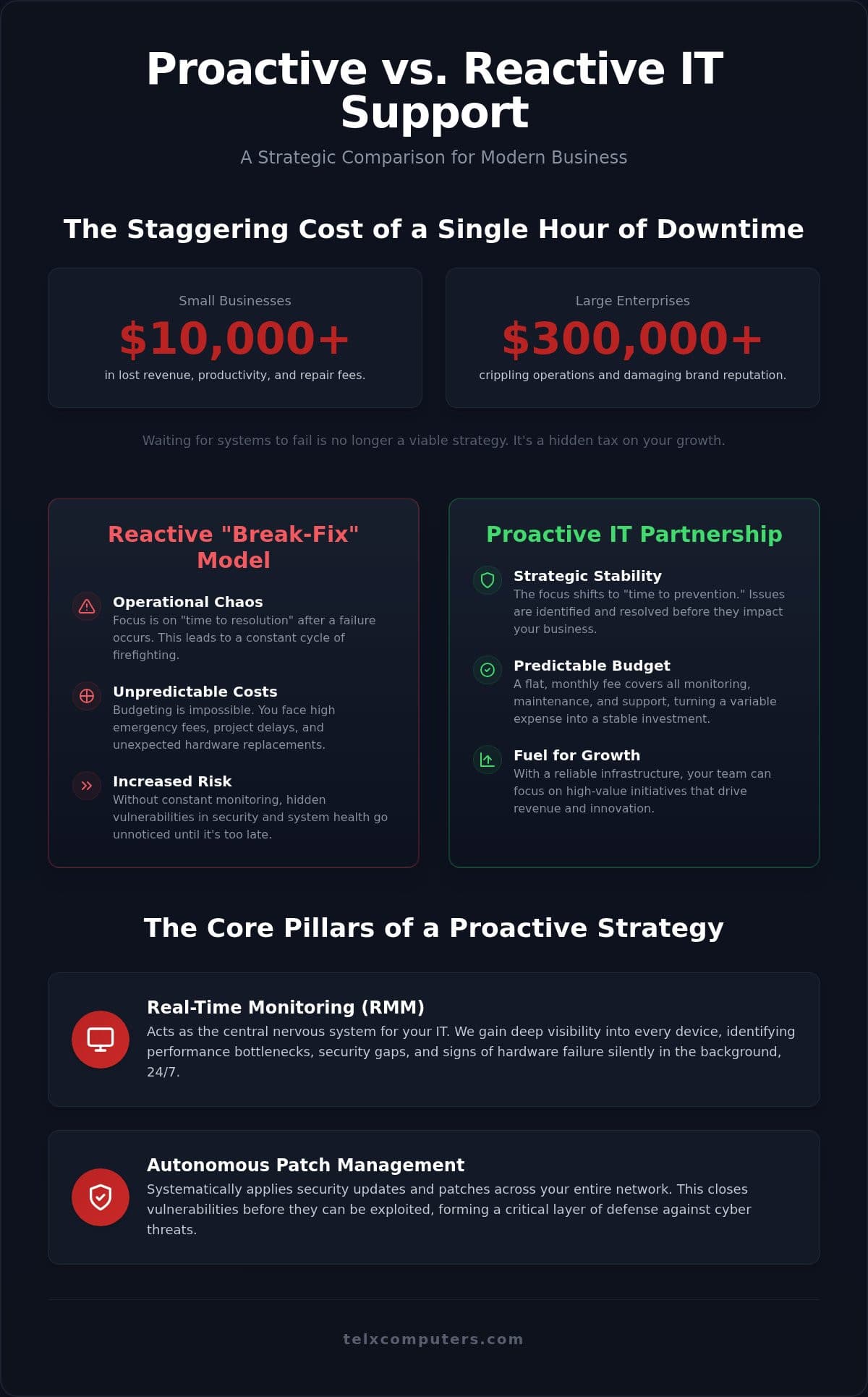
A single hour of system downtime can cost a small business $10,000 or more, while larger enterprises often face losses exceeding $300,000 for the same 60 minutes of inactivity. These figures highlight a painful reality for many leaders: the traditional “break-fix” model is no longer a viable way to run a company. When you wait for something to fail before calling for help, you aren’t just paying for a repair; you’re paying a “break-fix tax” in the form of lost productivity and emergency service fees. Adopting proactive IT support allows you to move away from this reactive chaos and toward a model of stability. It’s understandable if the constant cycle of technical fires and hidden security vulnerabilities leaves you feeling more like a firefighter than a CEO.
Transitioning to a vigilant, partner-oriented approach allows you to secure your infrastructure against threats before they manifest. We’ll show you how to trade technical anxiety for the peace of mind that comes with zero downtime and a predictable monthly budget. This blueprint explores the strategic shift toward a technology roadmap that doesn’t just keep the lights on, but actually fuels your business growth as a silent engine of success.
Key Takeaways
- Discover why the traditional “break-fix” model acts as a hidden tax on your growth and how to eliminate unpredictable emergency repair costs.
- Learn how real-time monitoring and autonomous patch management serve as the core pillars of a modern proactive IT support strategy.
- Understand the operational shift from “time to resolution” to “time to prevention” to ensure your critical business applications remain available 24/7.
- Identify the essential steps for building a technology roadmap that prioritizes network health and secures your infrastructure against hidden vulnerabilities.
- Explore how a strategic partnership with an expert guardian provides the stability and reliability needed to scale your enterprise with total peace of mind.
Beyond the Break-Fix Cycle: Why Proactive IT Support is Non-Negotiable
Stop thinking of IT as a utility that only requires attention when it fails. True proactive IT support is a holistic system of vigilant monitoring and maintenance designed to preempt failure before it disrupts your workflow. It represents a fundamental shift from treating technology as a cost center to viewing it as a strategic asset. By moving away from reactive repairs, you eliminate the “Hidden Tax” of emergency fees and lost data. This change replaces technical anxiety with operational stability, allowing you to focus on growth rather than troubleshooting. This partnership transforms your IT department from a source of stress into a competitive advantage, positioning us as a strategic ally rather than just another service provider.
To better understand how this shift impacts your business success, watch this helpful comparison:
The High Cost of Waiting for Something to Break
The ripple effect of a single hour of downtime is staggering. Research indicates that for small businesses, the cost can reach $10,000, while large enterprises often see losses exceeding $300,000 per hour. Beyond the immediate revenue hit, unreliable systems inflict long-term damage on your brand reputation. If clients can’t access your services or experience frequent glitches, they’ll quickly find a competitor who is always online. When you operate in a reactive state, you’re constantly playing catch-up, which prevents your team from focusing on high-value initiatives that drive revenue. Additionally, emergency “fixes” often create technical debt. These rushed solutions might restore service today, but they frequently overlook root causes, leading to more complex and expensive failures later. Investing in managed IT support service ensures these cycles of failure never begin.
The Proactive Philosophy: Vigilance Over Repair
Effective management requires an “Expert Guardian” mindset. This approach uses sophisticated tools like Remote Monitoring and Management (RMM) to oversee every endpoint on your network. Constant 24/7 monitoring acts as an early warning system, identifying hardware bottlenecks and software glitches before they impact your users. Instead of waiting for a server to crash, a proactive team identifies the signs of impending failure and resolves the issue during scheduled maintenance. This vigilance ensures that your infrastructure scales seamlessly as your business grows, proving that your technology can be the silent engine behind your success. Proactive IT support is the continuous alignment of technology and business goals.
The Core Pillars of a Modern Proactive IT Strategy
To move beyond the cycle of constant repairs, you need a structural foundation that supports continuous operations. Modern proactive IT support relies on four critical pillars that work together to create a resilient environment. These aren’t just software tools; they are integrated processes that allow your technology to scale alongside your business objectives. By focusing on prevention rather than reaction, these pillars transform your infrastructure into a reliable engine for growth.
Real-Time Monitoring and Remote Management (RMM)
RMM acts as the central nervous system of your IT infrastructure. These tools provide deep visibility into every device, allowing technicians to identify and resolve performance bottlenecks without interrupting your team’s workflow. If a CPU is running at high capacity or a hard drive shows signs of potential failure, we address it silently in the background. This approach relies on server monitoring systems that utilize predictive analytics. Instead of waiting for hardware to die, we manage the lifecycle of your assets, ensuring replacements happen during scheduled maintenance rather than emergency outages.
Autonomous patch management is the next essential layer. By closing security vulnerabilities the moment a vendor releases a fix, you significantly reduce the window of opportunity for attackers. This is paired with strategic data backup and disaster recovery planning. It’s not enough to just save files; you need a blueprint for how to resume operations within minutes if a catastrophic event occurs. This ensures that your data remains available and your business stays functional, regardless of external disruptions.
Cybersecurity as a Proactive Layer
Reactive security measures are no longer sufficient in an era of sophisticated ransomware. Waiting for an alert to trigger often means the intruder is already inside your network. A proactive stance begins with regular cybersecurity audits to uncover hidden weak points before they are exploited. We implement Multi-Factor Authentication (MFA) and Endpoint Detection and Response (EDR) as standard protocols. These layers work in tandem to monitor behavior and block suspicious activity in real time, rather than just scanning for known viruses.
Finally, end-to-end endpoint management secures your distributed workforce. Whether your team is in Miami, NYC, or working remotely, their devices must remain compliant and secure. If you’re unsure where your current infrastructure stands, you might want to request an assessment to see how these pillars can stabilize your operations. This holistic approach ensures every laptop, server, and cloud application is shielded by a vigilant guardian, providing you with the peace of mind to focus on your core business goals.
Proactive vs. Reactive Support: A Financial and Operational Comparison
Choosing between reactive and proactive IT support is ultimately a decision about financial risk management. In a reactive model, your IT expenses are unpredictable, often peaking during your most stressful moments of system failure. This creates a volatile budget where emergency repair costs can derail other business initiatives. Proactive models, however, align the interests of the service provider with your own. When your systems run smoothly, both parties succeed. This creates a foundation for a long-term ROI where infrastructure “just works,” allowing your team to focus on high-value projects instead of technical troubleshooting.
The Predictability of Fixed-Price Managed Services
Switching to a managed IT support service stabilizes your annual budget by replacing erratic hourly invoices with a single, predictable monthly fee. The traditional “break-fix” model contains an inherent conflict of interest: the provider only makes money when your technology fails. By contrast, a fixed-price model incentivizes the provider to keep your systems healthy and secure. This financial transparency eliminates the anxiety of hidden repair costs and allows for more accurate long-term planning. The recurring cost of a proactive subscription is a fraction of the $100,000 or more that 54% of organizations report as the cost of a single major data center outage.
Operational Continuity: The “Silent Engine” Effect
The ideal state of technology is when your employees never have to think about it. When proactive IT support is functioning correctly, it acts as a silent engine, resolving background issues before they reach the user’s awareness. This results in a significant boost to staff morale, as employees are no longer frustrated by recurring glitches or sudden system crashes. Regular maintenance also extends the life of your physical hardware assets, delaying expensive replacement cycles by keeping components optimized and clean of software bloat.
Through strategic IT consulting, we identify and prevent future technical bottlenecks before they impact your workflow. This shift from “Time to Resolution” to “Time to Prevention” ensures that your business maintains momentum. Instead of measuring success by how fast a technician arrives after a crash, we measure it by how many months pass without a single interruption. This operational continuity translates directly into higher productivity and a more resilient bottom line, ensuring your technology supports your growth rather than hindering it.
How to Build a Proactive Roadmap for Your Organization
Constructing a resilient infrastructure requires more than just installing software. It demands a structured sequence of actions that align your technology with your business objectives. A well-defined roadmap for proactive IT support ensures that every decision serves a long-term goal, preventing the accumulation of technical debt. By following these five steps, you can transform your current environment into a high-performance asset.
- Step 1: Audit. Conduct a comprehensive assessment of your network and hardware health to identify aging equipment and potential points of failure.
- Step 2: Prioritize. Identify your most critical business applications and data. Not every system requires the same level of redundancy, so focus resources where they matter most.
- Step 3: Baseline. Establish a standard for security and compliance. For organizations in regulated sectors, this means aligning with frameworks like HIPAA or SOC 2.
- Step 4: Implement. Deploy 24/7 monitoring and automated maintenance protocols to handle routine updates and early warning alerts.
- Step 5: Review. Schedule quarterly strategic business reviews with a vCIO to adjust the roadmap as your company scales.
Tailoring Support for Local Markets: Miami, NYC, and LA
A global strategy is only effective if it’s executed with local expertise. In high-stakes markets, geographical factors dictate specific proactive needs. For instance, IT support in Miami must prioritize hurricane readiness and rigorous data backup protocols to ensure continuity during severe weather. Conversely, NYC firms often deal with extreme office density and high-speed connectivity demands. Having a physical presence in Fort Lauderdale, Aventura, or Manhattan allows for rapid on-site response when a physical hardware issue requires an expert guardian on the ground. This localized focus ensures that your proactive dynamic isn’t just theoretical, but deeply rooted in the realities of your regional business community.
Industry-Specific Proactive Needs
Different industries face unique technical hurdles that require specialized roadmaps. We provide compliance-first proactive support for healthcare IT services, where protecting patient data is a legal and ethical mandate. For law firms, the focus shifts toward extreme uptime and ironclad document security to maintain billable hours and client confidentiality. Growing fintech companies in NYC or media entities in LA require scalability roadmaps that can handle massive data loads without lag. If you are ready to move beyond reactive fixes, you can request an assessment to build your custom roadmap today.
Strategic Partnership: The Telx Approach to Vigilant IT
Choosing a provider for proactive IT support isn’t just about selecting a software suite; it’s about finding a strategic ally who understands your operational pulse. At Telx, we don’t just fix what’s broken. We integrate with your team to act as a seamless extension of your own department. Our “Expert Guardian” model provides a 24/7 help desk supported by senior engineers who monitor your systems in real time. This ensures that while you focus on scaling your business, we serve as the silent engine maintaining your technical edge. You can see how this model fits your unique requirements by requesting a free instant quote today.
Holistic Management Over Disconnected Fixes
Our philosophy centers on internal integration rather than a series of disconnected repairs. We believe that technology should be a seamless part of your workflow, not a recurring hurdle. By offering unlimited, fixed-price plans, we foster open communication. Your team won’t hesitate to report a minor glitch before it becomes a major outage because they know the cost is already covered. This comprehensive approach is why many leaders choose our IT outsourcing services. We take ownership of your entire infrastructure, ensuring that security, backups, and network performance are always aligned with your long-term business goals.
Rapid Response and Local Accountability
While global technical standards are vital, local accountability provides true peace of mind. We maintain physical locations in Miami, New York, and Los Angeles to provide rapid on-site response when digital intervention isn’t enough. Knowing that a senior engineer can be at your office quickly alleviates the technical anxiety that often accompanies infrastructure management. We stand by our guarantee of professionalism and reliability, ensuring your business remains resilient in a competitive landscape. This physical presence allows us to blend global expertise with a deep commitment to your specific regional community.
Secure your business future by partnering with a vigilant guardian who is always one step ahead of potential threats. It’s time to replace the uncertainty of the break-fix cycle with the stability of a partner-oriented approach. By choosing a model rooted in reliability and competence, you ensure that your technology remains an asset rather than a liability. Reach out today to begin your transition toward a secure, scalable, and proactive infrastructure.
Secure Your Competitive Edge with Vigilant IT Management
Transitioning away from the “break-fix tax” is the most significant step you can take toward operational maturity. By implementing a framework of proactive IT support, you replace the chaos of emergency repairs with the stability of a technology roadmap that fuels your growth. You’ve seen how real-time monitoring and autonomous security layers act as a silent engine, preventing downtime before it impacts your bottom line. This shift allows your team to focus on high-value initiatives rather than troubleshooting recurring technical glitches.
Telx Computers stands as your expert guardian, providing the 24/7 vigilant monitoring and fixed-price unlimited support necessary to protect your infrastructure. Our physical presence in Miami, NYC, and LA ensures that local on-site response is always available when you need it most. You don’t have to navigate technical complexities alone; instead, you can rely on a partner-oriented approach that prioritizes your success. It’s time to trade technical anxiety for the peace of mind that comes with a dedicated strategic ally who is always one step ahead.
Get a Proactive IT Strategy and Instant Quote from Telx Computers
Let’s build a secure, resilient future for your business together. Your journey toward predictable costs and zero downtime starts with a single strategic decision.
Frequently Asked Questions
What is the main difference between proactive and reactive IT support?
Proactive IT support focuses on identifying and resolving potential issues before they cause downtime, whereas reactive support only addresses problems after they have occurred. This shift moves your organization away from the costly “break-fix” cycle where expenses are unpredictable and productivity is frequently interrupted. By using continuous monitoring and automated maintenance, a proactive partner ensures your systems remain stable, secure, and aligned with your business goals rather than just fixing hardware failures as they arise.
How much does proactive IT support cost for a small business?
We provide fixed-price, unlimited service plans that allow for predictable monthly IT budgeting. While hourly rates for emergency repairs can vary significantly and lead to unexpected financial strain, our model covers all routine maintenance and help desk support under a single recurring fee. This approach eliminates the conflict of interest found in reactive models and ensures your technology costs remain consistent as you scale, regardless of how many support tickets your team generates.
Can proactive support prevent all cyberattacks and ransomware?
While no system can claim 100% immunity, proactive IT support significantly reduces your attack surface through multiple layers of defense. We implement continuous vulnerability scanning, automated patch management, and advanced endpoint detection to block threats before they breach your perimeter. By conducting regular cybersecurity audits and enforcing protocols like Multi-Factor Authentication, we identify and close security gaps that reactive models often overlook, providing a much higher level of resilience against modern ransomware.
Does proactive IT support include hardware upgrades and procurement?
Yes, our comprehensive management includes hardware and software procurement services as part of a holistic technology strategy. We handle the entire lifecycle of your assets, from the initial recommendation and purchase of workstations or servers to their final decommissioning. This ensures your equipment remains modern and capable of supporting your workload. By managing procurement directly, we guarantee that all new hardware is fully compatible with your existing network security and cloud infrastructure.
How does 24/7 server monitoring actually work to prevent downtime?
Our real-time server monitoring systems track critical performance metrics such as disk space, CPU usage, and memory health 24/7. When a metric deviates from the baseline, our senior engineers receive an instant alert, often allowing them to resolve the issue remotely before your employees even notice a slowdown. This vigilant approach identifies hardware bottlenecks and software conflicts in their early stages, preventing the cascading failures that typically lead to significant system downtime and data loss.
Is proactive support necessary if my business is mostly in the cloud?
Absolutely, because your team still relies on local endpoints, network hardware, and stable internet connectivity to access those cloud resources. Even in a cloud-heavy environment, proactive IT support is essential for managing user permissions, securing mobile devices, and ensuring your SaaS applications are configured correctly. We monitor the local network infrastructure in your Miami or NYC office to prevent connectivity issues that could disconnect your staff from their critical cloud-based workflows and data.
What should I look for in a proactive Managed Service Provider (MSP)?
Seek a provider that offers 24/7 help desk support and fixed-rate recurring billing to ensure your costs remain predictable. A high-tier MSP should act as a strategic ally, providing regular vCIO reviews and a clear technology roadmap for your growth. It’s also vital to choose a firm with a physical presence in your region, such as Miami or Fort Lauderdale, to guarantee rapid on-site response when a hardware emergency requires an expert guardian on-site.
How does Telx Computers handle on-site emergencies in Miami or NYC?
Telx Computers maintains physical locations in Miami, New York, and Los Angeles to ensure rapid on-site response for our clients. If a technical issue cannot be resolved through our remote monitoring and management tools, we dispatch a senior engineer directly to your office. This local accountability provides peace of mind for businesses in Aventura or Manhattan, knowing that an expert who understands their specific environment is available to provide hands-on assistance during critical hardware failures.