





10 Apr Cloud Computing Services in Miami: The 2026 Business Continuity Guide
What if the next Category 4 storm could actually strengthen your business instead of shutting it down?
Key Takeaways
- Learn how cloud computing services Miami businesses rely on eliminate costly server maintenance while providing enterprise-grade infrastructure without the capital investment.
- Discover the proven 5-step migration process that ensures seamless transition from legacy systems to scalable cloud environments tailored for your specific business needs.
- Understand why cloud-based disaster recovery is the ultimate defense against South Florida’s hurricane season, with real-time data replication that guarantees zero data loss.
- Master the core components of modern cloud infrastructure, from IaaS virtual data centers to SaaS collaboration tools that streamline your entire operation.
- Explore how fixed-price, unlimited service plans make cloud budgeting predictable while delivering the reliability of having your own dedicated IT department.
Understanding Cloud Computing Services in Miami for 2026
Cloud computing represents the strategic shift from owning physical hardware to consuming IT resources as a scalable service. For Miami enterprises navigating 2026’s digital landscape, this transformation eliminates the operational burden of maintaining on-site infrastructure while delivering unprecedented flexibility and cost predictability.
Miami businesses are uniquely positioned to benefit from this evolution.
Core Components of Modern Cloud Infrastructure
Understanding the core components of modern cloud infrastructure is crucial for businesses seeking reliable cloud computing services Miami. These components not only enhance operational efficiency but also provide a robust framework for business continuity. Let’s explore the key elements that shape this infrastructure.
Infrastructure as a Service (IaaS)
IaaS allows businesses to build their virtual data centers with flexibility and scalability. Instead of investing heavily in physical servers, companies in Miami can leverage IaaS solutions to access computing resources on-demand. This means you can scale up or down based on your needs, ensuring you only pay for what you use. Major providers like Amazon Web Services (AWS) and Google Cloud offer comprehensive IaaS solutions, allowing seamless integration with existing systems.
Software as a Service (SaaS)
SaaS applications, such as Microsoft 365, streamline collaboration across teams. These tools facilitate remote work, enhance productivity, and eliminate the need for local installations. Specialized applications tailored for various industries can also be integrated, allowing businesses to customize their workflows. With SaaS, Miami businesses can ensure their teams stay connected and productive, regardless of location.
The Rise of Desktop as a Service (DaaS)
As remote work becomes the norm, DaaS is gaining traction in South Florida. This model provides secure access to desktops hosted in the cloud, enabling employees to work from anywhere without compromising security. DaaS solutions are particularly beneficial for businesses with a mobile workforce, ensuring that sensitive data remains protected.
Security Layers
Cloud-native security solutions significantly outperform traditional firewalls. These modern security layers are designed to protect against a wide range of threats, including ransomware. By integrating advanced security measures directly into your cloud architecture, you can enhance your defenses against increasingly sophisticated cyber threats.
Public, Private, and Hybrid Cloud Models
Choosing the right cloud model is essential for compliance and efficiency. For industries like legal and healthcare in Miami, a Private Cloud offers strict compliance and enhanced control over sensitive data. Conversely, the Hybrid Cloud provides flexibility for firms with legacy systems that still require on-site resources, offering the best of both worlds.
Comparing Major Platforms
When evaluating cloud hosting options, Microsoft Azure stands out for its comprehensive tools and ease of integration with existing Microsoft products. In contrast, customized private hosting offers tailored solutions that can address specific business needs. The choice between these platforms depends on your operational requirements and budget.
Securing the Virtual Perimeter
Integrating ransomware protection into your cloud architecture is vital. This proactive measure helps safeguard your data and ensures business continuity. Additionally, implementing Identity and Access Management (IAM) is critical for Miami’s mobile workforce, allowing you to control access to sensitive information effectively.
End-to-end encryption is also essential. Protecting data at rest and in transit mitigates risks associated with data breaches and unauthorized access.
In conclusion, embracing modern cloud infrastructure components not only prepares your business for the future but also strengthens your operational resilience. For tailored guidance on cloud computing services Miami, consider partnering with experts who can help you navigate these technologies effectively. Explore how Telx Computers can support your business’s cloud journey.
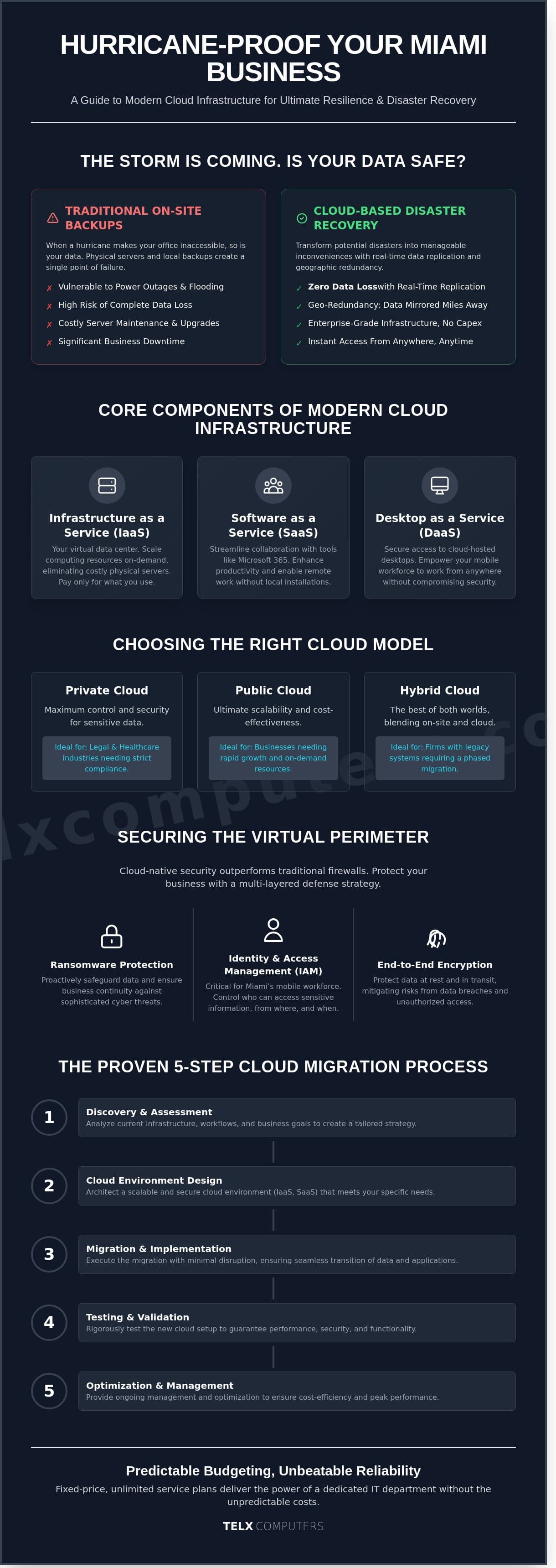
Disaster Recovery: Hurricane-Proofing Your Miami Business
When Hurricane Ian demonstrated its destructive power in 2022, South Florida businesses learned a harsh reality: traditional backup systems fail when your entire office becomes inaccessible. Cloud computing services Miami businesses rely on today represent the most robust defense against our region’s unpredictable storm seasons, transforming potential disasters into manageable inconveniences.
The difference between surviving and thriving during hurricane season lies in real-time data replication. Modern cloud infrastructure continuously mirrors your business data across multiple geographic locations, ensuring zero data loss even during extended power outages. This isn’t your grandfather’s backup tape sitting in a fire safe. It’s instantaneous, automatic protection that works while you sleep.
Geographic redundancy serves as your business’s insurance policy against localized disasters. Smart Miami companies store their critical backups in data centers located hundreds of miles from South Florida’s flood zones. When Hurricane Irma knocked out power to 6.8 million Floridians in 2017, businesses with properly configured cloud systems continued operations from temporary locations within hours, not weeks.
The Expert Guardian approach to business continuity planning goes beyond simple data protection. It encompasses comprehensive disaster recovery strategies that account for Miami’s unique environmental challenges: flooding, power grid instability, and telecommunications disruptions. This methodology focuses on maintaining operational capability rather than merely preserving files.
The Difference Between Backup and Business Continuity
Simple backups become worthless when your Miami office sits under three feet of storm surge. True business continuity means your team can access systems, process orders, and serve customers from any location with internet connectivity. Recovery Time Objective (RTO) measures how quickly you resume operations, while Recovery Point Objective (RPO) determines how much data you can afford to lose. Cloud computing services Miami professionals design systems where your employees work seamlessly from anywhere, even when the physical office remains offline for weeks.
Automated Failover Systems
Advanced cloud services automatically detect local disruptions and redirect traffic to backup servers within minutes. This failover process requires zero human intervention, activating the moment primary systems become unreachable. Testing these disaster recovery plans isn’t optional for South Florida firms; it’s essential preparation for inevitable weather events. Cloud computing solutions proved their worth during recent storm seasons, keeping local businesses operational while competitors struggled with flooded server rooms and corrupted hard drives.
The 5-Step Cloud Migration Process for Miami Firms
Successfully migrating to the cloud requires a structured approach that minimizes risk while maximizing business value.
Why Telx Computers is the Premier Cloud Partner in Miami
When Miami businesses choose cloud computing services Miami providers, they face a critical decision: partner with a distant vendor or work with a local team that understands their unique challenges. Telx Computers operates under a distinctive “Your IT Department” philosophy that transforms how companies approach cloud infrastructure. We don’t just manage your servers. We take complete ownership of your cloud environment, treating it as if it were our own internal network.
This ownership mentality drives everything we do. Our fixed-price, unlimited service plans eliminate the budget uncertainty that plagues traditional IT relationships. No surprise charges for emergency support calls. No hidden fees for additional monitoring. Your monthly investment stays predictable, allowing you to focus resources on business growth rather than IT crisis management.
Since 2002, we’ve built deep roots throughout the Miami, Aventura, and Fort Lauderdale communities. This isn’t just about geographic proximity. It’s about understanding the regulatory pressures facing Miami’s legal firms, the compliance requirements driving financial services, and the rapid scaling needs of South Florida’s growing tech sector. Our local presence means on-site response when remote troubleshooting isn’t enough.
Strategic Ally vs. Service Provider
Traditional cloud vendors deploy generic solutions and hope they fit. We align cloud architecture with your specific growth trajectory. Our proactive monitoring systems catch performance degradation before it impacts your team’s productivity. This approach has helped Miami businesses achieve 99.9% uptime consistently over the past five years. Learn more about our mission on our About page.
The Telx Difference in South Florida
Recognition as one of the top IT companies in Miami reflects our commitment to excellence, but our real differentiator is availability. Miami’s legal and financial sectors operate beyond standard business hours, requiring 24/7 support that actually responds. Our average response time for critical issues is under 15 minutes, not the industry standard of 4-8 hours.
Ready to modernize your cloud infrastructure with a partner who treats your success as our own? Contact Telx Computers today to discover how our “Your IT Department” approach can transform your technology from a cost center into a competitive advantage.
Your Miami Business Deserves Hurricane-Proof Cloud Protection
The path forward is clear: Miami businesses can’t afford to wait for the next storm to test their resilience.
Frequently Asked Questions
Is cloud computing safe for businesses with strict compliance needs in Miami?
Yes, cloud computing can be safe for businesses with strict compliance needs in Miami. Reputable cloud service providers implement robust security measures, including data encryption, access controls, and regular audits. For example, providers complying with HIPAA or GDPR follow stringent protocols to ensure data protection, providing peace of mind for businesses in regulated industries.
How much do cloud computing services in Miami typically cost for a small business?
The cost of cloud computing services in Miami for small businesses varies widely based on specific needs and service levels. According to a 2023 report by Clutch, small businesses can expect to pay between $50 to $500 per month for essential services, depending on storage requirements and user needs. It’s important to compare different providers to find a tailored solution that fits your budget.
What happens to my data if a hurricane hits the Miami area?
If a hurricane hits the Miami area, your data remains secure in the cloud. Leading cloud providers utilize data redundancy and geographically distributed data centers. For instance, if Miami is affected, your data can be accessed from a data center located in another state, ensuring business continuity and minimizing downtime.
Can I still use my existing software after migrating to the cloud?
Yes, you can still use your existing software after migrating to the cloud. Many cloud computing services in Miami offer compatibility with popular business applications. Additionally, you might consider Software as a Service (SaaS) options that mirror your current tools, ensuring a seamless transition while enhancing accessibility and collaboration. If your migration involves complex web-based systems, specialized services from Xell Technology can assist in repairing and optimizing your site for the new environment.
How long does a typical cloud migration take for a mid-sized Miami firm?
A typical cloud migration for a mid-sized Miami firm can take anywhere from a few weeks to several months. This timeframe depends on the complexity of your IT environment, including the amount of data and applications to be migrated. A well-planned migration strategy will help minimize disruption and ensure a smoother transition to cloud services.
Do I still need local IT support if all my data is in the cloud?
Yes, you may still need local IT support even if all your data is in the cloud. Local IT professionals can assist with network management, user training, and troubleshooting. Additionally, having local support ensures faster response times for critical issues that might arise, providing an extra layer of reliability for your business operations.
What is the difference between public and private cloud for a South Florida law firm?
The primary difference between public and private cloud for a South Florida law firm lies in data accessibility and control. A public cloud is shared among multiple users, which can reduce costs but may pose security risks. In contrast, a private cloud offers dedicated resources and enhanced security, making it ideal for law firms that handle sensitive client information and require strict compliance.
Can cloud computing help reduce my monthly electricity and hardware costs?
Yes, cloud computing can help reduce your monthly electricity and hardware costs. By migrating to the cloud, businesses can minimize the need for on-premises servers and associated energy consumption. According to a 2023 study by Gartner, organizations that transitioned to cloud services reported a 30% reduction in hardware costs and a significant decrease in energy bills, enhancing overall operational efficiency.