




16 Jun Beyond the Hourly Rate: Strategic Strategies for Avoiding IT Downtime Costs
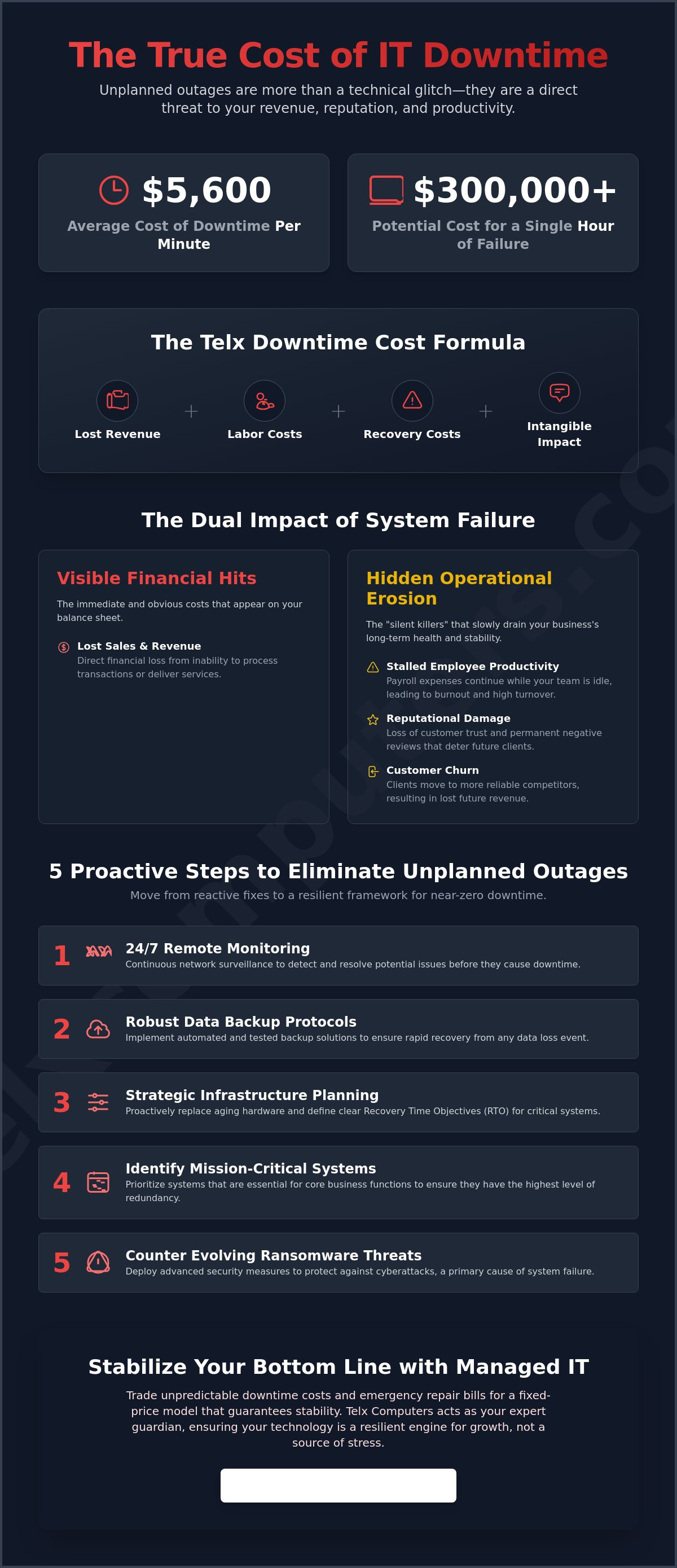
Did you know that the average cost of IT downtime has climbed to $5,600 per minute? For mid-sized enterprises, a single hour of system unavailability can easily breach the $300,000 mark according to recent ITIC data. These aren’t just abstract numbers. They represent lost sales, stalled employee productivity, and the slow erosion of customer trust. We know how frustrating it’s to deal with unpredictable bills and the anxiety of wondering when the next outage will strike. Focusing on avoiding IT downtime costs is no longer just a technical preference; it’s a fundamental requirement for business continuity.
You deserve a technology environment that works as hard as you do, providing stability instead of stress. This article will help you quantify your specific risks and implement a proactive framework that transforms IT from a cost center into a resilient engine of growth. We’ll outline the steps to move beyond reactive fixes and toward a strategic partnership that ensures near-zero unplanned downtime. By the end, you’ll have a clear roadmap for predictable budgeting and a more secure operational future that positions your business for long-term success.
Key Takeaways
- Quantify the financial impact of technical failures by distinguishing between obvious lost revenue and the hidden costs of stalled productivity.
- Master the Telx Downtime Cost Formula to prioritize mission-critical systems and begin avoiding IT downtime costs through strategic planning.
- Identify the primary technical triggers, such as aging infrastructure and evolving ransomware threats, that jeopardize your business stability.
- Learn the five essential proactive steps, including 24/7 remote monitoring and robust data backup protocols, to eliminate unplanned outages.
- Discover how a fixed-price Managed IT model stabilizes your technology budget while providing an expert guardian to monitor your network.
The True Cost of IT Downtime: More Than Just Lost Revenue
Downtime isn’t just a technical glitch; it’s a strategic threat to your business stability. We define downtime as any period where technical systems fail to support core business functions, essentially halting your ability to serve clients or generate value. While many leaders focus on the immediate loss of sales, the reality is much more complex. Understanding The True Cost of IT Downtime requires looking at both the visible financial hits and the invisible operational erosion. In South Florida’s high-speed market, where competition is fierce, avoiding IT downtime costs is a matter of survival.
To better understand the scale of this issue, watch this helpful video:
The direct costs are staggering, often reaching thousands of dollars per minute for mid-sized enterprises. However, the “silent killer” of your growth is the accumulation of indirect costs. Repeated minor glitches might not crash the whole network, but they erode client trust and damage your brand reputation over time. In Miami’s competitive landscape, your partners expect seamless performance. Failing to provide it opens the door for them to seek more reliable alternatives.
The Productivity Drain: Calculating Employee Idle Time
When your network fails, your payroll expenses continue regardless of output. Measuring a “work-stop” event involves analyzing the impact across every department, from sales to administration. Labor burden is the total cost of an employee during a system outage, including their salary, benefits, and taxes. Beyond the numbers, technical instability creates a toxic psychological environment for your team. Persistent issues lead to employee burnout and higher turnover rates because talented professionals want to work for an organization that provides the tools they need to succeed.
Reputational Damage and the Cost of Customer Churn
Modern customers have zero tolerance for “system is down” excuses. In today’s hyper-connected environment, an outage isn’t just an internal hurdle; it’s a public event that can trigger what we call the “Social Media Tax.” One significant failure can lead to permanent negative reviews that stay visible for years. While a single lost transaction is painful, the long-term value of a lost customer is devastating. If a client moves to a competitor because your systems were unavailable, you’ve lost years of future revenue. Prioritizing Ransomware Protection and system resilience is the only way to ensure avoiding IT downtime costs remains a central part of your growth strategy.
Calculating Your Exposure: A Framework for Quantifying Downtime Impact
Many business owners view IT issues as minor inconveniences until they see the actual bill. Quantifying your risk isn’t about fear; it’s about clarity. To help our partners maintain visibility, we utilize the Telx Downtime Cost Formula: (Lost Revenue + Labor Costs + Recovery Costs + Intangible Impact). This holistic approach ensures you aren’t just looking at the immediate sales drop but the total operational drain. Focusing on avoiding IT downtime costs begins with knowing exactly what’s at stake before the screen goes dark. Small businesses often underestimate this exposure, assuming their size makes them a lower priority for threats, yet their lack of redundancy often leads to higher relative losses.
A critical part of this framework involves identifying “Mission-Critical” versus “Non-Essential” systems. You must define your Recovery Time Objective (RTO), which is the maximum duration your business can survive without a specific system, and your Recovery Point Objective (RPO), which dictates the age of files that must be recovered from backup for operations to resume. As discussed in The True Cost Of Downtime, establishing these metrics is the difference between a managed recovery and a chaotic collapse. If you’re unsure where your vulnerabilities lie, you can request a tailored assessment to see how we can protect your specific infrastructure.
Direct vs. Indirect Financial Impact
Start by calculating your revenue per hour. If your business generates $100,000 a month over 160 working hours, every hour of downtime costs at least $625 in raw revenue. But don’t forget the hidden leaks. Service Level Agreement (SLA) penalties can trigger financial consequences if you fail to deliver for your own clients. Marketing waste also adds up quickly; running digital ads that lead to a broken landing page or an unresponsive checkout is simply burning your acquisition budget. These indirect hits often exceed the initial revenue loss.
The Cost of Data Recovery and Remediation
Emergency IT fees are notoriously high because “break-fix” providers often capitalize on your desperation during a crisis. If your backups fail or were never properly tested, you face massive data reconstruction costs where employees must manually rebuild lost files. This process is slow, expensive, and prone to human error. For those in regulated sectors like Healthcare IT, the stakes are even higher. Compliance fines and legal liabilities resulting from system unavailability can dwarf the actual technical repair costs. Prioritizing avoiding IT downtime costs means building a defense that accounts for these regulatory realities.
Common Culprits: Why Systems Fail in the Modern Enterprise
Identifying the root causes of system failure is the only way to move from reactive firefighting to proactive management. While hardware failure used to be the primary concern, the modern threat landscape has shifted heavily toward malicious actors who target operational continuity. However, for businesses in South Florida, the physical environment remains a persistent challenger that shouldn’t be ignored. By understanding these common culprits, you can build a defense strategy focused on avoiding IT downtime costs before they impact your balance sheet. Our role as your expert guardian is to anticipate these failures so you don’t have to.
The Proliferation of Ransomware and Cybercrime
Ransomware isn’t just about stolen data; it’s about total operational paralysis. Cybercriminals now design malware specifically to encrypt entire networks, making Ransomware Protection your most critical line of defense. Most of these attacks start with a single click. Inadequate security protocols allow phishing attempts to reach your staff, leading to total system lockouts that freeze every department simultaneously. Proactive monitoring acts as a vigilant sentinel, catching these intrusions before they can trigger a catastrophic outage. It’s much easier to stop a threat at the door than to negotiate for your data’s release while your team sits idle.
Infrastructure Instability and Aging Tech
Many organizations fall into the “it works for now” trap, but deferred maintenance is a ticking time bomb for your productivity. Ignoring Server Monitoring means you miss the early warning signs of hardware fatigue, such as overheating or disk errors. In Miami, these risks are amplified by our local climate. High humidity and consistent heat put immense strain on cooling systems, while frequent tropical storms cause power surges that can fry unprotected circuitry. Even cloud-based operations suffer when poor local network configuration creates connectivity bottlenecks that frustrate users and customers alike.
Even with the best technology, human error remains a top vulnerability. A lack of ongoing training leaves your team unprepared for the latest social engineering tactics. This is why partnering with established IT Companies in Miami is essential. Local expertise ensures a rapid on-site response when environmental or human factors bypass your digital defenses. You need a partner who understands the regional infrastructure and can act as an extension of your team to ensure you are consistently avoiding IT downtime costs. We take pride in being the silent engine behind your success, ensuring your systems remain a resilient foundation for growth.
5 Proactive Steps to Eliminating Unplanned Outages
Moving from awareness to action requires a shift in how you view your technology stack. It’s no longer enough to wait for a failure to occur. By implementing these five proactive steps, you move your organization into a state of continuous readiness, effectively avoiding IT downtime costs that plague less prepared competitors. We act as your vigilant partner in this transition, ensuring every layer of your infrastructure is fortified against both common and complex threats.
The Power of 24/7 Proactive Monitoring
Implementing Remote Monitoring and Management (RMM) for all endpoints provides a real-time pulse on your entire network. These tools identify failing hard drives or bottlenecked CPUs before they crash, allowing for intervention during scheduled maintenance windows rather than in the middle of a workday. Automated patching ensures every device remains secure without manual intervention, removing the risk of human oversight. Proactive monitoring turns a potential disaster into a routine ticket.
Building a Resilient Disaster Recovery Plan
Data loss is often the most expensive component of system failure. We recommend the 3-2-1 backup rule: maintain three copies of your data, on two different media types, with one copy stored off-site. For Miami businesses, a hybrid approach combining cloud and on-site storage offers the best protection against regional power issues and local hardware failures. A Disaster Recovery Plan is useless if it hasn’t been stress-tested in the last 6 months; regular drills ensure your team knows exactly how to respond when every second counts.
Standardizing hardware and software is another vital step to eliminate “configuration drift,” which occurs when mismatched equipment creates a chaotic, hard-to-support environment. Additionally, conducting regular Cybersecurity Audits allows you to patch vulnerabilities before they are exploited by malicious actors. Finally, shifting to a Managed IT model aligns your IT partner’s incentives with your uptime. When we manage your environment, our success is directly tied to your stability, creating a partnership rooted in mutual growth. To secure your operations, explore our Managed IT Support Service and see how we can anchor your business success.
Stabilizing Your Bottom Line with Telx Managed IT Services
Choosing a partner to manage your technology is a decision that impacts every facet of your organization’s financial health. We don’t just provide a service; we act as your expert guardian. This means maintaining constant vigilance over your network to ensure that potential issues are neutralized before they disrupt your operations. By focusing on avoiding IT downtime costs, we provide a level of stability that allows you to focus on your core business objectives without the constant threat of technical anxiety. Our success is fundamentally tied to yours; we only thrive when your systems are running at peak efficiency. We take pride in being the silent engine that powers your daily productivity.
Fixed-Price IT: Aligning Incentives for Uptime
The traditional “break-fix” model is inherently flawed because it creates a clear conflict of interest. When an IT provider charges by the hour, they actually benefit from your technical failures. This model rewards inefficiency and leads to unpredictable bill shock that can devastate a monthly budget. Our Managed IT Support Services operate on a fixed-price, unlimited model. This approach flips the script by aligning our incentives with your uptime. Because we receive a single monthly fee, it’s in our best interest to keep your systems perfect, effectively avoiding IT downtime costs through relentless optimization and preventive care.
A Strategic Ally for Your Growth
We’ve moved beyond the role of a typical service provider to become a strategic ally that understands your specific growth goals. Our deep roots in the regional business community mean we provide a localized focus that national providers simply can’t match. Whether your operations are based in Miami, Fort Lauderdale, or Aventura, our team is positioned to provide rapid on-site response for critical hardware failures that remote tools can’t resolve. We even maintain a strong presence in New York to support our clients with multi-regional footprints. This proximity ensures that even in the face of a physical disaster, your recovery time is minimized.
You don’t have to navigate technical challenges alone. Our approach replaces technical anxiety with a sense of security and peace of mind, knowing that a vigilant team is always one step ahead of potential threats. We focus on a holistic business strategy rather than a series of disconnected fixes, ensuring your IT infrastructure acts as a resilient engine of growth rather than a cost center. If you’re ready to eliminate the unpredictability of system failures and stabilize your technology budget, Get an Instant Quote today and let us become the silent engine behind your success.
Secure Your Operational Future
Your business deserves a foundation that supports your ambitions without the constant threat of technical failure. We’ve explored how avoiding IT downtime costs requires a shift from reactive repairs to a holistic, strategic framework. By quantifying your exposure and implementing proactive monitoring, you move from a state of technical anxiety to one of operational confidence. You’ve seen that the true cost of an outage extends far beyond the immediate transaction; it affects your team’s morale and your brand’s reputation for years to come.
Partnering with an expert guardian ensures your systems remain a silent engine of success. Telx Computers provides the stability you need through 24/7 Help Desk Support and Fixed-Price Unlimited Service Plans that eliminate financial surprises. With our physical presence in Miami, NYC, and LA, we offer the rapid response necessary to maintain continuity in high-speed markets. It’s time to stop paying for downtime and start investing in your growth. We’re ready to act as a seamless extension of your team.
Secure your business with a proactive IT partner—Get an Instant Quote from Telx Computers
We look forward to helping you build a more resilient and profitable future through technology that simply works.
Frequently Asked Questions
What is the average cost of IT downtime for a small business?
For small businesses with under 25 employees, research from ITIC indicates the average cost is approximately $1,670 per minute, which totals about $100,000 per hour. Larger SMBs can expect an average hourly hit of around $8,000 according to the Datto State of the Channel report. These figures include lost revenue, recovery fees, and the labor burden of idle staff during the outage.
How does proactive monitoring help in avoiding IT downtime costs?
Proactive monitoring identifies potential hardware failures and software bottlenecks before they trigger a system crash. By resolving these issues during scheduled maintenance, businesses are successful in avoiding IT downtime costs that occur during unplanned outages. This vigilant approach ensures your technology remains a stable engine for growth rather than a source of technical anxiety.
Is it cheaper to use a break-fix IT model or managed IT services?
Managed IT services are almost always more cost-effective because they provide predictable budgeting and prevent expensive emergency repairs. The break-fix model often hides the true cost of lost productivity and rewards the provider when your systems fail. A fixed-price managed service aligns your partner’s goals with your uptime, reducing the long-term financial drain of technical instability.
What are the most common causes of unplanned IT outages?
Research from Splunk indicates that 43% of downtime incidents stem from network or IT environment issues, while 32% result from cybersecurity events. Application or infrastructure failures account for another 24% of outages. Addressing these root causes requires a holistic strategy that includes robust security and constant system vigilance to catch failures before they escalate.
Can cloud computing help reduce the risk of downtime?
Cloud computing significantly reduces downtime risk by shifting infrastructure to highly redundant data centers managed by global providers. This move eliminates the single point of failure risk associated with aging on-site servers. While it doesn’t remove the need for local network stability, it ensures your critical applications and data remain accessible even if your physical office faces hardware or environmental challenges.
How often should a business test its disaster recovery plan?
You should test your disaster recovery plan at least every six months to ensure it remains effective against evolving threats. Regular stress-testing identifies gaps in your backup protocols and ensures your team is ready to act decisively during a crisis. A plan that hasn’t been verified recently is just a document; it’s not a reliable safety net for your operations.
What is the difference between RTO and RPO in business continuity?
Recovery Time Objective (RTO) is the maximum duration your business can survive without a system, while Recovery Point Objective (RPO) defines the maximum age of files you can afford to lose. Balancing these two metrics helps you prioritize which systems need the most aggressive protection. We help you define these targets to ensure your recovery strategy matches your actual operational needs.
Does managed IT service include cybersecurity protection?
Yes, comprehensive managed IT services integrate cybersecurity as a foundational layer of protection for your network. This includes ransomware defense, email security, and regular audits to find vulnerabilities before malicious actors can exploit them. By merging security with proactive system management, we create a unified defense that is essential for avoiding IT downtime costs in a complex threat landscape.