




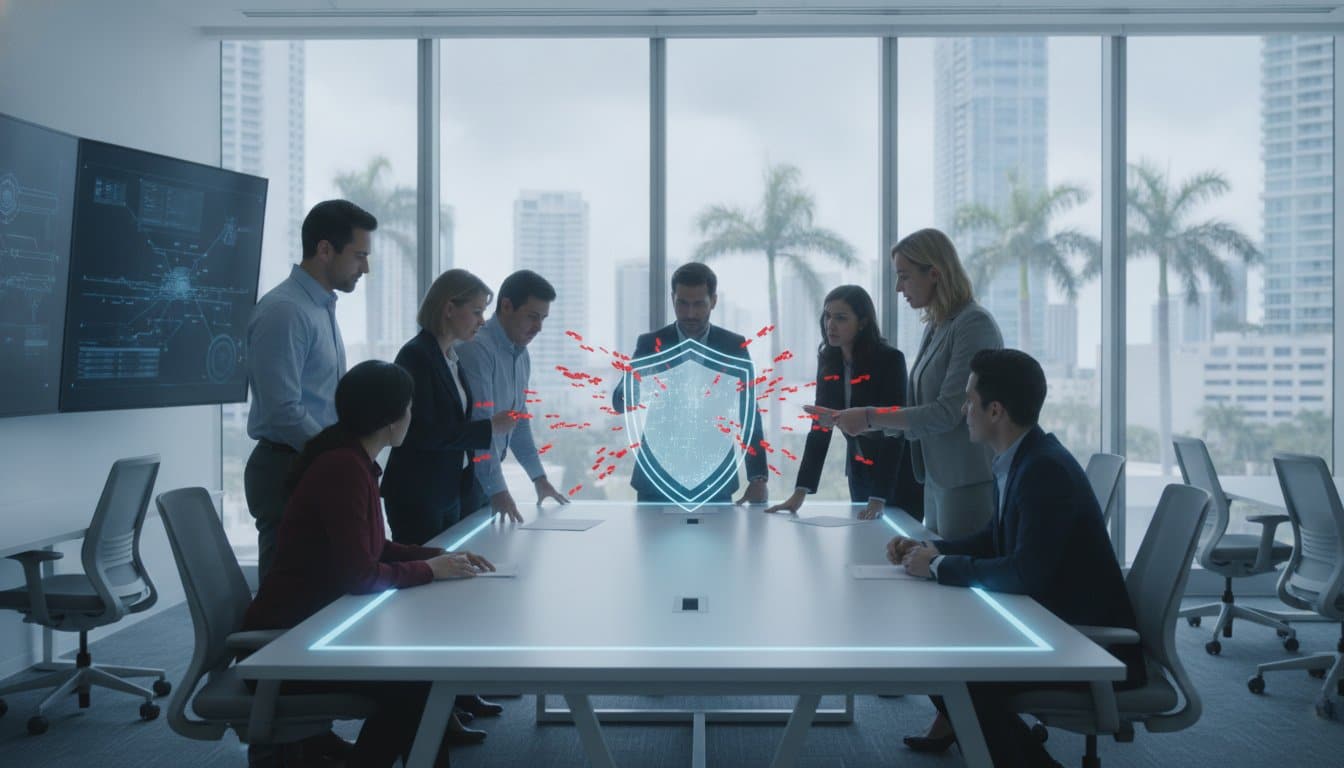
29 Aug Business Email Security: Protecting Your Organization’s Most Critical Asset
Did you know that 91% of cyberattacks start with a single phishing email? With the median time from receipt to the first click sitting at just 3.5 minutes, your organization is often only seconds away from a potential breach. It’s an exhausting reality for any business leader. You likely feel the weight of every suspicious message hitting your team’s inboxes, fearing that one wrong click will lead to a devastating ransomware attack. Technical protocols like DMARC or MFA might seem complex, but they’re the essential pillars of a reliable defense.
We understand that the sheer volume of modern threats feels insurmountable. However, robust business email security doesn’t have to be a source of constant anxiety. You deserve a strategy that moves beyond basic filters to provide a true sense of stability and peace of mind. This article will show you how to safeguard your corporate communications from sophisticated threats through a layered, managed security strategy. We’ll break down the latest trends in AI-generated phishing, provide a clear checklist of actionable protocols, and explain how expert monitoring transforms your defense into a proactive shield for your company’s future.
Key Takeaways
- Move beyond basic filters by understanding how a multi-layered defense protects your organization from sophisticated, intent-based social engineering.
- Build a robust business email security framework using Advanced Threat Protection and AI-driven filtering to identify malicious intent before it reaches the inbox.
- Secure your perimeter with actionable protocols like MFA and encryption to effectively neutralize high-risk threats like spear-phishing and credential theft.
- Leverage the power of 24/7 managed monitoring to ensure your critical communications are always under the watch of vigilant experts.
- Transition from reactive fixes to a holistic security strategy that fosters internal stability and positions your IT as a driver of business success.
Why Standard Email Filters Are No Longer Enough for Modern Business
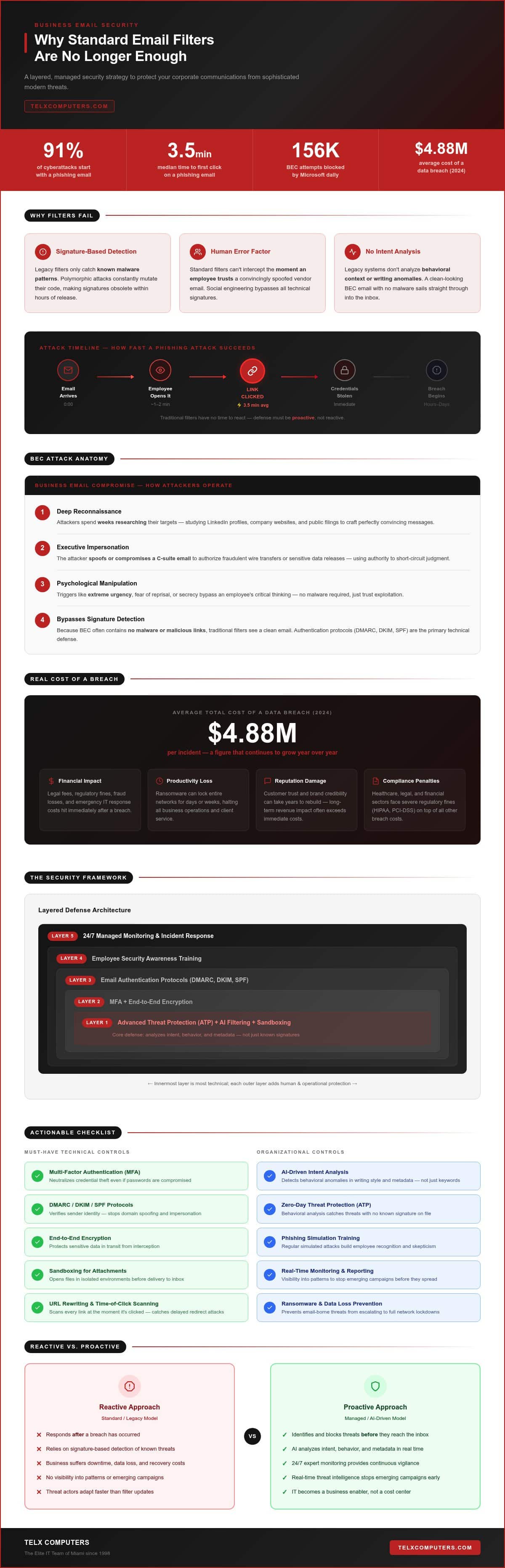
Legacy email filters were designed for a different era. They relied on signature-based detection to catch known malware and bulk spam. Today, cybercriminals have pivoted to polymorphic attacks and social engineering. Modern business email security must function as a multi-layered defense. It’s no longer just about blocking a malicious link. It’s about protecting against unauthorized access and data loss through a combination of technical controls and human vigilance. A robust approach to business email security ensures your organization stays ahead of attackers who exploit trust rather than just software vulnerabilities.
Standard filters often fail because they can’t catch the “human error” factor. When an employee receives a message that looks exactly like a legitimate request from a vendor, they often click without thinking. According to 2026 data from Cloudskope, the median time from a phishing email’s arrival to the first click is just 3.5 minutes. This speed makes traditional defenses obsolete. Microsoft currently blocks approximately 156,000 Business Email Compromise (BEC) attempts every single day, highlighting the massive scale of the problem.
The Sophistication of Business Email Compromise (BEC)
Attackers now spend weeks researching their targets to craft the perfect message. They often impersonate high-level executives to authorize fraudulent wire transfers or sensitive data releases. These campaigns use psychological triggers like extreme urgency or fear of reprisal to bypass an employee’s critical thinking. To defend against this, your team needs more than a firewall. Business Email Compromise (BEC) is a targeted attack that bypasses traditional signature-based detection by using spoofed or compromised accounts to manipulate victims. Integrating Email authentication protocols is a critical first step in verifying that the sender is truly who they claim to be.
Beyond Spam: The Real Cost of a Data Breach
The fallout from a successful attack extends far beyond a simple IT headache. Financial impacts include immediate legal fees, massive lost productivity, and long-term reputation damage that can take years to repair. The average cost of a data breach reached $4.88 million in 2024. Organizations must prioritize ransomware protection to prevent email-borne threats from locking down entire networks. If you’re managing healthcare IT services or IT for law firms, a single breach could trigger severe regulatory compliance penalties. We view your email not just as a communication tool, but as a critical asset that requires proactive, expert-led monitoring to remain secure.
The Anatomy of a Robust Email Security Framework
Building a resilient defense requires a shift from passive filtering to active, intelligent protection. A modern business email security framework relies on several core components working in unison: Advanced Threat Protection (ATP), end-to-end encryption, and rigorous authentication protocols. Unlike basic filters that look for known bad keywords, AI-driven systems now analyze the intent behind a message. They look for subtle anomalies in writing style or unusual metadata that suggest a compromise, even if the email contains no obvious malware.
Sandboxing plays a vital role in this architecture. When an email arrives with an attachment, the system opens it in a secure, isolated environment first. This process neutralizes malicious payloads before they ever reach an employee’s inbox. By the time a user sees the message, it has already passed through multiple layers of scrutiny. Real-time monitoring and reporting provide the visibility needed to identify patterns and stop emerging campaigns in their tracks.
Advanced Threat Protection (ATP) and Real-Time Filtering
Advanced Threat Protection identifies zero-day threats that lack a previous signature. It doesn’t wait for a known virus definition to be updated. Instead, it uses behavioral analysis to spot suspicious activity. Features like URL rewriting ensure that every link is scanned at the moment a user clicks it, providing time-of-click protection. This is essential because attackers often change the destination of a link after the email has already bypassed initial filters. This proactive approach works best when integrated with comprehensive server monitoring systems to maintain total visibility over your network health.
Authentication Protocols: SPF, DKIM, and DMARC
Technical protocols form the bedrock of trust in digital communication. SPF (Sender Policy Framework) acts as an authorized list of servers allowed to send mail on your domain’s behalf. DKIM (DomainKeys Identified Mail) adds a digital signature to every message, ensuring the content hasn’t been tampered with during transit. DMARC (Domain-based Message Authentication, Reporting, and Conformance) ties these two together. It provides a clear policy for what to do when a message fails authentication, which is the most effective way to prevent domain spoofing. Implementing these standards correctly can feel daunting, but it’s a necessary step for any organization focused on long-term business email security. If you’re unsure where your current defenses stand, our team can help you conduct managed IT support services to identify and close these technical gaps.
Identifying and Neutralizing Common Email-Based Cyber Threats
Modern threats aren’t just random spam. They’re calculated strikes. We categorize these into social engineering, malware, and credential theft. Each requires a specific, proactive response. Effective business email security involves spotting “look-alike” domains that use subtle misspellings to mimic your trusted partners. Display name spoofing is another common trick. It changes the sender’s visible name to a colleague’s name while hiding a malicious address behind the scenes. According to 2026 data from Barracuda Networks, 1 in 3 email messages are identified as malicious or unwanted spam, making it clear that the volume of attacks is persistent.
Phishing and Spear-Phishing: Targeting the Human Element
Attackers don’t just guess. They research. They use platforms like LinkedIn to find your job title, recent projects, and even your management structure to build a foundation of trust. This is spear-phishing. It’s a highly targeted version of traditional phishing that’s much harder to spot. Look for red flags like a sudden sense of extreme urgency, requests for sensitive data, or links that don’t match the sender’s domain. We’ve seen a massive 146% increase in QR code phishing attacks in early 2026, showing how quickly tactics evolve. We recommend using specialized IT consulting to develop internal policies that empower your team to question suspicious requests without fear.
Malware, Ransomware, and Malicious Attachments
A single malicious attachment can encrypt an entire corporate network in minutes. Attackers often hide malicious code within common file types like PDFs or Excel docs, assuming employees will trust these standard formats. Once opened, the file executes a script that installs ransomware or a credential harvester. It’s why endpoint security must be perfectly integrated with your email defense. If a breach occurs, having reliable network IT support in Miami ensures rapid containment and minimizes downtime. We focus on neutralizing these threats before they can move laterally through your infrastructure. This proactive stance prevents a single employee’s mistake from becoming a company-wide disaster.
Strategic Best Practices for Strengthening Your Email Defenses
Securing your organization’s communication requires a transition from awareness to action. We’ve seen how sophisticated modern threats have become, with 71% of organizations suffering a successful phishing attack in the past year according to Cloudskope data from May 2026. Strengthening your business email security involves a disciplined, multi-step approach that combines technical barriers with a vigilant workforce. By following these strategic best practices, you can transform your email from a vulnerability into a fortified asset.
- Step 1: Implement Multi-Factor Authentication (MFA) across all accounts to block unauthorized access.
- Step 2: Deploy an advanced email security gateway that utilizes AI to intercept threats before they reach the inbox.
- Step 3: Conduct regular cybersecurity awareness training to keep your team informed of evolving tactics.
- Step 4: Establish a clear incident response plan to ensure rapid containment during a crisis.
- Step 5: Regularly audit email permissions and access logs to maintain the principle of least privilege.
Implementing Multi-Factor Authentication (MFA)
MFA acts as a critical secondary lock on your digital doors. It’s the single most effective deterrent against credential theft. While many businesses still use SMS-based codes, these can be intercepted. We recommend moving toward Authenticator apps or, for maximum security, FIDO2 hardware keys. Industry data from Microsoft suggests that MFA can stop 99.9% of account compromise attacks. Even if an attacker steals a password, they’re blocked at the second gate. This simple layer of protection provides immense peace of mind for business owners who worry about a single compromised login.
Employee Awareness Training: Your First Line of Defense
Technology is only half the battle. Your employees are the front line. We use simulated phishing tests to identify which team members might need more support in spotting red flags. The goal is to build a “report, don’t click” culture where staff feel empowered to flag suspicious activity immediately. Regular training significantly reduces the likelihood of a successful breach by keeping the latest tactics, like QR code phishing, fresh in everyone’s mind. This proactive education turns your staff into a human firewall. If you’re looking for a partner to manage these complex protocols, we are one of the leading IT companies in Miami ready to act as a seamless extension of your own team.
Managed Email Security: The Telx Computers Approach to Proactive Protection
Many organizations mistakenly view business email security as a static software setting. In reality, it’s a dynamic frontline that requires constant vigilance and human expertise. We’ve developed a fixed-price managed IT support service that removes the guesswork and technical anxiety from your communication defense. Our “Expert Guardian” philosophy means we take full ownership of your technical landscape, acting as a strategic ally rather than just another service provider. For businesses in Miami and Fort Lauderdale, our physical presence ensures that if a situation requires an on-site response, our team is already in your neighborhood, ready to assist.
24/7 Monitoring and Rapid Incident Response
Threats don’t punch out at 5:00 PM, and neither do we. Industry research from 2026 shows that 34% of companies experience at least one account takeover incident every month. Our 24/7 help desk uses real-time monitoring to detect these anomalies long before they escalate into full-scale breaches. If we spot suspicious login patterns or unauthorized mail forwarding, we immediately isolate the compromised account to prevent lateral movement across your server. This level of responsiveness is backed by the Telx guarantee of reliability and uptime. We take pride in being the silent engine behind your success, handling the complex threats so you can focus on running your business.
Integrating Email Security into Your Holistic IT Strategy
Effective defense shouldn’t exist in a silo. We integrate your business email security into a broader IT outsourcing model that covers everything from cloud computing to disaster recovery. This holistic approach ensures that your email protocols are fully synchronized with your firewall and endpoint security. It’s about building an internal ecosystem where every layer reinforces the next, creating a sense of stability for your entire team. We invite you to get an instant quote for a comprehensive security audit. Let’s work together to ensure your communications remain your organization’s most protected asset.
Future-Proof Your Corporate Communications
Protecting your organization requires a shift from reactive fixes to a proactive, holistic strategy. We’ve explored how standard filters fall short against modern social engineering and why technical protocols like DMARC and MFA are essential pillars of trust. True business email security isn’t just a software setting; it’s a continuous commitment to vigilance and expert-led monitoring. By integrating these strategic layers, you replace technical anxiety with a sense of stability and peace of mind.
With 20+ years of cybersecurity expertise and a physical presence for localized support in Miami and Fort Lauderdale, we act as the expert guardian for your network. Our 24/7 proactive monitoring ensures your communications remain secure while you focus on growth. It’s time to take control of your digital perimeter. Secure your business communications with a free IT consultation from Telx Computers and discover the reliability of a strategic IT ally. You can move forward with confidence knowing your communications are in expert hands.
Frequently Asked Questions
How can I tell if my business email has been hacked?
Look for unexplained password reset requests or messages in your “Sent” folder that you didn’t write. Unusual login locations from outside the Miami or Fort Lauderdale area are another major red flag. Our team uses real-time monitoring to spot these anomalies instantly. If you notice your account is locked or you’re receiving bounce-back messages for emails you never sent, you should contact our 24/7 help desk immediately to secure your credentials.
What is the difference between a spam filter and an email security gateway?
A spam filter primarily identifies and redirects bulk marketing messages and junk mail. In contrast, an email security gateway acts as a sophisticated barrier that intercepts malicious attachments, identifies phishing attempts, and uses AI to analyze sender intent. While a filter keeps your inbox clean, a gateway protects your network from advanced threats. It’s a critical component of a robust business email security strategy for any modern South Florida enterprise.
Is Microsoft 365 or Google Workspace security enough for my business?
These platforms provide a solid foundation, but their default settings often lack the advanced threat protection (ATP) required to stop sophisticated BEC attacks. Standard security might miss polymorphic threats or zero-day vulnerabilities that haven’t been cataloged yet. We enhance these environments by adding a layer of 24/7 human oversight and customized cybersecurity audits. This ensures your communication remains a strategic asset rather than a vulnerable entry point for cybercriminals.
What is DMARC and why does my business need it?
DMARC is a technical policy that tells receiving servers how to handle emails that fail authentication checks. It’s the most effective way to prevent attackers from spoofing your domain to trick your clients or employees. With the retirement of legacy services like the UK NCSC’s Mail Check in March 2026, businesses must transition to commercial DMARC platforms. This protocol ensures your brand’s reputation remains intact by verifying every message sent from your domain.
How often should we conduct cybersecurity awareness training?
You should conduct training at least quarterly to keep pace with evolving threats like QR code phishing. Technology can only do so much; your employees are your first line of defense. We provide simulated phishing tests that help identify vulnerable team members and reinforce a “report, don’t click” culture. Regular education turns your staff into a human firewall, significantly reducing the 71% success rate seen in recent phishing attacks.
What should I do if an employee accidentally clicks a suspicious link?
You must isolate the affected device from the network immediately to prevent malware from spreading laterally. Change the employee’s login credentials and check for any unauthorized changes to their account settings. Our 24/7 help desk is ready to respond to these incidents for businesses in Miami and Fort Lauderdale. Acting quickly within the first few minutes can be the difference between a minor incident and a full-scale ransomware event.
Does email security also protect against ransomware?
Yes, comprehensive email security is a primary defense against ransomware. Since 91% of cyberattacks begin with a phishing email, stopping the malicious link or attachment at the gateway prevents the payload from ever executing. We integrate email defense with our broader network security and disaster recovery services. This multi-layered approach ensures that even if a threat bypasses one gate, your business is still protected by active, expert monitoring.
Why is a managed IT service provider better than just buying security software?
Software is just a tool, but a managed service provider like Telx Computers is a strategic ally. We bring 20+ years of experience and 24/7 proactive monitoring that software alone cannot provide. While software might flag a threat, our team actually investigates and neutralizes it. Our fixed-price unlimited service plans provide predictable budgeting and a localized presence in South Florida for rapid on-site response when your organization needs it most.