




23 Aug Managed IT Services vs. In-House IT: A Strategic Comparison for Modern Businesses
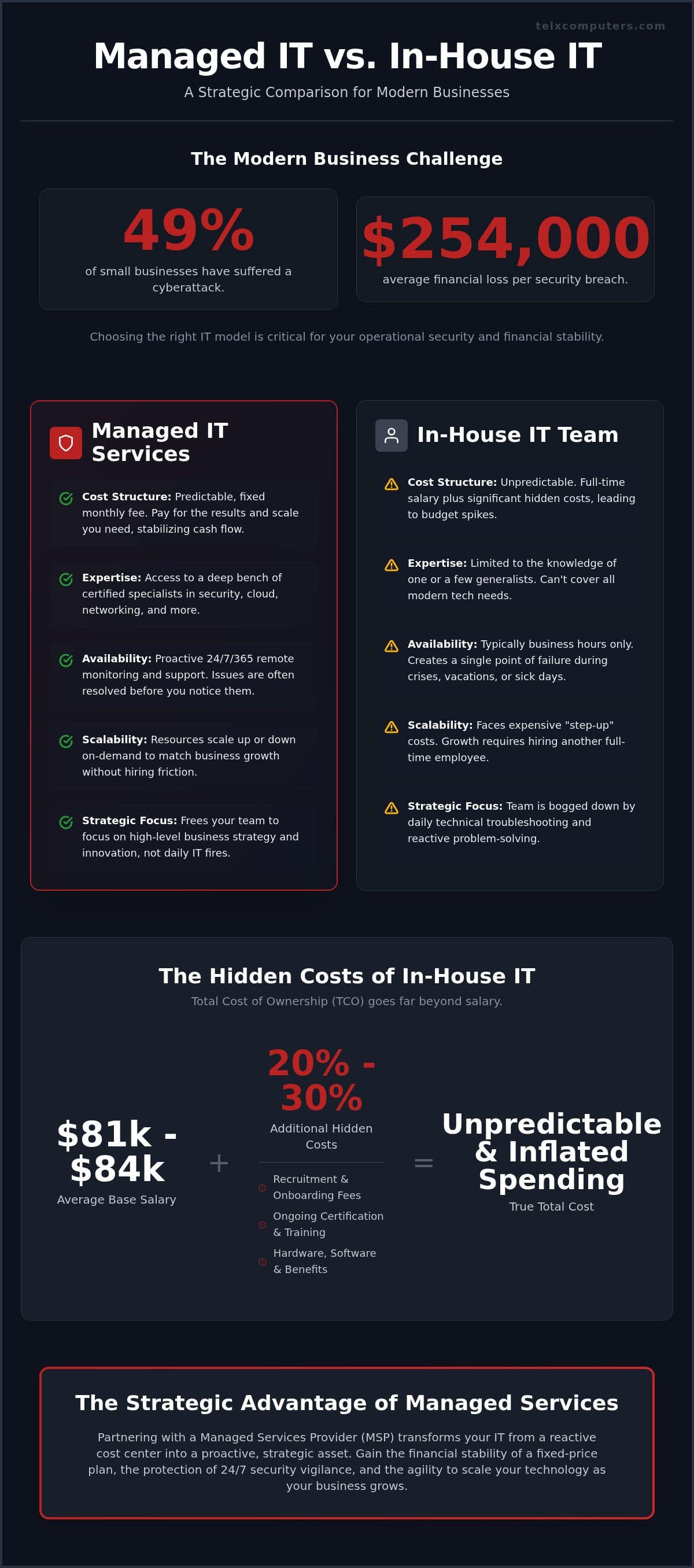
In 2026, 49% of small businesses suffered a cyberattack, with the average financial loss hitting $254,000 per breach. This data highlights why the choice between managed it services vs in-house it is one of the most critical decisions for your operational security. You need more than just a help desk; you need a strategic ally that functions as an expert guardian for your digital assets. Reliability isn’t just a goal, it’s the foundation of your success.
We know how draining it is to deal with frequent system downtime or the headache of finding and keeping skilled technicians. It’s difficult to plan for the future when your IT budget feels like a moving target. This comparison will clear the fog, showing you how to achieve predictable monthly budgeting and 24/7 technical support. We’ll break down how different models handle ransomware protection and infrastructure scaling so you can choose the path that empowers your company to grow without technical friction.
Key Takeaways
- Identify the hidden costs of internal hiring, including recruitment fees and mandatory certification training, to calculate your true Total Cost of Ownership.
- Evaluate how a dedicated security stack and 24/7 vigilance provide superior protection against the sophisticated ransomware threats emerging in 2026.
- Analyze the critical differences in managed it services vs in-house it to determine which model offers the scalability your business needs to grow.
- Use our strategic framework to assess whether your internal resources should focus on high-level business strategy or daily technical troubleshooting.
- Learn how partnering with a local strategic ally provides the financial stability of fixed-price service plans alongside rapid on-site support.
Understanding the Core Differences: Managed IT vs. In-House
Every business reaches a crossroads where they must decide how to handle their technology. Choosing between managed it services vs in-house it isn’t just about hiring; it’s about defining your operational backbone. In-house IT involves employing a dedicated internal team responsible for every server, workstation, and software update. Conversely, an MSP allows you to outsource these responsibilities to a specialized partner who acts as an extension of your company.
The old “break-fix” model, where you only call for help when something stops working, has become a liability. In 2026, with global IT spending projected by Gartner to reach $6.31 trillion, businesses can’t afford the downtime associated with reactive repairs. Modern Managed IT Services prioritize proactive management, identifying vulnerabilities before they cause a system crash. For mid-sized firms that already have a small team but need more bandwidth, Co-Managed IT offers a hybrid bridge, combining internal cultural knowledge with external technical depth.
To better understand how these two models function in a real-world setting, watch this helpful video:
The Role of the Internal IT Department
An internal team offers an immediate on-site presence and a deep understanding of your company’s specific legacy workflows. These employees live and breathe your culture, which makes them very effective at managing day-to-day operational tasks. However, relying solely on a small internal staff often creates a single point of failure. If your lead technician is out sick or on vacation during a network crisis, your operations could grind to a halt. This limitation makes the managed it services vs in-house it debate particularly relevant for growing companies that lack redundant staffing.
The Managed Services Provider (MSP) Model
An MSP shifts the focus toward 24/7 vigilance. By utilizing remote monitoring and management, these providers detect issues in real-time, often resolving them before your staff even notices a glitch. You gain shared responsibility for network uptime and cybersecurity, backed by a team of specialists rather than a single generalist. As 87% of MSPs increase their AI investments this year, these partners provide a technological edge that a small in-house department simply can’t match. You aren’t just buying a service; you’re securing a strategic ally that ensures your technology scales as fast as your business.
Evaluating Total Cost of Ownership (TCO) and ROI
Calculating the financial impact of managed it services vs in-house it requires looking beyond the monthly invoice. Most businesses focus on the obvious salary of a technician but overlook the true total cost of ownership. Hiring an internal specialist involves more than just a base salary, which averages between $81,000 and $84,000 in the United States. Beyond the paycheck, you must account for several hidden expenses that can inflate your actual spending by an additional 20% to 30%:
- Recruitment and onboarding fees (often reaching 20% of the annual salary).
- Ongoing certification training to keep skills relevant in a shifting threat landscape.
- Hardware, specialized software licenses, and dedicated office space.
- Payroll taxes, healthcare, and comprehensive benefit packages.
Direct Payroll vs. Fixed Monthly Fees
A single IT manager often lacks the breadth of knowledge required to manage a modern enterprise’s entire security stack. When your business grows, you face a “step-up” cost. You can’t hire half an employee; you must commit to another full salary to expand your capacity. Using IT outsourcing services eliminates this hurdle. You pay for the results and the scale you need today, with the ability to ramp up resources instantly. This model replaces unpredictable spikes in spending with a fixed-price, unlimited service plan that stabilizes your cash flow.
The Cost of Turnover and Technical Debt
Turnover is an expensive reality for many firms. The loss of institutional knowledge when a key technician departs can be devastating, often leaving systems undocumented and vulnerable. An MSP mitigates this risk by maintaining standardized documentation and a deep bench of experts who are always familiar with your environment. This structure also prevents “technical debt.” Without the constant vigilance of an expert guardian, internal teams often fall behind on cloud infrastructure updates and security patches. This delay creates vulnerabilities that lead to downtime, which cost small businesses an average of $254,000 per breach in 2026. Applying a Strategic Framework helps you see that the ROI of 24/7 server monitoring isn’t just about saving money; it’s about protecting your continuity. By shifting to a proactive stance, you ensure that minor hardware hiccups don’t escalate into catastrophic failures that halt your entire workforce.
If you’re ready to see how a predictable budget can transform your operations, you can get an instant quote to compare your current costs against a managed model.
Cybersecurity and 24/7 Vigilance: Who Protects You Better?
Many executives feel a sense of security seeing their servers in a closet down the hall. This is often a false sense of safety. Physical proximity doesn’t stop a digital breach, and in the strategic choice of managed it services vs in-house it, the winner is the model that provides a multi-layered security stack. A small internal team of one or two people cannot realistically watch your network 24/7 while simultaneously managing hardware upgrades and user support tickets. They eventually have to sleep, but cyber threats never do.
Sophisticated ransomware protection requires constant updates and a dedicated Security Operations Center. If your data is encrypted at 3:00 AM on a Sunday, a managed partner is already responding to the anomaly. An in-house technician might not see the alert until they log in on Monday morning, by which time the damage is often irreversible. True security relies on an expert guardian that operates one step ahead of potential threats, ensuring that disaster recovery isn’t just a plan on paper, but a functional shield for your business continuity.
Proactive Monitoring vs. Reactive Response
Proactive Monitoring is the act of identifying system vulnerabilities before they are exploited by attackers. This shift from “fixing what’s broken” to “preventing the break” is the hallmark of a reliable IT partner. Real-time server monitoring ensures your hardware health is always visible, preventing minor glitches from cascading into full system failures. For businesses operating across different time zones, 24/7 help desk support provides a sense of stability that a standard 9-to-5 internal department cannot offer.
Expertise Across the Tech Stack
Partnering with an MSP gives you instant access to specialized knowledge in virtualization, cloud computing, and VoIP without the burden of multiple executive-level salaries. Your partner manages the complexities of software licensing and hardware procurement, ensuring your systems never run on expired or vulnerable versions. This holistic oversight is vital for maintaining compliance in regulated sectors. Whether you require healthcare IT services in Miami or specialized support for law firms in Miami, having a partner who understands the specific audits in New York and South Florida keeps your organization secure and audit-ready at all times.
A Strategic Framework: Which Model Fits Your Business?
Deciding between managed it services vs in-house it requires a cold, hard look at your business objectives. Stability follows strategy. You must evaluate whether your current setup can withstand a major network failure or a sudden surge in new hires. If you’re planning to expand into new markets this year, your IT model must be elastic enough to support that growth without a massive capital injection. You don’t want your technology to be the bottleneck that prevents you from closing a deal or opening a new location.
Assess the balance between strategic planning and daily maintenance. If your internal team spends eight hours a day resetting passwords and troubleshooting printer drivers, they aren’t focusing on the high-level infrastructure projects that actually drive revenue. You need to determine your tolerance for downtime. For many modern firms, even four hours of disconnected systems leads to significant reputational damage and lost sales. In the managed it services vs in-house it debate, the MSP model often wins for those who prioritize 24/7 uptime and predictable operational expenses.
Signs You Should Move to Managed IT
Your current IT person might be a talented generalist, but they’re likely overwhelmed. When a single employee handles everything from cybersecurity to software licensing, things slip through the cracks. Frequent emergency IT costs that consistently exceed your monthly budget are a clear signal that your current model is unsustainable. Additionally, if you operate in the medical field, you need the specialized expertise required for Miami healthcare IT compliance. An expert guardian ensures that HIPAA standards are met without you having to micromanage every security patch or audit report.
When In-House IT Makes Sense
In-house IT remains a viable option for extremely large enterprises with thousands of users. These organizations often have the capital to build entire departments with specialized sub-teams for networking, security, and cloud architecture. If your company relies on highly specialized, non-standard physical hardware or proprietary software that you’ve developed entirely in-house, an internal team might be necessary. This is especially true for companies where the IT team is the primary product development engine, requiring deep, daily integration with the engineering and marketing departments. If you’re unsure which path fits your current scale, reaching out for professional IT support in Miami can provide the clarity you need to move forward confidently.
Telx Computers: Your Local Strategic Ally in Miami, NY, and LA
Telx Computers positions itself as a strategic ally rather than a mere vendor. In the ongoing debate of managed it services vs in-house it, the deciding factor for many South Florida enterprises is the availability of a local, rapid-response partner. While generic providers offer remote support, Telx provides IT support in Miami that includes physically being there when hardware failures demand immediate attention. This localized focus acts as a recurring anchor, ensuring that global technical standards meet the specific operational needs of our regional business community. We act as your expert guardian, shielding your organization from the technical anxiety that often accompanies growth.
Our approach moves beyond simple fixes. We look at your technology as a holistic engine for business expansion. By choosing Telx, you aren’t just outsourcing tickets; you’re gaining a partner that takes pride in being the silent engine behind your success. We handle the complexities of network security and cloud infrastructure so you can focus on your core mission.
The Extension of Your Team
We don’t replace your vision; we empower it. Telx integrates seamlessly with your existing staff, filling the gaps that a limited internal department often faces. Whether you need to augment your current technicians or require a completely outsourced solution, our 24/7 help desk and proactive security measures provide total peace of mind. For those seeking deeper regional insights, exploring Telx business IT services in Miami reveals how we’ve tailored our solutions to the unique demands of the South Florida market. Our goal is to ensure your team can focus on their core competencies while we maintain a secure, high-performance digital environment.
Predictable Budgeting for Secure Growth
One of the most significant pain points in the managed it services vs in-house it comparison is the unpredictability of costs. Telx eliminates “billable hour” anxiety through our fixed-price, unlimited service plans. This model allows you to budget with total accuracy, knowing that your IT expenses won’t spike during a crisis. We also provide strategic IT consulting and hardware procurement to help you plan for future scaling. Telx Computers serves as the silent engine behind a client’s success by managing the technical landscape. This proactive stance ensures that your technology is always one step ahead of potential threats, allowing you to scale securely and confidently in 2026 and beyond.
Securing Your Business Future with Strategic IT
Choosing between managed it services vs in-house it defines your organization’s resilience in an increasingly complex digital landscape. We’ve explored how hidden payroll costs and the rising threat of ransomware in 2026 make a proactive model essential for long-term stability. You need a partner that provides more than just technical fixes; you need an expert guardian that ensures your technology functions as a catalyst for growth rather than a bottleneck. Reliability remains the foundation of every successful enterprise.
Telx Computers offers the 24/7 Help Desk Support and Fixed-Price Unlimited Service Plans your business needs to eliminate budgeting anxiety. With Rapid On-Site Response in Miami, NY, and LA, we ensure your operations remain fluid and secure regardless of the challenges you face. Don’t let technical debt or staffing shortages stall your momentum. It’s time to transition to a model that offers total peace of mind and scalable support. Get an Instant IT Quote for Your Business today and start building a more reliable foundation for your company’s success. We’re ready to stand by your side as your strategic ally.
Frequently Asked Questions
Is managed IT cheaper than hiring an in-house IT manager?
Managed services typically provide a lower Total Cost of Ownership. When comparing managed it services vs in-house it, remember that an internal manager requires a salary plus benefits and taxes. An MSP offers a full team for a fixed monthly fee, eliminating the “step-up” costs of hiring additional staff. You gain access to a broad security stack and 24/7 vigilance without the overhead of internal payroll taxes, recruitment fees, or ongoing training costs.
Can I keep my current IT person and still use managed IT services?
Absolutely. This hybrid model is known as Co-Managed IT. Your internal staff maintains their deep knowledge of your company culture and legacy workflows while we act as a strategic ally. We handle the heavy lifting like server monitoring and network security, which frees your team to focus on high-level business strategy. This collaboration ensures your organization has both internal expertise and the specialized resources of a global technical standard.
How quickly can a managed IT provider respond to an on-site emergency?
For businesses in major hubs, response times are remarkably fast. Telx Computers provides rapid on-site response in Miami, New York, and Los Angeles to address critical hardware failures that remote tools can’t fix. While our 24/7 help desk resolves most issues instantly via remote access, we maintain a localized focus to ensure an expert guardian is at your door when physical intervention is necessary. This commitment to regional support keeps your downtime to an absolute minimum.
What happens to my data if I switch from in-house to managed IT?
Your data remains under your ownership and becomes significantly more secure during the transition. We perform a comprehensive security audit to identify existing vulnerabilities before migrating your assets to a more resilient environment. This process includes setting up robust data backup and disaster recovery solutions. Your information is encrypted and managed according to strict industry standards, ensuring that your switch from in-house to managed IT enhances your overall data integrity and accessibility.
Do managed IT services include hardware and software procurement?
Yes, comprehensive providers manage the entire lifecycle of your technology. We handle software licensing and hardware procurement to ensure your systems stay current and secure. This eliminates the technical debt that often accumulates when internal teams fall behind on updates. By managing these vendor relationships, we provide a technological edge and ensure your hardware meets the specific operational needs of a modern enterprise without you having to navigate complex product specifications.
Is managed IT suitable for small businesses with only 10-20 employees?
Managed services are exceptionally beneficial for small teams. In the managed it services vs in-house it debate, smaller firms often lack the capital to hire a full-time specialist. An MSP provides enterprise-grade security and 24/7 help desk support that would otherwise be unaffordable. This allows businesses with 10 to 20 employees to compete with much larger organizations by leveraging scalable technology that grows alongside their revenue and headcount.
How do managed IT services help with cybersecurity and ransomware?
We provide a multi-layered shield that an internal team rarely has the bandwidth to maintain. This includes real-time threat detection and automated email security to stop attacks before they reach your network. In 2026, where cyberattacks on small businesses are frequent, our role as an expert guardian is vital. If a breach occurs, our disaster recovery protocols ensure you can restore operations quickly, avoiding the average financial loss associated with modern ransomware.
What is the typical response time for a 24/7 help desk?
Top-tier providers aim for immediate acknowledgment and rapid resolution. By 2026, AI-driven efficiency is projected to reduce support ticket volumes by 40% to 60%, allowing our technicians to focus on complex issues. You don’t have to wait for an in-house person to finish their lunch or arrive at the office. Our 24/7 technical support ensures that your employees get the help they need within minutes, not hours, maintaining high productivity across all time zones.