




14 Aug Phishing Prevention: 2026 Small Business Security Framework
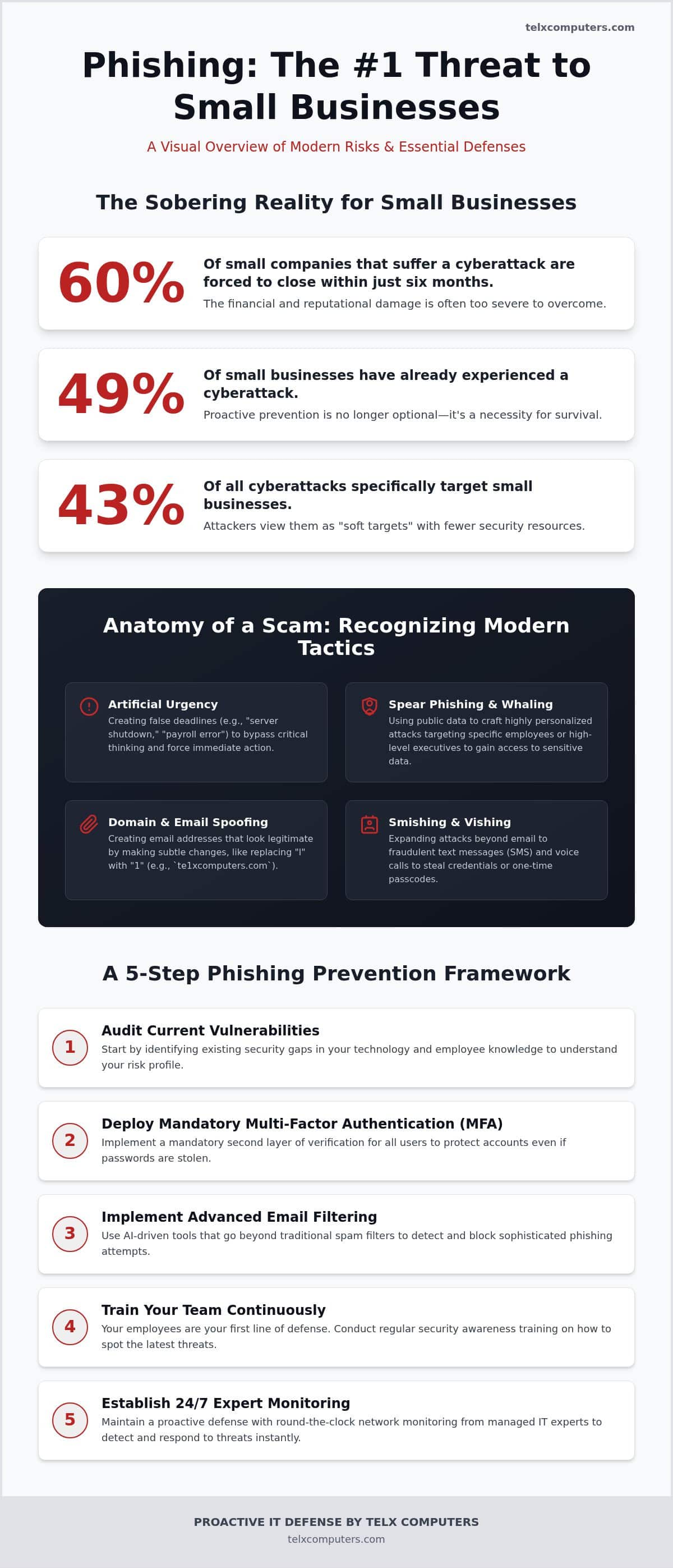
Did you know that 60% of small companies that fall victim to a cyberattack close their doors forever within just six months? It’s a sobering reality in 2026, especially since 49% of small businesses have already experienced an attack this year, making a proactive strategy for phishing prevention for small business a vital necessity for operational survival. You likely feel the constant pressure of protecting sensitive data while managing daily operations, often facing the high cost of potential ransomware and confusion over which security tools are actually effective.
We believe you deserve a strategic ally that replaces technical anxiety with stability and peace of mind. This article explains how to shield your organization using a combination of technical safeguards and expert-led employee training. You’ll gain a clear plan to secure company emails and reduce successful attacks, providing the confidence that comes from knowing an expert guardian is watching the network. By the end, you’ll have the roadmap needed to defend your enterprise against the year’s most sophisticated digital threats.
Key Takeaways
- Understand why small businesses are viewed as “soft targets” and how to flip the script by closing common security gaps.
- Learn to spot psychological triggers like forced urgency that attackers use to bypass your team’s better judgment.
- Discover how to implement effective phishing prevention for small business through essential tools like Multi-Factor Authentication (MFA) and AI-driven email filtering.
- Follow a streamlined 5-step checklist to audit your current vulnerabilities and deploy a mandatory security layer for all users.
- Explore how managed IT services provide the 24/7 monitoring and expert support needed to maintain a proactive defense without overwhelming your internal resources.
Why Phishing is the #1 Threat to Small Business Growth in 2026
Phishing remains the most persistent threat to your operations because it targets the one variable technical filters cannot always control: human psychology. By definition, phishing is a social engineering attack used to steal sensitive credentials or install malicious software on your network. For a comprehensive overview of phishing and its history, foundational resources describe how these tactics have evolved from simple spam to the sophisticated threats we see today. Cybercriminals don’t just go after global corporations. In fact, 43% of all cyberattacks in 2026 target small businesses because hackers view them as “soft targets” with fewer defenses.
For a growing firm, the real cost of a single malicious click goes far beyond data loss. You must account for crippling downtime, potential legal fees, and the devastating loss of client trust that often follows a breach. The landscape has shifted dramatically this year. We’re now seeing AI-generated deepfake emails that mimic the specific writing style of your colleagues and highly personalized spear phishing attempts that are nearly impossible to detect with a glance. This evolution makes robust phishing prevention for small business a strategic necessity rather than an IT afterthought, which is why many entrepreneurs turn to Cyberland Security for end-to-end protection.
The Shift from Mass Spam to Targeted Whaling
Attackers are moving away from broad “spray and pray” tactics in favor of “whaling.” This strategy targets high-level executives to gain access to the most sensitive data or financial controls. Business Email Compromise (BEC) is a primary tool here, where scammers intercept wire transfers by impersonating trusted partners. In high-stakes sectors like healthcare, law, and real estate in Miami and LA, these targeted strikes can result in hundreds of thousands of dollars in diverted funds before anyone notices a discrepancy. It’s a calculated, high-reward move that exploits the fast-paced nature of modern business communication.
Why Traditional Antivirus is No Longer Enough
Basic email filters and legacy antivirus software often fail against modern threats because they look for known malware signatures rather than behavioral anomalies. Today’s attacks frequently use legitimate-looking links or file-sharing invitations that bypass standard blocklists easily. Social engineering is the manipulation of human psychology rather than technical flaws. To stay secure, your office needs a “Zero Trust” architecture where every access request is verified regardless of its origin. By shifting toward proactive ransomware protection and managed security, you ensure your business isn’t just reacting to threats but actively preventing them from gaining a foothold.
Anatomy of a Scam: Recognizing Modern Phishing Tactics
Modern phishing doesn’t always look like a poorly written message from a distant stranger. In 2026, scammers use highly polished templates and generative artificial intelligence to bypass your intuition. One of the most effective tools in their arsenal is artificial urgency. By claiming a payroll error occurred or a critical server will shut down in minutes, they force you to act before you think. This psychological pressure is why effective phishing prevention for small business must start with identifying these emotional triggers.
Pay attention to the “External” tag at the top of your emails. While it might seem like a minor annoyance, it’s a vital warning that the sender isn’t part of your internal organization. Attackers often use spoofed domains, like replacing an “l” with a “1” to create “te1xcomputers.com” instead of “telxcomputers.com.” These subtle changes are designed to escape notice during a busy workday. Beyond email, smishing and vishing (voice phishing) are now common in the workplace. A scammer might call your desk pretending to be from a known service provider to “verify” your login credentials over the phone.
Common Phishing Variants Your Team Must Know
Spear phishing has become increasingly dangerous because it uses publicly available data from sites like LinkedIn to build trust. An attacker might mention a recent project or a specific colleague’s name to lower your guard. We’re also seeing a rise in “Quid Pro Quo” attacks, where scammers offer a “free” security audit to gain remote access to your workstation. Additionally, smishing is surging in 2026. Fraudulent texts claiming your Multi-Factor Authentication (MFA) has expired are a common tactic used to steal one-time passcodes from unsuspecting employees.
Reporting Procedures: What to Do Before Clicking
A culture of security relies on the “Pause and Verify” method. If you receive an unusual request for a wire transfer or sensitive data, contact the sender through a separate, known channel like a phone call or a new chat thread. You can safely inspect a link by hovering your mouse over it to reveal the true destination URL in the bottom corner of your browser. Following CISA phishing prevention guidelines ensures your team knows exactly how to handle these incidents. Creating a clear, no-blame reporting channel encourages employees to flag suspicious activity immediately. If you’re unsure about a specific email, our team at Telx provides business IT services in Miami to help you validate threats in real time.
Essential Technical Safeguards for Small Business Security
While employee awareness serves as your first line of defense, human error remains a persistent variable. Research indicates that 95% of cybersecurity incidents are attributed to human error, making a technical “safety net” non-negotiable. Effective phishing prevention for small business requires multiple layers of technology that work silently to intercept threats before they reach a workstation. These safeguards ensure that even if a team member makes a mistake, your network remains resilient and your data stays protected.
Advanced email filtering now utilizes artificial intelligence to analyze the intent and context of every incoming message. This technology catches malicious attachments and suspicious links that traditional, signature-based filters often miss. At the network level, DNS filtering provides an additional barrier by blocking access to known malicious websites entirely. If a user accidentally clicks a deceptive link, Endpoint Detection and Response (EDR) monitors the device for suspicious post-click behavior, such as unauthorized encryption or credential harvesting, allowing for immediate isolation of the threat.
The Power of Multi-Factor Authentication (MFA)
Multi-Factor Authentication (MFA) is the single most effective barrier you can implement against stolen passwords. MFA can stop 99% of bulk phishing attacks by requiring a second form of verification that hackers simply don’t have. We recommend moving away from SMS-based MFA, as cybercriminals can intercept these codes through SIM swapping. Instead, we help our partners deploy secure authenticator apps or physical hardware keys. Implementing these protocols across all cloud applications, including Microsoft 365 and Google Workspace, creates a robust defense that renders stolen credentials useless.
Network Security and Server Monitoring
A holistic security strategy involves watching the network from the inside out. Proactive server monitoring detects early signs of a breach by flagging unusual traffic patterns or unauthorized access attempts in real time. For businesses operating in NYC and LA, regular cybersecurity audits are essential to identify and patch vulnerabilities before they are exploited. Firewalls also play a critical role in this framework by preventing data exfiltration. If a phishing attempt succeeds in planting malware, a properly configured firewall can block that malware from “calling home” or sending sensitive business data to an external server. This integrated approach to phishing prevention for small business ensures your operations continue without disruption.
Implementing a Phishing Prevention Framework: A 5-Step Checklist
Building a resilient defense requires more than just installing software. It demands a structured approach that integrates technology with operational discipline. Only 34% of SMBs currently have a formal incident response plan, leaving the majority vulnerable to prolonged downtime after a breach. This 5-step checklist serves as your blueprint for establishing effective phishing prevention for small business in 2026.
- Step 1: Conduct a Baseline Security Audit. You can’t protect what you haven’t mapped. We identify your high-risk users and vulnerable entry points to find existing security gaps.
- Step 2: Deploy Mandatory MFA and Single Sign-On (SSO). This centralizes access and ensures that a single compromised password doesn’t lead to a total network breach.
- Step 3: Launch Ongoing Security Awareness Training (SAT). Regular micro-learning keeps security at the front of your team’s mind.
- Step 4: Establish an Incident Response Plan. Speed is everything. Knowing exactly who to call and what to shut down saves hours of recovery time.
- Step 5: Partner with an MSP. 24/7 monitoring ensures that while you sleep, an expert guardian is watching your traffic for anomalies.
Building a ‘Human Firewall’ Through Training
Annual training seminars are often ignored and quickly forgotten. Monthly, five-minute training sessions are far more effective because they build long-term retention. Phishing simulations allow employees to encounter “safe” versions of real-world threats, helping you identify high-risk staff without the danger of a real breach. When you incentivize reporting instead of punishing mistakes, you turn every employee into an active defender. This cultural shift is a cornerstone of phishing prevention for small business, as it encourages transparency over fear.
Incident Response: What to Do If Someone Clicks
If an employee does click a malicious link, immediate action is required to contain the threat. Disconnect the affected device from the network and reset all user credentials immediately. This prevents the threat from spreading laterally through your systems. Advanced ransomware protection serves as your last line of defense if malware begins to execute. For total business continuity, data backup & disaster recovery ensures you can restore your systems to a clean state without paying a ransom. Secure your network today by requesting an instant quote for our managed security services.
How Telx Computers Proactively Shields Your Business
Telx Computers doesn’t just provide tools; we provide a comprehensive defense system. We understand that phishing prevention for small business isn’t a one-time setup. It’s a continuous commitment to vigilance. Our 24/7 Help Desk Support ensures that when an employee spots a suspicious email at any hour, they have immediate access to an expert who can validate the threat. This proactive stance stops attacks before they can move laterally through your network. We take pride in being the silent engine behind your success, managing technical complexity so you can focus on core operations.
The Advantage of an Integrated Security Ally
We position ourselves as a strategic ally and an extension of your own team. This approach allows you to focus on growth while we handle the heavy lifting of network security. We’ve developed specialized roadmaps for high-stakes industries, ensuring tailored healthcare IT services and security for law firms. By replacing technical anxiety with professional stability, we provide the peace of mind necessary to operate in a high-risk environment. You’re never just a ticket number to us. You’re a partner whose security is our primary mission.
Predictable Budgeting for Enterprise-Grade Security
Monthly budgeting shouldn’t be a source of stress regarding your protection. Our fixed-price, unlimited service plans eliminate the uncertainty of IT costs. Many businesses fall into the “break-fix” trap, where they only receive support after a disaster has already occurred. This reactive cycle leaves your network vulnerable during the gaps between technician visits. Telx provides a different model based on proactive maintenance and constant oversight. Our managed IT services include real-time server monitoring and rapid on-site response for our partners in Miami, NYC, and LA. This localized focus ensures that global technical standards are applied with a personal, client-centric touch. Secure your organization’s future today by requesting an instant quote for our comprehensive security framework.
Securing Your Business Future Against 2026 Threats
The cybersecurity landscape of 2026 demands a shift from reactive fixes to a state of constant readiness. You’ve seen how attackers use AI and psychological triggers to bypass traditional defenses. By implementing a framework that balances advanced technical safeguards with a culture of security awareness, you effectively close the gaps that hackers exploit. This holistic approach to phishing prevention for small business ensures that your company remains a hard target, protecting both your financial assets and your professional reputation.
Telx Computers stands ready to serve as your strategic ally in this mission. We provide the stability your organization needs through 24/7 proactive network monitoring and fixed-rate unlimited IT support. Whether you require a rapid on-site response in Miami, NYC, or LA, our team acts as the silent engine driving your secure growth. Don’t leave your network’s safety to chance when you can have an expert guardian standing watch.
Get a Secure Managed IT Quote Today
Your business is built on hard work; let’s ensure it stays protected.
Frequently Asked Questions
What is the most common type of phishing attack on small businesses?
Spear phishing and Business Email Compromise (BEC) are the most frequent threats facing small teams in 2026. Unlike generic spam, these attacks use personalized details to trick employees into transferring funds or revealing sensitive credentials. Scammers often impersonate trusted vendors or internal executives to create a sense of legitimacy. This targeted approach is why standard email filters often fail, requiring a more nuanced strategy for phishing prevention for small business.
Can antivirus software stop all phishing attempts?
Antivirus software cannot stop every phishing attempt because these attacks primarily exploit human psychology rather than software vulnerabilities. While modern antivirus tools catch known malware, they often miss deceptive links that lead to fake login pages. You need a multi-layered defense that includes AI-driven email filtering and DNS blocking to catch what standard antivirus misses. Relying solely on one tool leaves your network exposed to sophisticated social engineering tactics.
Is multi-factor authentication (MFA) really necessary for a small team?
Multi-factor authentication is absolutely necessary regardless of your team’s size. Small businesses are often targeted specifically because hackers assume their security is weaker than that of a larger enterprise. MFA ensures that even if a password is stolen through a phishing site, the attacker cannot access your systems without the second verification factor. It’s the most cost-effective way to neutralize the impact of stolen credentials across your organization.
What should I do if an employee clicks a suspicious link?
Immediate containment is your priority. First, disconnect the affected device from the network to prevent malware from spreading laterally. Next, reset all account credentials for that user and check for any unauthorized changes in your cloud environment. Contacting your IT support team immediately allows for a professional forensic audit. This fast response helps determine if any sensitive data was exfiltrated before the breach was fully contained.
How often should small businesses conduct phishing awareness training?
Small businesses should conduct phishing awareness training at least once a month. Short, five-minute micro-learning sessions are more effective than long annual seminars because they keep security top of mind without causing training fatigue. Regular phishing simulations also help test your team’s readiness in a safe environment. Consistent reinforcement builds a stronger human firewall that can adapt to the rapidly changing tactics used by modern cybercriminals.
Does phishing only happen through email?
Phishing has expanded far beyond the inbox. Smishing (SMS phishing) and vishing (voice phishing) are increasingly common in professional settings. You might receive a text message claiming your account is locked or a phone call from someone pretending to be a tech support agent. Modern phishing prevention for small business must educate employees to be skeptical of any unsolicited communication that requests sensitive information, regardless of the platform or device used. To help your team navigate these mobile threats, Crazy Jonos Phones offers free mobile phone lessons and software optimization to keep devices secure.
What are the legal consequences of a phishing-related data breach?
A phishing-related breach can lead to severe legal and financial repercussions. Depending on your industry and location, you may face heavy regulatory fines for failing to protect sensitive client data. Beyond government penalties, businesses often face private lawsuits from affected parties. The long-term damage to your professional reputation can be even more costly, as clients are unlikely to trust a firm that cannot secure its own digital environment.
How can a managed IT service provider help with phishing prevention?
A managed IT service provider acts as an expert guardian for your network. We implement enterprise-grade email filtering, manage your MFA deployments, and provide 24/7 monitoring to catch anomalies in real time. By handling the technical complexity of your security framework, an MSP allows you to focus on business growth while maintaining a professional defense. This partnership provides the stability and peace of mind that comes from knowing experts are watching your network.