





10 Aug Strategic Business IT Support: A Comprehensive Framework for Modern Enterprises
With the average cost of a data breach for small businesses now reaching $3.31 million, your technology is no longer just a utility; it’s either your most critical asset or your greatest liability. You likely feel the weight of this reality every time a server lags or an unpredictable invoice arrives from your current provider. Reliable business it support should do more than just fix what’s broken. It should act as a silent engine that drives your operations forward without interruption, providing the stability you need to focus on your core mission.
We understand the frustration of slow response times and the anxiety that comes with evolving cyber threats like those addressed in the NIST Cybersecurity Framework 2.0. This article will show you how to transform your IT from a draining cost center into a strategic growth engine through proactive management. You’ll learn how a structured framework for modern enterprises ensures zero downtime, provides predictable monthly budgeting, and turns your technology provider into a true extension of your team. We’ll explore the shift from reactive fixes to a holistic strategy that keeps your business secure, compliant, and scalable in an increasingly complex digital landscape.
Key Takeaways
- Understand why shifting from a reactive “break-fix” mindset to proactive management is the only way to eliminate downtime and stabilize your budget.
- Identify the four essential infrastructure pillars required to build a secure, high-performance environment for your team.
- Learn how to evaluate business it support models to uncover the hidden financial risks and conflicts of interest in hourly billing.
- Master the selection process by recognizing the “green flags” that signal a provider’s ability to act as a strategic ally.
- Understand how 24/7 monitoring and specialized industry expertise create a “silent engine” that powers your long-term success.
What is Business IT Support and Why is Proactivity Essential?
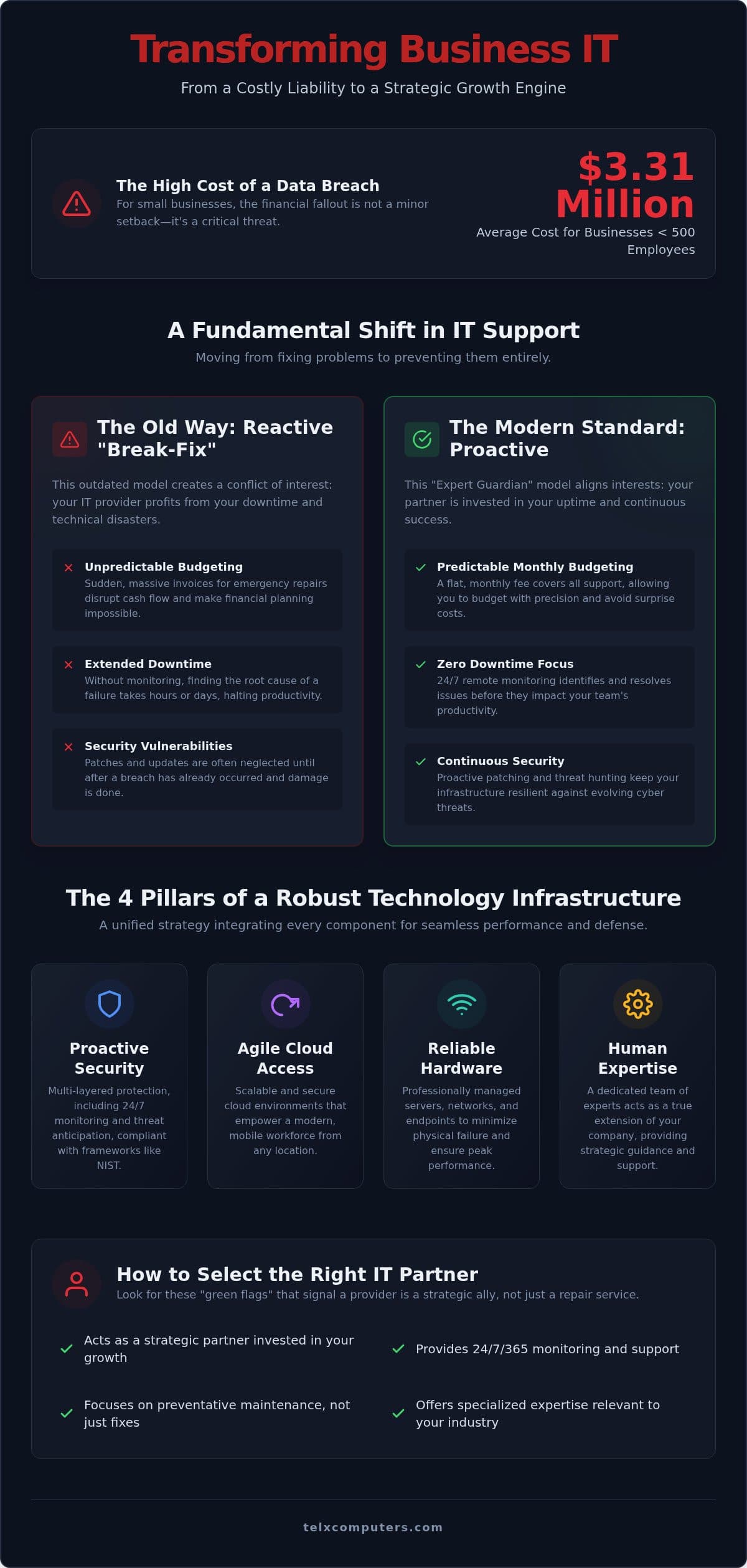
Modern business it support encompasses the holistic management of a company’s technology infrastructure, ensuring that hardware, software, and networks operate in perfect harmony. While many people associate Technical support with a help desk that answers calls when things go wrong, the industry has shifted toward a more sophisticated model. Waiting for a system to fail before seeking help is a high-risk financial strategy that creates unpredictable costs and operational chaos. This ‘Break-Fix’ mentality creates a fundamental conflict of interest; your provider only makes money when your business is suffering.
The traditional reactive model often leads to several critical business risks:
- Unpredictable Budgeting: Technical disasters create sudden, massive invoices that disrupt cash flow.
- Extended Recovery Times: Without proactive monitoring, identifying the root cause of a failure takes significantly longer.
- Security Vulnerabilities: Patching and updates are often neglected until a breach occurs.
Instead, the modern standard is the ‘Expert Guardian’ approach, where a dedicated team prevents issues before they ever reach your employees’ screens. This shift replaces technical anxiety with stability. When you treat technology as a strategic asset rather than a series of disconnected fixes, you gain a partner invested in your uptime. This alignment of interests is the cornerstone of a successful partnership, allowing you to budget with precision while maintaining a technological edge over competitors who are still stuck in a cycle of reactive repairs.
The Evolution from Reactive Repair to Managed Services
Years ago, IT support was often limited to an ‘IT guy’ who appeared only when a server crashed. As the digital landscape grew more complex, especially with the rise of sophisticated ransomware and the implementation of standards like the NIST Cybersecurity Framework 2.0, this reactive model became obsolete. Today, Managed IT Services use Remote Monitoring and Management (RMM) tools to oversee networks 24/7. This technology allows providers to identify a failing hard drive or a security vulnerability long before it causes a shutdown, turning IT into a silent engine of efficiency. It’s about being one step ahead of potential threats, ensuring your infrastructure remains resilient against the evolving tactics of modern cybercriminals.
The Business Impact of Zero Downtime
In a digital-first economy, downtime is not just a technical glitch; it is a direct drain on corporate revenue. Every minute your team spends staring at a spinning loading icon represents lost wages and missed opportunities. According to industry research, data breach costs for businesses with fewer than 500 employees average $3.31 million, a figure that highlights the catastrophic risk of inadequate protection. Beyond the immediate financial hit, frequent technical failures erode client trust and damage your brand’s reputation for reliability. Proactive business it support focuses on achieving zero downtime, which provides the stable foundation necessary for scaling your operations. When your technology works flawlessly, your team remains productive, and your business can grow without the constant fear of a sudden digital bottleneck.
The Core Pillars of a Robust Technology Infrastructure
A unified strategy is the bedrock of modern business it support. Instead of treating hardware and software as separate, disconnected entities, successful organizations view them as a single, integrated environment. This holistic approach ensures your technology serves as a silent engine, powering growth without the constant friction of technical failures. To achieve true stability, four essential pillars must work in concert: security, accessibility, reliability, and expert human oversight.
When these components are siloed, gaps emerge that cybercriminals are quick to exploit. A robust infrastructure integrates the following elements into a seamless defense and productivity suite:
- Proactive Security: Multi-layered protection that anticipates threats.
- Agile Cloud Access: Scalable environments that support a mobile workforce.
- Reliable Hardware: Managed server and network systems that minimize physical failure.
- Human Expertise: Immediate access to specialists who understand your specific business logic.
Cybersecurity and Network Protection
Security is the most critical pillar in an era where data breach costs for small businesses average millions of dollars. A multi-layered defense strategy includes robust firewalls, Endpoint Detection and Response (EDR), and Multi-Factor Authentication (MFA). These tools create a perimeter that is difficult to penetrate, especially when aligned with government standards for Cybersecurity for Small Business. Integrating advanced Ransomware Protection isn’t just a technical upgrade; it’s a fundamental requirement to safeguard your corporate reputation and continuity.
Cloud Infrastructure and Data Management
Cloud infrastructure provides the agility required for today’s hybrid workforces. By migrating from aging physical servers to scalable virtual environments, you improve data accessibility and team collaboration. This shift allows your staff to work securely from any location, ensuring business continues regardless of physical disruptions. Managed cloud solutions also simplify data backups, making disaster recovery a streamlined process rather than a desperate scramble. You can request a custom assessment to see how cloud migration can optimize your specific operational costs.
24/7 Help Desk and On-Site Support
Technology is only as effective as the people who manage it. Round-the-clock availability is essential for maintaining productivity, particularly for businesses with late shifts or global clients. While remote troubleshooting resolves the vast majority of issues, having a local on-site presence for physical hardware failures is vital for total peace of mind. A dedicated Managed IT Support Service reduces internal staff frustration by providing immediate, professional resolutions to complex problems. This level of business it support ensures your team stays focused on their primary goals rather than wrestling with technical glitches.
Comparing IT Support Models: Break-Fix vs. Managed IT
Choosing the right model for your organization requires an understanding of how different philosophies impact your bottom line. The traditional “Break-Fix” model is inherently reactive; you call for help only after a failure occurs. This creates a fundamental conflict of interest because your provider’s revenue increases as your technical problems multiply. In contrast, modern business it support through a managed model aligns the provider’s goals with your own. When you succeed through stable, uninterrupted operations, your partner succeeds. This shift from a transaction-based relationship to a strategic alliance is the foundation of long-term stability.
A side-by-side comparison reveals the stark differences in these approaches:
- Financial Predictability: Managed IT offers a fixed monthly fee, while Break-Fix results in volatile, unpredictable invoices.
- Incentive Structure: Managed partners prioritize prevention to reduce their own labor costs; Break-Fix providers profit from your downtime.
- System Health: Continuous monitoring identifies issues early, whereas reactive models ignore underlying problems until a total crash occurs.
The Financial Logic of Fixed-Rate Support
Predictable monthly fees eliminate the “bill shock” that typically follows a major network crash or security breach. By shifting to a fixed-rate structure, you can treat technology as a manageable operational expense rather than a series of financial emergencies. The ROI of Managed IT is realized through the significant reduction in emergency labor costs and the avoidance of expensive downtime. This comprehensive guide to IT support highlights how professional management provides a clearer path to fiscal planning. Unlimited support plans allow growing companies to scale their headcount without fearing that every help desk call will result in an additional hourly charge.
Operational Stability and Long-Term Strategy
Break-Fix providers generally lack the incentive to perform long-term planning because their engagement ends once the immediate fire is extinguished. They aren’t looking at your three-year growth plan or your aging infrastructure’s risk profile. Managed business it support introduces the role of a vCIO (Virtual Chief Information Officer) to provide high-level guidance. This strategic oversight ensures your technology roadmap aligns with your business objectives, preventing costly “quick fixes” that don’t scale. For organizations in South Florida, utilizing Business IT Services in Miami provides the local expertise needed to navigate regional challenges while maintaining global security standards. This partnership ensures your infrastructure isn’t just surviving day-to-day but is actively supporting your future expansion.
How to Evaluate and Select the Right IT Support Partner
Selecting a partner for business it support is a high-stakes decision that defines your organization’s operational resilience. You aren’t just hiring a vendor; you’re choosing a strategic ally to act as an extension of your own team. A major “green flag” is a provider that offers a comprehensive Service Guarantee, demonstrating they have skin in the game. Conversely, a “red flag” is any provider that avoids specific talk about response times or fails to mention proactive security audits. Your partner must also understand that technology isn’t generic. A law firm, for instance, requires specialized Legal IT support to manage strict confidentiality and discovery deadlines. Similarly, medical practices need Healthcare IT experts who navigate the complexities of HIPAA compliance without hesitation.
Key Questions for Your Potential IT Provider
Don’t settle for vague promises during the vetting process. Ask specifically: “Do you provide 24/7 monitoring or just a 24/7 help desk?” Monitoring means they identify a failing drive before your staff even logs in. Inquire about their backup testing frequency; a backup that hasn’t been tested is merely a suggestion, not a recovery plan. For businesses in South Florida, the most critical question involves disaster recovery. Your provider should have a documented strategy for hurricanes and local power outages, ensuring your data remains accessible even when the physical office is compromised. If you’re ready to see how a professional team handles these challenges, you can get an instant quote for your organization today.
The Importance of Local Expertise in Miami and Fort Lauderdale
A local presence is a non-negotiable requirement for rapid hardware response. While remote troubleshooting handles most software glitches, a physical server failure requires a technician on-site. IT Companies in Miami provide a deep understanding of the regional infrastructure and vendor landscape. This localized focus ensures that your business it support isn’t coming from a call center thousands of miles away. Having Fort Lauderdale IT Support means your strategic ally can be at your facility within hours to perform critical interventions. These local experts also manage regional compliance requirements and maintain relationships with local internet service providers, giving you an edge in resolving connectivity issues that national firms might miss.
Strategic IT Management with Telx Computers: Your Partner for Growth
Telx Computers positions itself as the premier choice for South Florida organizations that demand more than just basic troubleshooting. We function as the “Silent Engine” behind your daily operations, ensuring that every piece of technology contributes directly to your bottom line. By adopting the role of an “Expert Guardian,” we provide 24/7 Server Monitoring that acts as a vigilant shield against system failures and security threats. Our commitment to fixed-price, unlimited business it support ensures that your technology costs remain predictable even as your organization scales. This model removes the financial friction often associated with technical expansion, allowing you to invest in growth with total confidence. We understand that stability is the foundation of peace of mind, and we strive to replace technical uncertainty with a sense of total security.
The Telx Advantage: Proactive, Secure, and Reliable
Since our founding in 2002, we’ve remained deeply rooted in the Miami-Dade and Broward business communities. This long history allows us to blend global technical standards with a localized understanding of the unique regional challenges faced by those seeking business it support in South Florida. Our Network IT Support is designed to provide multi-layered defense that alleviates technical anxiety. We pride ourselves on acting as a seamless extension of your internal team, rather than a disconnected outside vendor. This level of integration means we take full ownership of your infrastructure, allowing your staff to focus on their primary objectives while we manage the complexities of the digital landscape. Our local presence ensures that help is always nearby, whether you need remote troubleshooting or rapid on-site intervention.
Get Started with a Tailored Technology Roadmap
Every partnership begins with a comprehensive technology audit designed to identify current bottlenecks and uncover future opportunities. This strategy session results in a tailored roadmap that aligns your IT investments with your specific business goals, ensuring you aren’t just buying services but investing in a scalable future. We believe in total transparency and fiscal predictability, which is why we encourage prospective partners to use our Instant Quote Tool to explore our unlimited service plans. This tool provides a clear, data-driven starting point for a conversation about how we can optimize your environment. Don’t let unpredictable IT costs or slow response times hold your organization back. Secure your business future today with a partner who prioritizes your uptime as much as you do.
Secure Your Path to Technological Excellence
Transforming your infrastructure from a reactive cost center into a strategic growth engine requires a fundamental shift in perspective. By prioritizing proactive management and establishing a robust framework of security and cloud accessibility, you eliminate the friction that holds many organizations back. Modern business it support is about more than just fixing hardware; it’s about a partnership rooted in reliability and forward-thinking strategy. You deserve a silent engine that powers your success without interruption or unpredictable billing cycles.
Since 2002, we’ve served the Miami and Fort Lauderdale communities with a commitment to fixed-price, unlimited support and 24/7 proactive monitoring. This approach replaces technical anxiety with the stability of an expert guardian. If you’re ready to optimize your operations and protect your corporate reputation, the next step is simple. Request an Instant IT Support Quote for Your Business today to see how a tailored technology roadmap can secure your future. We look forward to becoming the dedicated ally your business needs to thrive in an increasingly complex digital landscape.
Frequently Asked Questions
What is the average response time for business IT support?
Average response times vary significantly based on the provider’s resource levels and the severity of the issue. While some basic services might take several hours, high-tier providers typically respond to critical tickets within 15 to 30 minutes. Proactive business it support often eliminates the need for a response altogether by identifying and resolving hardware failures or software glitches before they impact your staff’s productivity.
How much does managed IT support typically cost for a small business?
The cost of managed services depends on several factors, including your total number of users, the complexity of your network, and your specific security requirements. Most modern enterprises prefer a fixed-price model because it provides fiscal predictability and aligns the provider’s incentives with your uptime. Instead of paying hourly for repairs, you pay a consistent monthly fee that covers all your ongoing maintenance and security needs.
Is 24/7 help desk support necessary for a local business?
Round-the-clock support is essential because technical failures and cyber threats don’t follow a standard workday. Even if your employees are offline, your servers and cloud applications continue to process data and face potential security risks. Having a 24/7 help desk ensures that critical issues are addressed immediately, preventing a minor glitch from becoming a major bottleneck when your team logs in the following morning.
Can business it support help with remote work security?
Professional business it support is vital for securing a distributed workforce. Providers implement multi-layered defenses such as encrypted Virtual Private Networks (VPNs), Multi-Factor Authentication (MFA), and Endpoint Detection and Response (EDR) to protect company data on home networks. These tools ensure that your remote employees can access internal resources safely without exposing your central infrastructure to the vulnerabilities often found in residential internet setups.
What is the difference between an IT consultant and an IT support company?
An IT consultant typically focuses on high-level strategy, such as digital transformation roadmaps or complex project planning. An IT support company handles the daily operational tasks, including troubleshooting, software updates, and hardware maintenance. Many modern managed service providers act as both, offering the strategic guidance of a consultant alongside the hands-on technical assistance required to keep your business running smoothly every day.
If you are exploring how to implement these strategies within your own organization, you can check out ITS Canada Inc to learn more about their technology advisory and consulting services.
How does proactive server monitoring prevent data loss?
Proactive monitoring identifies early warning signs of hardware failure, such as rising server temperatures or hard drive errors, before they cause a system crash. By catching these issues early, technicians can perform migrations or repairs during scheduled maintenance windows. This approach ensures that your data is always backed up and available, preventing the catastrophic loss that often occurs when a system fails unexpectedly without warning.
What should be included in a standard IT Service Level Agreement (SLA)?
A standard Service Level Agreement (SLA) should clearly define response time targets, uptime guarantees, and the specific scope of covered services. It acts as a contract of accountability, ensuring you know exactly what to expect during a technical emergency. Look for clauses that detail how the provider handles disaster recovery and data backups, as these are the foundational elements that protect your business continuity and long-term operational stability.
Do I need a local IT support company in Miami if my team is remote?
Maintaining a local partner in Miami is critical even for remote teams because your core infrastructure, such as servers and networking hardware, still requires physical oversight. Local experts understand regional challenges like hurricane preparedness and local regulatory requirements. If a hardware failure occurs at your central hub, a local technician can provide rapid on-site intervention that a purely remote or national provider simply cannot match.