





30 Jun Strategic IT Planning for Growth: A Comprehensive Framework for 2026
Gartner forecasts that global IT spending will reach $6.31 trillion in 2026, making strategic IT planning for growth more critical than ever for businesses that want to stay competitive. You likely feel the friction of technology that can’t keep up with your new hires or the sting of unpredictable bills that hurt your cash flow. It’s difficult to lead with confidence when you’re worried that a security breach might derail your expansion plans.
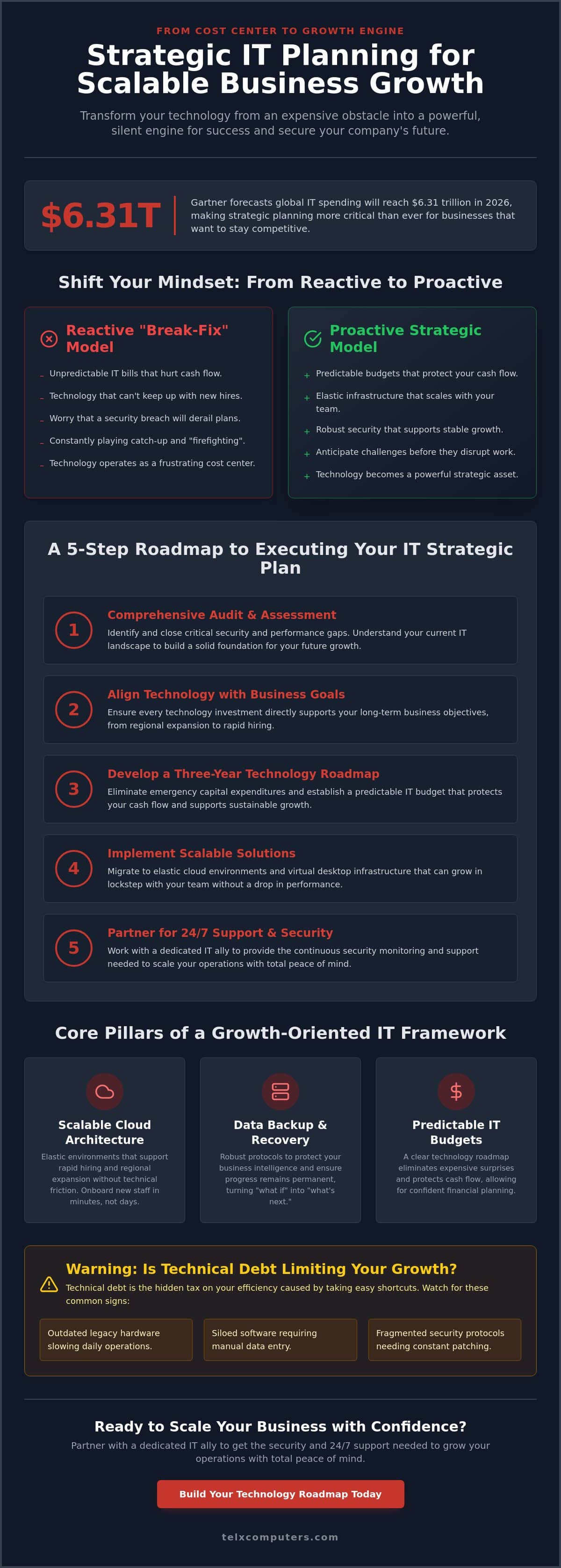
We believe your technology should act as a silent engine for success rather than a series of expensive obstacles. Growth requires stability. You’ll learn how to transform your infrastructure from a cost center into a powerful tool for scalable business expansion. This framework provides a clear roadmap for technical scalability, helping you secure predictable budgets and the peace of mind that comes from knowing your security scales alongside your team.
Key Takeaways
- Transition from a reactive “break-fix” mindset to a proactive model where technology serves as a strategic asset rather than an unpredictable expense.
- Discover how elastic cloud environments provide the infrastructure scalability necessary to support rapid hiring and regional expansion without technical friction.
- Implement a three-year technology roadmap to eliminate emergency capital expenditures and establish a predictable IT budget that protects your cash flow.
- Master a five-step framework for strategic IT planning for growth that starts with a comprehensive audit to identify and close critical security and performance gaps.
- Learn how partnering with a dedicated IT ally provides the security and 24/7 support needed to scale your operations with total peace of mind.
What is Strategic IT Planning and Why is it Critical for Growth?
Strategic IT planning is the intentional alignment of your technology assets with your long-term business objectives. It’s the difference between buying a tool because it’s popular and investing in a system because it drives your bottom line. A well-crafted strategic technology plan serves as a blueprint for your future. It ensures that every dollar spent on IT is a step toward your larger vision rather than a temporary patch on a sinking ship.
Moving away from a reactive “break-fix” model is the first step toward real expansion. When you only address technology when it fails, you’re constantly playing catch-up. Proactive management transforms your technology from a utility service into a strategic ally. This shift is essential for strategic IT planning for growth, as it allows you to anticipate challenges before they disrupt your workflow or stall your momentum.
To better understand how a strategic approach differs from a simple plan, watch this helpful video:
The Difference Between IT Maintenance and IT Strategy
Maintenance is about stability; strategy is about velocity. Maintenance ensures your email works today. Strategy ensures your communication systems can handle a 50% increase in staff by next quarter. A strategic win might look like migrating to a cloud infrastructure that facilitates rapid hiring and remote collaboration. Achieving this requires the foresight of a vCIO (Virtual Chief Information Officer). This role bridges the gap between technical execution and business leadership, ensuring your managed IT services directly fuel your revenue goals.
Identifying Growth-Limiting Technical Debt
Technical debt is the implied cost of additional rework caused by choosing an easy solution now instead of a better approach that would take longer. It acts as a hidden tax on your efficiency. In competitive hubs like Miami, technical debt can be the difference between winning a contract and losing it to a more agile competitor. Watch for these common signs of debt:
- Outdated legacy hardware that slows down daily operations and frustrates new hires.
- Siloed software that requires manual data entry and workarounds to share information.
- Fragmented security protocols that demand constant oversight and manual patching.
Instead of letting these bottlenecks pile up, a proactive strategy clears the path for seamless scaling. By addressing debt now, you ensure that your strategic IT planning for growth provides a smooth runway for your business to take off without being weighed down by yesterday’s shortcuts.
Core Pillars of a Growth-Oriented IT Framework
Scaling a business requires a foundation that bends without breaking. Rigid, on-premise systems often become the very ceilings that limit your potential. By moving toward elastic cloud environments, you gain the agility needed to respond to market shifts instantly. This transition is a hallmark of strategic IT planning for growth, ensuring your infrastructure expands in lockstep with your ambitions. It’s about building a system that welcomes more users and data without a drop in performance.
True growth also depends on data sovereignty and accessibility. Your leadership team needs real-time business intelligence to make informed choices. Protecting these insights requires robust data backup & disaster recovery protocols. This isn’t just a safety net; it’s a way to ensure that your progress remains permanent. When you integrate security and continuity into your core framework, you stop worrying about “what if” and start focusing on “what’s next.”
Scalable Cloud Architecture for Expanding Teams
Hosted server environments provide a unified platform for teams spread across multiple locations. This centralized approach eliminates the information silos that often plague growing companies. When you utilize Virtual Desktop Infrastructure (VDI), onboarding a new hire becomes a matter of minutes rather than days. They get immediate access to their tools from any device, keeping productivity high from day one. Because these systems use scalable pricing models, you can maintain a predictable budget even as your headcount rises.
Cybersecurity as a Business Enabler
Many leaders view security as a barrier, but it’s actually a powerful competitive advantage. Strategic IT planning for 2026 requires a security-first mindset that protects your reputation. Implementing world-class ransomware protection builds the trust necessary to win larger, more lucrative contracts. Clients want to know their sensitive data is safe in your hands. Regular cybersecurity audits identify vulnerabilities before they can be exploited, while advanced email security shields your expanding workforce from sophisticated social engineering attacks. Security isn’t just a shield; it’s a foundation for long-term trust.
If you’re unsure where your current infrastructure stands, you can request an instant quote to see how modern, secure solutions fit your growth targets. Investing in the right pillars today prevents the costly retrofitting of tomorrow.
Aligning Technology Resources with Business Expansion Goals
Growth without alignment is just chaos with a higher price tag. Successful expansion requires a bridge between your financial forecasts and your server room. A three-year technology roadmap acts as this bridge, transforming strategic IT planning for growth from a theoretical concept into a concrete operational plan. This long-term view allows you to anticipate hardware refresh cycles and software migrations long before they become emergency capital expenditures that drain your cash reserves.
Predictability is the primary currency of a scaling business. Fixed-price managed IT services provide the budgetary stability needed for aggressive expansion. When your technology costs are constant, you can allocate capital to marketing or sales with total confidence. Before implementing any new solution, utilizing professional IT consulting ensures that every tool is vetted for compatibility and ROI. This proactive vetting prevents the “shiny object syndrome” that often leads to fragmented, expensive tech stacks.
Budgeting for Innovation vs. Maintenance
Most businesses fall into the trap of spending 90% of their budget just to keep the lights on. We recommend the 70/20/10 rule. Allocate 70% of your resources to maintenance, 20% to growth-oriented improvements, and 10% to pure innovation. Managed IT services help you shift these ratios by using automation to handle routine tasks like patching and monitoring, effectively reducing the 70% maintenance burden. When evaluating the ROI of a new investment, use this checklist:
- Does it reduce manual labor hours for my core team?
- Can this solution scale to 2x our current user count without a total rebuild?
- Does it close a documented security gap?
- What is the projected timeline for full user adoption?
The Strategic Role of vCIO Services in South Florida
The business corridor in South Florida presents unique challenges, from hurricane readiness to a rapidly shifting labor market. A vCIO (Virtual Chief Information Officer) serves as your local navigator, helping you understand how tech talent trends in Miami impact your internal operations. Regular business reviews ensure your technology stays aligned with your quarterly goals, allowing for mid-course corrections as the market evolves. This localized expertise is especially vital for maintaining compliance in high-stakes industries like healthcare or law. Having an expert who understands both global standards and regional requirements provides the security you need to lead your industry.
A 5-Step Roadmap to Executing Your IT Strategic Plan
Execution is where vision meets reality. Without a disciplined rollout, even the most brilliant strategy remains a document on a shelf. Effective strategic IT planning for growth requires a structured sequence that minimizes risk while maximizing ROI. This five-step roadmap ensures your technology stack evolves into a high-performance engine, proving that strategic IT planning for growth is an ongoing process rather than a one-time event.
- Step 1: Comprehensive IT Audit: Documenting every asset, assessing your current security posture, and identifying existing bottlenecks.
- Step 2: Gap Analysis: Mapping your current capabilities against your specific growth requirements to see what is missing.
- Step 3: Solution Design: Selecting the hardware, software, and cloud infrastructure that fits your specific workflow.
- Step 4: Phased Implementation: Executing changes in manageable waves to prevent operational downtime.
- Step 5: Continuous Optimization: Using real-time data and server monitoring to refine the system constantly.
Conducting a Thorough Technology Audit
A modern audit goes beyond a simple inventory of laptops and servers. It must scrutinize your network security layers, evaluate hardware lifecycles, and verify software licensing compliance. Often, an internal team is too close to the daily operations to see the looming risks. An external perspective identifies hidden vulnerabilities that could lead to costly breaches or system failures. A successful audit identifies exactly where your current tech will fail as you double your revenue.
For businesses that rely heavily on custom applications, it is also beneficial to visit Test Triangle to learn how digital assurance testing can safeguard your software during periods of rapid growth.
Managing the Transition: Phased Implementation
System migrations shouldn’t paralyze your business. We prioritize strategies that allow for “hot swaps” and off-peak transitions to ensure zero downtime. Employee training is just as important as the code itself. If your team doesn’t understand how to use new strategic tools, your investment is wasted. During this critical transition, 24/7 support is non-negotiable. You need an expert guardian ready to resolve issues immediately, keeping your momentum high while you scale.
Ready to move from planning to action? You can request an instant quote today to begin your audit and build a roadmap tailored to your specific expansion goals.
Partnering for Success: The Telx Computers Approach to Growth
Telx Computers acts as your expert guardian. We don’t just fix hardware; we secure your future expansion. In competitive markets like Miami, you need an ally that understands the local landscape while maintaining global standards. Our physical presence in Miami, New York, and Los Angeles ensures that we provide rapid on-site response whenever your operations demand it. This geographic reach supports businesses scaling across the country, providing a consistent level of professional sophistication regardless of where you open your next office.
By integrating our team into your operations, you gain more than just technical support. You gain a partner invested in your strategic IT planning for growth. We take pride in being the silent engine behind our clients’ success. This allows you to focus on high-level business strategy while we manage the granular details of your infrastructure. We stay one step ahead of potential threats, ensuring your stability remains unshakable as you reach new milestones.
Why Fixed-Price Managed IT is the Ultimate Growth Hack
The traditional “break-fix” model is a major barrier to expansion. When you pay by the hour, every technical question feels like an added expense. This leads employees to ignore minor issues until they become catastrophic failures that halt productivity. Our fixed-rate, unlimited service plans remove this friction entirely. We encourage your team to seek help early, ensuring small glitches don’t snowball into downtime. This model perfectly aligns our interests with yours. We both want a stable, high-performing network. Our Telx Computers Guarantee reflects this commitment to reliability and long-term peace of mind.
Getting Started: Your Strategic IT Consultation
The best time to start your strategic IT planning for growth was years ago. The second best time is today. Don’t wait for a security breach or a system crash to rethink your technology stack. Transitioning to a proactive model is a streamlined process designed to create immediate momentum and efficiency. You can receive an instant quote or book a consultation to begin your journey toward a friction-free technical future.
We invite you to become part of the Telx family and experience the stability that comes with having a vigilant, forward-thinking ally at your side. Your business deserves a technology stack that’s ready for the challenges of tomorrow. Let’s build a roadmap that transforms your IT from a cost center into a powerful engine for scalable success.
Secure Your Competitive Edge Today
Transitioning to a proactive IT model is more than a technical upgrade; it’s a fundamental shift toward sustainable business expansion. By aligning your technology roadmap with long-term goals and systematically eliminating technical debt, you transform your infrastructure into a silent engine for success. This level of strategic IT planning for growth ensures your security and budget remain predictable even as your headcount increases and you enter new markets.
Telx Computers provides the stability and expert guardianship your organization deserves. We offer 24/7 proactive monitoring and help desk support to keep your operations running smoothly around the clock. Our fixed-price plans eliminate financial surprises, while our dedicated teams in Miami, New York, and Los Angeles stand ready for rapid on-site response whenever you need us. We take pride in handling the technical complexities so you can focus on leading your industry with total confidence.
Ready to build a friction-free future? Get an Instant Strategic IT Quote for Your Business. Your expansion is within reach, and we’re here to provide the reliable framework that takes you there.
Frequently Asked Questions
What is the difference between IT strategy and IT tactics?
IT strategy defines your long-term destination, while IT tactics are the individual steps you take to get there. Strategy focuses on how technology supports your business objectives over the next three to five years. Tactics involve the specific tools, such as a server upgrade or software patch, used to meet those goals. One is your vision; the other is your execution.
How often should a business update its strategic IT plan?
You should review your strategic IT plan every quarter and perform a comprehensive update once a year. Business goals often shift as market conditions evolve. Regular reviews allow you to adjust your roadmap to match new revenue targets or labor trends. This consistency prevents your technology from falling behind your operational needs.
Does strategic IT planning require a massive upfront investment?
Strategic IT planning for growth doesn’t always demand a large capital expenditure at the start. It often reveals opportunities to save money by consolidating redundant software or automating manual tasks. By using a phased implementation approach, you can spread costs over several months or years while still achieving your desired scalability.
How does IT planning help with industry-specific compliance like HIPAA?
Effective planning integrates compliance requirements directly into your technical framework. For industries like healthcare, this means your data backup and network security protocols are designed to meet HIPAA standards from the beginning. This strategic approach often extends to specialized administrative support, where providers like ClicFone Télésecrétariat help manage medical communications while maintaining professional standards. You stop reacting to audits and start operating with the confidence that your systems are inherently secure and compliant.
What is a vCIO and do I really need one for my business?
A vCIO is a strategic advisor who provides high-level technology leadership without the cost of a full-time executive. You need one if you want to stop treating IT as a utility and start using it as a growth engine. They bridge the gap between your technical team and your business leadership, ensuring every investment supports your bottom line.
Can a strategic IT plan help reduce my overall operational costs?
Yes, a well-executed plan reduces operational costs by eliminating technical debt and inefficient manual processes. By automating routine tasks and optimizing software licensing, you lower the overhead required to maintain your systems. This efficiency allows you to reinvest those savings into innovation and expansion.
What are the first signs that my current IT infrastructure is hindering growth?
Look for signs like slow employee onboarding, frequent system outages, or staff using unauthorized personal apps to get their work done. When your team spends more time fighting with tools than serving clients, your infrastructure is a bottleneck. These symptoms indicate that your current tech can’t handle your current workload, let alone future expansion.
How do I ensure my IT strategy remains flexible enough for market changes?
Flexibility comes from choosing modular, cloud-based architectures rather than rigid, proprietary hardware. A successful approach to strategic IT planning for growth prioritizes interoperability. This allows you to swap individual tools or scale specific services without rebuilding your entire network from scratch. Your roadmap should be a living document that evolves with your business.