





19 Jun Getting a Predictable IT Budget: A Strategic Framework for Business Leaders
Your technology budget shouldn’t feel like a game of financial roulette where unexpected server failures and emergency repair bills always take the house’s cut. It’s frustrating to face inconsistent invoicing from hourly consultants while Shadow IT costs quietly erode your margins. With Gartner projecting global IT spending to reach $6.15 trillion in 2026, getting a predictable IT budget is no longer just a financial goal; it’s a competitive necessity. You need a strategy that replaces technical anxiety with operational stability.
We understand that you’re looking for peace of mind, not just another vendor. This article explains how to transform technology from a volatile expense into a stable, strategic asset through proactive planning and fixed-fee managed services. You’ll learn how to establish a flat monthly IT line item and implement a three-year hardware replacement schedule. By shifting your focus from reactive fixes to a structured framework, you can finally eliminate emergency technical surcharges and treat your infrastructure as the silent engine behind your success.
Key Takeaways
- Identify the “Iceberg Effect” of reactive IT spending and how hidden productivity losses impact your bottom line more than visible repair bills.
- Transition from unpredictable capital spikes to steady operational expenses by implementing a proactive three to five year hardware replacement schedule.
- Discover how shifting to a utility model through fixed-fee managed services provides the most effective framework for getting a predictable IT budget.
- Understand why robust cybersecurity and disaster recovery function as essential budget insurance, protecting your organization from catastrophic emergency restoration fees.
- Learn how an “Expert Guardian” approach to infrastructure management ensures your technology remains a silent, reliable engine for long term business growth.
The Hidden Costs of Reactive IT: Why Your Current Budget is Volatile
Many business leaders view technology spending as an unpredictable storm, reacting only when systems fail. This “break-fix” model creates a volatile financial environment where cash flow is constantly interrupted by emergency repairs. By failing to prioritize strategic Information Technology Management, organizations trap themselves in a cycle of technical anxiety that halts growth. You’re essentially paying to stay in place rather than moving forward.
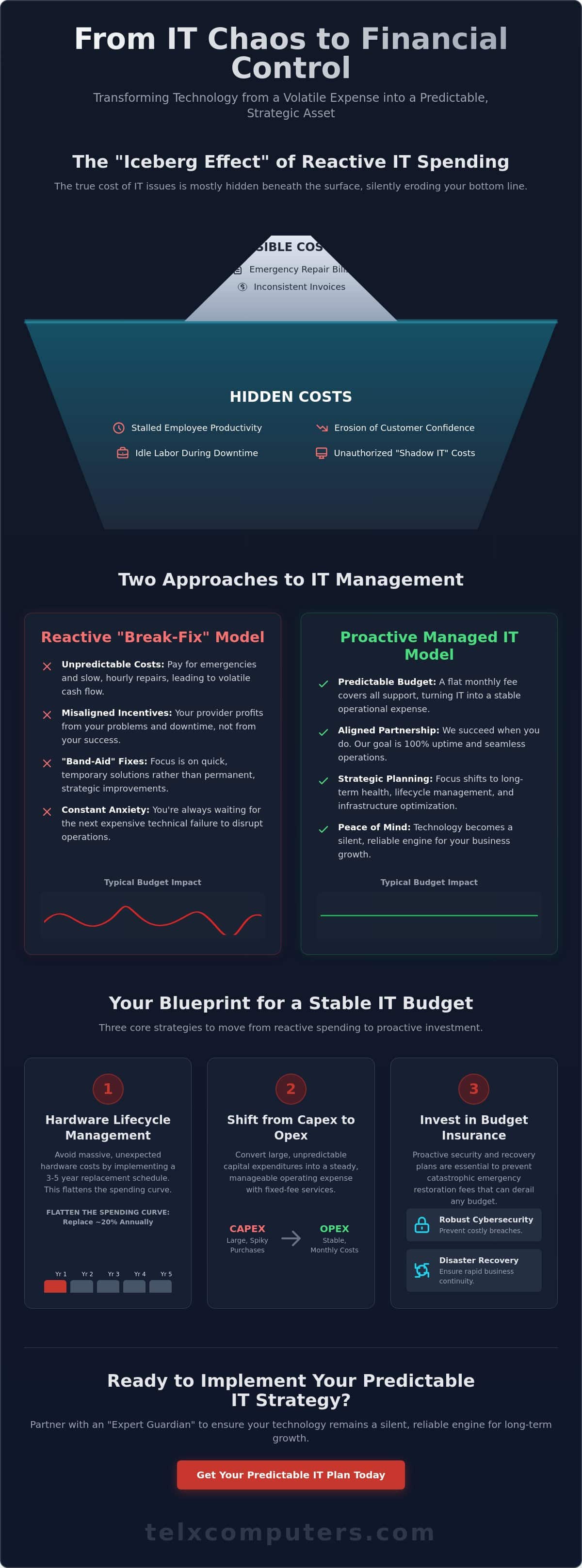
Getting a predictable IT budget requires you to look beyond the immediate invoice. Consider the “Iceberg Effect” of technology spending. The visible portion, the repair bill, is often just a fraction of the total cost. Beneath the surface lies the massive bulk of invisible losses, including stalled employee productivity and the erosion of customer confidence. Aging hardware acts as a ticking financial time bomb, waiting to disrupt operations when you can least afford it.
To better understand the challenges of financial planning in uncertain environments, watch this helpful video:
The Break-Fix Cycle vs. Proactive Management
Traditional hourly billing models often create a fundamental misalignment between you and your IT provider. When consultants are paid by the hour, they’re incentivized to perform slow repairs rather than implementing permanent solutions. This reactive approach leads to “band-aid” fixes that fail under pressure, eventually triggering expensive emergency service surcharges. Moving to a managed IT support service eliminates this conflict by focusing on continuous uptime instead of billable hours.
Quantifying Downtime: The True Budget Killer
Downtime is more than an inconvenience; it’s a direct hit to your bottom line. You can quantify this by adding your lost hourly revenue to the cost of idle labor. When a server fails, you’re still paying for salaries, rent, and overhead, yet your output drops to zero. This accumulation of technical debt makes getting a predictable IT budget impossible. You end up paying for yesterday’s neglect instead of investing in tomorrow’s innovation. “Cheap” support often results in the highest total cost of ownership because it ignores these systemic failures.
Building a Strategic IT Roadmap: Forecasting Your Technology Lifecycle
A strategic roadmap isn’t just a list of future purchases; it’s a blueprint for operational stability. By adopting a disciplined approach to IT Strategic Planning, leaders can shift their technical spending from volatile Capital Expenditures (Capex) to steady Operating Expenditures (Opex). This transition is the cornerstone of getting a predictable IT budget. It allows you to view technology as a utility rather than a series of expensive surprises.
Your roadmap should account for every piece of infrastructure, from the servers in your rack to the laptops on your desks. By mapping out these assets, you gain the foresight to allocate funds before a crisis occurs. This proactive stance is a critical step in getting a predictable IT budget while ensuring your team always has the tools they need to perform. If you’re unsure where your current infrastructure stands, you can get an instant quote to see how a managed approach stabilizes your costs.
Hardware Lifecycle Management
Hardware failures don’t happen on your schedule. They happen at the worst possible moment, often during your busiest season. We recommend a strict five-year rotation rule to maintain equilibrium. Implementing a consistent refresh cycle where you replace 20% of your fleet annually ensures that no single year bears the brunt of a massive refresh cost. This method flattens the spending curve and keeps your team productive with modern, secure devices. Professional procurement through computer IT services in Miami allows you to plan these upgrades well in advance, securing better pricing and ensuring compatibility across your entire network.
Software and Licensing Audits
Shadow IT and “zombie” subscriptions are silent budget killers that quietly drain your resources. These are software licenses for employees who left the company months ago or redundant SaaS tools used by different departments for the same task. Regular audits identify these leaks and protect you from unexpected compliance fines. Consolidating your software needs under a single provider often unlocks volume pricing that isn’t available to smaller, fragmented accounts. By budgeting for major version upgrades and security patches in advance, you avoid the “nickel and diming” that plagues reactive organizations.
As you look toward your 2026 business growth objectives, your IT roadmap serves as the silent engine of that expansion. It ensures your infrastructure scales alongside your revenue, preventing technical bottlenecks from slowing your momentum. This long-term vision transforms IT from a cost center into a strategic asset that supports your broader corporate goals.
The Financial Shift: Comparing Managed Services to Traditional IT Support
Traditional IT support often functions like a tax on failure. In the old break-fix model, your provider only makes money when your systems are down, creating a fundamental conflict of interest. Managed services flip this dynamic by establishing a “utility” model for technology. You pay a set monthly fee for a comprehensive managed IT support service, which covers everything from background maintenance to user support. This shift is the most direct path toward getting a predictable IT budget because it replaces fluctuating hourly bills with a single, reliable line item.
The financial math of managed services becomes even clearer when you compare it to the cost of an internal hire. Employing one full-time IT professional in Miami involves not just a salary, but also benefits, taxes, and ongoing training costs. Even then, you’re limited to the expertise of a single person who eventually needs vacations and sleep. In contrast, partnering with a Managed Service Provider (MSP) gives you access to a full team of specialists and a virtual CIO (vCIO). This vCIO acts as your strategic financial ally, helping you plan your investments years in advance so you aren’t blindsided by technical debt.
Fixed-Rate Billing: The End of Invoice Surprises
A true flat-fee contract should be all-inclusive, covering 24/7 help desk support, active security monitoring, and routine system updates. It’s important to distinguish between “Maintenance” and “Projects” within your agreement. Maintenance includes the daily tasks required to keep your business running smoothly, while Projects involve significant changes like moving to a new office or a total network overhaul. For mid-sized firms, IT outsourcing services provide the scale needed to handle these requirements without the “nickel and diming” that plagues traditional consulting. This clarity is essential for getting a predictable IT budget that your CFO can actually trust.
Incentive Alignment: Why MSPs Want You to Stay Online
When you move to a managed model, your IT partner’s profitability is directly tied to your uptime. If your systems break, it costs the provider time and resources to fix them under your fixed-rate plan. Consequently, they’re incentivized to use proactive server monitoring to catch and resolve issues before they result in a high-cost emergency. This alignment of goals ensures that your provider is always working to prevent problems rather than just reacting to them. Service Level Agreements (SLAs) further protect your budget by contractually guaranteeing specific response times and system performance standards, ensuring you receive the value you pay for every month.
Cybersecurity and Disaster Recovery: Protecting Your Budget from Catastrophic Surprises
A single ransomware attack can bankrupt a small-to-medium business within days. While many leaders focus on the immediate ransom demand, the true financial damage stems from forensic investigations, legal fees, and total operational paralysis. You should view cybersecurity as a form of budget insurance. It’s a fixed, manageable cost that prevents a six-figure emergency recovery bill from devastating your annual projections. Achieving and getting a predictable IT budget requires you to neutralize these catastrophic variables before they strike.
South Florida businesses face a unique set of fiscal threats. Hurricane season isn’t just a weather event; it’s a business continuity challenge that can lead to weeks of lost revenue if your data is trapped on a flooded local server. Budgeting for these regional risks ensures that your company remains resilient regardless of the forecast. By implementing robust ransomware protection and off-site redundancies, you secure your financial future against both digital and physical disasters.
Preventing the Cost of a Data Breach
Cyber insurance premiums are rising sharply, and providers now require proof of sophisticated defenses before they’ll even issue a policy. You can lower these recurring costs by demonstrating proactive security measures rather than waiting for a breach to occur. Compliance fines in specialized sectors are far more expensive than regular security audits. Investing in professional network security is a strategic choice, especially for healthcare and legal firms in Florida that must protect sensitive client data from litigation and regulatory penalties.
Disaster Recovery as a Fixed Operational Expense
Disaster recovery shouldn’t be a “rainy day” fund that you hope you never use. It needs to be a non-negotiable budget line item. Transitioning to cloud-based backups eliminates the physical risks associated with South Florida’s climate. You must calculate your Recovery Time Objective (RTO) to understand exactly how much downtime your budget can survive. This foresight is the only way of getting a predictable IT budget when the unexpected occurs. To see how these protections fit into your broader financial plan, explore our managed IT support services to build a resilient framework.
Implementing Your Predictable IT Strategy with Telx Computers
Moving from the chaos of reactive repairs to a structured financial model requires more than just a new service provider; it requires a strategic ally. Telx Computers adopts an “Expert Guardian” approach to manage your infrastructure, ensuring that your technology serves as a silent engine for growth rather than a source of technical anxiety. By shifting to our business IT services, you replace the “Iceberg Effect” of hidden costs with a transparent, utility-based model. This transition is the final, essential step in getting a predictable IT budget that protects your margins and empowers your leadership team.
Our “Fixed-Price, Unlimited Service” model eliminates the fear of the unknown. During your first 90 days, we focus on total environment stabilization. We don’t just patch problems; we identify the root causes of volatility mentioned in previous sections, such as aging hardware or redundant software licenses. This allows us to implement the long-term roadmaps necessary for getting a predictable IT budget. You can stop worrying about hourly billing and start focusing on your core operations, knowing that your technology costs are locked in and your systems are under constant, vigilant care.
The Telx Onboarding Process
Stabilization is our first priority. We begin by conducting a deep-dive audit of your current network to identify immediate risks and performance bottlenecks. Once we’ve secured your perimeter, our 24/7 help desk becomes the first line of defense for your staff, significantly reducing the productivity losses associated with employee downtime. We understand that different industries face unique regulatory hurdles; therefore, we provide customized solutions specifically tailored for Miami law firms and healthcare providers. This specialized focus ensures that your compliance needs are met without triggering unexpected legal or forensic expenses.
Your Strategic Ally for Growth
We take pride in being an extension of your internal team. While many providers offer remote-only support, our physical presence in Miami, Aventura, and Fort Lauderdale allows us to provide rapid, on-site assistance when South Florida’s unique challenges, like hurricane season, demand a local response. This proximity, combined with our vCIO services, ensures that your technology strategy is always aligned with your regional business goals. The Telx guarantee ensures that your technology remains a stable, high-performing asset, providing the ultimate peace of mind through a commitment to consistent uptime and financial transparency.
Your journey toward financial stability starts with a clear understanding of your current technical landscape. Don’t let another month of “nickel and diming” erode your profitability. Request a comprehensive technology audit today or use our instant quote tool to see exactly how a managed approach can flatten your spending curve and secure your operational future.
Take Control of Your Technology Investment
Transforming your infrastructure from a source of financial stress into a reliable asset is a strategic necessity. By eliminating the “Iceberg Effect” of reactive repairs and adopting a disciplined hardware lifecycle, you protect your cash flow from the volatility of technical debt. Getting a predictable IT budget isn’t just about controlling costs; it’s about creating the stability your team needs to innovate and scale without fear of the next technical failure.
Telx Computers has spent over 20 years serving South Florida businesses as a vigilant guardian. Our fixed-price plans eliminate hidden emergency fees, while our 24/7 proactive monitoring and help desk support ensure your systems remain the silent engine behind your success. You don’t have to navigate technical complexity alone when you have a partner committed to your long-term growth.
Get your predictable IT budget started with an Instant Quote from Telx Computers
Your path to operational peace of mind starts with a single proactive step. We’re ready to help you build a secure, stable, and scalable future for your organization.
Frequently Asked Questions
What is the most common cause of IT budget overruns?
Reactive spending on emergency repairs and the “break-fix” cycle is the primary driver of budget volatility. When you wait for a system to fail before addressing it, you pay a significant premium for expedited service and parts. This lack of foresight forces leaders to pull funds from other departments, making the goal of getting a predictable IT budget nearly impossible. Proactive maintenance identifies these risks before they become expensive crises.
How much should a small business in Miami typically budget for IT per employee?
National averages for managed IT services typically range between $100 and $250 per user per month, depending on your industry’s specific security and compliance needs. In Miami, businesses must also account for regional factors such as robust disaster recovery and high speed connectivity. These investments ensure that operations remain stable during local weather events, preventing the hidden costs of extended downtime.
Does a fixed-fee Managed IT plan include hardware upgrades?
Most fixed-fee agreements cover the labor for maintenance and ongoing support rather than the physical cost of new laptops or servers. However, a comprehensive plan includes the strategic procurement and setup of new equipment as part of your service. This distinction is vital for getting a predictable IT budget because it separates recurring service fees from your planned capital investments for hardware refreshes.
To understand the breakdown of these costs further, you can discover more about Fixed Monthly Managed IT Service Fees through CX IT Services, an Australian provider specializing in transparent billing models.
Can an IT roadmap really help me save money on my taxes?
Strategic technology planning allows you to maximize tax incentives like Section 179 deductions for equipment purchases. By scheduling your hardware upgrades according to a roadmap, you can time your investments to offset taxable income more effectively. You should consult with your financial advisor to see how specific technology lifecycles align with your broader corporate tax strategy and depreciation schedules.
How does proactive monitoring reduce my monthly IT spending?
Proactive monitoring identifies minor system glitches in the background before they escalate into total network outages. By resolving a failing hard drive or a security vulnerability early, your team avoids the massive productivity losses associated with company wide downtime. This vigilant approach ensures that your monthly spend remains focused on growth and efficiency rather than expensive emergency restoration efforts.
What is the difference between Capex and Opex in IT budgeting?
Capital Expenditure (Capex) refers to major upfront investments in physical assets like servers, while Operating Expenditure (Opex) covers recurring costs like software licenses and managed services. Shifting your technology spending toward an Opex model makes your monthly cash flow more stable and easier to forecast. This transition is a fundamental step for leaders who want to avoid the financial spikes of traditional IT procurement.
Is it cheaper to have an in-house IT person or an MSP in Miami?
Partnering with a Managed Service Provider (MSP) is typically more cost effective for small to mid sized firms than hiring a full time internal employee. An in house professional requires a salary, benefits, and ongoing training, yet they only offer the expertise of one individual. An MSP provides access to an entire team of specialists and 24/7 support for a fraction of the cost of a single senior hire.
How often should we update our IT roadmap to keep the budget predictable?
You should conduct a formal review of your technology roadmap at least once a year to align with your annual financial planning. Quarterly check ins are also beneficial to adjust for changes in your workforce or emerging security threats. Keeping this roadmap current ensures that your long term projections remain accurate and that your technical infrastructure continues to support your evolving business objectives.