





01 Jun Improving Business Productivity with Technology: A Strategic Guide for 2026
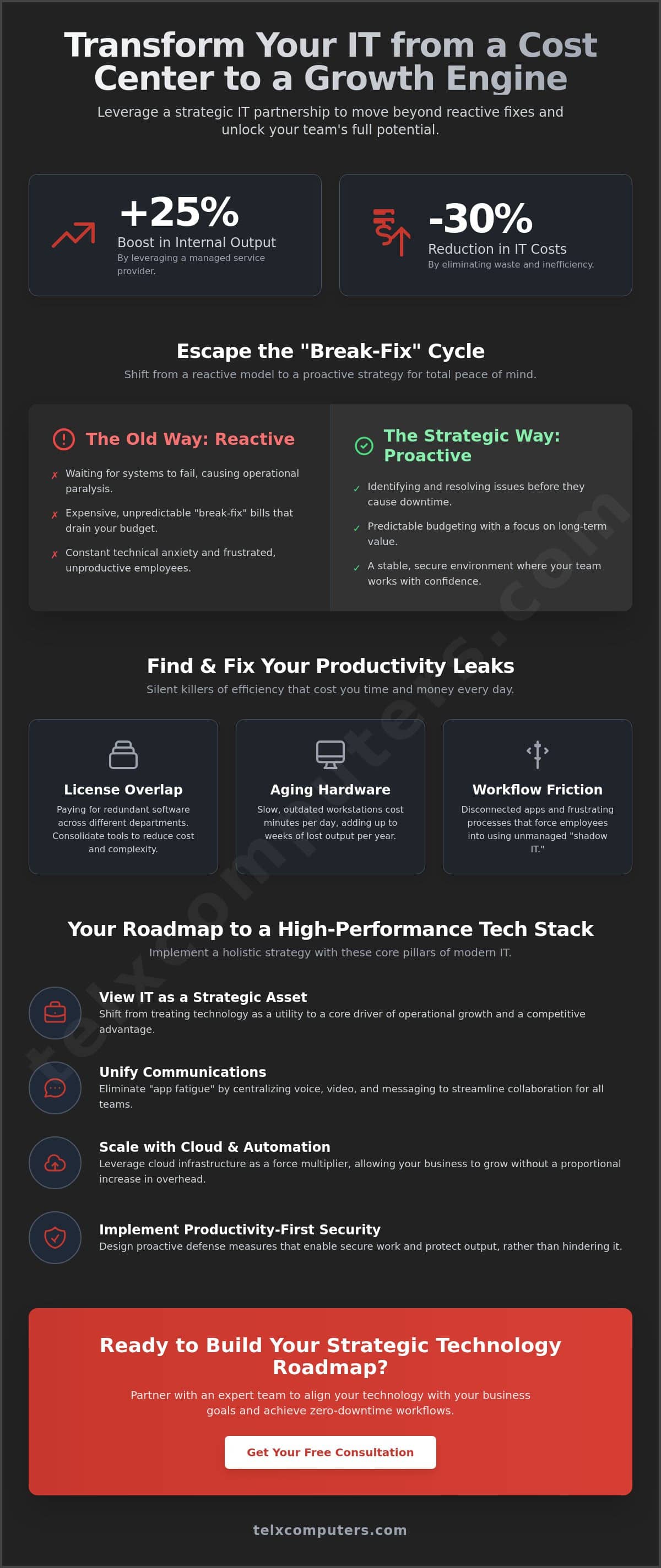
Did you know that organizations leveraging managed service providers can boost their internal output by up to 25% while slashing IT costs by nearly a third? It’s a striking figure from recent industry reports, yet many leaders still feel trapped in a cycle of reactive repairs and expensive “break-fix” bills. You likely recognize the frustration of disconnected software and the lingering anxiety that a single cybersecurity threat could halt your operations entirely. Improving business productivity with technology isn’t about simply buying more tools; it’s about integrating a strategy that works as hard as you do.
We’re here to help you move past technical disruptions and toward a future of zero-downtime workflows. You’ll discover how to transform your IT from a support function into a high-octane engine for operational efficiency and growth. This article outlines the logic behind predictable budgeting, seamless remote collaboration, and the proactive security measures that turn your technology into a silent partner in your success. By the end of this guide, you’ll have a clear roadmap to replace technical anxiety with total peace of mind.
Key Takeaways
- Shift your perspective from viewing technology as a simple utility to a strategic asset that powers long-term operational growth.
- Eliminate “app fatigue” by centralizing communication channels through unified systems that streamline collaboration for both remote and on-site teams.
- Learn how cloud infrastructure and automation serve as force multipliers, allowing your team to scale without a proportional increase in overhead.
- Discover the logic of “Productivity-First Security,” where proactive defense measures are designed to enable work rather than hinder it.
- Master the art of improving business productivity with technology by leveraging managed IT partnerships for predictable budgeting and expert oversight.
The Evolution of Business Productivity: Why Technology is the New Foundation
Modern professionals often feel buried under a mountain of digital tools designed to save time. This is the productivity paradox; as organizations add more applications, employees often find themselves more distracted by constant notifications and fragmented interfaces. While 88% of organizations now use AI automation in at least one function, many still struggle to see a direct impact on their bottom line. True success in improving business productivity with technology requires moving beyond viewing IT as a mere utility. Leading enterprises now treat their digital infrastructure as a strategic asset that powers every operational move.
Historically, productivity-improving technologies have always required careful implementation to yield real results. When technology is treated as a series of disconnected fixes, it creates “shadow IT,” where frustrated employees use unmanaged personal apps to get their work done. This creates massive security gaps and data silos that hinder growth. A holistic business strategy replaces these band-aid solutions with an integrated ecosystem where every tool talks to the next, ensuring your team stays focused on high-value tasks rather than troubleshooting software.
To better understand how these shifts impact your daily operations, watch this helpful video:
Shifting from Reactive to Proactive Operations
Waiting for a server to crash or an email system to fail is a recipe for operational paralysis. The old break-fix model kills momentum and drains employee morale because it forces your team to stop working whenever a glitch occurs. By switching to a proactive model through managed IT support service, you identify bottlenecks before they stop work. Implementing robust server monitoring systems ensures that technical issues are resolved silently in the background. This transition replaces technical anxiety with a sense of stability, allowing your staff to work with total confidence.
Identifying Productivity Leaks in Your Current Tech Stack
Many firms pay for redundant software licenses without realizing it. A basic audit often reveals that different departments use three different tools for the same task, creating unnecessary “friction points” in daily workflows. Legacy hardware is another silent killer of efficiency. While slow processing speeds might only cost a few minutes a day per person, across an entire team, that adds up to weeks of lost output annually. Improving business productivity with technology starts with a clear-eyed look at these leaks:
- License Overlap: Consolidating tools to reduce costs and training requirements.
- Hardware Lifecycle: Replacing aging workstations before their failure rates spike.
- Workflow Friction: Removing steps in digital processes that frustrate employees.
Organizations that embrace this strategic oversight can reduce overall IT costs by 20% to 30% while significantly boosting their team’s daily output. It’s about building a foundation that supports your goals today and scales for your needs tomorrow.
Streamlining Collaboration with Unified Communication Systems
Communication is often the first thing to break as a company grows. By 2026, the global unified communications market is expected to reach $109.18 billion, a clear indicator that businesses are moving away from fragmented tools. Unified Communications (UC) isn’t just a fancy term for chat; it’s a strategic framework that brings voice, video, messaging, and data into a single interface. When your team doesn’t have to hunt for information across four different apps, they spend more time on billable work. Improving business productivity with technology depends heavily on this internal cohesion. It’s about breaking down the information silos that prevent your sales team from seeing what your operations team is doing in real time.
App fatigue is a silent killer of focus. The average employee toggles between different applications dozens of times an hour, losing a few seconds of mental momentum with every switch. Centralizing these channels ensures that data is synchronized across all devices, whether your staff is in the office or working from a satellite location. This level of integration ensures that everyone operates from a single version of the truth, which is essential for maintaining accuracy and speed in a fast-paced market.
Beyond Instant Messaging: Creating a Synchronized Digital Workspace
A truly productive workspace integrates project management tools directly into your communication stream. Instead of just chatting about a task, your team should be able to see the task’s status, deadlines, and relevant documents within the same window. Standardized communication policies are vital here. You need clear rules on when to send an email versus when to start a video call to keep digital noise to a minimum. Centralized document storage with strict version control prevents the “which file is the latest?” headache that plagues so many unmanaged environments. If you need help organizing these layers, looking into it outsourcing services can provide the structural expertise your internal team might lack.
The Role of VoIP and Cloud Connectivity in Remote Efficiency
Modern VoIP solutions allow your team to maintain a professional presence from anywhere. Whether they’re on a mobile device or a laptop, they carry their office extension with them. This mobility is enhanced by “presence” features, which allow colleagues to see who is available, in a meeting, or away. This small detail saves hours of “Are you there?” messages every week. Improving business productivity with technology also requires ensuring high-speed connectivity for video conferencing, especially in remote branches. Without reliable bandwidth, the best collaboration tools in the world won’t prevent the frustration of a dropped call or a laggy presentation. It’s about creating a seamless experience where the technology disappears, leaving only the work behind.
Leveraging Automation and Cloud Infrastructure for Scalable Growth
Scalability is the hallmark of a healthy enterprise, but you can’t scale effectively if your team is bogged down by manual data entry or outdated hardware. Automation acts as a force multiplier, allowing small and mid-sized teams to punch far above their weight class. With the global AI automation market valued at $169.46 billion in 2026, it’s clear that industry leaders are moving away from manual labor for repetitive tasks. Improving business productivity with technology relies on these systems to handle the heavy lifting, ensuring your staff focuses on high-value strategy rather than administrative busywork.
Shifting from physical server rooms to scalable cloud environments is a critical step in this evolution. Traditional on-site servers represent a significant capital expenditure and a single point of failure. In contrast, cloud infrastructure serves as the backbone of business continuity. It provides a level of resilience that physical hardware simply can’t match, especially when it comes to disaster recovery. By automating data entry and reporting, you don’t just save time; you drastically reduce the risk of human error that often leads to costly operational delays.
Automating Repetitive Workflows to Reclaim Billable Hours
Every minute your team spends on manual invoicing or customer onboarding is a minute lost to growth. Basic process automation can reclaim dozens of hours per week across a standard office. For example, Remote Monitoring and Management (RMM) tools allow us to automate IT maintenance, patching systems and updating software without human intervention. This proactive approach ensures your environment stays optimized without interrupting your workflow. When you calculate the hours saved, the return on investment for automation becomes undeniable.
- Invoiced Automation: Auto-generating bills based on project milestones to improve cash flow.
- Standardized Onboarding: Automating user setup to ensure new hires are productive on day one.
- Verified Backups: Removing the risk of forgotten manual backups with scheduled cloud uploads.
Cloud-First Strategies: Accessibility Without the Hardware Burden
Adopting cloud computing removes the physical ceiling that often stunts business growth. Instead of purchasing new servers every time you hire more staff, you simply scale your cloud resources up or down as needed. This shift from a capital expenditure (CapEx) model to an operating expense (OpEx) model makes your IT budgeting predictable and lean. Virtual Desktop Infrastructure (VDI) further enhances this by providing secure, high-performance remote access to company resources from any device. It’s a key component in improving business productivity with technology, ensuring your team has the tools they need whether they’re in a Miami office or working from a satellite location across the country.
Protecting Your Output: The Critical Link Between Security and Productivity
Security is often viewed as a hurdle that slows down workflows. However, true “Productivity-First Security” acts as a silent guardian that enables work rather than hindering it. When your defense is proactive, it keeps the digital environment stable, ensuring that your team never hits a wall. Improving business productivity with technology is impossible if your network is constantly under siege or prone to crashes. With the global cost of cybercrime projected to rise to $13.82 trillion by 2028, the stakes for your digital output have never been higher. The real cost of a ransomware attack isn’t the ransom payment itself; it’s the total paralysis of your operations. Every hour of downtime is an hour of lost revenue and eroded client trust.
Proactive cybersecurity audits identify vulnerabilities before they turn into disasters. By securing the network layer, you provide a stable foundation for collaboration tools like Slack or Zoom. Competitors often focus on the apps themselves but ignore the network stability required to run them. Without this stability, even the best software becomes useless. Employee training also plays a pivotal role. When your staff knows how to spot a phishing attempt, they become an active part of your defense, preventing the disruptions that lead to costly recovery phases.
Why Cybersecurity is a Productivity Strategy, Not Just a Defense
Robust ransomware protection keeps your business engine running 24/7. It’s about more than just blocking threats; it’s about building resilience so work continues even during an attempted breach. Tools like Single Sign-On (SSO) and Multi-Factor Authentication (MFA) actually improve efficiency by reducing the number of passwords employees need to remember while keeping access secure. This approach ensures that security measures feel like a natural part of the workday rather than a series of obstacles. Improving business productivity with technology requires this balance of tight security and fluid access.
Minimizing Costly Downtime Through Real-Time Server Monitoring
Strategic server monitoring is the direct link to achieving 99.9% uptime. Automated backups ensure that if a failure does occur, data recovery takes minutes instead of days. Consider the financial impact on a Miami law firm: losing just one hour of access to case files can cost thousands in billable hours and potential legal complications. By identifying hardware bottlenecks before they cause a crash, you maintain the high-speed environment necessary for modern competition. If you’re ready to secure your operations and boost efficiency, you can request an instant quote to see how proactive management fits your business model.
Building a Strategic Technology Roadmap with a Managed IT Partner
Improving business productivity with technology requires more than just a collection of apps; it demands a navigator who understands how those tools fit into your specific business model. While previous sections detailed the “what” of modern tech, the “how” depends on having an expert guardian. This partner doesn’t just fix what’s broken. They align your digital infrastructure with your long-term growth goals. Organizations that switch to managed service providers can reduce their overall IT spend by up to 30% while boosting team output by 25%. This isn’t a coincidence; it’s the result of moving away from the expensive, reactive break-fix model toward a proactive partnership.
The break-fix approach is inherently flawed because the provider only profits when your business suffers a failure. This creates a conflict of interest that leaves your team vulnerable to recurring glitches. A strategic partner operates on the opposite principle. By managing the tech so you can manage the business, your partner ensures that every system is optimized, patched, and secure before an issue even arises. This is the ultimate secret to improving business productivity with technology: stop managing the tools and start managing the results.
Transitioning to Fixed-Price, Unlimited IT Support
The “all-you-can-eat” support model completely changes the psychology of your office. Under hourly billing, employees often hesitate to call for help because they’re worried about the cost of a support ticket. This leads to staff “working around” small bugs, which wastes hours of time every month. Unlimited 24/7 help desk support encourages your team to solve small issues fast. When technical peace of mind is built into a predictable monthly budget, you can forecast your ROI with total clarity. It turns IT from an unpredictable expense into a stable, high-performance engine for your daily operations.
Personalized IT Consulting for Competitive Markets
Generic solutions rarely work in high-stakes environments. By partnering with IT companies in Miami, you gain a strategic ally that understands the regional business landscape. Whether you’re operating in Fort Lauderdale or Aventura, local expertise ensures a rapid on-site response when a physical presence is required. This personalized approach allows for industry-specific tailoring, which is vital for sectors with strict requirements:
- Legal Services: Ensuring document management systems are both high-speed and compliant with client confidentiality standards.
- Healthcare: Tailoring cloud and security protocols to meet HIPAA regulations while maintaining seamless patient data access.
- Finance: Implementing high-tier encryption and redundant backups to protect sensitive transactional data.
Technology is the fuel that drives your company forward, but a strategic partner is the navigator who keeps you on the fastest route to success. A customized IT roadmap ensures that your infrastructure doesn’t just support your current needs but scales effortlessly as you capture more market share. It’s time to replace technical anxiety with the confidence that comes from a perfectly managed digital foundation.
Secure Your Competitive Edge for the Years Ahead
The journey toward operational excellence requires shifting your focus from managing individual tools to building a cohesive, strategic ecosystem. You’ve seen how unified communications eliminate app fatigue and how cloud-first strategies remove the physical limits on your company’s growth. Most importantly, you now understand that true security isn’t just a defensive wall; it’s the foundation of consistent uptime and team focus. Improving business productivity with technology is most effective when you move away from the stress of reactive repairs and embrace a proactive, managed approach.
As your strategic ally, we provide the stability and expertise needed to keep your business moving forward. With 24/7 proactive monitoring, fixed-price unlimited support plans, and rapid on-site response in Miami, NYC, and LA, we act as the silent engine behind your success. Don’t let technical disruptions stall your momentum any longer. You can Get an Instant IT Support Quote for Your Business today and start building a roadmap that scales with your ambition. We’re ready to help you turn your technology into your greatest competitive advantage.
Frequently Asked Questions
How does technology specifically increase employee productivity?
Technology increases productivity by automating repetitive tasks and streamlining communication flows. It removes the manual barriers that force employees to switch between disconnected applications. By integrating tools into a single workspace, your team spends less time on administrative overhead and more time on high-value projects. This shift ensures that every hour worked contributes directly to your bottom line. Improving business productivity with technology starts by giving your staff the right tools to stay focused.
What is the most cost-effective technology for small business productivity?
Unified Communications (UC) is often the most cost-effective entry point for growing firms. By consolidating voice, video, and messaging into one platform, you eliminate redundant subscriptions and reduce “app fatigue.” This centralization allows a small team to respond to clients faster and collaborate without the friction of disparate systems. It’s a high-impact investment that yields immediate efficiency gains without requiring a massive hardware overhaul.
Can cloud computing really save my business money in 2026?
Yes, cloud computing saves money by shifting technology costs from a capital expenditure to a predictable operating expense. You no longer need to invest in expensive on-site servers that require physical maintenance, cooling, and eventual replacement. Instead, you pay only for the resources you use. This scalability ensures you aren’t overpaying for idle capacity during slower business cycles, keeping your budget lean and efficient.
How much downtime is considered “normal” for a mid-sized business?
The modern standard for business continuity is “three nines” or 99.9% uptime. While some legacy systems might experience occasional hiccups, any downtime that halts your operations is a sign of an unstable infrastructure. Even a few minutes of disconnection can lead to lost data and frustrated clients. Aiming for near-zero downtime through proactive monitoring is the only way to protect your professional reputation and maintain steady output.
What is the difference between Managed IT and traditional IT support?
Managed IT is a proactive partnership, whereas traditional support is a reactive “break-fix” model. Traditional IT only intervenes when something stops working, which often results in expensive emergency fees and lost work hours. Managed IT focuses on preventing issues before they occur. This approach keeps your systems optimized 24/7, ensuring that technology remains a silent engine for your success rather than a source of constant interruptions.
How do I know if my current IT infrastructure is holding my business back?
Your infrastructure is likely holding you back if employees frequently use manual workarounds or unmanaged personal apps to complete their tasks. Frequent software crashes, slow data transfer speeds, and a lack of integration between departments are clear warning signs. If your team spends more time troubleshooting their tools than using them, your current setup is a bottleneck that is actively draining your profitability.
Is automation only for large enterprises, or can small businesses benefit too?
Small businesses actually stand to gain the most from automation because it acts as a significant force multiplier. It allows a lean team to handle a high volume of tasks, such as invoicing or customer onboarding, without the need to hire additional staff. By automating these workflows, small firms can compete with much larger organizations by maintaining lower overhead and significantly faster response times.
What are the first steps to improving business productivity with technology?
The first step in improving business productivity with technology is conducting a comprehensive audit of your current digital environment. This identifies “friction points” where tools are failing or overlapping. Once you understand these gaps, you can build a strategic roadmap with a managed partner. This plan ensures that every new technology investment aligns perfectly with your specific operational goals and your long-term vision for growth.