





30 May How to Justify IT Spending to Your Boss: A Strategic Framework for Approval
If you approach your leadership team asking for “better hardware,” you’ve already lost the battle. In a landscape where the average cost of a US data breach has climbed to $10.22 million, your boss isn’t looking for faster gadgets; they’re looking for business resilience. Learning how to justify IT spending to your boss requires moving past technical specifications and focusing on how Managed IT Services and proactive security protect the organization’s profitability. With SaaS inflation hitting 13.2 percent this year, every dollar in your budget must be framed as a strategic investment rather than a departmental expense.
We understand the frustration of having a critical request denied because of an “if it ain’t broke, don’t fix it” mentality. It’s a dangerous position that leaves you responsible for systems held together by luck. This article provides a strategic framework to translate complex technical needs into clear business outcomes. You’ll learn how to present a case that secures an approval, establishes a predictable IT budget, and ensures your network remains a silent engine of success rather than a ticking liability. We’ll show you how to align your technical roadmap with the company’s long-term growth goals.
Key Takeaways
- Bridge the communication gap by translating complex technical requirements into the growth-oriented language that executives prioritize.
- Master the strategic framework for how to justify IT spending to your boss by focusing on the “Cost of Inaction” rather than just upfront price.
- Learn how to quantify the financial impact of downtime and security vulnerabilities to present a data-driven case for risk mitigation.
- Apply a structured five-step process to audit your current environment and build a bulletproof budget proposal that aligns with corporate goals.
- Discover how a strategic partnership for managed IT services can eliminate budget surprises and provide the high-level expertise needed to secure leadership approval.
The Language Gap: Why Your Boss Doesn’t Understand Your IT Needs
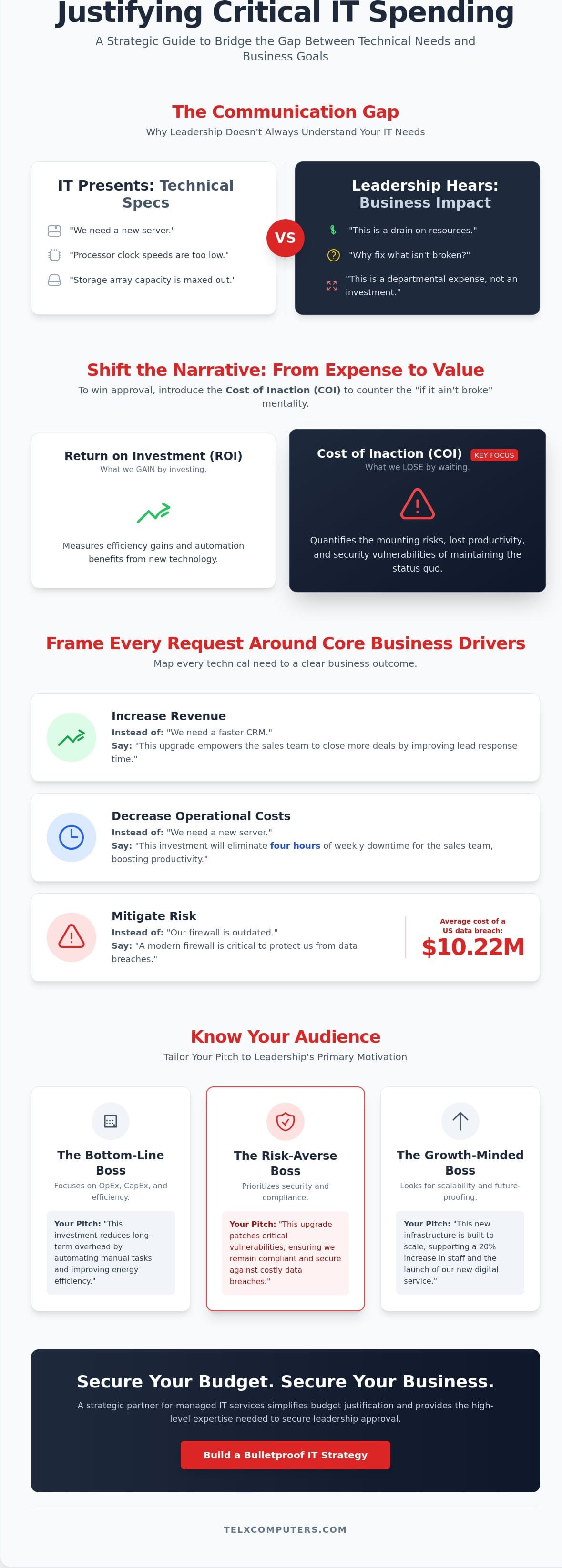
The Technical-Business Divide is a real barrier to organizational growth. It happens when technical teams present solutions based on hardware specifications while leadership evaluates requests based on fiscal impact. This disconnect often turns IT into a “black box” cost center in the eyes of executives. They see the outgoing expenses for managed IT services or cloud subscriptions, but they don’t always see the underlying value. When you struggle with how to justify IT spending to your boss, it’s usually because the proposal falls into one of three traps: a lack of clarity, a lack of urgency, or a lack of alignment with company goals.
To bridge this gap, you must stop acting like a “fixer” who simply reacts to broken equipment. Instead, position yourself as a strategic technology partner who understands the company’s operational pulse. This transition requires a shift in how you communicate needs, moving from technical jargon to clear, declarative statements about business stability.
To better understand the nuances of professional communication with leadership, watch this helpful video:
The Translation Layer: Technical Specs vs. Business Outcomes
Leadership rarely cares about the clock speed of a processor or the capacity of a storage array. They care about business outcomes. Saying “we need a new server” sounds like a drain on resources. Conversely, saying “we need to eliminate four hours of weekly downtime for the sales team” sounds like a significant saving. Every request you make should map directly to one of three core business drivers: increasing revenue, decreasing operational costs, or mitigating risk. This approach provides a clear Return on Investment (ROI) that any executive can appreciate. Using the active voice helps demonstrate your competence and proactivity during these high-stakes budget meetings.
Identifying Your Boss’s Primary Motivation
Understanding the psychological driver behind a “no” is the first step toward getting a “yes.” You aren’t just pitching a project; you’re pitching a person. Tailoring your message to these motivations is the most effective way to learn how to justify IT spending to your boss while building long-term trust.
- The Bottom-Line Boss: This leader focuses strictly on OpEx and CapEx. They want to see how an investment reduces long-term overhead or improves efficiency.
- The Risk-Averse Boss: This leader prioritizes security and compliance. They’re motivated by the fear of data breaches, which now cost US companies an average of $10.22 million per incident.
- The Growth-Minded Boss: This leader looks for scalability. They want to know if the current infrastructure can handle a 20 percent increase in staff or the launch of a new digital service.
When you understand what keeps your boss up at night, you can present IT solutions as the cure for their specific anxiety. This shifts the conversation from “spending money” to “securing the future.”
ROI vs. COI: Shifting the Narrative to Business Value
Transitioning from an expense conversation to a value conversation is the secret to learning how to justify IT spending to your boss. Most executives think in terms of Return on Investment (ROI), which measures the efficiency gains and automation benefits a new tool provides. Aligning IT to business priorities ensures every dollar spent contributes to the bottom line. However, ROI only tells half the story. To win over a conservative leadership team, you must introduce the Cost of Inaction (COI).
COI represents the price the company pays for maintaining the status quo. It accounts for the mounting risks of aging hardware, the high cost of manual workarounds, and the inevitable fallout of a security failure. While ROI looks at what you gain, COI highlights what you’re currently losing. For many organizations, the COI of maintaining a legacy system is far higher than the investment required to modernize it. This is especially urgent as cloud providers forecast a 5 to 10 percent price increase in mid-2026, while SaaS inflation has already hit 13.2 percent. Staying stagnant actually costs more than moving forward.
Quantifying Efficiency and Productivity
Outdated technology is a quiet drain on payroll. When systems lag, you’re paying employees to wait. You can calculate the value of saved time by multiplying the number of employees by their average hourly rate and the hours lost to technical friction. Beyond just time, consider the human element. Frustrated employees are more likely to leave, and the cost of turnover is often higher than the cost of a hardware refresh. Modern cloud solutions, supported by managed IT support, enable remote work flexibility. This allows your team to stay productive from anywhere without the bottlenecks of old-school VPNs or server lag.
The Predictability Factor
Bosses hate financial surprises. The “Break-Fix” model is a nightmare for budgeting because it creates unpredictable spikes in spending when things inevitably fail. Shifting to managed IT support stabilizes the balance sheet by replacing emergency repairs with a fixed monthly fee. This predictability allows a CFO to forecast the fiscal year with 100 percent accuracy. When you can guarantee that IT costs will remain flat regardless of how many support tickets are opened, your plan becomes much easier to approve. The Telx Computers guarantee of unlimited support acts as a final layer of budget protection. If you’re still wondering how to justify IT spending to your boss, starting with a clear, predictable cost model is the best way to gain their confidence. You can even get an instant quote to begin building your business case today.
Calculating the Cost of Inaction: Risk and Security
The most dangerous phrase in a boardroom is “it won’t happen to us.” This logical fallacy often stalls critical investments, yet the data suggests a different reality. In 2026, the average cost of a data breach in the US reached an all-time high of $10.22 million. For small businesses with under 500 employees, that figure still averages a staggering $3.31 million per incident. Learning how to justify IT spending to your boss becomes much simpler when you move from abstract fears to concrete calculations. You must present the budget not as a “maybe” but as a necessary shield against catastrophic loss.
One of the most effective strategic approaches to IT budgeting is to perform “downtime math.” Use this simple formula to show the impact of a system failure: (Number of employees) x (Average hourly rate) x (Hours of outage). If 50 employees earning $40 per hour are idle for just four hours, the company loses $8,000 in pure productivity alone. This doesn’t even account for missed sales or the fact that it takes an average of 241 days to fully identify and contain a breach. Trust is hard to price, but losing client confidence after a security failure can lead to a multi-year decline in contract renewals.
For our local community, these risks are often compounded by the environment. Highlighting the necessity of disaster recovery is vital for Miami businesses that face seasonal weather-related outages. A single hurricane or severe tropical storm can knock out local infrastructure for days. Without a verified off-site backup and a recovery roadmap, a business might never reopen its doors.
Ransomware: The Ultimate Justification
Paying a ransom is only the tip of the iceberg. The real cost lies in the forensic investigations, legal fees, and total system rebuilds that follow. Proactive ransomware protection is now a prerequisite for financial stability. Cyber insurance carriers are tightening their requirements, with premiums forecasted to increase by 15 to 20 percent this year. Carriers now demand proof of managed detection and response (MDR) and multi-factor authentication. By conducting regular cybersecurity audits, you can identify “red flags” before they turn into “red ink” on the company’s annual report.
Compliance and Legal Liabilities
In highly regulated sectors, the cost of non-compliance can be fatal to a firm’s reputation and its bank account. This is particularly true for those in healthcare or law, where data privacy is mandated by federal statutes. Outdated software doesn’t just run slowly; it creates legal vulnerabilities and insurance gaps that leave the business owners personally exposed. Positioning IT upgrades as a mandatory “legal and safety” requirement shifts the focus from discretionary spending to essential corporate governance. It’s about protecting the entity from preventable litigation.
5 Steps to Build a Bulletproof IT Budget Proposal
Securing approval for a new project isn’t about luck. It’s about a structured process. To understand how to justify IT spending to your boss, you must first move away from technical wish lists and toward a business-centric roadmap. This five-step process ensures your proposal is rooted in logic and financial reality.
- Step 1: Audit the current state. Perform an “As-Is” assessment. Document the age of your hardware, the number of support tickets generated by legacy systems, and any recent close calls with security.
- Step 2: Identify business pain points. Conduct a “Gap Analysis.” Connect technical limitations to departmental friction. If the sales team can’t access data remotely, that is a business gap, not just a cloud issue.
- Step 3: Research solutions. Contrast your current maintenance costs with modern alternatives. Get an instant quote to establish a baseline for your comparison.
- Step 4: Create a tiered proposal. Offer “Good, Better, and Best” options. This gives your boss a sense of control and choice, making a “yes” more likely for at least one of the tiers.
- Step 5: Present the Executive Summary. Distill your entire case into a single page. Most executives won’t read a 20-page technical audit, but they will read a one-page summary that highlights risk and reward.
Build your first tiered proposal today by getting an instant quote to see how predictable spending can transform your department.
Crafting the One-Page Executive Summary
Your executive summary must be concise. Focus on four pillars: the Problem, the Solution, the Cost, and the Business Impact. Avoid technical jargon at all costs. Instead of discussing “latency” or “IOPS,” use terms like “operational continuity” and “data integrity.” These words resonate with leadership because they imply stability. A single sentence should summarize the entire project’s value. For example: “This strategic IT investment ensures operational continuity and data integrity while reducing long-term financial risk through proactive threat mitigation.”
Handling Objections with Confidence
Anticipate the “no” before it happens. When a boss says “It’s too expensive,” pivot immediately to the Cost of Inaction. Remind them that the $10.22 million average cost of a US data breach is far more expensive than any proactive measure. If they suggest waiting until next year, highlight the escalating threat landscape. Mention that cyber insurance premiums are forecasted to rise by 15 to 20 percent. Delaying security upgrades today could make the company uninsurable tomorrow. Use competitive benchmarking to create a sense of urgency. Point out that competitors in Miami are already using these tools to move faster and protect their clients better. This positions the spend as a necessary step to maintain a competitive edge. Mastering these scripts is how to justify IT spending to your boss without feeling like you’re begging for a favor.
The Strategic Ally: How Telx Computers Simplifies IT Justification
Securing a budget approval is often a matter of having the right data and a partner who speaks the language of leadership. Telx Computers acts as a fractional CTO for your organization, providing the high-level strategic oversight needed to build compelling business cases. We don’t just provide technical support; we equip you with the metrics and risk assessments that make the question of how to justify IT spending to your boss much easier to answer. By positioning technology as a tool for growth rather than a recurring cost, we help you transition from a reactive “fixer” to a proactive leader.
Our “silent engine” philosophy ensures that your infrastructure remains stable and secure behind the scenes. When systems work flawlessly, you look like a hero to your leadership team. We provide the peace of mind that comes from knowing a vigilant, forward-thinking entity is always one step ahead of potential threats. With local expertise across Miami, Fort Lauderdale, and Aventura, our team delivers rapid on-site response times that global providers simply cannot match. This regional commitment ensures your operational continuity is never at the mercy of a distant support center.
Predictable Budgeting with Telx
Executive frustration often stems from the unpredictable “Break-Fix” cycle. When systems fail unexpectedly, it forces emergency spending requests that disrupt fiscal planning. Switching to managed IT services eliminates these budget surprises by moving to a fixed-rate model. This holistic strategy allows us to integrate with your internal team and align your technology roadmap with your company’s specific growth targets. Our 24/7 server monitoring identifies potential issues before they escalate into costly outages, ensuring that your budget remains stable and your network remains reliable.
Ready to Present Your Case?
You don’t have to build your IT proposal alone. Telx Computers offers the professional authority and data-driven insights you need to gain executive buy-in. With over 20 years of experience in the Miami IT landscape, we understand the unique challenges and regulatory requirements facing local enterprises. We provide the documentation and ROI analysis that proves modern IT is an investment in your company’s future resilience. If you are ready to stop fighting for every dollar and start building a predictable, secure environment, we are here to help. Contact Telx Computers today to build your strategic IT roadmap and secure the approval you need to move forward.
Secure Your Budget and Strengthen Your Infrastructure
Mastering the art of how to justify IT spending to your boss transforms your role from a cost-center manager to a strategic asset. By bridging the technical-business divide and quantifying the Cost of Inaction, you prove that proactive technology is a safeguard for the company’s future. You’ve learned how to audit your environment and present a tiered proposal that speaks the language of leadership.
Telx Computers stands ready to support your next move. Our Miami-based rapid response team provides the local expertise your organization needs to maintain operational continuity. With 24/7 proactive monitoring and fixed-price unlimited support, we eliminate the budget surprises that cause executive friction. You don’t have to build your business case alone.
Get a Strategic IT Quote to Show Your Boss and take the first step toward a more resilient, predictable network. Your leadership team will appreciate the clarity, and you’ll gain the stability you need to lead with confidence.
Frequently Asked Questions
How do I explain the ROI of cybersecurity when we haven’t had a breach yet?
Frame cybersecurity as a critical component of business continuity rather than a reaction to a crisis. Explain that a lack of past incidents is the result of previous vigilance, not a guarantee of future safety. Use industry benchmarks for recovery time to show how an investment in network security prevents the kind of catastrophic downtime that would immediately halt company revenue and damage client trust.
What is the best way to present a large capital expense (CapEx) for hardware?
Present CapEx as a strategic tool for long-term operational stability. You should detail the hardware lifecycle and demonstrate how aging equipment increases help desk tickets while slowing down employee output. By investing in a refresh now, the company avoids the much higher costs of emergency replacements and the invisible productivity tax paid every time a legacy system lags or crashes.
Can managed IT services actually save my company money in the long run?
Managed IT services save money by converting variable, high-impact emergency costs into a flat, predictable monthly fee. This model eliminates the need for expensive in-house training and specialized tool sets. It also reduces the financial impact of employee turnover. The institutional knowledge stays with your strategic partner rather than walking out the door with a single staff member.
How often should I review our IT budget with my boss?
Schedule a formal budget review at least once every quarter. This frequency allows you to align technical spending with shifting business goals before the two become misaligned. Frequent touchpoints prevent sticker shock during annual planning. These meetings also help you demonstrate how to justify IT spending to your boss through consistent, incremental wins rather than one massive, high-pressure request.
What are the most common mistakes when asking for an IT budget increase?
The most frequent error is leading with technical specifications instead of business outcomes. Executives often reject proposals that feel like buying toys rather than solving problems. You must avoid using dense jargon that obscures the value of the request. Ensure every dollar requested links directly to a specific operational goal, such as improving remote work access or meeting new compliance standards.
How do I justify the cost of 24/7 help desk support for a small team?
Focus on the opportunity cost of your high-value employees. When a small team handles their own technical issues, they aren’t focusing on revenue-generating tasks. 24/7 help desk support ensures that a minor login issue at night doesn’t derail a project the following morning. It also prevents internal burnout by removing the burden of constant technical troubleshooting from your core staff.
Should I mention competitors when trying to justify new technology?
Use competitive benchmarking to show where the company stands in the regional market. If competitors leverage cloud computing to offer faster client response times, your organization is at a competitive disadvantage. Framing the request as a way to maintain or gain a market edge makes the technology feel like a strategic necessity rather than an optional upgrade for the department.
What data points are most important to a CFO in an IT proposal?
CFOs prioritize predictability and risk mitigation above all else. Provide clear data on the total cost of ownership over three to five years. Include specific figures on current maintenance labor costs and potential savings through automation. This financial clarity helps you master how to justify IT spending to your boss by showing you’ve done the fiscal homework required for a major decision.