





09 Jul 25 Essential Questions to Ask a Potential MSP Before Signing in 2026
Is your current IT provider a strategic guardian of your growth, or just a reactive expense waiting for the next system failure? You likely feel the constant pressure of unpredictable IT costs and the nagging anxiety that a single ransomware breach could paralyze your operations. It’s frustrating when help desk tickets sit untouched while your team’s productivity stalls. To find a true partner, you need a rigorous set of questions to ask a potential MSP that goes beyond surface-level promises. You deserve a partner that acts as an extension of your own team, ensuring your technology supports your long-term business goals rather than hindering them.
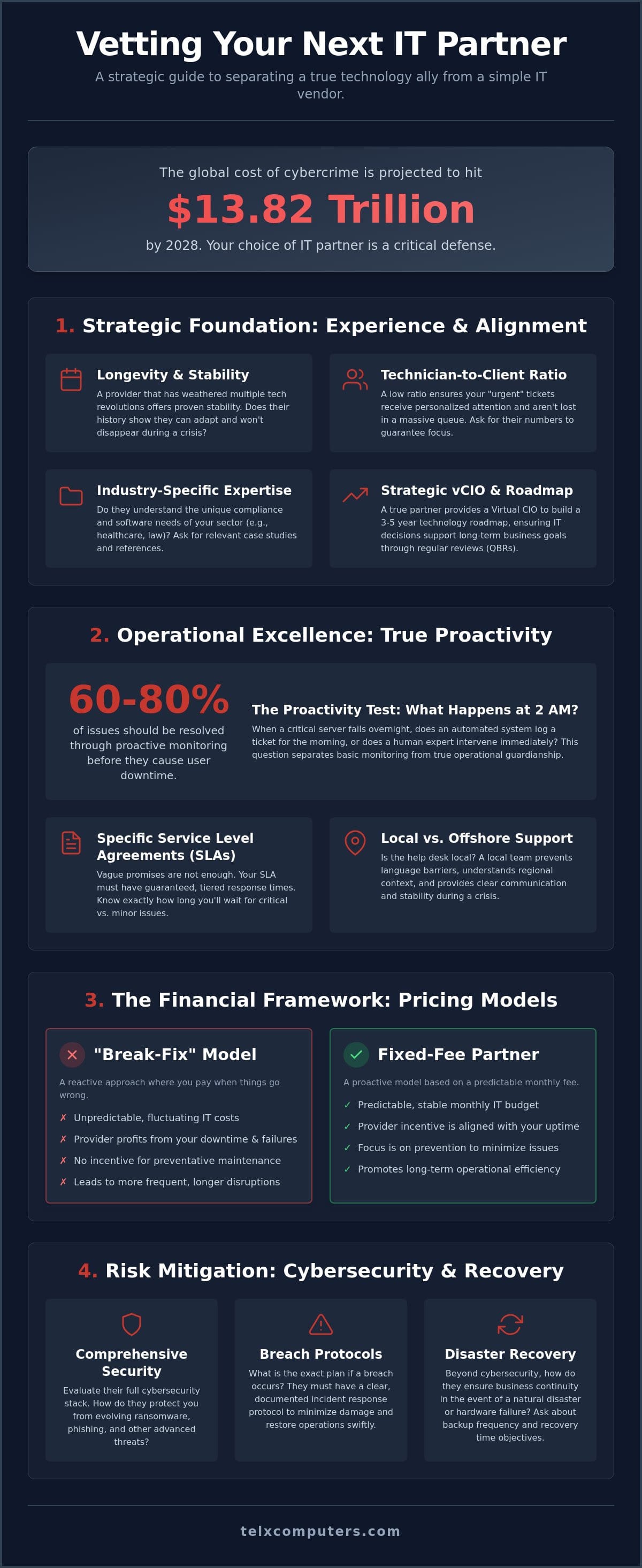
We understand that selecting a technology firm is a high-stakes decision for any modern enterprise. In an era where the global cost of cybercrime is projected to hit $13.82 trillion by 2028, you cannot afford to settle for a basic vendor. This article provides a strategic framework to help you separate high-tier technology partners from simple IT shops. We will preview the 25 essential queries you must use to vet a provider’s proactive monitoring capabilities, compliance expertise, and commitment to a predictable monthly budget. By the end of this list, you’ll have the tools to secure total peace of mind for your digital infrastructure.
Key Takeaways
- Identify why longevity and technician-to-client ratios are critical indicators of a partner’s ability to provide personalized, long-term stability.
- Learn the specific questions to ask a potential MSP to distinguish between basic automated alerts and true proactive human intervention during critical system failures.
- Understand the financial pitfalls of the “break-fix” model and why a fixed-fee service plan aligns your provider’s incentives with your business growth.
- Evaluate a provider’s cybersecurity stack and breach protocols to ensure your organization remains protected against evolving ransomware threats.
- Discover how a strategic partnership with a local expert can replace technical anxiety with a roadmap designed for operational efficiency.
The Strategic Foundation: Questions About Experience and Business Alignment
Selecting a Managed service provider (MSP) is a decision that dictates your company’s operational resilience for years to come. Longevity in this space isn’t just about a firm’s age; it’s about their ability to adapt as technology shifts. When you’re preparing your list of questions to ask a potential MSP, start with their history. A provider that has weathered multiple economic cycles and technological revolutions offers a level of stability that a startup simply cannot match. This experience ensures they won’t disappear when a major crisis hits or when the market fluctuates.
You should also evaluate the ratio of technicians to clients. High-tier partners maintain a balance that ensures your tickets don’t languish in a massive queue. If a firm is overextended, your “urgent” request becomes just another number. You need a partner that provides personalized attention, treating your infrastructure with the same care as their own. Moving beyond “fixing computers” requires a team that understands how your specific systems drive your revenue.
To better understand how to vet your technology partner, watch this helpful video:
Industry-Specific Expertise and Client Success Stories
Every sector faces unique hurdles. A firm that excels in retail might struggle with the stringent compliance needs of healthcare or the high-stakes data privacy required for law firms. Ask for case studies that mirror your specific environment. Do they understand your proprietary software? Can they provide references from long-term clients with similar infrastructure? True expertise means they don’t just fix problems; they anticipate the specific risks inherent to your field.
The “Strategic Ally” Assessment
A basic vendor fixes what’s broken, but a strategic ally builds a roadmap for your future. You need to know how they plan for the next three to five years. Do they offer regular Quarterly Business Reviews (QBRs) to align your technology with your growth? This is where a dedicated Virtual CIO (vCIO) becomes indispensable. They act as a high-level advisor who translates complex technical data into actionable business strategies. Professional it consulting bridges the gap between tech and profit by ensuring every hardware upgrade or software migration directly supports your bottom line. When refining your questions to ask a potential MSP, ensure they view themselves as an extension of your leadership team rather than just a help desk.
Operational Excellence: Questions to Uncover True Proactivity
Many vendors claim to be proactive, but true proactivity is tested when your team is asleep. When you vet an MSP, you must look past the marketing jargon. Ask what happens at 2 AM if a critical server fails. Does an automated system simply log a ticket for the morning, or does a human expert intervene immediately? Mature providers resolve 60% to 80% of issues through monitoring before they ever cause downtime for the user. This is the hallmark of a partner that acts as your silent engine, preventing fires rather than just putting them out.
Your Service Level Agreement (SLA) shouldn’t be a vague promise of “good service.” It must specify guaranteed response times for different tiers of issues. If your help desk is outsourced to an offshore call center, you’ll likely face language barriers and delayed resolutions that stall your productivity. A local team understands your regional business context and can communicate clearly during a crisis, providing a sense of stability that remote-only firms cannot match.
Real-Time Monitoring and 24/7 Help Desk Capabilities
Don’t just take their word for it; ask for a walkthrough of their server monitoring systems. You need to know the average “Time to Resolution” for Tier 1 tickets. It’s also vital to verify if support is truly unlimited. Some firms cap hours, which leads to unpredictable billing and technical anxiety. If you’re looking for clarity on your specific needs, you can request an instant quote to see how a fixed-fee model aligns with your budget.
On-Site Support and Local Presence
Digital tools are powerful, but they can’t replace a physical presence when hardware fails. One of the most important questions to ask a potential MSP is how quickly a technician can reach your office. If you’re based in South Florida, you need a partner with a physical footprint in the area for rapid hardware swaps. Ask about their specific process for emergency on-site visits. A local IT company in Miami ensures that your business doesn’t grind to a halt while waiting for a technician to travel from another state.
The Financial Framework: Comparing Pricing Models and Hidden Costs
Financial predictability is the bedrock of a healthy business relationship. When you evaluate technology partners, you must look closely at how they generate revenue. Many businesses fall into the “Break-Fix” trap, where they only pay for IT services when something fails. This model creates an inherent conflict of interest. Your provider technically profits more when your systems are down, as every minute of downtime translates into billable hours. This reactive approach doesn’t just drain your budget; it actively discourages the proactive maintenance needed for long-term stability.
In contrast, a fixed-fee model aligns your goals with your provider’s incentives. Under this structure, the MSP’s profitability depends on your network’s uptime. They’re motivated to resolve issues before they escalate because downtime costs them resources without increasing your bill. This shift in dynamics transforms the relationship from a transactional vendor to a strategic ally. It’s one of the most critical guaranteed IT budget strategies for current operations, ensuring that your costs remain flat regardless of technical hurdles.
Fixed-Price vs. Hourly Billing Models
Industry data shows that 63% of MSPs have moved toward a per-user pricing model to provide this exact level of predictability. When preparing your list of questions to ask a potential MSP, demand a detailed breakdown of what “unlimited support” actually entails. Does it include remote help desk only, or are on-site visits covered? Are there caps on the number of tickets your team can submit? Transparency here prevents technical anxiety when a major project or recurring issue arises. You need to know that your monthly investment covers the full scope of your daily operations.
Onboarding Fees and Project-Based Charges
Transitioning to a high-tier partner often involves an initial onboarding phase. This one-time cost ensures your infrastructure meets the provider’s security and performance standards. You should also inquire about how major projects, such as cloud migrations or network overhauls, are handled. These are typically billed as separate project-based charges rather than being tucked into the monthly fee. One of the essential questions to ask a potential MSP is whether they offer price protection or multi-year contract stability. A reliable partner will offer clear, itemized invoicing that leaves no room for surprise bills at the end of the month, allowing you to focus on growth rather than accounting discrepancies.
Risk Mitigation: Cybersecurity, Compliance, and Disaster Recovery
The global cost of cybercrime is projected to climb to $13.82 trillion by 2028. This staggering figure highlights why your technology partner must be an expert guardian rather than a simple technical utility. When you compile your questions to ask a potential MSP, you must evaluate their ability to stay ahead of these evolving threats. A basic security package is no longer sufficient; you need a comprehensive stack, such as the solutions provided by ManagePoint, that includes real-time monitoring and proactive defense layers designed to stop an attack before it reaches your network.
Compliance management is another area where many providers fall short. Stricter regulations like the NIST Cybersecurity Framework 2.0 now place a heavy emphasis on governance and supply chain risk. If your business operates in healthcare or finance, you need a partner who understands the granular requirements of HIPAA or the EU Digital Operational Resilience Act (DORA). With GDPR fines already surpassing €7.1 billion, the cost of a compliance failure is simply too high to ignore. Your provider must demonstrate a deep understanding of these legal frameworks to protect your reputation and your bottom line.
Proactive Threat Hunting and Network Security
Modern attackers use AI to create adaptive malware, making Endpoint Detection and Response (EDR) tools a non-negotiable requirement for current operations. Ask your potential partner how they handle ransomware protection and what specific training they provide to your employees. Your staff is often the first line of defense. You should also inquire if the MSP performs regular internal security audits on their own systems. This ensures they aren’t a weak link that could lead to a supply chain attack on your organization.
Disaster Recovery and Business Continuity
A backup is only as good as its last successful test. You need to know a provider’s specific Recovery Time Objective (RTO) and Recovery Point Objective (RPO). These metrics define how quickly they can get you back online and how much data might be lost in the process. A high-tier partner will provide a demonstration of their cloud-based failover capabilities. This ensures your operations remain stable even during a localized disaster. If you are ready to secure your infrastructure with a dedicated guardian, explore our managed IT support services to see how we prioritize your protection.
Making the Final Choice: Why Telx Computers is Your Strategic Ally
After reviewing the essential questions to ask a potential MSP, the final step is identifying a partner that truly embodies these high standards. Telx Computers positions itself as more than a service provider; we’re your strategic ally and expert guardian. We combine the enterprise-grade security protocols of a global corporate IT department with the personalized, accessible touch of a local firm. Our fixed-price model is specifically designed to eliminate technical anxiety by ensuring your business interests and our operational goals are perfectly aligned. You’ll never face surprise invoices or hidden project fees. Instead, you gain a dedicated team focused entirely on your uptime and long-term scalability.
We recognize that trust is built through reliability and proactivity. Our onboarding process isn’t a simple checklist; it’s a comprehensive transition strategy. We dive deep into your infrastructure to remediate existing vulnerabilities before they become costly disruptions. This meticulous approach ensures your team experiences a seamless handoff with zero downtime. Whether you’re operating in Miami, NYC, or LA, our goal remains the same. We act as the silent engine behind your success, allowing you to focus on your core mission while we handle the technical complexities.
Our Commitment to Local Business Communities
We take immense pride in our role within regional business hubs. As a top IT company in Miami, we understand the unique operational needs and regulatory hurdles faced by businesses in South Florida. Our rapid response teams in Fort Lauderdale and Aventura provide the physical presence necessary for immediate hardware support and emergency on-site intervention. We don’t just act as a third-party vendor. We become an internal extension of your team, fostering a sense of ownership and integration that remote-only providers can’t replicate. This localized focus ensures that while we implement global technical standards, we remain anchored in your specific community.
Taking the Next Step Toward Secure Growth
Finding the right answers to your questions to ask a potential MSP is only half the battle. Implementing those strategic solutions is where Telx excels. Your journey toward a more stable and secure infrastructure begins with a professional network assessment. During your first consultation, our specialists will evaluate your current technology stack and identify any hidden risks that could threaten your continuity. We provide a clear roadmap that links technical upgrades directly to your profit goals. To start building a predictable monthly budget today, you can use our Instant Quote tool for an immediate estimate. Secure your organization’s future by choosing a partner that treats your growth as their own priority.
Secure Your Operational Future with a Proven Partner
Transitioning from a reactive IT vendor to a strategic ally is the most important decision your leadership team will make this year. By utilizing these questions to ask a potential MSP, you’ve established a rigorous framework that prioritizes transparency, proactivity, and long-term stability. You now understand how to vet for true 24/7 monitoring and why a fixed-fee model is the only way to align your provider’s success with your own profit goals.
Telx Computers stands ready to serve as your expert guardian. With physical locations in Miami, New York, and Los Angeles, we guarantee a rapid on-site response that remote-only firms simply can’t match. Our fixed-price, unlimited service plans eliminate technical anxiety, allowing you to budget with total confidence while our 24/7 help desk remains vigilant over your infrastructure. Your growth deserves a foundation built on reliability and expert care.
Get an Instant IT Quote for Your Business and take the first step toward a resilient technology roadmap today.
Frequently Asked Questions
What is the difference between an MSP and a typical IT guy?
An MSP functions as a comprehensive team of specialists providing proactive, 24/7 oversight, whereas a typical IT individual usually operates on a reactive, break-fix basis. While a single technician might fix a laptop, an MSP manages your entire infrastructure, security, and long-term technology roadmap. This team-based approach ensures you aren’t vulnerable to a single person’s availability or limited skill set, providing a much higher level of reliability.
While businesses require this robust infrastructure management, individuals often need a more patient, personalized approach; for those seeking tech support for older adults, you can discover 55 Plus Computer Help LLC.
How long does it take to transition to a new managed service provider?
A standard transition typically takes between 30 and 90 days to reach full strategic alignment, though the initial technical takeover happens much faster. During the first few weeks, the new provider audits your network, secures administrative credentials, and deploys monitoring tools. This phased approach ensures a seamless handoff without disrupting your daily operations or causing downtime. It allows the new team to stabilize your environment before implementing major changes.
Should I choose a local MSP or a national provider?
You should prioritize a provider that offers a local presence for rapid on-site response while maintaining enterprise-grade standards. While national providers offer scale, they often lack the regional knowledge and physical proximity required for hardware emergencies. A local partner with a robust infrastructure provides the best of both worlds. They act as a true extension of your team in cities like Miami or NYC, ensuring a technician can be at your office within hours if needed.
What are the red flags to look for during an MSP sales pitch?
Red flags include vague Service Level Agreements (SLAs), a lack of transparent pricing, and a heavy focus on selling hardware rather than discussing business outcomes. If a provider cannot explain their specific protocol for a data breach or refuses to provide client references, they likely lack the maturity to be your strategic ally. Be wary of any pitch that doesn’t include a list of specific questions to ask a potential MSP regarding their security stack.
Does an MSP replace my internal IT staff or support them?
An MSP can either replace your internal IT department or work alongside them in a co-managed capacity. In a co-managed model, the MSP handles repetitive tasks like server monitoring and patching. This allows your internal staff to focus on high-level, business-specific projects that drive growth. This collaboration strengthens your overall security posture and provides your team with access to specialized enterprise tools and 24/7 help desk support they might not have otherwise.
How does an MSP handle cybersecurity for remote employees?
Providers manage remote security through a combination of Endpoint Detection and Response (EDR) tools, multi-factor authentication (MFA), and secure virtual private networks (VPNs). By implementing a Zero Trust architecture, the MSP ensures that every device accessing your network is verified and monitored, regardless of its physical location. This approach mitigates the risks associated with home Wi-Fi networks and personal device usage, keeping your corporate data secure outside the traditional office perimeter.
What happens if I am not satisfied with the MSP service after signing?
Your contract should include clear performance-based exit clauses that allow you to terminate the agreement if the provider fails to meet documented SLAs. High-tier partners conduct regular business reviews to address concerns before they escalate. It’s vital to discuss the offboarding process before signing. This ensures your data, passwords, and credentials remain under your control and are handed over professionally if you decide to transition to a different provider in the future.
Are there hidden costs in a “fixed-price” IT contract?
While a “fixed-price” contract covers recurring maintenance and support, major projects like office moves or massive cloud migrations are typically billed as separate project-based charges. You should ask for a clear list of exclusions, such as new hardware purchases or specialized cabling. A transparent provider will itemize these potential costs upfront. This ensures your monthly IT budgeting remains predictable and free of surprise bills, allowing for more accurate financial planning and peace of mind.