





13 Jun In-House IT vs. Outsourced IT: A 2026 Cost Comparison and Strategic Analysis
Did you know that the total compensation for a single mid-senior in-house developer now reaches up to $240,000 per year once you factor in benefits and overhead? For many business leaders, the realization that one person’s salary often exceeds the cost of a fully managed team is a significant wake-up call. You’ve likely felt the sting of rising salary demands and the nagging fear that a single resignation could leave your entire network exposed to ransomware. This in-house IT vs outsourced IT cost comparison provides the financial clarity you need to move beyond guesswork and into a data-driven strategy for your organization.
We understand that you’re looking for stability and predictable budgeting in an increasingly volatile technical market. We promise to provide a comprehensive breakdown of the total cost of ownership for internal teams versus managed services to help you make a secure investment. This analysis explores the hidden expenses of recruitment, specialized security tooling, and the global cybersecurity talent gap that currently stands at 4.8 million positions. You’ll gain a clear view of how to access a full team of experts for the price of one hire, ensuring your IT infrastructure remains a silent engine for your success rather than a source of technical anxiety.
Key Takeaways
- Understand the true “fully burdened cost” of internal staffing, which includes benefits and overhead that often double a base salary.
- Learn how fixed-price managed services replace unpredictable emergency repair bills with stable, predictable monthly budgeting.
- Discover the financial impact of IT turnover and how to mitigate the risk of institutional knowledge loss during a global talent shortage.
- Access a detailed in-house IT vs outsourced IT cost comparison to determine which model best supports your long-term growth and security goals.
- Identify the specific scenarios where a strategic partnership provides faster response times and enterprise-grade protection for your employees.
The Baseline: Defining In-House vs. Outsourced IT Structures
To conduct an accurate in-house IT vs outsourced IT cost comparison, you must first understand the structural differences between these two operational models. In-house IT refers to a dedicated professional or a small team on your direct payroll. These employees work within your office and handle everything from password resets to server maintenance. While this provides a sense of physical presence, it limits your technical depth to the specific skill set of those individuals. Conversely, outsourced IT involves a strategic partnership with a managed service provider (MSP). When you partner with an expert ally like Telx Computers, you gain access to a full department of specialists who provide 24/7 support and high-level consulting.
The technical environment has shifted dramatically. In the past, many businesses relied on a “break-fix” model where you only called for help when something stopped working. By 2026, this reactive approach has become a significant financial risk. Proactive managed environments are now the standard for organizations that prioritize stability. Understanding What is Outsourcing? helps clarify how modern firms leverage external expertise to maintain 99.9% uptime. This shift ensures that your technology serves as a growth engine rather than a constant source of emergency expenses.
To better understand this concept, watch this helpful video:
The “One Man Shop” vs. The Managed Team
Relying on a “one-man IT department” is increasingly dangerous. With a global cybersecurity talent gap of 4.8 million positions, finding one person who masters cloud security, network architecture, and help desk support is nearly impossible. A single internal hire creates a dangerous single point of failure where a single vacation or illness can leave your entire digital infrastructure vulnerable and unsupported. MSPs solve this by providing a Global Network Operations Center (NOC) experience. You aren’t just hiring a person; you’re integrating an entire department into your business strategy. This collective intelligence ensures that complex security threats are identified and neutralized by specialists, not generalists.
The Evolution of Managed Services in 2026
Support speed is no longer tied to how fast someone can walk to your desk. AI-driven automation now handles routine maintenance and patch management with zero human intervention. This evolution means that 24/7 monitoring detects potential hardware failures or software glitches before they disrupt your employees. Physical proximity has become secondary to technical proactivity. By the time an employee notices a slow connection, an automated system has likely already rerouted traffic or cleared the bottleneck. This high-speed response creates a sense of seamless continuity that a single on-site technician simply cannot match, especially during after-hours or holiday periods.
The In-House Reality: Calculating Salaries, Benefits, and Overhead
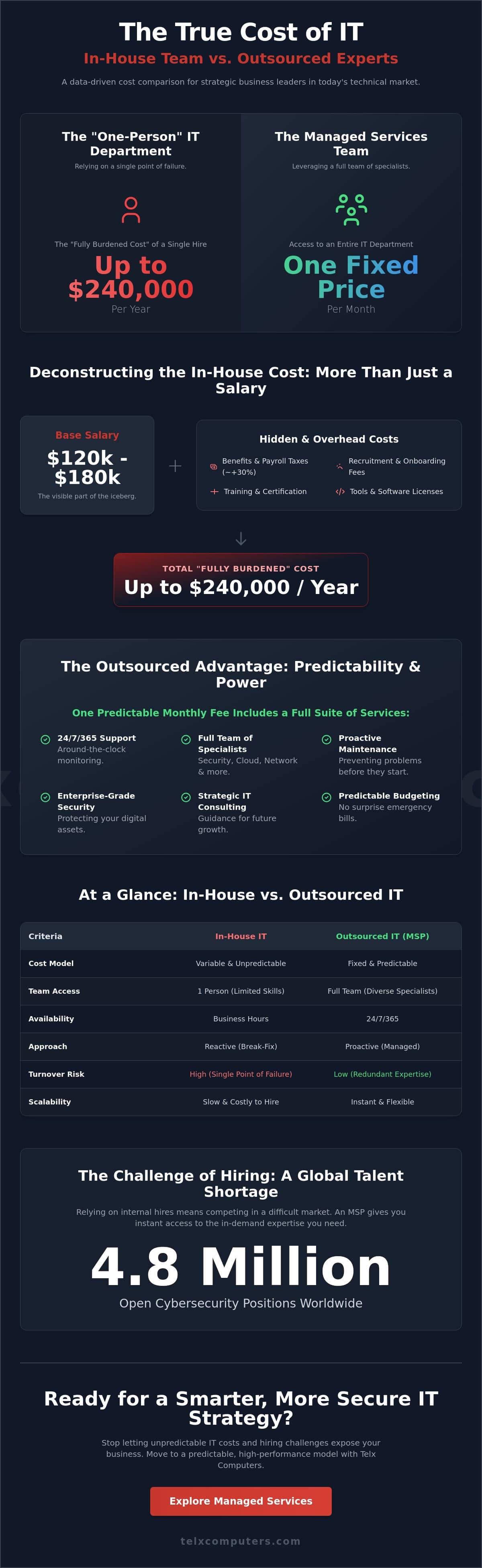
Many executives view IT staffing through the lens of a single line item: the base salary. This narrow perspective often leads to a skewed in-house IT vs outsourced IT cost comparison. In reality, the base salary is just the starting point of a complex financial commitment. By 2026, a mid-senior level professional often commands a total compensation package between $120,000 and $180,000. When you add the “burdened” costs, that figure frequently climbs to $240,000 per year. You aren’t just paying for their time; you’re funding their entire operational existence within your company.
The Hidden Multipliers of Payroll
The “fully burdened cost” of an employee includes several layers that don’t appear on a job offer letter. Payroll taxes, healthcare benefits, and 401k contributions typically add another 20% to 30% to the base salary. Recruitment fees alone often consume a significant portion of a new hire’s annual salary before they even step through your door. Once they arrive, you must provide office space, high-end hardware, and a suite of enterprise tools. Internal teams require dedicated software licenses for Remote Monitoring and Management (RMM) and Professional Services Automation (PSA). These tools can cost between $5,000 and $20,000 annually, a burden that managed service providers distribute across their entire client base.
If you’re curious about how these numbers apply to your specific headcount, you can request an instant quote to compare your current spending against a managed model.
Local Market Pressures: Miami, NYC, and LA
Your geographic location significantly dictates your IT budget. In New York City and Los Angeles, cost-of-living adjustments drive salaries toward the higher end of the national average. Florida faces a different challenge. The tech talent shortage in the region has created a highly competitive environment where Tier 1 and Tier 2 technicians can demand premium pay. This scarcity makes it difficult to maintain a full team without constant salary renegotiations. As one of the leading IT companies in Miami, we see firsthand how local market pressures force businesses to overpay for generalist talent. A localized in-house IT vs outsourced IT cost comparison frequently reveals that regional firms pay a 40% premium for internal staff compared to the national average. Continuous education and certifications add another layer of expense, as you must pay to keep your staff current on the latest cybersecurity threats and cloud architecture standards.
The Outsourced Advantage: Comparing Fixed Costs and Scalability
When performing an in-house IT vs outsourced IT cost comparison, the most striking difference isn’t just the final number. It’s the nature of the expense itself. While internal departments represent a series of high, fixed capital expenditures (CapEx), managed services shift your technology budget into a predictable operational expenditure (OpEx). This transition allows you to pay for only the resources you consume. You no longer need to worry about the massive upfront costs of buying servers or the recurring sting of software licensing renewals. Instead, you gain a streamlined, all-inclusive model that aligns perfectly with your monthly cash flow.
Managed service providers leverage massive economies of scale that a single business cannot replicate. We invest in high-end tools like enterprise-grade Remote Monitoring and Management (RMM) and Endpoint Detection and Response (EDR) systems. Because these costs are distributed across hundreds of clients, you receive the protection of a million-dollar security stack for a fraction of the price. This “all-inclusive” nature of modern contracts means your monthly fee covers everything from 24/7 help desk access to complex network security updates. You’re effectively hiring a full team of specialists for less than the cost of one senior internal hire.
Total Cost of Ownership (TCO) Comparison
To truly understand the financial impact, you must look at the Total Cost of Ownership. The following table illustrates how a typical mid-sized organization’s expenses break down between the two models. These figures reflect the current 2026 market realities for technical talent and infrastructure requirements.
| Expense Category | In-House Model (1-2 Hires) | Managed IT Services |
|---|---|---|
| Base Compensation | $140,000 – $180,000+ | Included in Monthly Fee |
| Benefits, Taxes, & Overhead | $40,000 – $60,000 | $0 |
| Security & Monitoring Tools | $15,000 – $35,000 annually | Included |
| Recruitment & Training | $20,000+ per hire | $0 |
| Financial Predictability | Low (Variable) | High (Fixed) |
By choosing Managed IT Support Services, you eliminate the “unpredictable IT bill” that plagues so many growing firms. You can scale your operations on demand. If you open a new branch or hire ten new employees, your support capacity expands instantly without the need for a lengthy and expensive recruitment process.
Predictability as a Growth Strategy
Predictable budgeting isn’t just a convenience; it’s a competitive advantage. When you know exactly what your IT costs will be every month, you can allocate capital more aggressively toward sales, marketing, and product development. Proactive maintenance plays a vital role here. For example, constant server monitoring identifies hardware vulnerabilities and software bottlenecks before they escalate into high-cost emergency repairs. This vigilance prevents the “emergency project” surcharges that often occur when an internal technician is overwhelmed or lacks the specific expertise to handle a critical failure. You move from a state of constant fire-fighting to a state of strategic expansion.
The Hidden Factors: Attrition, Training, and the Cost of Downtime
A truly accurate in-house IT vs outsourced IT cost comparison must account for the volatile nature of the modern labor market. Financial spreadsheets often capture the cost of an active employee, but they rarely reflect the devastating expense of an empty desk. With 57% of recruitment managers currently reporting extreme difficulty in finding skilled IT staff, the departure of a single internal admin can trigger a recruitment crisis. You aren’t just losing a set of hands; you’re losing years of institutional knowledge and specialized network understanding that can’t be replaced overnight.
The “Vacation and Sick Leave” gap is another hidden financial drain. When your sole IT professional takes a week off or falls ill, your network remains vulnerable. During these periods, who monitors for security breaches at 3 AM? Who handles a server crash on a Sunday afternoon? Managed service providers eliminate this risk by providing a deep bench of experts who work in shifts. This ensures that your business receives the same high-tier protection and response times every day of the year, regardless of individual staff schedules. This level of redundancy is nearly impossible to achieve with an internal team without doubling or tripling your payroll.
The Recruitment Treadmill
The average tenure of IT professionals has shortened significantly as the global cybersecurity talent gap reaches 4.8 million positions. This “Recruitment Treadmill” forces businesses into a cycle of constant re-hiring, where recruitment fees often cost 20% to 30% of a technician’s annual salary. Beyond the fees, there is the risk of “Brain Drain.” If a sole admin leaves without documenting the specific quirks of your legacy systems or the locations of all administrative passwords, your business faces a dangerous operational vacuum. We solve this through standardized, enterprise-grade documentation. This process ensures that technical transitions are seamless and that your business intelligence remains an asset of the company, not a secret held by a single employee.
Quantifying the Risk of Unmanaged Security
Unmanaged risk is the most expensive line item in any in-house IT vs outsourced IT cost comparison. Internal teams often fall behind on patching and vulnerability management because they’re buried under daily help desk tickets. This delay creates a window of opportunity for attackers. The financial impact of a ransomware attack can be catastrophic, often exceeding the annual cost of a managed support contract in a single afternoon. Furthermore, cybersecurity insurance providers now demand rigorous proof of 24/7 monitoring and multi-factor authentication. Partnering with a managed provider often makes these premiums cheaper because you can demonstrate professional oversight of your entire digital estate.
Protect your business from unmanaged risk and unpredictable downtime by exploring our ransomware protection services today.
Strategic Alignment: Choosing the Right Model for Your Business
Selecting the ideal support structure requires an honest assessment of your organizational goals and technical complexity. While our in-house IT vs outsourced IT cost comparison highlights the efficiency of managed services, there are specific scenarios where an internal team remains a valid choice. Large enterprises with highly proprietary legacy systems or specialized manufacturing processes often require on-site technicians who focus exclusively on one environment. If your technology is the core product you sell, maintaining that intellectual property within your walls provides a level of control that some global corporations prefer despite the massive overhead.
For small to mid-market firms, outsourcing is almost always the clear winner. These organizations must prioritize growth and security without the luxury of a multi-million dollar payroll budget. By shifting the burden of network maintenance to a strategic ally, you free your leadership to focus on market expansion. You gain the peace of mind that comes from knowing an expert guardian is watching your network while you sleep. Similar to how an expert Kfz-Sachverständigenbüro Gollenstede provides independent, professional valuations for vehicle damage, a comprehensive IT audit is the next step in identifying hidden expenses you’ve likely overlooked, such as unused software licenses and the true cost of employee downtime.
The Hybrid Solution: Co-Managed IT
Many growing businesses find themselves in a middle ground where they have a talented IT manager but lack the resources for a full department. This is where the co-managed IT model provides a powerful advantage. Instead of replacing your internal lead, you empower them with enterprise-grade MSP tools and 24/7 help desk support. This partnership reduces the burnout of internal staff by offloading the repetitive “heavy lifting” of patch management and routine troubleshooting. For firms with 50 to 250 employees, this hybrid model offers peak financial efficiency. It keeps your strategic knowledge in-house while leveraging our global NOC for around-the-clock protection.
Your IT Roadmap for 2026
Moving from an internal mess to a managed success requires a logical transition plan. You shouldn’t make a decision based on base salaries alone. Use this final checklist to evaluate your current trajectory:
- Audit Total Spend: Calculate your fully burdened payroll costs including benefits, taxes, and office space.
- Identify Coverage Gaps: Determine who is responsible for security alerts at 2 AM or during holiday weekends.
- Assess Tooling Costs: Compare your individual software license fees against the all-inclusive pricing of an MSP.
- Evaluate Risk: Measure the potential financial impact of a 4.8 million position talent gap on your ability to re-hire if an admin leaves.
The technical landscape moves too quickly for a reactive approach to succeed. Whether you choose a fully managed partner or a hybrid co-managed structure, the goal is to create a stable, predictable environment that supports your employees. Ready to see the numbers for your business? Get an instant IT quote today and take the first step toward a more secure and cost-effective future.
Secure Your Financial and Technical Future
Navigating the modern technical landscape requires a shift from viewing IT as a simple utility to treating it as a core business strategy. This in-house IT vs outsourced IT cost comparison makes it clear that the most expensive choice is often the one that leaves you with unmanaged risks and unpredictable bills. By prioritizing stability, you replace the high turnover and recruitment treadmill of internal staffing with a vigilant, expert guardian that never takes a day off.
We provide the fixed-price, unlimited service plans and 24/7 proactive monitoring your business needs to stay ahead of threats. With rapid on-site response in Miami, NYC, and LA, our team acts as a seamless extension of your own. You can finally stop worrying about the “what ifs” and start focusing on your next phase of expansion. You deserve a technical partner that delivers both high-tier corporate performance and personalized regional commitment.
Ready to see how these numbers transform your specific budget? Get an Instant IT Quote for Your Business today. Let’s build a secure, reliable foundation for your long-term success together.
Frequently Asked Questions
Is outsourced IT support cheaper than hiring a full-time employee?
Yes, outsourcing typically provides a full team of experts for significantly less than the total burdened cost of one senior hire. While a mid-senior developer can cost up to $240,000 annually when you include benefits and overhead, a managed service provider delivers 24/7 support for a fraction of that amount. This in-house IT vs outsourced IT cost comparison shows that businesses often save between 35% and 60% by opting for managed services over internal staffing.
What are the hidden costs of managing an internal IT department?
Hidden costs include recruitment fees, ongoing training certifications, and specialized software licenses for RMM and EDR tools. You also pay for office space, hardware provisioning, and payroll taxes that add 20% to 30% to a base salary. Perhaps the largest hidden cost is the “single point of failure” risk. Your network knowledge leaves the building when an employee resigns, forcing you back onto the expensive recruitment treadmill.
How much does managed IT services cost per user in 2026?
Pricing for managed services is typically structured as a predictable monthly fee based on your specific headcount and infrastructure complexity. While industry averages vary, most small to mid-market firms find that a comprehensive managed contract is substantially lower than the overhead of a single Tier 2 technician. This model allows you to scale your costs up or down as your team grows without the friction of hiring or firing.
Can I keep my current IT person and still use an outsourcing company?
You can certainly maintain your internal staff through a co-managed IT model. Your internal lead focuses on proprietary systems and high-level strategy while we handle the 24/7 monitoring, help desk tickets, and routine security patching. This partnership reduces burnout for your staff and ensures your network has professional oversight even when your internal admin is on vacation or sick leave. It combines institutional knowledge with enterprise-grade resources.
What happens to my data security if I outsource my IT services?
Your data security typically improves because you gain access to enterprise-grade security operations centers and incident response teams. Managed providers use advanced tools for ransomware protection and continuous vulnerability scanning that are often too expensive for a single business to purchase alone. We act as a vigilant guardian, ensuring your environment meets the latest compliance standards and cybersecurity insurance requirements to keep your assets secure.
Does outsourcing IT actually improve response times for employees?
Outsourcing generally improves response times by utilizing a deep bench of technicians rather than a single person. While an internal hire might be stuck in a meeting or working on a server, a managed help desk has multiple specialists available to take calls immediately. AI-driven automation and proactive monitoring also resolve many issues before your employees even notice a problem. This creates a seamless support experience that keeps your team productive.
How do I calculate the ROI of switching to a managed IT service provider?
To calculate ROI, compare your fully burdened internal costs against a fixed monthly service fee. Include the cost of downtime, recruitment, and the software licenses you currently pay for separately. Most firms find that a detailed in-house IT vs outsourced IT cost comparison reveals an immediate return through reduced emergency repairs and improved employee productivity. You’re trading unpredictable capital expenditures for stable, predictable operational expenses.
Are there specific IT cost benefits for businesses in Miami or NYC?
Businesses in high-cost markets like Miami and NYC benefit from avoiding the steep Cost-of-Living Adjustments required for local technical talent. Since the tech talent shortage in Florida is particularly acute, outsourcing allows you to bypass the bidding wars for local technicians. You get global technical standards with the benefit of rapid on-site support when physical hardware needs attention. This localized focus ensures your regional business remains competitive and secure.