





07 Aug Fixed-Rate Budgeting for IT: Achieving Financial Predictability in 2026
What if your IT budget was the most predictable line item on your balance sheet, rather than a constant source of monthly anxiety? For many executives, the reality of managing technology feels like waiting for the next expensive “break-fix” repair bill to arrive. You deal with hidden fees and the looming threat of technical debt that triggers sudden, massive emergency expenditures. It’s a reactive cycle that makes accurate financial forecasting nearly impossible. Adopting a model of fixed-rate budgeting changes this dynamic entirely, shifting your focus from putting out fires to driving innovation.
You deserve a technology partner that acts as an expert guardian for your infrastructure. We’ll show you how to transform IT from a volatile expense into a predictable strategic asset for the 2026 fiscal year. We’ll explore how a consistent monthly expense covers all your support needs, reduces stress, and eliminates the sticker shock of aging hardware like Windows Server 2016, which reaches its end of support in early 2027. This approach provides a silent engine of efficiency that powers your business without the administrative friction of variable costs.
Key Takeaways
- Learn how transitioning from Capital Expenditure (CapEx) to an Operational Expenditure (OpEx) model stabilizes your monthly cash flow.
- Discover how fixed-rate budgeting eliminates hidden fees and simplifies the accounting process for your 2026 fiscal planning.
- Calculate the true cost of the “Downtime Tax” and see why proactive monitoring is more cost-effective than reactive repairs.
- Follow a step-by-step framework to audit your current IT spending and align your infrastructure with future growth projections.
- Understand the value of an expert guardian who provides 24/7 support and unlimited service without surprise invoices.
What is Fixed-Rate Budgeting in the Context of Managed IT Services?
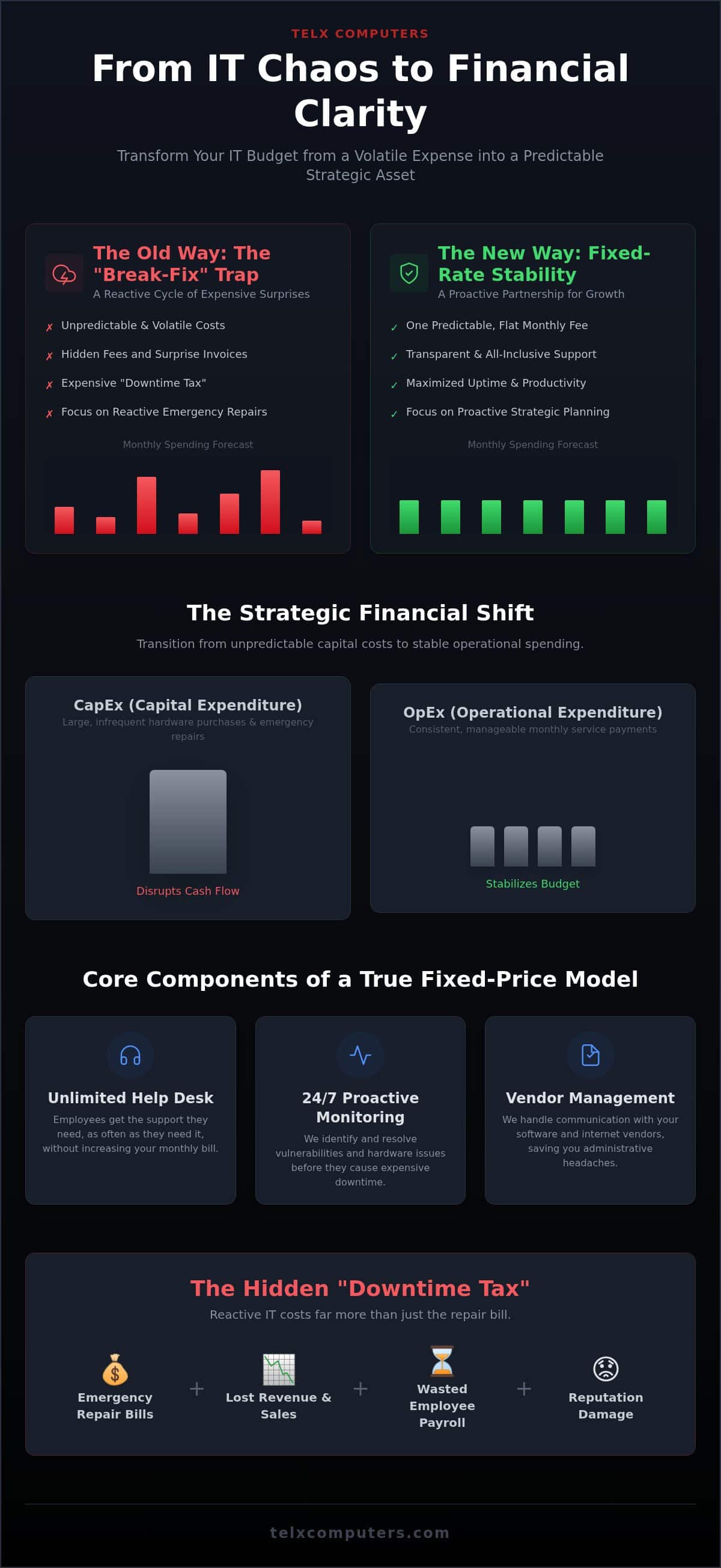
Fixed-rate budgeting is a flat-fee model for comprehensive technology management. It replaces the erratic billing of the past with a single, predictable monthly payment. This financial structure allows businesses to treat IT as a utility rather than a series of expensive surprises. While a dictionary might define “fixed” as something that doesn’t change, in the B2B world, it represents a commitment to stability. It ensures that your technology remains operational without requiring a separate invoice for every minor adjustment. Your technology becomes a silent engine that supports your goals rather than a source of administrative friction.
To understand why this model is gaining traction, it helps to ask: What is a Managed Service? Essentially, it’s a proactive partnership where the provider takes responsibility for the health of your systems for a set fee. This contrasts sharply with the traditional “Break-Fix” model, which is the primary enemy of financial stability. In a break-fix scenario, your IT provider only makes money when your business is suffering from downtime. This creates a conflict of interest that fixed-rate models solve by aligning the provider’s goals with your uptime. When your systems run smoothly, both you and your IT partner succeed.
Moving to this model facilitates a transition from Capital Expenditure (CapEx) to Operational Expenditure (OpEx). Instead of budgeting for massive, one-time hardware purchases or emergency server repairs, you spread those costs into manageable monthly payments. This shift is particularly beneficial for SMEs looking to improve cash flow. The Service Level Agreement (SLA) acts as your financial safeguard, legally guaranteeing that your support costs remain static regardless of how many help desk tickets your team submits. It provides the peace of mind that your budget is protected against the volatility of the tech landscape.
The Shift from Reactive Expenses to Proactive Investment
Reactive IT management creates “budget spikes” that can instantly derail your quarterly goals. If a server fails unexpectedly, you aren’t just paying for the hardware; you’re paying for emergency labor and losing revenue every hour your team is offline. Fixed-rate IT budgeting acts as a strategic financial hedge against technical failure. There is a profound psychological benefit to knowing exactly what your IT costs will be on day one of every month. It allows leadership to focus on growth rather than wondering if the next email will contain a four-figure repair bill. Proactive maintenance ensures your team stays productive, turning IT into a competitive advantage.
Core Components of a Fixed-Price IT Model
A true fixed-price model must be comprehensive to be effective. It should include several key pillars to ensure you don’t face unexpected charges:
- Unlimited help desk support: Your employees can call for assistance as often as needed without increasing your monthly bill.
- Remote monitoring and management (RMM): We use proactive tools to catch vulnerabilities and hardware failures before they result in expensive downtime.
- Vendor management: Your provider handles the procurement and communication with third-party software or internet vendors, saving your team hours of administrative work.
By bundling these services, you create a managed IT support service that functions as an extension of your own team. This holistic strategy prevents the “nickel and diming” that often occurs with a la carte services.
The Strategic Advantages of Predictable IT Spending for 2026
Predictable IT spending provides a level of financial clarity that goes beyond simple bookkeeping. For small and medium-sized enterprises (SMEs), managing cash flow is a constant balancing act. When technology costs fluctuate, it creates unnecessary pressure on liquid assets. Adopting a model of fixed-rate budgeting allows leadership to allocate resources with precision. This stability is a core component of strategic IT cost reduction, as it eliminates the need for emergency contingency funds that often sit idle. It transforms technology from a variable risk into a stable foundation for growth.
CFOs find particular value in this model because it simplifies the accounting and auditing lifecycle. Instead of reconciling dozens of varied invoices for software licenses, labor hours, and hardware repairs, there is a single, recurring entry. This transparency makes it easier to track the return on investment (ROI) for technology initiatives and ensures that IT spending aligns with broader corporate objectives. It removes the friction from financial reporting, allowing your leadership team to focus on high-level strategy rather than chasing down individual service receipts.
Eliminating the “Surprise” Factor in Technology Costs
Traditional IT contracts often hide costs in the fine print. You might see additional charges for travel time, after-hours support, or emergency “rush” fees. These variables turn a standard month into a financial hurdle. A fixed-rate model shifts the burden of efficiency onto the service provider. Because the fee is static, the provider is incentivized to keep your network in peak condition. If your systems fail, it costs the provider time and resources, not you. Local businesses have seen the impact of this shift firsthand. For example, a Miami-based legal firm reported a 20% reduction in total annual IT costs by moving away from hourly billing. You can see how this works for IT companies in Miami that prioritize long-term stability over short-term repair fees.
Aligning IT Infrastructure with Long-Term Business Goals
Scaling a business in 2026 requires agility. When you add ten new employees, you shouldn’t have to recalculate your support costs based on hourly rates. A fixed-rate budgeting model allows you to scale your workforce without scaling your IT complexity. It also includes strategic IT consulting as a standard part of the partnership. Instead of paying for a “band-aid” fix when something breaks, you receive expert guidance on proactive upgrades that drive revenue. You can use the savings from predictable budgeting to reinvest in customer-facing technologies or AI-driven automation. If you’re ready to see how these numbers look for your organization, you can request an instant quote to begin your financial planning.
Fixed-Rate vs. Break-Fix: A Comparative Financial Analysis
Choosing between a fixed-rate model and the traditional break-fix approach is more than a service preference; it’s a decision about who carries the financial risk of your technology. In a break-fix scenario, the burden sits entirely on your shoulders. When a server fails or a network goes down, you pay for every hour of labor required to restore operations. Conversely, fixed-rate budgeting shifts that risk to the service provider. Because the monthly fee remains the same regardless of the effort required, the provider is financially motivated to ensure your systems never fail in the first place.
When you analyze the Total Cost of Ownership (TCO) over a three-year period, the “cheap” hourly rates of the pay-as-you-go model often reveal themselves as the most expensive option. While the monthly cost of a managed plan is visible and consistent, the cumulative costs of emergency repairs, travel fees, and hardware replacements in a reactive model create a jagged, unpredictable expense line. You also have to account for the “Downtime Tax.” This is the calculated cost of lost productivity when your employees can’t access their tools. For a firm with 50 employees, even a few hours of downtime can result in thousands of dollars in wasted salary and lost revenue opportunities.
The Hidden Costs of the Pay-As-You-Go IT Model
The pay-as-you-go model contains a fundamental conflict of interest: your IT provider benefits from your problems. The more things break, the more they earn. This dynamic often leads to inconsistent service quality, especially during peak emergency periods when multiple clients may be vying for the same technician’s time. Beyond the labor costs, there is a significant administrative overhead. Your accounting team must track, verify, and approve dozens of small IT invoices every quarter. This creates a “death by a thousand cuts” scenario that drains your internal resources and complicates your long-term financial planning.
Calculating the ROI of Predictability
Measuring the return on investment for technology requires looking at both hard and soft savings. Hard savings often come from lower insurance premiums, as many providers offer better rates to businesses that can prove they have proactive server monitoring systems and compliance measures in place. Soft savings are equally vital. When your team isn’t constantly battling technical glitches, employee morale increases and management stress levels drop. True IT ROI is measured by the absence of emergencies, not the speed of repairs. By investing in a guaranteed service level, you ensure that your technology remains a silent engine for success rather than a recurring line item for crisis management.
Steps to Implementing a Fixed-Rate Budgeting Strategy
Implementing a successful fixed-rate budgeting strategy starts with a clear-eyed assessment of your current environment. You need to move beyond simply paying bills and start analyzing the data behind them. This process ensures that your transition to a flat-fee model isn’t just a change in billing, but a fundamental improvement in how your business handles technology. By following a structured implementation plan, you can eliminate service gaps and ensure that your 2026 fiscal year is your most stable yet. A well-executed transition turns your IT department into a silent engine that powers growth without financial friction.
Auditing Your Current Technology Stack
Start by reviewing the last 12 months of IT invoices for recurring patterns. Are you paying for the same network issues month after month? Do you notice spikes in labor costs every time a specific piece of software updates? This audit reveals the hidden technical debt that might be draining your budget. You should also identify aging hardware, such as servers approaching end-of-life, that will require capital investment soon. Understanding these variables allows you to choose a Managed IT Support Service that covers proactive maintenance, preventing these issues from becoming future invoices. This step is essential to ensure your new plan is truly “all-inclusive” rather than a limited service that leaves you vulnerable to extra charges.
Selecting the Right MSP for Your Industry
Industry-specific experience is non-negotiable for accurate fixed-rate budgeting. A firm in the healthcare sector has vastly different compliance and security needs than a legal practice or a manufacturing plant. If your provider doesn’t understand the nuances of HIPAA or legal document management, their “fixed” rate might quickly balloon with out-of-scope charges for compliance audits or specialized software support. When evaluating potential partners, ask direct questions: “What exactly is NOT included in the fixed rate?” and “How do you handle hardware procurement?”
For businesses with Miami and Fort Lauderdale locations, local response times are a critical metric. A fixed rate is only valuable if the service is available when you need it. Verify that your partner can provide 24/7 help desk support and has the capacity to handle your 2026 growth projections, including new user seat requirements. Once you’ve selected a partner, draft a transition timeline that includes a comprehensive network audit and a clear “go-live” date to avoid any service overlaps. If you’re ready to see how a flat-fee structure can stabilize your operations, request an instant quote to begin your audit today.
Telx Computers: Your Partner for Fixed-Price, Unlimited IT Support
Telx Computers positions itself as more than a vendor; we’re a strategic ally. We act as the silent engine behind South Florida’s most successful enterprises. By handling the complexities of technology, we allow you to focus on your core business objectives. Our commitment to fixed-rate budgeting means you’ll never see a surprise invoice or a hidden fee. We provide the Telx Guarantee, which focuses on results rather than billable hours. Our 24/7 help desk support is included in your flat rate, ensuring your team stays productive without concern for increasing costs.
Why Miami Businesses Trust Our Predictable Pricing Model
We understand the local landscape intimately. Among IT Companies in Miami, Telx stands out by blending global technical standards with a specific commitment to our regional business community. Our presence in Miami, New York, and LA allows us to provide rapid response times while maintaining a personalized, client-centric approach. Local firms have successfully stabilized their monthly cash flow by moving away from volatile repair bills and embracing our predictable model. This stability replaces technical anxiety with a sense of security and peace of mind.
Beyond the Budget: The Value of Proactive Security
True financial predictability is impossible without robust security measures. A single cyberattack can result in massive losses that far exceed any monthly service fee. Our fixed-rate plans integrate comprehensive ransomware protection and real-time server monitoring as standard features. This proactive stance prevents the need for emergency spending and safeguards your reputation. We act as an expert guardian, staying one step ahead of potential threats so you don’t have to. Using fixed-rate budgeting as a foundation, we build a secure infrastructure that supports your long-term growth.
Achieving financial predictability for the 2026 fiscal year starts with a simple conversation. We invite you to take the first step by requesting a customized fixed-rate quote tailored to your organization’s specific requirements. Our team will work with you to identify your needs and provide a clear, declarative path toward a more stable technological future. Let us be the silent engine that drives your success while you watch your business reach new heights.
Secure Your Financial Future with Predictable IT
Transitioning to a model of fixed-rate budgeting is the most effective way to eliminate the technical anxiety that stems from unpredictable repair bills. By shifting from a reactive mindset to a proactive operational model, you ensure that your technology serves as a silent engine for growth rather than a source of financial friction. This approach stabilizes cash flow, simplifies accounting, and provides a strategic hedge against downtime for the 2026 fiscal year.
Telx Computers has spent over 20 years serving the Miami business community with a focus on reliability and transparency. Our fixed-price, unlimited service plans include 24/7 proactive monitoring and help desk support without the threat of hidden fees. You deserve a partner that acts as an expert guardian for your infrastructure, allowing you to focus entirely on your corporate vision. Your technology shouldn’t be a gamble; it should be a guarantee.
Take the first step toward total financial predictability today. Get Your Instant Fixed-Rate IT Quote Today. You’re ready to build a more stable and secure future for your organization.
Frequently Asked Questions
What is the main difference between fixed-rate and variable IT budgeting?
Fixed-rate budgeting provides a set monthly cost regardless of service volume, while variable budgeting fluctuates based on hourly repairs and emergency fees. The variable model often leads to financial spikes during system failures. A fixed model ensures your technology costs remain a predictable operational expense. This allows for more accurate fiscal planning and eliminates the stress of waiting for the next repair invoice to arrive.
Does fixed-rate budgeting include hardware costs or just services?
Most fixed-rate plans focus on unlimited labor, proactive monitoring, and management services. While hardware itself is typically a separate capital expenditure, our plans include hardware procurement and vendor management. We help you plan for lifecycle replacements so you aren’t surprised by aging equipment. This distinction ensures your service costs stay flat while you maintain a clear roadmap for future physical infrastructure investments.
Can I switch to a fixed-rate model if my current IT infrastructure is outdated?
You can certainly transition to a fixed-rate model with an aging infrastructure. We begin with a comprehensive network audit to identify immediate vulnerabilities and technical debt. Once we stabilize your environment, we bring it under our expert guardian umbrella. This proactive approach prevents outdated systems from causing the budget spikes common in reactive models, eventually leading to a more modern and secure technology stack.
How do fixed-rate IT plans handle major projects like office relocations?
Major one-time initiatives like office relocations or large-scale infrastructure overhauls are typically handled as separate projects outside the monthly service fee. However, because we act as your strategic ally, we provide the planning and consulting for these events as part of our partnership. This ensures you have a clear, separate quote for project work, maintaining the integrity of your monthly operational budget.
Is fixed-rate budgeting more cost-effective for small businesses in Miami?
It’s highly cost-effective for Miami SMEs that need to protect their monthly cash flow. Small businesses often lack the liquid capital to handle sudden four-figure emergency repair bills. By using fixed-rate budgeting, you lock in a manageable monthly cost that covers everything from help desk support to network security. It allows you to compete with larger enterprises by having a high-tier IT department at a predictable price.
What happens to my fixed rate if my company grows and adds more employees?
Our fixed-rate plans are designed to scale alongside your organization. When you add new employees, your monthly rate typically adjusts based on a per-user or per-seat model defined in your agreement. This remains predictable because you know the exact cost of each new hire’s technology support in advance. It eliminates the complexity of calculating additional hourly labor as your team expands and your infrastructure grows.
Are cybersecurity audits typically included in fixed-rate IT plans?
Yes, periodic cybersecurity audits are a standard component of our proactive management strategy. We don’t just fix problems; we look for potential threats before they manifest. Our plans include the monitoring and auditing necessary to maintain compliance and protect your data from evolving threats. This integrated approach ensures your security posture remains strong without requiring a separate, expensive consulting engagement every year.
How does Telx Computers handle emergency after-hours support under a fixed-rate plan?
Telx Computers includes 24/7 help desk support as a core feature of our fixed-price plans. You don’t pay extra for emergency or after-hours labor because our goal is to keep your business running at all times. Whether a problem arises at noon or midnight, our team is available to resolve it immediately. This commitment ensures that technical failures never result in an increased bill for your organization.