





24 Jul How to Choose a Managed Service Provider: A Strategic Selection Framework
Your IT infrastructure should be the silent engine of your success, not a source of constant financial surprise. If you’ve spent the last quarter dealing with unpredictable invoices or waiting hours for a vendor to respond to a critical breach, you’ve felt the weight of technical anxiety. Knowing how to choose a managed service provider is no longer just about finding a vendor; it’s about securing an expert guardian that protects your operations around the clock. We understand that your business requires more than a series of disconnected fixes to maintain a competitive edge.
We believe you deserve a strategic ally that integrates seamlessly with your team to provide stability and peace of mind. This framework helps you master the evaluation process to find a partner that offers proactive security and a dedicated local presence in Miami, NYC, or LA. We’ll examine how to move from reactive fixes to a growth-oriented roadmap characterized by predictable budgeting and zero downtime. By the end of this guide, you’ll have the logic needed to select a partner that acts as a true extension of your organization.
Key Takeaways
- Shift from reactive “Break-Fix” repairs to a proactive partnership that anticipates and neutralizes technical issues before they disrupt your workflow.
- Learn the strategic framework for how to choose a managed service provider by evaluating vertical-specific expertise and specialized cybersecurity capabilities.
- Prioritize a local presence in Miami, NYC, or LA to ensure rapid on-site support for critical hardware challenges that remote-only vendors cannot resolve.
- Secure your budget with fixed-price unlimited service plans that provide total cost predictability and remove the conflict of interest found in hourly billing.
- Prepare for a seamless onboarding process that transforms your IT environment into a documented, high-performance asset within the first 30 days.
What is a Managed Service Provider and Why Does Your Business Need One?
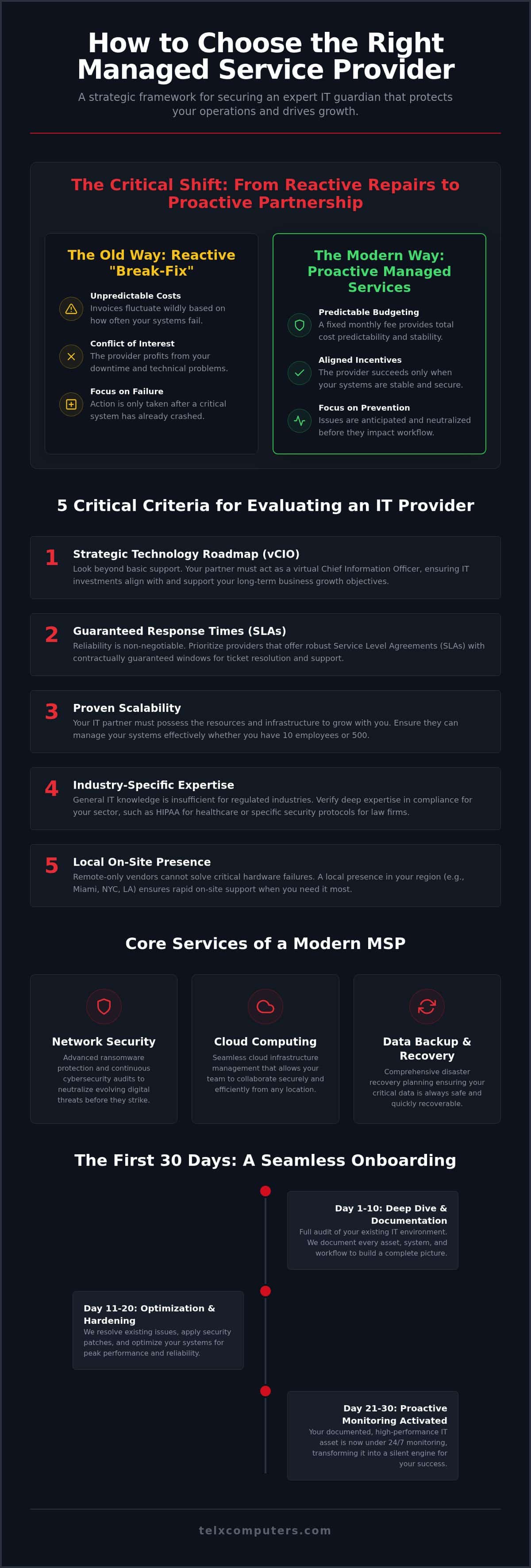
Understanding how to choose a managed service provider begins with defining what this partnership actually entails. At its core, a What is a Managed Service Provider (MSP) is a strategic ally that assumes responsibility for your organization’s technology infrastructure under a fixed-fee subscription model. Unlike a vendor you call only when a screen goes black, an MSP acts as your expert guardian. This shift from a vendor relationship to a strategic alliance is essential for modern enterprises that can’t afford even a single hour of operational downtime.
The traditional “Break-Fix” model is fundamentally flawed because it relies on failure to generate revenue for the technician. In that scenario, your provider makes more money when your technology stays broken. Managed services flip this script. By operating under a predictable monthly fee, the MSP’s incentives align perfectly with yours. They succeed when your systems are stable, secure, and efficient. In 2026, this has evolved into comprehensive technology management where the focus isn’t just on resolving tickets, but on driving business growth through a robust, silent engine of technical excellence.
The Evolution from Reactive Support to Proactive Management
The old mentality of waiting for a system to crash before seeking help is a recipe for financial disaster. When a server fails unexpectedly, the costs extend far beyond the repair bill; they include lost employee productivity, missed client opportunities, and potential reputational damage. Implementing proactive server monitoring creates a stable environment where potential bottlenecks are identified and resolved before they impact your workflow. This vigilance is supported by 24/7 help desks that ensure your team remains productive regardless of the hour, replacing technical anxiety with a sense of total stability.
Core Services to Expect from a Modern MSP
A high-tier partner provides a holistic suite of services designed to protect and scale your business. You should expect a sophisticated mix of technical edge and personalized care that covers these essential areas:
- Network Security: This includes advanced ransomware protection and continuous cybersecurity audits to stay ahead of evolving threats.
- Cloud Computing: Seamless infrastructure management that allows your team to collaborate securely from any location.
- Data Backup and Recovery: Comprehensive disaster recovery planning that ensures your data is always reachable, even in the event of a localized hardware failure.
By integrating these services into a single, cohesive strategy, an MSP functions as an extension of your own team. They provide the technological foundation that allows you to focus on your core business objectives without the constant fear of a digital breach or system collapse.
5 Critical Criteria for Evaluating an IT Services Provider
Selecting a partner is a high-stakes decision for any growing enterprise. A rigorous evaluation ensures your chosen ally can handle the pressure of your specific industry while maintaining a technological edge. When researching how to choose a managed service provider, you must look beyond basic technical support. You need to verify if they can act as a vCIO (virtual Chief Information Officer) to provide a strategic technology roadmap. This long-term alignment ensures your IT investments support business growth rather than just keeping the lights on.
Your search should prioritize providers that offer robust Service Level Agreements (SLAs) with guaranteed response times. Reliability is the cornerstone of a successful partnership. If a provider cannot commit to specific windows for ticket resolution, they cannot function as your expert guardian. Scalability is equally vital. Your IT partner must possess the resources to manage your infrastructure whether you have 10 employees or 500, ensuring your growth is never throttled by technical limitations.
Industry-Specific Knowledge: Law Firms and Healthcare
General IT knowledge isn’t enough when your business is subject to strict regulatory oversight. For instance, healthcare IT services require deep expertise in HIPAA compliance to protect sensitive patient data and avoid massive fines. Similarly, IT services for law firms must account for unique document management systems and the absolute necessity of client confidentiality. A provider that understands these verticals will offer multi-vendor support, managing the complex software ecosystem your specific profession relies on every day.
Vetting Cybersecurity Capabilities
Cybersecurity is the most critical layer of modern IT management. You should demand transparency regarding their real-time threat detection protocols. Ask how they handle incident classification and what their specific recovery time objective (RTO) is during a disaster. A reliable partner doesn’t just react to breaches; they prevent them through regular cybersecurity audits and proactive email security. They should be one step ahead of potential threats, acting as a vigilant shield for your digital assets. If you’re ready to see how a professional framework applies to your business, you can request a tailored technology assessment to identify potential gaps in your current setup.
The right provider blends global technical standards with a commitment to your specific operational needs. By focusing on these five criteria, you replace technical anxiety with a sense of stability, knowing your silent engine is being managed by professionals who understand your business as well as you do.
The Local Advantage: Why Regional Presence Matters in 2026
Remote-only MSPs often promise the world through a screen, but they’re helpless when a local network switch burns out or a physical server fails. Evaluating an IT Services Provider requires looking at their physical footprint rather than just their digital dashboard. In major hubs like Miami, NYC, and LA, having a technician who can arrive on-site within hours is the difference between a minor hiccup and a total operational standstill. Since North America held 32.4% of the global managed services revenue in 2025, the competition is high; however, the true differentiator remains physical accessibility. This localized focus serves as a recurring anchor, blending global technical standards with a specific commitment to your regional business community.
When you’re determining how to choose a managed service provider, consider their knowledge of your specific city’s infrastructure. Local partners understand the quirks of regional ISPs and power grids, allowing them to anticipate outages or connectivity issues that a national provider might miss. They act as a physical extension of your internal team, providing a sense of stability that remote-only support simply cannot replicate. This hands-on approach alleviates technical anxiety, replacing it with the confidence that an expert guardian is just a short drive away.
Choosing a Top IT Company in Miami
Miami businesses face a unique business climate that demands high-speed efficiency and resilience. Seeking out IT support in Miami ensures that critical hardware replacements happen in real-time rather than waiting for a shipping label from a distant warehouse. This reach extends to surrounding hubs like Fort Lauderdale and Aventura, ensuring that your secondary offices or remote branches receive the same level of expert guardianship. A local partner doesn’t just fix your computers; they understand the regional landscape and the specific challenges of doing business in South Florida.
Logistics: Hardware Procurement and Office Moves
A local presence is indispensable during major transitions. Whether you’re upgrading your server room or planning an office relocation, having boots on the ground streamlines the entire process. Local MSPs manage hardware procurement and physical network migrations with a level of precision that remote vendors can’t match. They handle the heavy lifting of setting up workstations and configuring servers on-site. These project-based professional services are the silent engine behind a successful move, ensuring your new space is online and secure from day one without the typical teething problems of a new setup.
Pricing Models: Fixed-Price Unlimited vs. Billable Hours
Financial surprise is one of the leading causes of technical anxiety for business owners. When you’re evaluating how to choose a managed service provider, the pricing structure often reveals the provider’s true priorities. Many organizations are lured by the low entry cost of billable hours, only to find themselves penalized with massive invoices every time a system fails. This “Break-Fix” model creates a fundamental conflict of interest; the technician earns more money when your technology stays broken. A strategic ally, conversely, thrives when your systems are perfect.
Our fixed-price, unlimited service plans remove this friction by aligning our goals with yours. Because we operate on a predictable monthly fee, our incentive is to ensure your infrastructure is so stable that it never requires emergency intervention. This model transforms IT from a volatile expense into a predictable utility. It allows your leadership team to focus on business growth planning with a clear understanding of your monthly operational costs, providing the peace of mind that comes from total budget stability.
The Hidden Costs of “Cheap” IT Support
The real cost of a low-cost IT vendor isn’t found in their hourly rate, but in the downtime they fail to prevent. Industry research indicates that the average cost of IT downtime can reach $10,000 per hour for mid-sized enterprises when factoring in lost productivity and missed opportunities. Relying on “per-ticket” pricing often leads to neglected infrastructure because every proactive suggestion feels like an upsell. We define Predictable IT as the total elimination of emergency bill spikes through vigilant, proactive management. You can get an instant quote to see how a fixed-rate plan compares to your current unpredictable spending.
What Should Be Included in Your Monthly Fee?
A comprehensive managed service agreement should act as a silent engine for your success, covering every essential layer of your digital environment. When you choose a partner, ensure your monthly fee includes these core components:
- Unlimited Help Desk Support: 24/7 access to technicians who resolve issues without extra “per-call” charges.
- Proactive Maintenance: Real-time monitoring of servers and workstations to catch failures before they happen.
- Security Software Licenses: Integrated protection including advanced email security and endpoint detection.
- Strategic Consulting: Regular business reviews and vCIO services to ensure your technology supports your long-term roadmap.
By bundling these services into a single, transparent fee, you gain more than just technical support. You gain a dedicated department that is fully invested in your efficiency and security. This approach replaces the stress of fluctuating invoices with a sense of stability, allowing your organization to scale with confidence.
How to Transition to a Managed IT Services Partner
The final stage in your journey of how to choose a managed service provider is the onboarding process. This 30 day window is the most critical period of the partnership, as it sets the foundation for your long-term stability. Transitioning to a professional ally shouldn’t be a source of stress; instead, it’s the moment technical anxiety begins to fade. During this phase, your new expert guardian assumes ownership of your digital environment, transforming a collection of disconnected fixes into a cohesive, high-performance engine.
A successful transition starts with meticulous documentation. We map every facet of your infrastructure, including physical servers, individual workstations, and cloud-based assets. This visibility allows us to manage your systems with surgical precision. Once the environment is documented, we establish your security perimeter and integrate robust network IT support. We also finalize the communication protocols for your team, ensuring every employee knows exactly how to reach the 24/7 help desk for immediate resolution. This clarity ensures that your operations remain smooth and uninterrupted from day one.
The Discovery and Audit Phase
We begin with a deep-dive audit designed to identify hidden vulnerabilities that could lead to future downtime. This phase is about more than just finding bugs; it’s about aligning your technology with your 2026 business goals. We evaluate your current hardware and software to see where legacy systems are dragging down performance. By cleaning up these outdated elements, we improve overall system speed and security. This proactive approach ensures your technology roadmap is built on a clean, optimized foundation rather than a patchwork of old solutions.
Finalizing the Partnership
Before the transition is complete, we review our service commitments and the guarantee that protects your investment. We believe in total transparency, which is why we spend time training your staff on how to use the new support systems effectively. When your team feels confident in the tools they use, productivity soars. Choosing the right partner means finding someone who acts as a true extension of your organization, providing the stability you need to scale without fear of a digital collapse.
Ready for a strategic ally that treats your success as its own? Get an instant quote for your business today.
Secure Your Competitive Edge with a Strategic IT Ally
Mastering how to choose a managed service provider is the first step toward transforming your technology from a burden into a silent engine for success. You’ve learned that a true strategic ally provides more than just remote troubleshooting; they offer the security of a local physical presence and the absolute predictability of fixed-price plans with no hidden fees. By selecting a partner with rapid on-site response capabilities in Miami, NYC, and LA, you ensure that hardware failures never stall your momentum.
We believe your organization deserves the peace of mind that comes with 24/7/365 Guardian-level monitoring. This vigilant approach identifies and neutralizes threats before they can impact your bottom line or your reputation. It’s time to move past the technical anxiety of unpredictable IT spending and embrace a proactive roadmap designed for growth. You can Request a Free IT Strategy Consultation and Instant Quote to see how an expert guardian can stabilize your infrastructure. Your business is ready to scale, and we’re ready to provide the stability you need to lead your industry with confidence.
Frequently Asked Questions
What is the difference between an MSP and traditional IT support?
The primary difference lies in proactivity versus reactivity. Traditional IT support typically follows a break-fix model where you pay only when something fails. An MSP acts as a strategic ally, using 24/7 monitoring to prevent issues before they cause downtime. This proactive stance ensures your technology functions as a silent engine for success rather than a source of constant interruptions.
How much do managed IT services typically cost for a small business?
Managed IT service costs depend on your specific needs, such as user count and security depth. When researching how to choose a managed service provider, look for fixed-price unlimited plans. These models provide budget predictability by covering everything from 24/7 help desk support to proactive maintenance in one monthly fee. This removes the financial anxiety of hourly billing and ensures your provider is focused on system stability.
Can an MSP help with our move to the cloud?
Yes, an MSP provides the strategic roadmap and technical execution needed for a seamless cloud transition. We handle the migration of data, applications, and infrastructure while ensuring your security perimeter remains intact. This process minimizes downtime and ensures your cloud environment is optimized for scalability and performance from the moment you go live. It’s about making the transition secure and efficient.
Do I still need an internal IT person if I hire an MSP?
Not necessarily, but an MSP can also work alongside existing staff. Many organizations use an MSP to handle 24/7 monitoring and help desk support, freeing up internal IT for high-level business strategy. This co-managed model provides the best of both worlds: internal institutional knowledge paired with the deep resources and vigilant protection of a full-scale corporate IT department. Specialized partners like 72 System can further support this model by offering expert data recovery and computer training services.
How quickly can an MSP respond to a cybersecurity threat?
Response times are immediate thanks to real-time server monitoring and automated threat detection systems. An expert guardian identifies suspicious activity the moment it enters the network. This allows for instant incident classification and mitigation. By neutralizing threats before they escalate, an MSP protects your digital assets and minimizes the risk of a data breach or operational standstill.
What happens if my server goes down after business hours?
If a server fails after hours, our 24/7/365 monitoring systems trigger an immediate alert to our technical team. We begin remote remediation efforts instantly to resolve the issue before your business opens. In cases where physical intervention is required, our local presence in Miami, NYC, and LA allows for rapid on-site response to replace hardware and restore services without delay.
Is it better to choose a local IT company or a national provider?
Determining how to choose a managed service provider often comes down to the need for physical presence. Local providers offer the critical advantage of rapid on-site response for hardware failures that remote-only national vendors cannot handle. A local partner understands regional infrastructure and can provide hands-on support in major business hubs, ensuring your physical and digital environments are equally secure.