





23 Jul Business Network Security in Los Angeles: A Strategic Framework for 2026
Your firewall is configured. Your antivirus is running. So why are Los Angeles businesses just like yours still suffering costly breaches, regulatory fines, and weeks of operational chaos after a single incident? The uncomfortable truth is that a collection of security tools is not a security strategy. For growing companies navigating the realities of business network security in Los Angeles, the gap between “we have protection” and “we are protected” can cost everything.
If you’ve felt that tension, you’re not alone. Managing a hybrid workforce, keeping pace with California’s evolving CCPA and CPRA requirements, and absorbing the unpredictable costs that follow a security incident are pressures that every serious LA business owner recognizes. The complexity is real, and the stakes keep rising.
This article cuts through that complexity. You’ll walk away with a clear, layered framework for securing your network, achieving genuine regulatory compliance, and building a security posture that supports growth rather than strangling it. From foundational infrastructure controls to rapid incident response, here’s what a strategic approach to network security actually looks like for Los Angeles businesses in 2026.
Key Takeaways
- Effective business network security in Los Angeles requires a multi-layered defense strategy — not just individual tools — to protect against the ransomware and data exfiltration threats targeting high-value LA businesses.
- A secure network depends on the right combination of hardware, software, real-time monitoring, and rapid incident response working together as a unified system rather than isolated fixes.
- Partnering with a managed security provider like Telx Computers often delivers a lower total cost of ownership than building an in-house team, with fixed-price plans that eliminate unpredictable IT spending.
- California’s CCPA and CPRA regulations carry real financial consequences, and regular cybersecurity audits are one of the most effective ways to identify compliance gaps before regulators do.
- A proactive, 24/7 monitoring model backed by local on-site response capability is what separates a reactive security posture from one that actively supports your business growth.
The State of Business Network Security in Los Angeles
At its core, network security is best understood not as a product you purchase, but as a living system you continuously operate. It encompasses the policies, technologies, and controls that protect the integrity, confidentiality, and availability of your data and systems. For Los Angeles businesses operating across hybrid environments, that definition carries serious operational weight.
The threat environment has shifted. Attackers aren’t brute-forcing perimeters the way they once did. They’re exploiting trusted remote access credentials, targeting misconfigured cloud environments, and using ransomware as a precision instrument against organizations that hold high-value data. A firewall stops traffic at the gate. It doesn’t monitor what’s already inside, and it doesn’t respond when an employee’s compromised credentials open the door from the inside out.
Why LA Businesses Face Unique Security Challenges
Southern California’s business ecosystem creates a concentrated target. Los Angeles hosts dense clusters of growth-stage technology companies, entertainment studios, healthcare providers, and legal firms, all of which routinely handle sensitive intellectual property, protected health information, and confidential client records. That concentration of high-value data in a single metropolitan area is a known attractor for sophisticated threat actors.
The hybrid workforce compounds the risk. Employees connecting from home networks, coffee shops, and co-working spaces across LA County introduce dozens of uncontrolled access points into what was once a defined network perimeter. Each remote session is a potential entry vector if endpoint controls and access policies aren’t actively enforced.
California’s regulatory environment adds another layer of pressure. CCPA and CPRA don’t just set privacy standards; they assign liability when those standards aren’t met. For businesses handling California resident data, a breach isn’t only an operational crisis. It’s a compliance event with measurable financial consequences.
From Firewalls to Holistic Defense
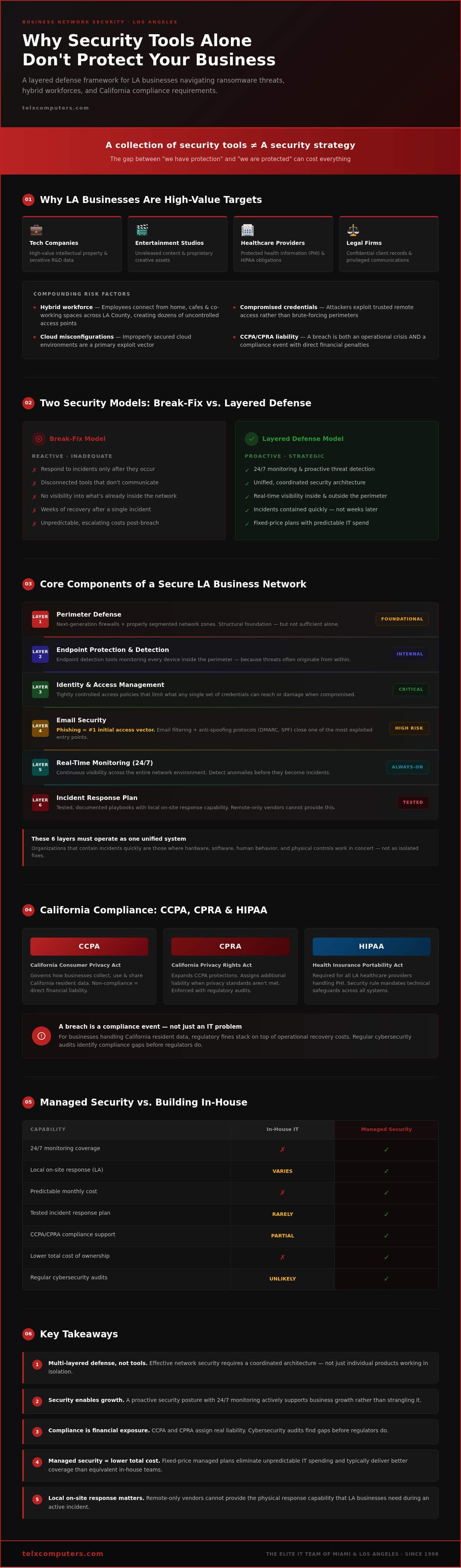
The break-fix model of IT security, where you respond to incidents as they occur, was already struggling before hybrid work became standard. It’s now genuinely inadequate. Effective business network security in Los Angeles requires a layered defense architecture: endpoint protection, identity and access management, real-time monitoring, email security, and a tested incident response plan working as a single, coordinated system.
This is where Managed IT Services change the equation. Rather than assembling disconnected tools and hoping they communicate, a managed security model delivers 24/7 vigilance, proactive threat detection, and the local on-site response capability that remote-only vendors simply can’t provide. Think of it this way: network security is your business’s most reliable insurance policy, one that pays out in prevented downtime rather than recovered losses.
Core Components of a Secure Los Angeles Business Network
Security tools don’t protect your business. A coordinated security architecture does. There’s a meaningful difference between the two, and understanding it is what separates organizations that contain incidents quickly from those that spend weeks recovering from them. For effective business network security in Los Angeles, that architecture needs to operate across every layer: hardware, software, human behavior, and physical space.
At the perimeter, next-generation firewalls and properly segmented network zones form the structural foundation. But the perimeter alone isn’t enough. Inside that boundary, endpoint detection tools, encrypted communication channels, and tightly controlled access policies must work in concert. Email security deserves particular attention here. Phishing remains the most common initial access vector for breaches, and a well-configured email filtering solution, paired with anti-spoofing protocols like DMARC and SPF, closes one of the most exploited entry points in any business network. The cybersecurity best practices published by the Cybersecurity and Infrastructure Security Agency reinforce this layered approach as the baseline standard for organizations of any size.
Physical infrastructure matters just as much. Structured cabling, properly segmented guest Wi-Fi networks, and secured server rooms aren’t optional extras. They’re control points. An unsecured wireless network in a Los Angeles office building shared with dozens of other tenants is an open invitation. Treating physical and digital security as separate disciplines is a mistake that sophisticated threat actors actively exploit.
Advanced Threat Detection: MDR and SOC
Traditional antivirus operates on signatures: it recognizes known threats and blocks them. Managed Detection and Response (MDR) does something fundamentally different. It analyzes behavioral patterns across your entire environment, identifying anomalies that signature-based tools would never flag. A 24/7 Security Operations Center (SOC) takes that capability further, applying human analysis to automated alerts and making real-time decisions about containment. Telx’s server monitoring systems integrate directly into this model, providing continuous infrastructure visibility that supports the uptime your operations depend on. The goal isn’t just detection. It’s detection fast enough to matter.
The Human Element: Education and Access Control
No firewall stops an employee who hands over their credentials to a convincing phishing email. Security awareness training converts your workforce from a vulnerability into an active defense layer. Pair that training with mandatory Multi-Factor Authentication across every business application and you’ve eliminated the most common credential-based attack path. In physical Los Angeles office environments, RFID-based access control systems add a final layer of accountability, ensuring that server rooms, network closets, and sensitive workspaces are accessible only to authorized personnel. This is where business network security in Los Angeles gets concrete: protection that extends from the cloud down to the door.
If you’re assessing where your current architecture has gaps, a managed IT services consultation is a practical starting point for identifying what’s missing before an incident does it for you.
Managed Security vs. In-House IT: Cost and Strategy Analysis
Building an internal cybersecurity team sounds appealing until you price it out. A single experienced security analyst commands a six-figure salary in the Los Angeles market, and that’s before benefits, training, licensing, and the tools they need to do the job. Stack two or three specialists together to cover shifts and vacations, and you’ve created a substantial fixed overhead that grows independently of whether your threat environment actually demands that level of staffing on any given week. For most growing LA businesses, that math doesn’t work.
The talent problem compounds the cost problem. Cybersecurity professionals are in short supply nationally, and Los Angeles competes with technology firms, entertainment studios, and healthcare networks for the same limited pool of qualified candidates. Even when businesses successfully hire, turnover is high and burnout is real. Security work is relentless by nature, and a two-person internal team covering business network security in Los Angeles around the clock is a structural vulnerability dressed up as a solution.
A managed security provider changes that calculus entirely. Rather than replacing one expensive specialist with another, you’re accessing an entire team of specialists, a 24/7 Security Operations Center, and enterprise-grade tooling under a single, predictable monthly agreement. The model trades unpredictable capital expenditure for consistent operational spending, which is a meaningful advantage when you’re trying to forecast growth.
Predictable Budgeting with Fixed-Rate Managed IT
Telx Computers operates on a fixed-rate billing model, which means your security investment doesn’t spike when something goes wrong. Emergency breach remediation, after-hours support calls, and unplanned infrastructure assessments are the events that quietly destroy IT budgets in the break-fix model. Fixed-rate managed IT absorbs those variables. Unlimited help desk access also means your team resolves security questions immediately rather than queuing them behind a cost-per-ticket calculation. For businesses navigating compliance obligations under the California Consumer Privacy Act (CCPA), that responsiveness matters: compliance gaps don’t wait for business hours. Explore how Telx IT outsourcing services structure this model for LA businesses.
The Strategic Advantage of Local LA Support
Remote-only vendors can monitor your network. They can’t walk your server room when a hardware failure creates a physical access vulnerability. Local on-site response is a distinct operational capability, not a premium add-on. When a network switch fails or a physical intrusion compromises a secure area, the time between incident and resolution is measured in minutes with a local partner, not hours. Local proximity directly compresses Mean Time to Recovery (MTTR), which translates to less downtime and lower incident costs. A partner embedded in the Los Angeles business community also understands the local vendor landscape, building relationships and supply chain familiarity that remote providers simply don’t have.
This is what separates a strategic ally from a third-party vendor. Telx doesn’t manage your business network security in Los Angeles from a distance. It operates as an extension of your team, with the accountability and presence that proximity enables.
Navigating Compliance: CCPA, HIPAA, and Beyond
Regulatory compliance isn’t a checkbox exercise. For Los Angeles businesses handling consumer data, patient records, or financial information, it’s an ongoing operational discipline with real financial consequences when it breaks down. California’s privacy framework is among the most demanding in the country, and the businesses that treat it as a documentation project rather than a security architecture problem are the ones that regulators find first.
The CCPA/CPRA Roadmap for Los Angeles Businesses
The California Consumer Privacy Act and its successor, the California Privacy Rights Act, establish enforceable rights for California residents: the right to know what data you collect, the right to delete it, and the right to opt out of its sale. Violations carry civil penalties up to $7,500 per intentional violation. The path to compliance follows three concrete steps:
- Step 1: Data mapping. You can’t protect what you haven’t located. A thorough data inventory identifies every system, application, and third-party integration where consumer information lives. This isn’t a one-time audit; it’s an ongoing process that must account for new tools and vendors as your business grows.
- Step 2: Technical controls. Access restrictions, encryption at rest and in transit, and role-based permissions ensure that consumer data is accessible only to those with a legitimate operational need. These controls are the technical backbone of CCPA compliance, and they’re the same controls that underpin effective business network security in Los Angeles more broadly.
- Step 3: Incident response planning. CCPA and CPRA both impose breach notification requirements with defined timelines. A formal incident response plan, tested before an incident occurs, is the mechanism that makes those deadlines achievable. Without it, organizations scramble and miss windows that trigger additional liability.
Regular cybersecurity audits are what keep this roadmap accurate. Environments change, vendors change, and employee behavior changes. An audit conducted annually, or after any significant infrastructure change, surfaces compliance gaps before a regulator or threat actor does it for you.
Industry-Specific Security Standards
Healthcare practices operating in Los Angeles face HIPAA’s Security Rule requirements on top of California’s state-level obligations. Encrypted communications for patient data, strict access logging, and Business Associate Agreements with every vendor that touches protected health information are non-negotiable. Telx’s healthcare IT services are built around these requirements, ensuring that clinical workflows don’t become compliance liabilities.
Financial firms and retailers carry their own regulatory weight. FINRA governs broker-dealers and requires documented cybersecurity programs with evidence of supervisory controls. PCI-DSS applies to any business processing card payments, mandating network segmentation, vulnerability scanning, and strict access controls around cardholder data environments. Legal practices face attorney-client privilege obligations that translate directly into data security requirements. Telx’s IT services for law firms address those obligations with the specificity that general IT providers rarely deliver.
Data backup and disaster recovery aren’t optional for any of these frameworks. HIPAA explicitly requires recoverable data backups. PCI-DSS mandates tested recovery procedures. CCPA’s breach notification requirements presuppose that you know what data was affected, which is only possible with complete, current backup records. A disaster recovery plan that’s never been tested isn’t a plan; it’s a liability.
If your current compliance posture has gaps you haven’t fully mapped, a managed IT services consultation is a practical first step toward closing them before they become costly.
Securing Your Growth with Telx Computers in Los Angeles
Every framework discussed in this article, from layered defense architecture to regulatory compliance, only delivers its full value when it’s actively managed by people who treat your security as their own. That’s the philosophy behind Telx Computers. Founded in 2002, Telx operates as an expert guardian for Los Angeles businesses, not a remote help desk that reacts when things break, but a proactive security partner embedded in your operational reality.
The distinction matters. Plenty of vendors will sell you tools. Far fewer will take ownership of the outcome.
The Telx Advantage: Proactive Vigilance
Telx’s 24/7 help desk functions as an extension of your internal team, not a third-party queue. When your staff encounters a security concern at any hour, they reach a live specialist who already knows your environment. That familiarity compresses resolution time in ways that generic support contracts simply can’t replicate.
Rapid on-site response is where Telx’s local presence becomes a concrete operational advantage. Remote monitoring catches threats. Physical presence resolves them. When a hardware failure creates a network vulnerability or a physical access issue demands immediate attention, Telx technicians respond in person across Los Angeles, not from a call center in another time zone. For business network security in Los Angeles, that proximity is a measurable asset.
Reliability isn’t just a claim. The Telx service guarantee formalizes that commitment, giving clients a documented standard of accountability that reflects genuine confidence in the service model. It’s the kind of assurance that separates a strategic ally from a vendor hoping you don’t notice the gaps.
Get Your Custom Security Strategy
A Telx cybersecurity audit and network assessment starts with your actual environment, not a generic checklist. The process identifies specific vulnerabilities, maps your compliance obligations under CCPA, HIPAA, or PCI-DSS as applicable, and surfaces the gaps that represent your highest-priority risk. From that baseline, Telx builds a tailored security strategy aligned to your business size, industry, and growth trajectory.
The result is a fixed-price managed IT proposal with no hidden escalation clauses. Your security investment stays predictable, which means your technology planning stays honest. No surprise invoices after an incident. No cost-per-ticket calculations discouraging your team from asking questions.
Strengthening your business network security in Los Angeles starts with a clear picture of where you stand today. Get an instant quote for your LA business and take the first step toward a security posture that actively supports your growth rather than quietly limiting it.
Your Next Step Toward a More Secure Los Angeles Business
The framework laid out in this article comes down to one core principle: business network security in Los Angeles isn’t something you set up and forget. It’s a living system that requires continuous monitoring, tested response plans, and a partner who treats your security as their own responsibility.
Three things make the difference between a reactive posture and a genuinely protected one: 24/7 proactive network monitoring that catches threats before they escalate, fixed-price unlimited support plans that keep your IT budget honest, and local rapid on-site response that resolves physical and network incidents fast. Together, they close the gap between “we have tools” and “we are protected.”
The businesses that come out ahead aren’t necessarily the ones with the biggest security budgets. They’re the ones that stopped treating security as an afterthought and started treating it as a growth enabler.
You don’t need to figure this out alone. Secure your Los Angeles business with a custom IT strategy and instant quote from Telx Computers, and start building a security posture that works as hard as you do.
Frequently Asked Questions About Business Network Security in Los Angeles
What are the most common network security threats for businesses in Los Angeles?
Ransomware, phishing attacks, and credential theft are the threats LA businesses encounter most frequently. Southern California’s concentration of entertainment, healthcare, legal, and technology firms makes it a high-value target for attackers who research their victims before striking. Phishing remains the most common initial access method, often exploiting employee email accounts to gain a foothold before moving laterally through the network.
Insider threats and misconfigured cloud environments round out the picture. As LA businesses expanded hybrid work arrangements, improperly secured remote access points created new vulnerabilities that attackers actively probe. The common thread across all these threats is that they bypass perimeter defenses by exploiting trusted users, credentials, or configurations rather than brute-forcing firewalls.
How much does business network security cost for a small company in LA?
We don’t publish specific pricing here because security costs vary considerably based on your industry, number of users, compliance obligations, and existing infrastructure. What we can say is that the managed IT model trades unpredictable incident costs for a fixed monthly investment, which makes budgeting far more reliable than the break-fix alternative. A single unplanned breach remediation typically costs far more than months of proactive managed security coverage.
The most useful starting point is a network assessment that maps your actual environment and risk profile. From there, a provider like Telx Computers can build a fixed-price proposal tailored to your specific situation rather than quoting a generic package that may over- or under-serve your needs. An instant quote is a practical first step.
Is a firewall enough to protect my business from ransomware in 2026?
No. A firewall controls traffic at the network boundary, but ransomware typically enters through phishing emails, compromised credentials, or vulnerable remote access tools, all of which can pass through a firewall without triggering any alert. Once inside, ransomware moves laterally across systems that a perimeter-focused defense never monitors. Stopping it requires behavioral threat detection, endpoint protection, and real-time monitoring—utilizing CJX Secure Systems to enhance visibility and risk management—that operates inside the network, not just at its edge.
Effective ransomware defense also depends on tested data backup and disaster recovery procedures. Even when prevention fails, organizations with current, verified backups can restore operations without paying a ransom. The firewall is a necessary component of your architecture, but treating it as a complete solution leaves the majority of your attack surface unaddressed.
What is the difference between managed IT services and cybersecurity services?
Managed IT services cover the full operational health of your technology environment: network infrastructure, help desk support, server monitoring, software licensing, cloud management, and security. Cybersecurity services focus specifically on threat detection, incident response, compliance, and vulnerability management. In practice, the boundary between them is narrowing because you can’t manage IT effectively without embedding security into every layer of the operation.
Telx Computers integrates both disciplines under a single managed service model. Rather than coordinating between a separate IT provider and a separate security vendor, clients get unified coverage where infrastructure management and threat monitoring inform each other continuously. That integration closes the coordination gaps that attackers routinely exploit when security and IT operations are siloed.
How does CCPA compliance affect my business’s network security requirements?
CCPA and CPRA require businesses to implement reasonable security measures to protect California consumer data, and they impose breach notification obligations with defined timelines when those protections fail. In practical terms, this means your network security architecture needs to include access controls, encryption, data mapping, and a tested incident response plan, not as optional enhancements, but as compliance requirements with financial consequences for non-compliance.
For business network security in Los Angeles, CCPA compliance and strong security posture are largely the same objective pursued through the same technical controls. Access restrictions, role-based permissions, and audit logging protect your data operationally and satisfy regulatory requirements simultaneously. Regular cybersecurity audits are what keep that alignment accurate as your systems, vendors, and workforce evolve.
Can managed IT services help my Los Angeles business support a remote workforce securely?
Yes, and it’s one of the strongest use cases for the managed model. Securing a distributed workforce requires enforced Multi-Factor Authentication, encrypted VPN or zero-trust access configurations, endpoint protection on every device connecting to your network, and continuous monitoring across all those access points. Assembling and maintaining those controls internally demands specialized expertise that most growing LA businesses don’t have on staff.
A managed IT provider deploys and monitors those controls as part of your standard service agreement. Your remote employees get secure, reliable access without IT becoming a bottleneck, and your security team gets visibility into every endpoint regardless of where it’s physically located. For hybrid workforces spread across LA County and beyond, that centralized visibility is what makes the difference between managed risk and unmonitored exposure.
What should I look for when choosing a network security provider in Los Angeles?
Prioritize local on-site response capability, 24/7 monitoring with human analyst support, and a fixed-price billing model that doesn’t penalize you for using the service. A provider who can only respond remotely creates a meaningful gap when physical infrastructure issues arise. Industry-specific compliance experience matters too; a provider familiar with HIPAA, PCI-DSS, or CCPA requirements will save you significant time and risk compared to one who treats all clients identically.
Ask for documented service guarantees and references from businesses in your industry and size range. Longevity and local presence are meaningful signals: a provider like Telx Computers, operating in the LA market since 2002, brings vendor relationships, community familiarity, and institutional knowledge that newer or remote-only alternatives simply don’t have. The right partner functions as an extension of your team, not a third-party ticket queue.
How often should my business undergo a cybersecurity audit?
At minimum, once per year. That baseline applies to most businesses, but several events should trigger an additional audit regardless of when the last one occurred: adding a significant number of remote employees, migrating to new cloud infrastructure, onboarding a new vendor with access to your systems, or experiencing any security incident. Waiting for the annual calendar when your environment has fundamentally changed is how compliance gaps accumulate undetected.
For businesses operating under HIPAA, PCI-DSS, or CCPA obligations, more frequent assessments are often warranted because regulatory requirements evolve and your data environment changes continuously. A cybersecurity audit isn’t a one-time certification; it’s a calibration check that keeps your security architecture aligned with your actual risk profile. Treating it as an ongoing discipline rather than an annual formality is what separates proactive organizations from reactive ones.