




10 Jul IT Support Service Level Agreement (SLA): A Strategic Guide for Business Leaders
If you view your IT support service level agreement (SLA) as just another piece of legal paperwork, you’re likely leaving your business’s continuity to chance. Most leaders treat these contracts as safety nets for when things go wrong, but the most successful organizations use them as strategic blueprints for growth. It’s frustrating when you’re stuck waiting hours for a response while your team’s productivity grinds to a halt. You deserve a technology partner that treats your uptime as their primary mission, not just a checkbox on a spreadsheet.
We understand the anxiety that comes with hidden costs and the fear of technology failing during your most critical business hours. This guide will help you master the complexities of IT Support SLAs to ensure your business enjoys maximum uptime and a truly proactive partnership. You’ll gain a clear framework for holding providers accountable, learn why the distinction between response and resolution times is vital for your operations, and discover how to achieve predictable IT budgeting. With industry standards for compliance sitting at 95% or above, we’ll show you how to move beyond simple technical metrics to create a sense of stability and peace of mind for your entire enterprise.
Key Takeaways
- Learn how to transform your IT support service level agreement (SLA) from a passive contract into a strategic tool that guarantees business continuity and operational stability.
- Understand the technical nuances of uptime guarantees and support tiers to ensure your critical systems receive the appropriate level of expert attention.
- Discover the differences between customer-based and service-based agreements to determine which model best aligns with your specific operational requirements.
- Identify common hidden exclusions and learn how to implement service credits that hold your provider accountable for their performance benchmarks.
- Explore how a fixed-price, unlimited support model aligns your provider’s goals with your own, eliminating the conflicts of interest found in traditional contracts.
What is an IT Support SLA and Why Does It Matter for Your Strategy?
An IT support service level agreement (SLA) is far more than a technical contract; it’s the operational heartbeat of your business. It serves as a foundational pillar of Managed IT Services, defining the exact standards of performance you can expect from your technology partner. Many providers offer “best effort” agreements, which essentially mean they’ll get to your problems when they can. In contrast, a guaranteed performance contract provides binding benchmarks for uptime and response times. This distinction is critical for business leaders who can’t afford the high cost of unplanned downtime.
Transparency in these service standards is what builds a bridge of trust between a CEO and their MSP. When you have a clear Service-Level Agreement (SLA), you aren’t guessing about the health of your infrastructure. You have documented proof of reliability. This clarity transforms IT from a mysterious cost center into a predictable, strategic asset that supports your broader business goals.
To better understand how these agreements function in a business context, watch this helpful video:
The Business Impact of Service Guarantees
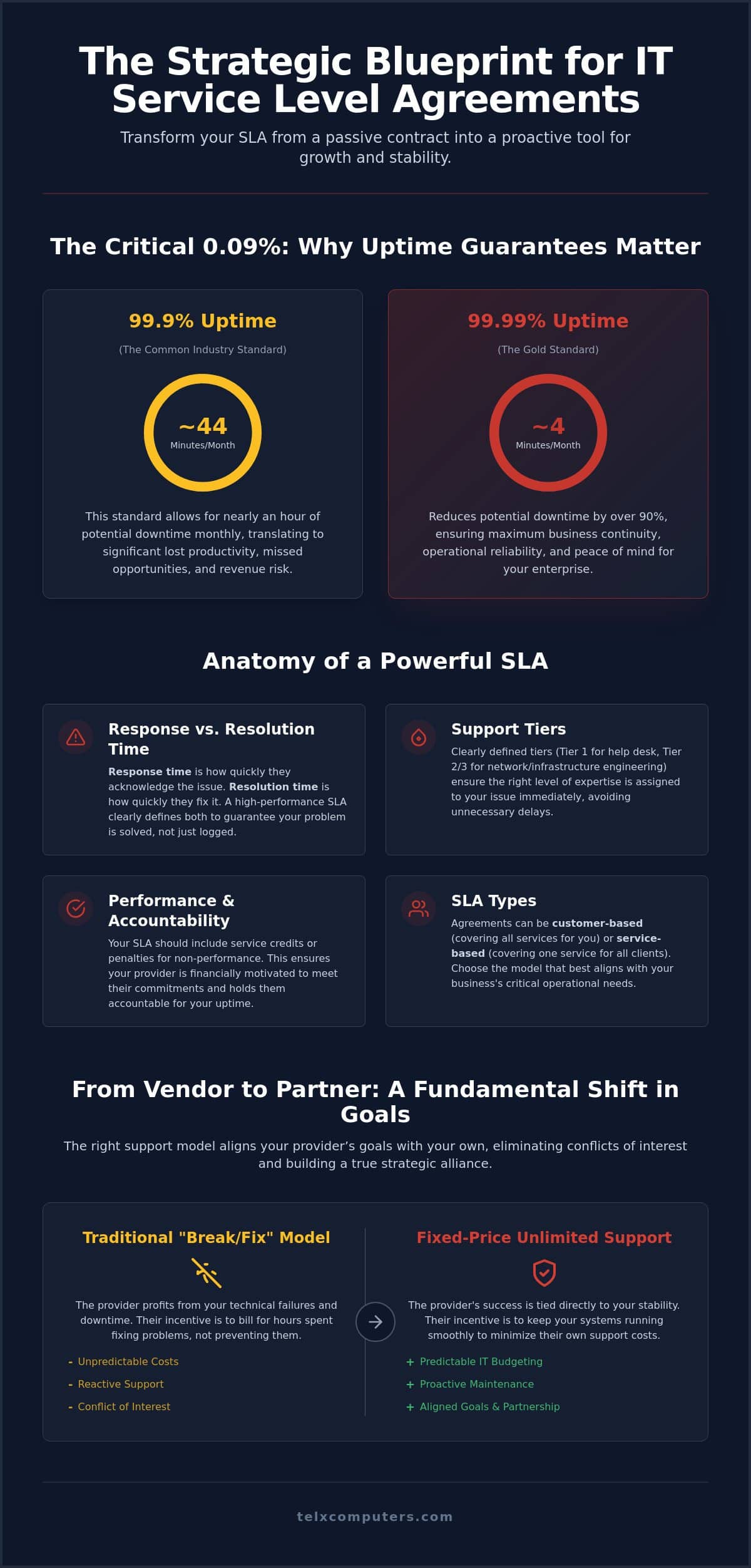
Uptime isn’t just a technical metric; it’s a revenue protection strategy. The difference between 99.9% uptime and 99.99% uptime represents nearly 40 minutes of potential lost productivity every month. For high-stakes environments, these minutes translate to thousands of dollars in lost wages and missed opportunities. Clear SLAs also allow for predictable IT budgeting by ensuring you aren’t hit with surprise invoices for emergency fixes. Additionally, these agreements play a vital role in regulatory compliance for healthcare IT services and law firms that must guarantee data availability and security at all times.
Beyond the Legal Jargon: A Strategic Alliance
You should view your IT support service level agreement (SLA) as a roadmap for long-term technology growth. At Telx Computers, we position ourselves as a strategic ally rather than a mere vendor. We take pride in our performance accountability, acting as an expert guardian for your digital assets. Our fixed-price, unlimited support model fundamentally changes the traditional dynamic. Instead of a provider profiting from your technical failures, our goals align with your uptime. When your systems stay up, we both succeed. This proactive approach replaces technical anxiety with a sense of stability, allowing you to focus on scaling your enterprise while we serve as the silent engine behind your success.
Core Components of a High-Performance IT Service Level Agreement
A high-performance IT support service level agreement (SLA) isn’t just a list of promises. It’s a technical architecture that defines how your business survives a crisis. At its core, the agreement must specify availability and uptime. While many providers tout 99.9% uptime, known as the “Three Nines,” this standard actually allows for nearly 44 minutes of downtime every month. For a modern enterprise, that’s a lifetime of lost productivity. You should look for a partner that treats these numbers as a minimum baseline, not a distant goal.
Your agreement should also detail the tiers of technical expertise available to you. When evaluating different Types of SLAs, ensure your provider defines exactly who is responsible for each tier of support. Tier 1 covers basic help desk issues, while Tier 2 and Tier 3 involve deeper network and infrastructure engineering. Without these definitions, you might find yourself stuck with a generalist when you need a specialist. A transparent service scope is equally vital. It clearly lists inclusions and exclusions to prevent billing surprises. Regular reporting and review cycles ensure these standards remain aligned with your evolving business strategy.
Response Time vs. Resolution Time
Don’t fall for the acknowledgment trap. Many providers boast a 15-minute response time, but that often just means an automated email hit your inbox. Real accountability requires a focus on resolution time. For Priority 1 critical issues, you should expect a 15-minute response and a resolution within 1 to 4 hours. Priority 2 high-impact tickets typically require a 30 to 60-minute response and a 4 to 8-hour fix. MTTR (Mean Time to Repair) is the gold standard for resolution metrics. Setting these realistic benchmarks ensures your team isn’t left in limbo during a hardware failure or software crash.
Performance Metrics and KPIs
Efficiency is measured through specific KPIs, such as first-call resolution rates. This metric tells you how often your team’s problems are solved on the very first contact. High-tier providers also focus on system availability for both cloud and on-site infrastructure. By utilizing proactive server monitoring, an expert guardian can often resolve a hardware failure before your employees even notice a lag. This proactive stance prevents tickets from being created in the first place, maintaining your operational momentum. If your current agreement feels vague, it might be time to see what a transparent partnership looks like with an instant quote customized for your specific business needs.
Evaluating Different Types of IT Support SLAs
Selecting the right IT support service level agreement (SLA) requires an understanding of how different structures impact your daily operations. A customer-based SLA is a bespoke document tailored to your specific business needs. It covers all services used by your organization under one umbrella, making it ideal for companies with unique workflows or specialized software. On the other hand, service-based SLAs are standardized agreements that apply to every client using a specific technology, such as a cloud hosting platform or a VoIP system. While these are easier to implement, they lack the personalized touch required for complex strategic growth.
For larger organizations with diverse departments, multi-level SLAs offer a hybrid approach. These agreements combine corporate-level standards for every employee with specific customer-level metrics for individual departments. Choosing the right model depends on your industry complexity and your tolerance for risk. If your business relies on a highly customized tech stack, a customer-based approach ensures your “Expert Guardian” understands the nuances of your specific environment. This level of customization prevents the friction often found in one-size-fits-all contracts.
The Managed IT Services Model
Adopting managed IT support services simplifies the management of these complex agreements. In a traditional break-fix model, the provider only makes money when your technology fails, creating a fundamental conflict of interest. A fixed-price managed model flips this script. Because you pay a consistent monthly fee, your MSP is incentivized to keep your systems running perfectly. Proactive maintenance becomes the default state rather than an afterthought. This alignment of goals ensures that your IT support service level agreement (SLA) acts as a catalyst for uptime rather than just a recovery plan.
Industry-Specific SLA Requirements
Certain sectors in South Florida face unique regulatory pressures that must be reflected in their service contracts. For healthcare practices in Miami, an SLA must explicitly address HIPAA compliance and data availability. A delay in accessing patient records isn’t just an inconvenience; it’s a potential legal liability. Similarly, South Florida law firms require strict data security mandates and rapid response times to meet court deadlines and client confidentiality standards. For these high-stakes industries, ensuring your agreement includes direct access to Tier 3 technical expertise is non-negotiable. You need specialists who can resolve complex infrastructure issues immediately, replacing technical anxiety with the confidence that your firm’s reputation is protected.
Negotiating Your SLA: Red Flags and Local Considerations
Negotiating your IT support service level agreement (SLA) is where you transform a generic document into a shield for your specific operations. Many business leaders focus solely on the monthly cost, but the real value lies in the fine print. Hidden exclusions often lurk in the details, such as “out-of-scope” charges for mobile device management or surcharges for on-site visits that weren’t clearly defined. You must ensure your agreement includes every device and software application critical to your workflow to avoid billing surprises that disrupt your predictable IT budgeting.
Reliability requires accountability. A high-performance agreement must include service credits or penalties for missed benchmarks. If your provider fails to meet the agreed-upon uptime or response times, there should be a clear, pre-defined financial consequence. This ensures your MSP remains a vigilant partner rather than a passive vendor. Additionally, verify that the contract is scalable. As your business grows in Miami or Fort Lauderdale, your SLA should seamlessly accommodate new users and locations without requiring a complete legal overhaul. If you’re ready to see how a transparent agreement protects your bottom line, request an instant quote today to get started.
South Florida Disaster Recovery Standards
In our region, disaster recovery isn’t a theoretical exercise. Your agreement must account for regional emergencies, especially during hurricane season. A partner with physical locations in Miami and Fort Lauderdale provides a massive advantage, offering rapid hardware replacement when shipping lines are down. Beyond weather, your SLA should explicitly define recovery time objectives (RTO) for ransomware protection. Knowing exactly how quickly your “Expert Guardian” can restore your data after a cyberattack provides the peace of mind necessary to operate in a high-risk digital landscape.
Reviewing the Termination Clause
An effective partnership is built on trust, but a professional leader always prepares for an exit. Review the termination clause to ensure you can leave the agreement if the MSP consistently fails to meet its metrics. Data portability is a non-negotiable requirement. You must retain ownership of all system configurations, passwords, and documentation to ensure a smooth transition if you change providers. At Telx Computers, we believe a guarantee of service is far more valuable than a restrictive exit clause. Our fixed-price model aligns our success with yours, making the need for termination a distant concern by ensuring we get it right the first time.
Why Telx Computers Sets the Gold Standard for IT Support SLAs
Choosing a technology partner shouldn’t feel like a simple vendor transaction. At Telx Computers, we reject the traditional client-provider dynamic in favor of becoming your strategic ally. We believe a high-performance IT support service level agreement (SLA) should reflect a shared mission. Our fixed-price, unlimited support model fundamentally eliminates the conflict of interest found in hourly billing. Instead of profiting when your systems fail, we’re financially incentivized to keep your network running perfectly. This alignment ensures that our goals are identical to yours: maximum uptime and zero technical friction.
Our commitment to your success is backed by 24/7 help desk availability and a deep bench of local, South Florida-based expertise. We don’t believe in offshoring your critical support needs to distant call centers. When a hardware failure occurs or a security threat emerges, you need an expert guardian who understands the local landscape. By integrating proactive security and server monitoring into every service level, we maintain a vigilant watch over your infrastructure, acting as the silent engine that powers your daily operations.
The Telx Difference: Proactive vs. Reactive
Most providers wait for the phone to ring before they start working. We take the opposite approach by using real-time monitoring to resolve potential issues before they ever impact your IT support service level agreement (SLA) benchmarks. This proactive stance is supported by our significant investment in local infrastructure across Miami, Aventura, and Fort Lauderdale. Telx Computers has a 22-year history of delivering reliable IT results to the South Florida business community. This longevity is a testament to our ability to adapt to changing technical landscapes while maintaining a personalized, client-centric focus.
Get a Strategic IT Evaluation
If you’re unsure whether your current provider is meeting their obligations, it’s time for a professional audit. Many business leaders discover performance gaps only after a major system failure occurs. We can help you evaluate your current managed IT support service to identify hidden exclusions or unrealistic recovery times. Our team works with you to customize a service plan that aligns with your specific growth goals, ensuring your technology remains an asset rather than a liability. To see how we can transform your operational stability, you can get an instant quote for your business IT needs and take the first step toward a more secure future.
Take Command of Your Technology Strategy
Your IT infrastructure should be a catalyst for growth, not a source of constant anxiety. By mastering the nuances of an IT support service level agreement (SLA), you transition from managing problems to orchestrating a seamless digital environment. A robust agreement ensures your provider acts as a vigilant guardian, prioritizing uptime and aligning technical expertise with your specific business outcomes.
Choosing a partner with a local Miami and Fort Lauderdale presence provides the immediate response and hardware reliability that South Florida businesses require. When you combine this geographic advantage with fixed-price unlimited plans and 24/7 help desk support, you eliminate the financial unpredictability of traditional IT models. This strategic approach replaces technical uncertainty with stability, allowing you to focus on your core mission while a dedicated ally secures your digital foundation.
It’s time to audit your current expectations and demand a higher standard of performance. Secure Your Business with a Strategic IT Partner—Contact Telx Computers Today. We look forward to powering your long-term success.
Frequently Asked Questions
What is the difference between an SLA and a KPI in IT support?
An SLA is the formal commitment that defines the minimum level of service a provider must deliver, while a KPI is the specific metric used to measure performance against those standards. Think of the SLA as the legal promise and the KPI as the scorecard. For example, your agreement might mandate 99.9% uptime, while the KPI tracks the actual percentage achieved each month to ensure accountability.
How much does a managed IT service level agreement typically cost?
The cost of an IT support service level agreement (SLA) varies based on your total user count and the complexity of your network infrastructure. Most professional firms offer tiered models that reflect the depth of coverage required for your specific operations. Instead of focusing on the lowest price, evaluate the ROI of unlimited support and proactive monitoring. A fixed-price model often provides the best value by aligning your provider’s goals with your uptime, much like the professional retainer services offered by MZ-Law provide predictable legal support for growing businesses.
What happens if my IT provider fails to meet the SLA response times?
When a provider fails to meet agreed-upon response times, the agreement should trigger specific remedies, such as service credits. These credits act as a financial penalty for the provider and a partial refund for your lost productivity. If these failures become a consistent pattern, the contract should provide a clear path for termination. This structure ensures your technology partner remains focused on delivering the high standard of service your business requires.
Does an SLA cover hardware replacement and software procurement?
Most SLAs cover the expert management and installation of hardware and software, but the actual cost of physical components or licenses is typically separate. Your provider acts as a strategic consultant to ensure you procure the right equipment for your needs. However, a high-tier agreement will include guaranteed response times for hardware failure, ensuring a specialist is on-site in Miami or Fort Lauderdale quickly to handle the replacement and minimize disruption.
Can I customize an SLA for my specific business hours in Miami?
Yes, a professional IT support service level agreement (SLA) should be fully customizable to match your organization’s specific operating hours. Whether you run a standard office in Aventura or a 24/7 medical facility in Miami, the agreement must reflect your critical windows of operation. Customizing these hours ensures that response and resolution benchmarks apply when they matter most to your team, providing a sense of stability and peace of mind.
What is a “Service Credit” and how does it work in an IT contract?
A service credit is a pre-defined financial reimbursement issued to you when a provider fails to meet a specific performance benchmark. It’s typically calculated as a percentage of your monthly service fee. This mechanism provides a clear consequence for missed targets, such as uptime failures or slow response times. It transforms the agreement from a passive document into an active tool for holding your technology partner accountable for their performance.
Is 24/7 support always included in a standard IT support SLA?
24/7 help desk support is not always a standard feature, so you must verify this during negotiations. Some providers offer support only during business hours, while others provide around-the-clock coverage for critical emergencies. At Telx Computers, we include 24/7 proactive monitoring to ensure your systems stay protected even when your office is closed. This vigilant approach prevents potential threats from escalating during off-hours and ensures your business is always ready for the next day.
Why is resolution time more important than response time in an SLA?
Resolution time is the gold standard for performance because it measures how quickly a technical problem is actually fixed. While a response time merely acknowledges that a ticket has been received, resolution time tracks the total duration of your team’s disruption. Focusing on resolution ensures your employees get back to work as quickly as possible. It prevents the acknowledgment trap where providers respond quickly but take days to deliver a functional, long-term solution.