





20 Jun Future-Proofing Your Business Technology: A Strategic Roadmap for 2026
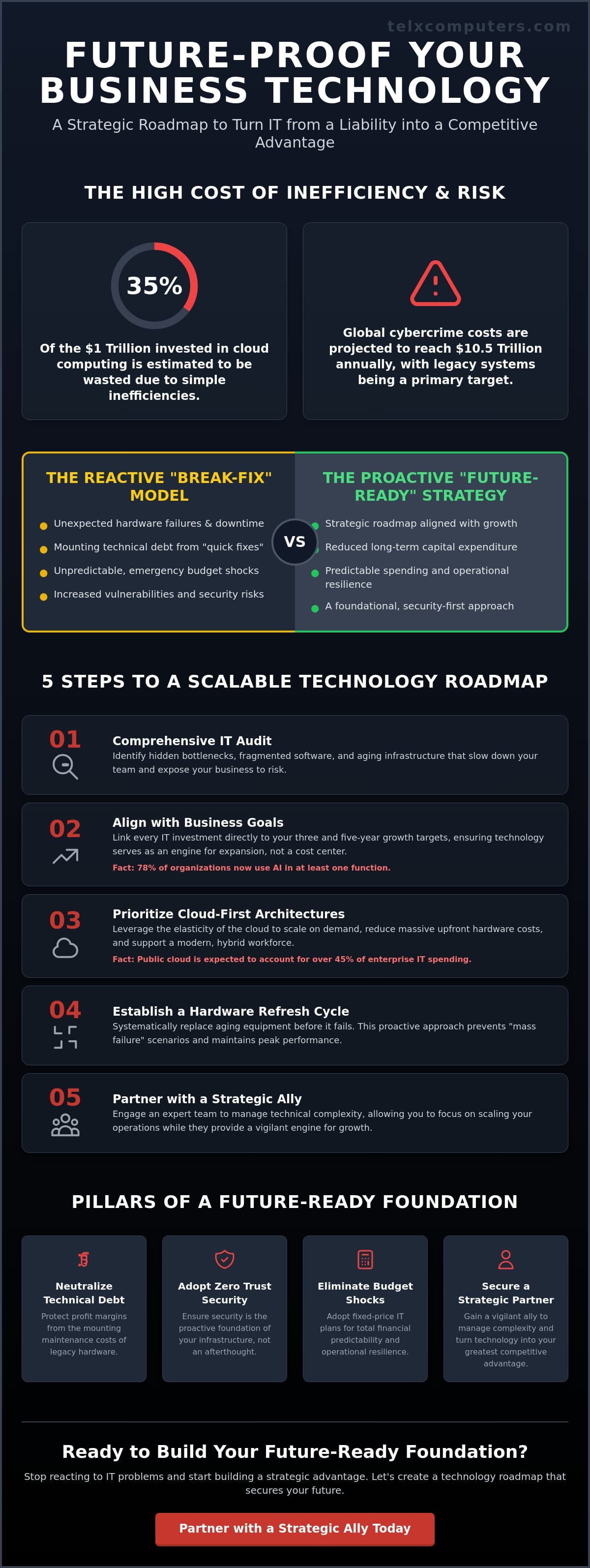
Did you know that up to 35% of the $1 trillion invested in cloud computing this year is estimated to be wasted because of simple inefficiencies? It’s a staggering figure that highlights why future-proofing your business technology is no longer optional for those who want to remain competitive. You’ve likely felt the sting of unexpected hardware failures or the creeping anxiety that your current systems can’t keep pace with the rapid shift toward AI and remote work. It’s exhausting to manage technical debt when you should be focused on scaling your operations.
We understand that you need more than just a service provider; you need a strategic ally to secure your digital foundation. This article shows you how to protect your bottom line by building a resilient, scalable infrastructure that supports long-term growth. We’ll walk through a clear roadmap to help you transition from unpredictable emergency fixes to a secure, high-speed environment where monthly spending is predictable and your network is ready for whatever comes next. By the end, you’ll have the confidence to turn technology from a source of stress into your greatest competitive advantage.
Key Takeaways
- Neutralize technical debt to protect your profit margins from the mounting maintenance costs of legacy hardware.
- Build a scalable technology roadmap that links every IT investment directly to your three-year and five-year growth targets.
- Transition to Zero Trust Architecture to ensure security is the foundation of your future-proofing your business technology efforts.
- Eliminate budget shocks by adopting fixed-price IT plans that provide total financial predictability and operational resilience.
- Partner with a strategic ally to manage technical complexity, providing your enterprise with a vigilant engine for long-term growth.
Beyond the Buzzword: What Future-Proofing Your Business Technology Really Means
In the fast-moving landscape of 2026, many executives mistake technological speed for strategic progress. True Future-proofing isn’t about chasing every new gadget that hits the market. Instead, it’s the deliberate alignment of your IT infrastructure with your long-term business objectives. When you focus on future-proofing your business technology, you’re building a foundation that stays relevant even as industry standards evolve. This requires a shift from viewing IT as a series of disconnected fixes to seeing it as a holistic engine for growth.
There’s a critical distinction between bleeding-edge and future-ready. Bleeding-edge tech often carries high risks, unproven security protocols, and the potential for rapid obsolescence. A future-ready infrastructure, however, prioritizes stability and interoperability. It uses Lego-block architectures where components can be swapped without collapsing the entire system. This proactive stance ensures you aren’t just reacting to threats; you’re anticipating them before they impact your operations.
To better understand this concept, watch this helpful video:
The High Cost of Reactive IT
The break-fix model is a silent killer of modern profit margins. When you wait for a server to fail before addressing it, you’re paying for more than just the repair. You’re paying for lost productivity and damaged client trust. Technical debt is the implied cost of additional rework caused by choosing an easy solution now instead of a better approach that would take longer. In 2026, with global cybercrime costs projected to reach $10.5 trillion, these quick fixes often leave backdoors open for ransomware. This leads to emergency expenses that far exceed the cost of managed IT support.
The ROI of a Future-Ready Strategy
Investing in scalable systems significantly reduces long-term capital expenditure. By utilizing cloud environments effectively, you can avoid the waste that currently accounts for 35% of enterprise cloud spending. Beyond the balance sheet, modern technology is a primary driver for employee retention. In a world of hybrid work, your team expects seamless, secure access to tools. A flexible tech stack allows your business to pivot instantly when market conditions shift, ensuring you remain a leader rather than a laggard.
Building a Scalable Technology Roadmap for Long-Term Growth
Scaling a business requires a precise blueprint that eliminates guesswork. Without a roadmap, your IT spend becomes a series of reactive expenses rather than a strategic investment. To truly master future-proofing your business technology, you must move through a structured implementation framework that looks beyond immediate needs. This process transforms your infrastructure from a static cost center into a dynamic engine for expansion.
Step one involves a comprehensive IT audit. We identify hidden bottlenecks that slow down your team, such as aging switches or fragmented software. Once the current state is clear, step two aligns your technology investments with your three-year and five-year business targets. Research shows that 78% of organizations now use AI in at least one function; your roadmap must account for these shifts early to ensure you future-proof your business against more agile competitors. Step three prioritizes cloud-first architectures. Public cloud spending is expected to account for more than 45% of enterprise IT spending this year, providing the elasticity needed to grow without massive upfront costs. Step four establishes a hardware refresh cycle to prevent “mass failure” scenarios. Finally, step five involves partnering with a managed IT services provider to act as your vigilant guardian, ensuring these steps are executed with professional precision.
Cloud Computing as the Foundation of Flexibility
Hosted server environments offer a level of reliability that on-premise hardware simply cannot match. If your office loses power, a cloud-based server keeps your data accessible. Virtual Desktop Infrastructure (VDI) further empowers this flexibility. It allows your team to access a secure, high-performance workstation from any location, supporting the modern standard of hybrid work. As your data demands increase, scalable cloud storage expands instantly. This ensures you never hit a wall during a growth spurt or seasonal peak.
The Importance of Interoperability
Choosing “open” systems is a critical defensive move against vendor lock-in. When your software uses standard APIs, it can communicate easily with other tools in your suite. This integration allows for a unified operating model where data flows fluidly between departments. Always prioritize software that evolves via regular firmware and feature updates. This ensures your tools grow alongside your company, rather than becoming a static liability. If you’re unsure where your current stack stands, you can get an instant quote for a professional assessment of your environment.
The Security-First Approach to Future-Ready Infrastructure
Security isn’t a final layer you add once your systems are built; it’s the very foundation of any successful strategy for future-proofing your business technology. With global cybercrime costs projected to reach $10.5 trillion this year, an unprotected network is a massive liability. Small businesses are especially at risk, as 70% of cyber attackers now deliberately target them. They aren’t just looking for big corporations; they’re looking for the easiest entry point. If your average cost of a data breach hits the expected $4.88 million mark, your company’s survival could be at stake.
The traditional approach of building a “digital moat” with a simple firewall is no longer sufficient. We’ve transitioned to Zero Trust Architecture, a model where every user and device must be verified regardless of their location. The Zero Trust market is now valued at $48.43 billion, reflecting its status as the global standard for modern enterprises. To stay ahead, you must conduct regular cybersecurity audits to find vulnerabilities before hackers do. These audits identify weak points in your armor, allowing us to patch gaps that would otherwise lead to devastating ransomware incidents. In 2026, we also utilize AI-driven threat detection to monitor patterns in real time. This “agentic AI” handles routine security patching and identifies anomalies at speeds no human team could match.
Proactive Monitoring vs. Disaster Recovery
There’s a significant difference between reacting to a crash and preventing one. Our server monitoring systems work around the clock to identify hardware fatigue or software conflicts before they cause downtime. Real-time threat hunting goes far beyond simple antivirus software by actively searching for dormant malware or suspicious lateral movement within your network. This “Expert Guardian” mindset ensures we’re always one step ahead of the threat landscape, providing you with the stability needed to focus on your core operations.
Compliance as a Competitive Advantage
Staying ahead of complex regulations like HIPAA or GDPR does more than just avoid fines; it protects your reputation. For Miami law firms and healthcare providers, compliant data handling is a baseline requirement for client trust. Automated compliance tracking now simplifies this process, ensuring that your data sovereignty and privacy standards remain airtight even as state-level statutes evolve. By positioning your business as a secure, compliant entity, you turn technical necessity into a powerful marketing asset that reassures your partners and clients.
Operational Resilience: Disaster Recovery and Predictable IT Budgeting
Operational resilience is the heartbeat of a stable enterprise. While previous sections focused on growth and security, those pillars collapse without a plan to keep your business running during a crisis. True future-proofing your business technology involves preparing for the worst-case scenario while stabilizing your monthly overhead. In South Florida, where environmental risks are a reality, having a localized partner who understands the terrain is vital for maintaining continuity.
Reliability stems from a robust data backup & disaster recovery strategy. We provide rapid on-site response for businesses across Miami, Fort Lauderdale, and Aventura, ensuring that physical hardware issues don’t paralyze your workflow. This level of local vigilance is a key component of future-proofing your business technology in a region prone to environmental disruptions. An “unlimited support” model further drives employee productivity by removing the fear of billing increments every time a technician is called. This shift creates a culture where technical hurdles are solved instantly rather than ignored until they become catastrophic.
Hurricane Readiness and Business Continuity
Miami businesses face a unique storm season that demands more than just basic insurance. Protecting physical hardware involves redundant power supplies and secure, elevated storage, but the digital component is even more critical. Off-site cloud backups ensure your data survives even if your local facility is compromised. A true disaster recovery plan should be tested quarterly to ensure a Recovery Time Objective (RTO) of under four hours. This proactive testing confirms that your team can resume operations almost immediately after a disruption, preserving your reputation and revenue.
Moving from CAPEX to OPEX with Managed IT
Predictable budgeting is a cornerstone of strategic growth. Traditional IT models rely on large, lumpy capital expenditures (CAPEX) that hit your balance sheet every few years when servers fail or licenses expire. By shifting to an operational expenditure (OPEX) model through managed services, you replace these spikes with a consistent monthly fee. This fixed-rate billing allows for accurate annual forecasting and frees up capital for other business initiatives. As your headcount scales, your outsourced IT department scales with you, providing a seamless transition that avoids the “budget shock” of unexpected repairs. To see how a predictable IT budget can transform your planning, request an instant quote today.
Partnering for Success: How Telx Computers Future-Proofs Your Enterprise
Choosing the right partner is the final, most critical step in future-proofing your business technology. While having a roadmap is essential, the execution of that plan requires a level of vigilance that most internal teams can’t maintain alone. We position ourselves not just as a service provider, but as a strategic ally dedicated to handling the mounting complexities of modern IT. Our 24/7 help desk serves as the silent engine behind your success, resolving issues in the background so your team stays focused on high-value initiatives. This proactive approach replaces technical anxiety with the stability of a high-tier corporate department.
We understand that the modern workforce is often decentralized. To support this, we maintain physical locations in Miami, New York, and LA, providing a unique hybrid support model that combines remote efficiency with on-site reliability. Whether you’re a growing startup or an established enterprise, we guarantee a level of service that scales with your needs. Our role as an expert guardian means we’re always one step ahead of the threat landscape, ensuring your infrastructure remains a competitive asset rather than a source of frustration.
The Telx Advantage: Local Expertise, Global Standards
There’s a significant benefit to working with a partner that understands the specific pulse of the Miami business community. We blend global technical standards with a deep commitment to our regional partners, integrating seamlessly with your internal team to provide a holistic strategy. This ownership of your technical outcomes ensures that every software update or network tweak aligns with your broader goals. If you’re ready to see how your current infrastructure stacks up against industry benchmarks, you can request an instant quote to evaluate your current IT spend and identify areas for optimization.
Taking the First Step Toward a Future-Ready Office
The journey toward a resilient infrastructure begins with three immediate actions: audit, roadmap, and secure. We start by uncovering the bottlenecks in your current environment, then build a scalable plan that supports your growth targets for years to come. It’s about investing in the foundation, not just the features. By moving away from reactive maintenance and toward a proactive strategic model, you protect your profit margins and empower your workforce. Your technology should be the engine of your growth, not the anchor holding you back. Contact Telx Computers today to start your technology transformation and secure your company’s future.
Elevate Your Infrastructure for the Challenges Ahead
Building a resilient digital foundation is the most significant investment you can make for your company’s longevity. We’ve explored how shifting from reactive models to proactive strategic planning eliminates the hidden drain of technical debt. By prioritizing Zero Trust security and scalable cloud architectures, you ensure your network remains a powerful engine for growth rather than a static liability. It’s about creating an environment where your team can thrive without the constant fear of downtime or cyber threats.
Success requires more than just modern tools; it demands a vigilant partner who acts as an extension of your own team. Telx Computers provides the stability you need through 24/7 proactive server monitoring and fixed-price unlimited support plans that bring total predictability to your IT budget. Whether you require rapid on-site response in Miami, New York, or Los Angeles, we’re ready to serve as your expert guardian. This level of dedication ensures that your technology evolves as fast as the market does.
Take the first step toward future-proofing your business technology and replacing technical anxiety with peace of mind. Secure your business growth with a free IT strategy consultation from Telx Computers. Your path to a secure, scalable, and high-performance future starts with a single strategic decision today. We look forward to building that future alongside you.
Frequently Asked Questions
What is the first step in future-proofing my business technology?
The first step is conducting a comprehensive IT audit to identify your current bottlenecks and vulnerabilities. You can’t build an effective roadmap without a clear understanding of your starting point. This audit evaluates your hardware lifecycle, software licensing, and existing security protocols to uncover hidden technical debt. Once you have this baseline, you can begin to align your technology investments with your specific three-year and five-year business growth targets.
How often should a business update its technology roadmap?
You should review and update your technology roadmap at least once a year to stay ahead of the curve. In high-growth sectors or industries heavily impacted by AI, quarterly reviews are often more effective. This frequency allows you to adjust for rapid market shifts and new regulatory changes, such as evolving state privacy laws. Regular updates ensure your IT strategy remains a dynamic engine for success rather than a static document.
Is cloud computing safer than on-premise servers for future-proofing?
Cloud computing is generally safer because it offers built-in redundancy and enterprise-grade security that most small businesses can’t replicate on their own. While on-premise hardware is vulnerable to local disasters like hurricanes, cloud environments provide robust data backup & disaster recovery to ensure continuity. Managed cloud providers also handle routine security patching, which is a critical part of future-proofing your business technology against evolving ransomware threats.
How does a managed IT service provider help with future-proofing?
A managed IT service provider acts as a strategic ally by handling the day-to-day complexity of your infrastructure. We provide 24/7 help desk support and proactive server monitoring to catch potential issues before they cause downtime. By outsourcing these tasks, you gain access to a high-tier corporate IT department without the overhead of internal hiring. This partnership allows you to focus on scaling your operations while we maintain your technological edge.
Can a small business afford to future-proof its technology?
Small businesses can definitely afford to future-proof their systems by adopting an operational expenditure (OPEX) model. Instead of large, unpredictable capital hits for hardware, you pay a predictable monthly fee for managed services. This fixed-rate billing makes high-level technology accessible to smaller organizations. It prevents the budget shock of emergency repairs and allows you to scale your tech stack incrementally as your headcount and revenue grow.
What is the role of AI in business technology for 2026?
In 2026, AI has moved from a standalone tool to an embedded feature in everyday business applications. Agentic AI now handles routine tasks like ticket routing, security patching, and data analysis with minimal human oversight. This shift allows your team to focus on strategic decision-making. Future-proofing your business technology requires integrating these AI capabilities to maintain a competitive advantage and improve overall operational efficiency across your entire organization.
How do I protect my business from becoming obsolete?
You protect your business from obsolescence by moving away from the idea of a finished technology product. Instead, adopt a mindset of continuous evolution and build a flexible architecture where components are easily swapped. Use open systems and APIs to prevent costly vendor lock-in. This approach ensures your infrastructure can integrate new tools as they emerge, keeping your operations modern and responsive to market changes without requiring total system overhauls.
Does future-proofing require replacing all my current hardware?
Future-proofing doesn’t require an immediate replacement of all your current hardware. It involves establishing a strategic refresh cycle that prioritizes the most critical components first. We identify which aging systems pose the highest risk for failure or security breaches and replace them systematically. This phased approach manages your cash flow while gradually moving your office toward a more resilient, high-performance environment that supports your long-term growth objectives.