





29 May 7 Critical Signs You Need a New IT Provider to Fuel Business Growth
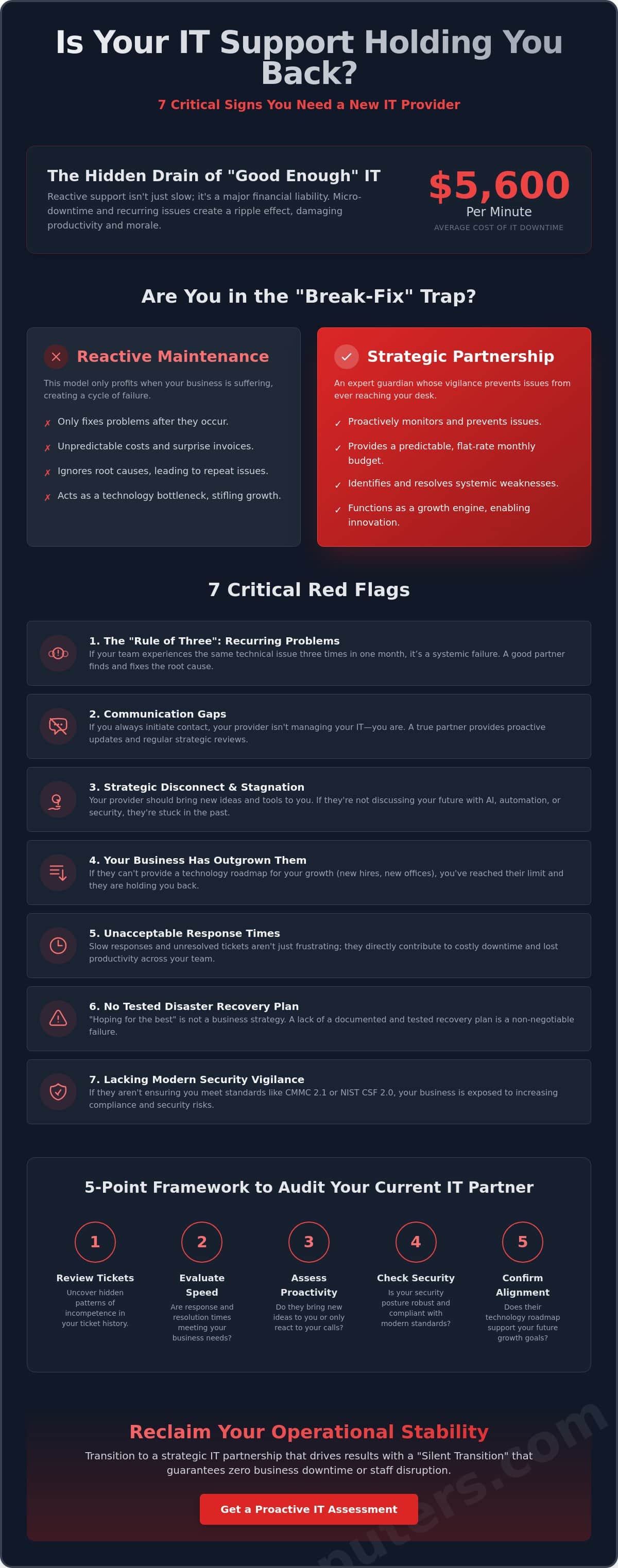
Did you know the average cost of IT downtime can reach $5,600 per minute? If your current support team only responds after your systems crash, they aren’t just slow; they’re expensive. Many business leaders feel a growing sense of anxiety over data breaches or frustration with unpredictable monthly invoices, sensing that their technology has become an anchor rather than an engine for growth. Recognizing the signs you need a new IT provider is the first step toward reclaiming your operational stability and peace of mind.
It’s exhausting to deal with employee complaints about slow computers while worrying if your security protocols meet the latest CMMC 2.1 or NIST CSF 2.0 standards. You deserve a partner who acts as a vigilant guardian, ensuring your network remains secure and your team stays productive. We will help you identify the red flags holding your business back and explain how to transition to a strategic IT partnership that drives results. This article explores seven critical indicators that your current support is failing and provides a clear roadmap to help you achieve zero downtime and predictable budgeting as you pursue your 2026 growth goals.
Key Takeaways
- Differentiate between basic maintenance and strategic IT support to ensure your technology acts as a growth engine rather than a bottleneck.
- Identify the specific communication gaps and operational “Rule of Three” that serve as undeniable signs you need a new IT provider.
- Evaluate whether your current partner is proactively bringing new tools and security innovations to your business or simply reacting to problems.
- Apply a 5-point performance framework to audit your current partnership and uncover hidden patterns of incompetence in your ticketing history.
- Learn how to execute a “Silent Transition” to a new managed service provider without experiencing business downtime or staff disruption.
Understanding the High Cost of “Good Enough” IT Support
In 2026, the gap between maintenance IT and strategic IT has become a chasm that separates market leaders from those struggling to stay afloat. Maintenance IT simply keeps the lights on; it’s a reactive approach that fixes what breaks but ignores the future. In contrast, a strategic Managed service provider (MSP) acts as an expert guardian. This role is meant to be invisible during peak performance because their vigilance prevents issues from ever reaching your desk. If you’re constantly aware of your technology because it’s failing, you’re already seeing the first signs you need a new IT provider.
Transitioning your technology from a cost-center to an investment-driven strategy is essential for adopting modern tools like AI and automation. When your tech is merely “good enough,” it creates a ripple effect that damages employee morale and retention. Frustrated workers who fight their tools every day eventually look for better environments. If your current provider isn’t discussing how to integrate these high-speed efficiencies, they’re likely one of the signs you need a new IT provider. To better understand this concept, watch this helpful video:
The Hidden Drain of Reactive IT Management
The “break-fix” trap is a cycle of failure where your provider only makes money when your business is suffering. This model ignores the high cost of micro-downtime. A five-minute glitch might seem small, but when it happens across a 50-person team multiple times a week, it adds up to dozens of hours in lost labor. Proactive monitoring is the standard for modern business security, identifying vulnerabilities before they become catastrophic breaches. This shift ensures your team stays focused on billable work rather than troubleshooting through recurring technical errors.
Why Your Business Has Outgrown Basic Tech Support
Many organizations start with a local “IT guy” who handles basic repairs, but this model doesn’t scale. When you hire ten new employees or open a satellite office, legacy systems often buckle under the pressure. If your current support can’t provide a technology roadmap that supports your future goals, it’s a clear indicator that you’ve reached their limit. Seeking Managed IT Services in Miami allows you to access enterprise-level infrastructure that grows as you do, replacing technical anxiety with a sense of stability. A partner should offer more than just fixes; they should offer a vision for your operational future.
Critical Operational Red Flags: Is Your Provider Failing You?
Operational excellence is the baseline for any successful business. When your technology functions as a silent engine, you can focus on scale and strategy. However, certain patterns of behavior from your IT support team act as clear signs you need a new IT provider. One of the most telling indicators is the “Rule of Three.” If your team experiences the same technical issue three times within a single month, you aren’t dealing with a series of bad luck. You are witnessing a systemic failure. A competent partner doesn’t just patch a symptom; they identify and resolve the root cause to ensure the problem never returns.
Communication gaps represent another major warning sign. If your provider only reaches out when you initiate a call, they aren’t managing your IT; you are. A true strategic ally provides proactive updates and regular deep-dive audits to ensure your infrastructure remains resilient. For organizations in South Florida, this is especially critical. A lack of a tested disaster recovery plan is a non-negotiable red flag. In a region prone to seasonal weather disruptions, “hoping for the best” is not a strategy. If you’re unsure where your current infrastructure stands, you can quickly request an instant quote to see how a more robust plan fits your budget.
Unacceptable Response Times and Unresolved Tickets
Industry standards for critical response times are typically measured in minutes, not hours or days. If your current provider leaves your staff waiting, your productivity is bleeding out. Watch out for “Zombie Tickets,” those unresolved issues that get closed without a real fix, only to rise again a week later. This often indicates a lack of high-tier expertise or a support desk that is overwhelmed. Modern, flexible workforces require 24/7 help desk support to stay operational across different time zones and schedules. Anything less leaves your business vulnerable during non-traditional hours.
Security Vulnerabilities and Compliance Gaps
The security landscape has shifted dramatically. IBM Security reports that the average cost of a data breach has reached $4.45 million globally. For South Florida law firms and medical practices, the stakes are even higher due to strict compliance requirements like HIPAA and the new modernization rules expected this year. Simply having a firewall is no longer a sufficient defense. You need layers of Ransomware Protection and active threat hunting. If your provider hasn’t updated your security roadmap to include the latest NIST CSF 2.0 standards, your data is at risk. These gaps are definitive signs you need a new IT provider who prioritizes your digital safety.
The Strategic Disconnect: When Your Provider Stops Innovating
If your IT provider hasn’t suggested a single workflow improvement or security upgrade in the last six months, they’ve likely fallen into the “Set It and Forget It” trap. This strategic disconnect is one of the most common signs you need a new IT provider. Technology moves fast. A setup that was adequate in 2023 will likely struggle to meet the demands of your 2026 growth goals. Your provider should be bringing new tools and efficiencies to you, acting as a proactive engine for your success rather than waiting for you to identify problems yourself.
Cloud stagnation is a prime example of this disconnect. Many businesses remain tethered to aging physical servers because their provider lacks the initiative to migrate them. Transitioning to modern cloud infrastructure can often reduce hardware-related expenses by 30% while significantly increasing operational flexibility. A high-tier IT Consultant Firm will vet your entire software stack for efficiency, ensuring every license and tool you pay for actually serves your bottom line. To learn more about how to streamline your infrastructure, it is helpful to consult experts in the field. If you’re the one doing the research on how to improve your systems, you’re paying for a partner but acting as your own CTO.
Lack of Long-Term Technology Roadmapping
A professional IT roadmap is far more than a list of upcoming hardware purchases. It’s a living document that includes quarterly business reviews and three-year projections tailored to your specific industry. Without this level of foresight, your business will inevitably face “emergency” hardware expenses that blow your budget and disrupt your operations. A strategic ally plans for your growth, not just your survival. They look ahead to ensure your infrastructure can handle new hires, new locations, and increased data demands before they become bottlenecks. To see how a dedicated team can help you build this roadmap, you can discover Mytech Partners and their strategic consulting approach.
Opaque Billing and Unpredictable IT Costs
You should never be surprised when you open your monthly IT invoice. Opaque billing and frequent “out-of-scope” charges are major red flags. Many businesses still operate under an hourly “break-fix” model, which fundamentally misaligns incentives. In that model, the provider makes more money when things take longer to fix. By contrast, a Managed IT Support Service offers a fixed-price structure. This model creates predictable budgeting and ensures your provider is incentivized to create a stable, ticket-free environment. If your current invoices are unpredictable, it’s time to seek a partnership rooted in transparency and reliability.
Auditing Your Current IT Partnership: A Performance Framework
Evaluating your technology partner requires a structured approach that moves beyond surface-level satisfaction. To determine if your current arrangement is truly serving your growth, apply a 5-Point Audit focused on Response, Resolution, Security, Strategy, and Support. These categories reveal the subtle signs you need a new IT provider before a minor glitch turns into a major disaster. A provider who excels in one area but fails in strategy or security is not a partner; they’re a liability.
Start by reviewing your ticketing history for patterns of incompetence. If the same issues keep appearing, or if tickets remain open for days without a clear resolution path, your provider lacks the high-tier expertise required for a modern enterprise. You should also assess the personal touch. A partner who knows your staff by name provides a level of accountability that faceless call centers cannot replicate. Finally, perform a contract check. Look for hidden fees for “out-of-scope” support or restrictive exit clauses that make it difficult to transition to a more capable ally.
Measuring ROI Beyond the Monthly Invoice
Employee wait time is a silent profit killer. When your staff sits idle waiting for a password reset or a server reboot, you’re paying for labor that produces zero value. High-quality network IT support in Miami ensures that these micro-delays don’t accumulate into weeks of lost productivity during peak business seasons. Beyond the numbers, consider the Peace of Mind metric. If you spend your weekends worrying about potential data breaches, your provider isn’t doing their job. A guaranteed night of sleep is a primary benefit of a truly proactive partnership. Don’t settle for less than total confidence in your infrastructure.
Assessing Communication and Transparency Standards
Transparency is the bedrock of a secure partnership. You must have full access to your own passwords, network documentation, and software licenses at all times. If your provider is reluctant to share this information, they are essentially holding your data hostage. You should also receive proactive status reports that detail your system health and security posture without having to ask for them. A lack of transparency is a major warning sign that your provider is hiding vulnerabilities or operational gaps. If your current partnership feels like a black box, it’s time to gain clarity. Request an instant quote today to see how transparent, strategic IT support can transform your business operations.
Navigating the Transition to a Proactive Managed IT Partner
Once you recognize the signs you need a new IT provider, the final hurdle is often the fear of the transition itself. Many business owners worry that switching will cause massive downtime or data loss. This is a common myth. A professional Managed IT Partner uses a “Silent Transition” method. This process involves installing non-intrusive monitoring tools alongside your current provider’s setup to map your network before the official handover. Your staff shouldn’t even notice the change until they receive their first welcome email from a more responsive help desk. Ignoring the signs you need a new IT provider only delays the inevitable and compounds your operational risk.
Local presence is a critical factor for businesses in Miami, Aventura, and Fort Lauderdale. While remote support handles the majority of issues, on-site emergencies require a technician who can arrive at your office quickly. Telx Computers provides this localized security, backed by a guarantee of unlimited support and fixed pricing. This model ends the billing headaches and unpredictable invoices that often characterize failing IT relationships. With the global managed services market projected to reach $332.78 billion in 2026, the industry is shifting toward these high-efficiency, partner-led models that prioritize stability over hourly billing.
What to Look for in a Modern MSP in Miami and Beyond
You need more than just a repair service. Look for a partner that offers 24/7 localized help desk support rather than an outsourced call center where your tickets get lost in a queue. Industry-specific expertise is also vital. Whether you’re in Healthcare, Law, or Finance, your provider must understand specific compliance requirements like DORA or the latest HIPAA modernization rules. Reviewing IT Companies in Miami reveals that Telx integrates deeply with the regional business community, providing the specialized knowledge required for South Florida’s unique regulatory landscape.
Ensuring a Seamless Handover Without Operational Disruption
A successful move relies on a 30-day overlap strategy. During this window, your new provider audits your existing infrastructure while the old provider remains on call for legacy issues. This ensures no data is lost and every administrative credential is secure. You must regain ownership of your passwords and network documentation to prevent being held hostage by a former partner. Professional offboarding should be clean and cooperative. Once your new systems are verified, you can move forward with a technology roadmap built for your future. Ready to reclaim your peace of mind? Get an instant quote for a proactive partnership and see how a strategic ally fuels your growth.
Secure Your Competitive Edge with a Strategic IT Alliance
Your technology should never be a source of anxiety or a bottleneck for your ambitions. Identifying the signs you need a new IT provider is the first step toward reclaiming your focus and fueling your organization’s success. Moving from a reactive model to a proactive partnership ensures that your infrastructure remains a silent, powerful engine for your team. You deserve a partner who acts as a vigilant guardian, offering more than just basic repairs.
We provide the stability your business needs through 24/7 proactive monitoring and a commitment to rapid on-site response across Miami-Dade and Broward. With fixed-price unlimited support, you can finally achieve predictable budgeting and total peace of mind. It’s time to stop fighting your tools and start leveraging them to reach your long-term growth targets. Request an Instant Quote to See How Telx Computers Can Protect Your Growth. We are ready to make your transition seamless, secure, and successful.
Frequently Asked Questions
How long does it typically take to switch IT providers?
Most transitions take between 30 and 60 days to complete successfully. This timeline allows your new partner to perform a deep-dive audit, install monitoring tools, and secure all administrative credentials. A structured approach ensures that all critical systems are documented and managed before your old contract expires. Taking this time prevents security gaps and ensures a smooth handover of your digital assets.
Will my business experience downtime during the transition?
You should not experience any downtime if the transition is managed by a professional team. A proactive partner uses a “Silent Transition” method, working in the background alongside your existing provider to map your network. They only perform final cutovers during off-peak hours to ensure your staff remains productive. This method ensures your backend infrastructure shifts to a more reliable platform without interrupting your daily operations.
What should I do if my current IT provider is not cooperating with the move?
You should immediately review your service contract for language regarding data ownership and transition assistance. If they refuse to provide passwords or documentation, your new provider can often use specialized tools to regain control of your network. Professionalism is key; a strategic ally will help you navigate this friction while securing your digital assets and administrative access. They act as your advocate to ensure a clean offboarding process.
How do I know if my business is large enough for managed IT services?
Any organization with at least 10 users typically benefits from a managed model. If you rely on technology for daily operations, communication, or data storage, you’re large enough. Managing these systems internally often leads to the very signs you need a new IT provider, such as slow resolution times and security gaps that put your growth at risk. A managed approach provides the enterprise-level tools necessary to scale securely.
What are the most common hidden fees in IT contracts?
Hidden fees often appear as “out-of-scope” labor charges for basic maintenance or high costs for onboarding new hardware. Some providers also charge extra for essential services like data backups or after-hours emergency support. You should look for a fixed-price model that includes unlimited help desk support. This structure creates predictable budgeting and ensures you are never surprised by your monthly technology invoice.
How often should my IT provider be giving me a security audit?
You should receive a comprehensive security audit at least once per year, with smaller quarterly reviews. These sessions ensure your systems align with evolving standards like NIST or the latest health and financial regulations. Regular auditing identifies vulnerabilities before they become breaches. If your provider hasn’t reviewed your security posture recently, it’s a major indicator of a strategic disconnect that could leave your data vulnerable to modern threats.
Can a new IT provider help me with compliance like HIPAA or SOC2?
Yes, a specialized IT consultant firm will align your infrastructure with specific regulatory requirements. They implement the necessary encryption, access controls, and reporting tools to ensure you meet legal standards. This proactive approach reduces your liability and prepares your organization for official audits. It’s one of the most important signs you need a new IT provider who understands your industry. They act as your expert guardian for compliance.
Why is a local Miami IT company better than a national remote-only provider?
A local provider offers rapid on-site response for hardware failures that remote support simply cannot fix. They also understand South Florida’s unique challenges, such as seasonal weather threats and regional compliance needs. Having a partner who can physically visit your office in Miami, Aventura, or Fort Lauderdale provides an extra layer of security and accountability that a remote-only call center lacks. This localized focus ensures your business remains operational regardless of the situation.