





24 Oct Business Continuity Solutions for Pompano Beach Manufacturers
Business continuity solutions for manufacturers in Miami, Aventura, and Fort Lauderdale help keep essential operations running during disruptions. A continuity plan identifies critical people, processes, facilities, technology, and resources, then explains how to maintain or resume priority work. Disaster recovery is one part of continuity planning, focused on restoring systems, applications, and data after an outage or failure.
For manufacturers, an interruption can affect more than production. A practical plan from Telx Computers accounts for dependencies such as power, data access, replacement parts, suppliers, and communication, giving teams clear priorities instead of leaving them to improvise under pressure.
This article explains how to assess business impacts, develop recovery strategies for technology, workplaces, and people, and test plans as operations change. It also covers how to evaluate continuity software that organizes plans, coordinates communication, and tracks reviews and exercises. The goal is a practical approach suited to your operation and a clearer path through disruption.
Key Takeaways
- Identify the people, processes, facilities, technology, and resources your operation needs to keep essential work moving during a disruption.
- Set recovery priorities around operational impact, including how long critical functions can remain unavailable and how much data the business can afford to lose.
- Build recovery strategies for technology, work locations, communication, and staff coverage rather than relying on a single solution or person.
- Use regular exercises to reveal gaps, then update the plan when staffing, infrastructure, or operations change.
- Choose continuity software that fits your workflows and supports communication, plan management, and clear tracking of reviews and tests.
What is Business Continuity Planning?
A business continuity plan explains how a manufacturer will maintain essential work during disruption. It brings together risk assessment, assigned responsibilities, and practical recovery steps.
According to the International Organization for Standardization, ISO 22301 is a recognized management systems standard developed by ISO Technical Committee 223 for societal security. It offers a reference point for organizing continuity management, while each manufacturer must shape its plan around its own processes and risks.
The cost of manufacturing continuity planning and disaster recovery in South Florida depends on the operation’s sites, critical systems, recovery needs, and level of planning support. Request a quote based on your specific requirements.
Manufacturers in Pompano Beach can use managed IT services for technology recovery and broader continuity planning for organization-wide preparedness. Compare how each approach addresses production dependencies, data recovery, response responsibilities, and plan testing.
Business interruption and supply-chain disruption coverage depends on the policy and type of coverage. Policies generally cover damage from specified events, such as hail or windstorms. Review whether the policy’s covered damage and interruption provisions address your operation’s risks.
Include official City of Pompano Beach and Broward County emergency-management communications in plans for local alerts and response coordination. Record how staff will receive updates and who will relay instructions if normal communication systems fail.
Planning and Response Responsibilities
Assign responsibility for declaring an incident, contacting staff, coordinating departments, and tracking recovery priorities. Name a backup for each key role so the response does not depend on one person being available. For example, production leaders can assess affected lines while IT staff evaluate system access. Keep responsibilities and contact procedures together in an accessible, current plan.
Risk Assessment for Continuity Planning
List hazards that could interrupt production, then rank them by likelihood and operational impact. Assess how power loss, unavailable data, supplier delays, or equipment failure could affect critical processes. Trace dependencies: a production line may rely on a specific networked system, replacement part, or vendor. Use these connections to prioritize recovery actions and direct protection where an interruption would have the greatest effect.
Plan Coverage for Manufacturing Operations
Identify the resources needed to resume priority production: equipment, applications, configurations, data, staff, suppliers, and communication channels. Document how teams will operate if a facility, network, or essential resource becomes unavailable. Include options for replacement technology and temporary operating locations. Identify critical materials or services that suppliers might delay, then define alternative steps and who will coordinate them.
Business continuity planning provides a structured approach to risk management and business impact analysis. Consider employees, customers, facilities, infrastructure, and data backup solutions. Assess how third-party vendors affect critical functions and whether their plans support recovery. Backup planning should account for data criticality and the redundancy needed to restore information within a timeframe that meets the company’s needs.
Connect business continuity management with the other risk management approaches used across the organization. Comparing preparedness costs with potential losses from an interruption can help leaders allocate resources for protection.
Recovery strategies for technology, workplaces and people
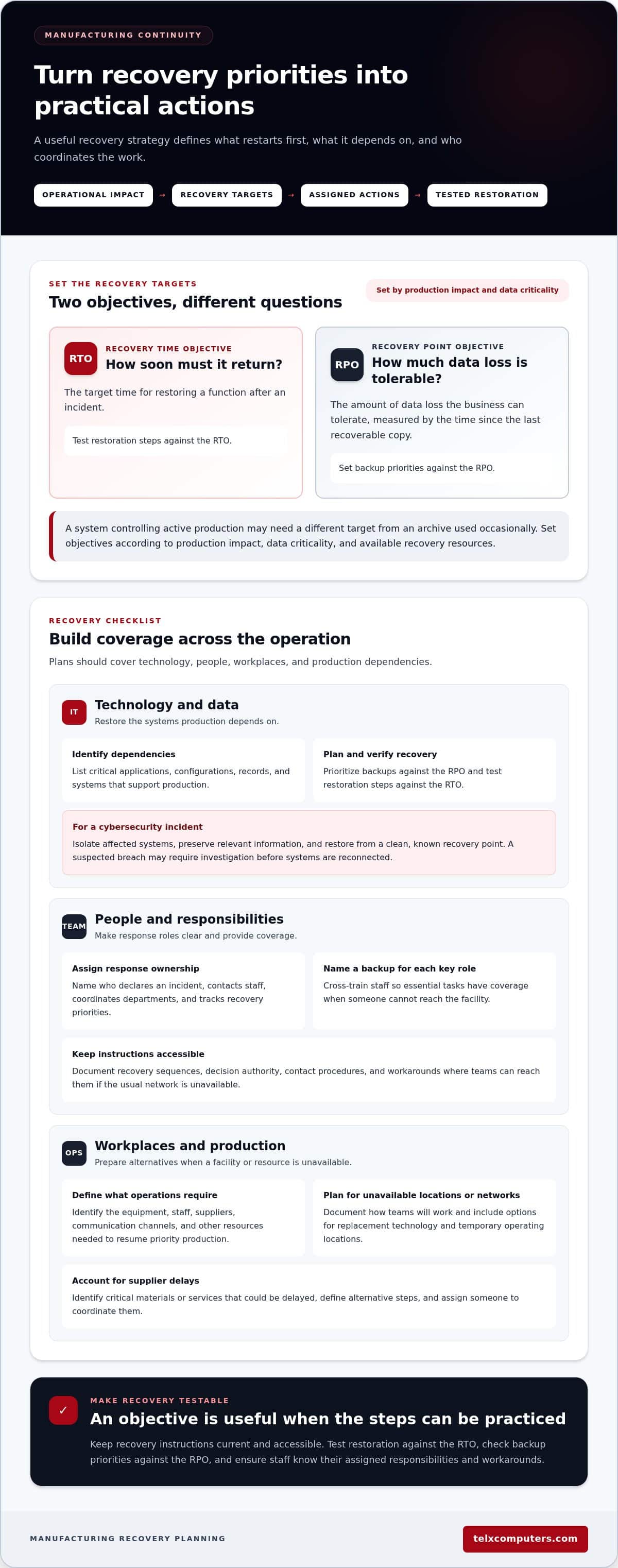
A useful recovery strategy turns operational priorities into assigned actions. For each disruption, define what must restart first, which resources it requires, and who will coordinate the work.
Recovery Time and Point Objectives
A Recovery Time Objective (RTO) sets the target time for restoring a function after an incident. A Recovery Point Objective (RPO) defines how much data loss, measured by the time since the last recoverable copy, the business can tolerate. Set each objective according to production impact, data criticality, and available recovery resources. For example, a system controlling active production may need a different target from an archive used occasionally.
Written Plans and Staff Responsibilities
Write down the recovery sequence, decision authority, contact procedures, and workarounds for essential tasks. Give each action a primary owner and a backup, then make the instructions accessible if the usual network is unavailable. NIST recommends documenting standard operating procedures and cross-training staff so tasks have adequate coverage during disruptions. A manufacturing team can practice switching responsibilities when a key operator cannot reach the facility.
Data Recovery and Cybersecurity Incidents
Rapid data recovery starts with identifying the applications, configurations, and records production depends on. Set backup priorities against the RPO, and test restoration steps against the RTO. For a cybersecurity incident, isolate affected systems, preserve relevant information, and restore from a clean, known recovery point. Treat a suspected breach differently from a simple password loss: compromised systems may need investigation before reconnection.
Document who can authorize restoration and how teams will confirm that recovered systems support safe, accurate work. Backups are useful only when staff know how to access them and the recovery process has been exercised.
Preparing for Local Disruptions
For hurricanes, flooding, and power outages in Pompano Beach, map the equipment, records, and communications each site needs to operate. Identify critical systems that depend on electricity, define safe shutdown steps, and plan how staff will receive instructions if the usual workplace or network is unavailable. Keep recovery copies accessible away from the primary site, and include a temporary operating location in the response plan.
Generator installation, fuel storage, and facility emergency procedures must account for applicable local and state requirements, equipment, fuel type, and site conditions. Document responsible roles, shutdown actions, and communication procedures in the written plan.
Review strategies after changes to staffing, infrastructure, or production processes. A tabletop exercise can test whether staff understand their roles, while a restoration exercise can reveal gaps between documented recovery steps and actual system access.
A manufacturing business continuity plan should include crisis or emergency plans, incident response plans, department and management continuity plans, and IT recovery plans. Document arrangements and recovery timeframes so people know what to do when a disaster occurs.
Business continuity planning helps organizations set Recovery Time Objectives and Recovery Point Objectives that match operational needs and available resources. Manufacturers with multiple production plants may consider cloud-based disaster recovery plans, which can require less testing time and a smaller staff. More broadly, continuity strategies combine planning, data backup and recovery, communication procedures, infrastructure redundancy, and ongoing testing. Recovery plans can help manufacturing companies respond to disruptions more quickly and reduce financial losses.
Business impact analysis
A business impact analysis (BIA) shows how a disruption could affect essential manufacturing functions. It helps leaders rank recovery priorities by examining operational consequences, people, technology, and resource dependencies.
Disruption Impacts on Operations
Map each production process, from receiving materials to quality checks and shipment. For every function, identify what would stop if a facility, key employee, application, or data source became unavailable. A production line may depend on networked controls, while shipping may rely on order records and carrier communication. Trace these connections to understand how one failure could affect downstream work.
Assess the consequences for people, customers, and output. Consider whether employees can perform tasks safely, whether an interruption will delay customer orders, and whether another department can continue working. Record which functions must resume first and the conditions needed to restart them. This distinguishes an inconvenience, such as a delayed report, from an interruption that stops a critical production step.
Ask the same questions about each function: what is affected, who depends on it, and what resources are needed to restore it? Department leads can describe workarounds and operational limits. Compare their answers to identify conflicts, such as two teams needing the same specialist or equipment during recovery. Set priorities for the whole organization, not just the department reporting the disruption.
Mapping Resources to Business Needs
Map each priority function to the people, equipment, technology, data, facilities, and third parties it needs. For example, packaging may depend on trained operators, functioning machinery, production instructions, power, and a supplier’s materials. Record who owns each resource and what alternatives are available if it cannot be accessed. This connects business impact findings to practical recovery decisions.
- People: Identify essential skills, role coverage, and decision authority.
- Technology: Link applications and data to the processes that use them.
- Physical resources: Record equipment, utilities, work areas, and replacement needs.
- External dependencies: Note suppliers and services that support critical functions.
Use the map to identify single points of dependency, such as one specialist, system, or source of a critical part. Compare preparedness options with the potential business impact of losing that resource. A practical BIA does more than list assets: it explains how each resource supports a function and what the organization can do if that connection fails.
Review the analysis with department leads and update it when processes, systems, staffing, or suppliers change. A new production system, for instance, may change data access needs and create different dependencies. Keep assumptions visible so decision-makers can distinguish verified workflows from workarounds that still need validation.
Testing, exercises, and continuous improvement
A written continuity plan needs practical testing to show whether people can follow it and recovery steps work. Manufacturers should review and test plans annually, then revise them when exercise findings or operational changes reveal gaps.
To create, test, and update a plan, assign owners to essential functions, document response steps, run exercises, record results, and address identified weaknesses. Repeat the cycle after changes to staffing, infrastructure, or production.
Testing Policies and Procedures
Set a testing policy that names the exercise owner, scope, participants, and records to retain. A tabletop exercise can walk managers through a power outage, while a communication test checks whether staff receive instructions. A recovery exercise can test backup restoration and system access. Choose scenarios that reflect actual production dependencies, and document failures, decisions, and corrective actions.
For readiness reviews, keep the current plan, exercise schedule, results, and remediation records organized in one secure location. These records help leaders show that procedures have been reviewed and tested, rather than relying on memory. A reviewer can trace a finding, such as an outdated contact, to its owner and resolution. Testing should establish whether staff can use the plan, not merely whether a document exists.
Testing and Updating the Plan
Use exercise results to update procedures, contacts, recovery priorities, and resource assumptions. Assign each corrective action to a responsible role, record its status, and verify the change in a later exercise. Review the plan annually and after changes to infrastructure, staffing, or operations. This keeps recovery strategies aligned with how the manufacturing business actually works.
Consulting support can help structure exercises, interpret technical recovery findings, and turn gaps into prioritized actions. The business must still provide accurate production workflows and decision-making roles, because those details determine whether a scenario reflects real operations. For example, a test involving a failed application should include the team that depends on its data, not only technical staff.
Choose exercise methods based on the capability being tested. A tabletop discussion checks decision-making; communication testing checks message delivery; a recovery exercise checks whether systems and data can be restored. A full continuity assessment can examine how these elements work together. Use different methods over time, and do not treat a successful discussion as proof that a backup or recovery process works.
After each exercise, record the scenario, participants, actions taken, and unresolved issues. Compare results with the plan’s recovery priorities, then revise procedures where teams encountered unclear instructions or missing access. Schedule follow-up testing for important corrections. This repeatable improvement cycle helps keep procedures usable as equipment, software, suppliers, and staff responsibilities evolve.
Business continuity software selection
Manufacturers in Pompano Beach can combine continuity management software with data backup and recovery, emergency communications, and infrastructure redundancy. Choose tools to support the operation’s workflows and recovery priorities, rather than buying features in isolation.
Start by listing what employees need to do during an emergency. Then compare software with the tasks it must support: maintaining current plans, contacting staff, recording exercises, and tracking weaknesses that still need attention. Business continuity solutions for manufacturers in Pompano Beach should make responsibilities and next steps clear to the people who must act.
- Emergency communication: Look for two-way communication with staff through voice, text, and email, so employees can receive instructions and respond.
- Plan records: Check whether teams can organize procedures, contacts, responsibilities, and recovery priorities in an accessible system.
- Testing visibility: Reporting and dashboards should show whether plans were reviewed and tested, and whether identified weaknesses were addressed.
- Fit to operations: Assess whether the system can represent the company’s actual sites, departments, processes, and dependencies.
Test each capability during evaluation. For example, trace how a plan owner updates a procedure, how employees receive an alert, and how management sees an unresolved exercise finding. A useful demonstration follows the same steps staff would use under pressure. Confirm that the workflow supports both plan maintenance and real response decisions.
Consider how the software will work with existing communication and data systems. A continuity platform organizes plans and response activity; it does not replace tested backups or a recovery strategy. Define which system holds the current version of each record, who can access it during an outage, and how updates reach relevant teams.
Compliance management features may help organizations meet applicable industry regulations and standards. Assess those features against the company’s actual obligations and recordkeeping needs. Do not choose software solely for a broad compliance module; prioritize functions the business will maintain and use.
There is no one-size-fits-all option. A manufacturer with several sites may prioritize consistent plan access and coordinated communication, while a single-site operation may focus on clear responsibilities and simple updates. The right business continuity solutions for manufacturers in Pompano Beach connect software choices to operational needs and the team’s capacity to maintain them. Compare the effort needed to keep information current, train employees, and track corrective actions.
Before choosing, establish who owns configuration, plan updates, user access, and exercise records. Set evaluation criteria from operational needs, then use a realistic disruption scenario to check whether the software helps employees prepare and coordinate. Discuss continuity technology needs as a practical next step.
Telx Computers: Managed IT Services
Telx Computers helps manufacturers align technology support with continuity priorities through Managed IT Services. Turn to its team when you need to coordinate day-to-day IT operations with recovery planning, protect business systems, or support access to cloud resources.
Network Security and Cloud Computing can support a broader technology strategy, while 24/7 Help Desk Support gives employees a channel for IT assistance. These offerings complement a manufacturer’s own continuity plan; operational leaders still define production priorities, staff responsibilities, and site-level procedures.
As a practical next step, identify the systems and support needs that matter most during an interruption. Contact Telx Computers to discuss how Managed IT Services can support your manufacturing operation.
Make Your Next Continuity Move
A continuity plan is more useful when technology decisions reflect how your manufacturing team works. Identify where IT support, system security, and employee assistance can strengthen response priorities, then align those needs with a practical technology approach.
For manufacturers evaluating business continuity solutions in Pompano Beach, Telx Computers can help connect operational needs with Managed IT Services, Network Security, and 24/7 Help Desk Support. The right support can complement your internal plan while your team maintains ownership of production priorities and response decisions.
Bring your key technology concerns and recovery priorities into a conversation with Telx Computers. Contact Telx Computers to discuss a suitable next step for your operation. With a clear plan and the right technology partnership, your team can move forward with greater confidence.
Frequently Asked Questions
How can manufacturers protect production systems, data, and operational technology from cyberattacks and outages?
Separate production technology from general business systems, restrict access to authorized users, and protect remote connections used by staff or vendors. Keep an inventory of essential controllers, software, and configuration files so teams know what needs protection. For example, document how a compromised workstation could affect a connected production system. Coordinate security updates with operations, then verify that critical equipment works correctly after changes.
How should manufacturers compare cloud backups, off-site backups, colocation, and managed disaster recovery?
Compare these options by the recovery environment they provide, the work your staff must manage, and how quickly essential systems can return. Cloud backups store copies in cloud infrastructure; off-site backups keep copies away from the primary facility. Colocation places company equipment in a separate data-center facility, while managed disaster recovery adds recovery support. Match each option to the systems, data, and internal expertise your operation depends on.