





08 Oct Cybersecurity for Wealth Management Firms in Aventura
What if a routine email or compromised account exposed client records and interrupted advisory work? Wealth management firms handle sensitive information across inboxes, devices, cloud services, and vendor platforms, creating multiple points that need protection. That’s why cybersecurity for wealth management firms in Aventura must safeguard the full flow of client data, not just the office network. Phishing, payment fraud, and ransomware can threaten daily operations and the trust clients place in your firm.
Security needs to be strong without slowing the work clients depend on. Start by identifying your riskiest workflows, then apply layered safeguards and assign responsibility for maintaining them. This article covers practical ways to assess email security, access controls, monitoring, backups, and incident readiness, including the role vendors play in your security picture. Telx Computers provides managed IT and cybersecurity support for businesses in Aventura, Miami, and Fort Lauderdale, helping connect these protections with day-to-day operations.
Key Takeaways
- Map onboarding, reporting, document exchange, and payment workflows to identify where sensitive information needs protection.
- Use layered safeguards to address impersonation, account compromise, and ransomware while supporting essential advisory work.
- For cybersecurity for wealth management firms in Aventura, review controls across identity, email, endpoints, networks, backups, and monitoring.
- Turn assessment findings into an action plan by prioritizing gaps, assigning owners, and reviewing controls regularly.
- Connect managed IT, security audits, support, monitoring, and backups to help maintain dependable daily operations.
Why Aventura Wealth Management Firms Need Workflow-Based Cybersecurity
Wealth-management cybersecurity protects client information, financial accounts, business systems, and the firm’s ability to operate. For cybersecurity for wealth management firms in Aventura, a useful starting point is not a list of tools. First map how information moves through advisory work, then identify safeguards for each step that won’t unnecessarily complicate routine service.
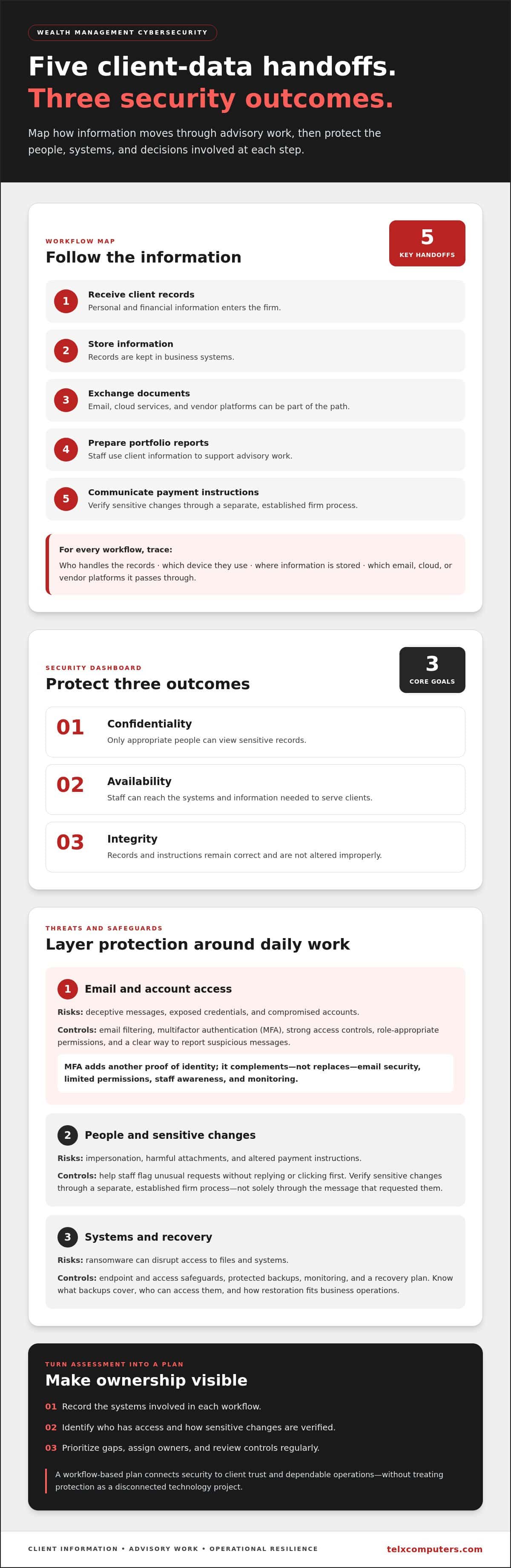
Consider a client relationship from onboarding onward. Staff collect personal and financial records, store them in business systems, exchange documents by email or cloud services, prepare portfolio reports, and communicate payment instructions. Each handoff creates a point where information could be exposed, changed without authorization, or become unavailable. A workflow view helps connect safeguards to actual work. Understanding Computer Security also provides a broad foundation for thinking about the protection of systems and networks.
To see how cybersecurity applies across financial services, watch this overview:
For each workflow, ask what must remain confidential, available, and accurate. Confidentiality means only appropriate people can view sensitive records. Availability means staff can reach the systems and information needed to serve clients. Integrity means records and instructions remain correct and aren’t altered improperly. A weakness in any one area can undermine confidence, delay decisions, or complicate a transaction.
Workflow-based cybersecurity protects client trust and operational resilience by securing sensitive information at every step of the advisory process. This keeps planning focused on business outcomes rather than treating security as a disconnected technology project.
Which wealth-management workflows carry the greatest exposure?
Trace records from the moment staff receive them: who handles them, which device they use, where they store them, and whether they pass through email, cloud services, or vendor platforms. Pay particular attention to administrator accounts, which can affect broad system access, and changes to financial instructions, where an unauthorized edit could have serious consequences. For each workflow, record the systems involved, who has access, and how sensitive changes are verified.
Why does Aventura location matter to the security plan?
Aventura firms may support clients and employees across South Florida, with work taking place in an office, remotely, or on mobile devices. The plan should account for those different working conditions without assuming location creates a unique threat. Telx Computers serves businesses in Aventura, Miami, and Fort Lauderdale with managed IT support that can coordinate with the firm’s team. The goal is consistent protection wherever advisory work happens.
Risk varies by firm. A small team with limited vendor access may have different priorities from a firm with numerous systems and complex document flows. Mapping workflows first helps leaders see where access, oversight, and recovery planning deserve attention. It also gives IT and advisory staff a shared picture of how safeguards can support reliable service instead of obstructing it.
The Cybersecurity Threats and Controls Aventura Wealth Managers Should Understand
Threats often target routine communication. A message that appears to come from a client, custodian, or colleague may prompt an employee to reveal credentials, open a harmful attachment, or act on altered payment instructions. Account compromise can also let an intruder access sensitive records or send convincing messages from a legitimate account. For cybersecurity for wealth management firms in Aventura, controls should address both the technology and the decisions people make while serving clients.
Layered safeguards give the firm multiple ways to prevent, detect, and recover from an incident. They don’t make incidents impossible. FINRA’s cybersecurity guidance for financial firms offers resources on managing cybersecurity risks and responding to threats. Firms can use such guidance alongside their own risk assessments and established procedures.
How can firms reduce email and account compromise risk?
Combine email filtering with multifactor authentication (MFA), strong access controls, and a clear process for reporting suspicious messages. Give staff only the access needed for their roles, and make it easy to flag unusual requests without replying or clicking first. Verify sensitive changes, especially payment instructions, through a separate, established firm process rather than relying solely on the message that requested them.
MFA reduces account-takeover risk by requiring an additional proof of identity, but it can’t replace email security, access controls, staff awareness, or monitoring. These measures work together: filtering can reduce unwanted or deceptive messages, while MFA and limited permissions make a stolen password less useful. Telx Computers provides email security that can complement these practices. Its ransomware protection planning also supports efforts to limit disruption if an attack reaches firm systems.
What role do backups and monitoring play?
Ransomware can disrupt access to files and systems, so pair endpoint and access safeguards with protected backups and a recovery plan. Know what information the backups cover, who can access them, and how restoration would fit into business operations. Documenting these details ahead of time helps teams make recovery decisions with less uncertainty.
Ongoing monitoring can help teams spot unusual activity or service issues that warrant investigation. It doesn’t replace incident response, and an alert alone doesn’t establish what happened. Staff should know how to escalate a concern, and technical support should know which advisory systems and workflows are most important to restore. Telx Computers provides server monitoring as part of its managed IT services.
Build safeguards around actual risk. A firm might prioritize account access for employees who handle financial instructions, while also checking that email safeguards, endpoint protection, and recovery plans support the systems used for daily advisory work. Review the controls when workflows, staff access, or vendor connections change. This keeps security practical and aligned with client service.
How to Evaluate Cybersecurity Coverage Without Disrupting Advisory Work
Improving security doesn’t have to mean changing every system at once. A phased approach lets a firm address consequential gaps while preserving essential advisory workflows. For each safeguard, identify what it protects, who owns it, how it affects staff, and how it will be maintained. Schedule changes around operational needs and explain them clearly so employees know what to expect.
The NIST Cybersecurity Framework for Risk Management can help organize this review around identifying, protecting, detecting, responding, and recovering from cyber risks. Use it as a planning reference, not a certification or guarantee of compliance. Technical safeguards support a firm’s security program, but they don’t determine regulatory applicability or replace governance decisions. Qualified compliance or legal advisors can help interpret obligations for the firm’s specific status and activities.
Use this coverage comparison to spot areas that need review. For each one, record current safeguards, gaps, business impact, an accountable owner, and ongoing maintenance needs.
Which questions reveal gaps in a firm’s current controls?
Check whether access matches each person’s role and is reviewed when responsibilities change. Can staff report suspicious messages through a clear, familiar process? Are incident responsibilities documented, and do relevant people know how restoration decisions would be made? Reviewing these questions together can uncover gaps between written procedures and daily practice before they disrupt client service.
How should firms balance protection with practical operations?
Compare each proposed change by risk reduction, staff impact, ownership, and maintenance needs. Prioritize safeguards that protect sensitive workflows without adding avoidable steps to routine work. A managed IT partner can coordinate ongoing technology support with security priorities.
For cybersecurity for wealth management firms in Aventura, the result should be a practical sequence, not a disruptive overhaul. Telx Computers supports ongoing IT and security planning for businesses in Aventura, Miami, and Fort Lauderdale. Explore support for your firm’s IT operations as you turn assessment findings into a managed plan.
A Practical Cybersecurity Action Plan for an Aventura Wealth Management Firm
A useful cybersecurity plan turns findings into assigned work. Start with a focused cybersecurity audit, then use the results to build a prioritized roadmap that protects advisory operations and makes ownership clear. For cybersecurity for wealth management firms in Aventura, the plan should reflect the firm’s systems, people, vendors, and recovery dependencies, not a generic checklist.
Use this sequence to move from assessment to ongoing improvement:
- Map sensitive workflows. Document how client information moves through onboarding, reporting, document exchange, and financial instructions. Note the systems and people involved at each step.
- Assess current controls. Review safeguards across systems, user access, email, devices, networks, vendors, backups, and monitoring. Record what’s working and where evidence or ownership is unclear.
- Prioritize gaps. Rank findings by potential effect on sensitive information and essential advisory work. Distinguish urgent exposure from improvements that can be scheduled for a later phase.
- Assign owners. Name the person responsible for each remediation item and define who coordinates an incident. Include leadership, IT support, compliance personnel, and relevant outside advisors in their appropriate roles.
- Review and update. Track actions to completion, revisit unresolved risks, and update the plan as the firm’s technology and operations change.
What should a cybersecurity review document?
Create a controlled working record of critical systems, sensitive information locations, user access, and third-party dependencies. Solutions such as EmberHound can help pinpoint and inventory where sensitive client files and card data reside across systems. For each safeguard, capture its current state, known gaps, accountable owner, and agreed priority. Include recovery contacts and escalation paths so the right people can coordinate, but keep sensitive operational details in appropriately protected documentation rather than distributing them broadly.
Incident responsibilities should be practical. Leadership can direct business decisions, IT support can coordinate technical investigation and restoration, and compliance personnel can help assess internal obligations. Relevant outside advisors may support decisions within their expertise. SEC or FINRA rules may apply depending on the firm and its activities, so verify current requirements and applicability with qualified compliance or legal advisors before relying on a particular interpretation. For broader institutional governance and risk management strategies, firms often reference specialized industry advisors such as versapien.com.
How can firms test readiness and maintain progress?
Revisit the review after material changes to technology, staffing, vendors, or business processes. Tabletop discussions can help participants practice communication and decision-making using a scoped scenario. Separately, planned backup restoration exercises can help reveal whether documented recovery steps work as expected. Record lessons, assign follow-up actions, and track completion without treating any exercise as proof that all risk has been removed.
Ongoing managed IT support can connect technical maintenance with the firm’s security priorities. Telx Computers provides managed IT support for coordinated technology operations. Build a clearer path from assessment to action with Telx Computers cybersecurity and IT support.
How Telx Computers Supports Cybersecurity for Wealth Management Firms in Aventura
Strong protection depends on how well technology safeguards fit the firm’s everyday work. Telx Computers supports businesses in Aventura, Miami, and Fort Lauderdale with managed IT, network security, email security, cybersecurity audits, server monitoring, and data backup and disaster recovery. These services can be coordinated around the systems and workflows your team relies on, connecting risk review with ongoing technology management.
For an advisory firm, that means looking beyond isolated tools. A cybersecurity audit can help document current controls and potential gaps. Network and email security address different parts of the firm’s technology environment, while monitoring and backup services support oversight and recovery planning. Priorities depend on the firm’s systems, access patterns, vendors, and operational needs. No single service can eliminate risk, but a coordinated approach can make responsibilities and next steps clearer.
What does an integrated security partnership look like?
An integrated relationship connects day-to-day user issues with broader security and continuity needs. Help desk support assists staff with technology problems, while network and email security support protection across key systems and communications. Server monitoring provides ongoing oversight, and backup services contribute to recovery readiness. Telx Computers provides 24/7 help desk support alongside these services, supporting dependable operations rather than treating security as a one-time project.
Ongoing coordination also helps keep technology safeguards aligned as firm operations change. A change in staff responsibilities may call for an access review, while a new vendor connection may prompt a closer look at system dependencies. Telx Computers provides network IT support in Miami and serves businesses in Aventura and Fort Lauderdale.
What should a firm expect from the next conversation?
Start with details that will make the discussion useful: which advisory workflows are most important, where staff encounter technology friction, which security concerns are top of mind, and what recovery dependencies the firm needs to understand. You don’t need to arrive with a finished technical plan. A clear picture of current priorities gives the conversation a practical starting point.
A cybersecurity audit can help establish that picture by reviewing systems, access, safeguards, and potential gaps. It can inform a prioritized plan for improvement, while leaving regulatory interpretation and compliance decisions with the firm and its qualified advisors. The goal is a grounded view of what’s in place and what deserves attention, not a promise that risk can be removed.
Telx Computers works with businesses in Aventura, Miami, and Fort Lauderdale to connect cybersecurity priorities with ongoing IT operations. Discuss your firm’s cybersecurity priorities with Telx Computers and take the next step toward a practical, coordinated plan.
Make Your Next Security Decision Count
A stronger security program doesn’t need to begin with a sweeping technology overhaul. Choose a clear first step: identify the workflow or concern that most needs attention, then use it to guide a focused conversation about practical safeguards and ongoing support. This keeps cybersecurity for wealth management firms in Aventura connected to the way your firm operates and the confidence clients place in your team.
Telx Computers provides cybersecurity audits and IT support for businesses in Aventura, Miami, and Fort Lauderdale. Bring your priorities, questions, and current challenges to a discussion, and start shaping a plan that fits your firm’s operations.
Discuss cybersecurity support for your Aventura wealth management firm. A clear next step can help your team move forward with greater confidence.
Frequently Asked Questions
Is cybersecurity different for a wealth management firm?
Yes. Foundational safeguards may resemble those used in other businesses, but priorities should reflect how the firm handles client records, account permissions, financial messages, and advisory applications. Map a process such as onboarding through storage and reporting, then identify who can access each stage and how changes are approved. For cybersecurity for wealth management firms in Aventura, firm-specific workflows should shape the review rather than a generic checklist.
How can a wealth management firm protect sensitive client information?
Start by tracing how information moves from collection to storage, sharing, and eventual retention or disposal. Assign access according to job responsibilities, and remove or adjust permissions when an employee’s role changes. Protect the devices staff use, apply secure email practices, and make suspicious-activity reporting straightforward. Include vendors in access reviews, too. A clear inventory helps the firm decide which safeguards need attention first and who will maintain them.
Is multifactor authentication enough to secure a wealth management firm?
No. Multifactor authentication adds a verification step, but it can’t stop every type of compromise or prevent misuse by someone who already has legitimate access. Pair it with appropriate email and device protections, access reviews, staff reporting procedures, network safeguards, backups, monitoring, and a response plan. Check that authentication covers the accounts and services employees actually use, including remote access where applicable, and make sure staff know how to report unexpected prompts.
What should a wealth management firm do after a ransomware incident?
Follow the firm’s incident plan and notify the designated leadership and IT responders. Avoid deleting files, restarting systems, or making other unplanned changes that could complicate investigation or recovery. Preserve relevant information and use documented procedures to assess affected systems and restore operations. The right legal, regulatory, client-notification, and insurance steps depend on the facts and the firm’s obligations, so involve qualified advisors promptly rather than relying on assumptions.
How often should a wealth management firm review its cybersecurity?
Review the program regularly and after meaningful changes to technology, staff access, vendors, or business processes. A new client portal or revised employee responsibilities, for example, may change who needs access and how information flows. Revisit safeguards, owners, and open remediation actions, then record what needs follow-up. The review schedule should reflect the firm’s risk profile and applicable obligations, not an arbitrary calendar alone.
Can a managed IT provider support a wealth management firm’s cybersecurity?
Yes. A managed IT provider can coordinate technical operations such as monitoring, network and email security, user support, and backup services. The firm still owns its business decisions and applicable compliance responsibilities, so define who handles technical response, internal escalation, and compliance review. For advisory teams working across Miami, Aventura, and Fort Lauderdale, clear coordination between firm leaders and IT support can help keep technology decisions connected to client-service needs.